How can advisors use career exploration questions to improve student decision-making?
Advisors can improve career exploration by moving beyond interests and using structured questions to uncover values, strengths, constraints, work preferences, decision criteria, and evidence. A diagnostic questioning framework helps students compare options, challenge assumptions, clarify trade-offs, document progress, and build stronger career decisions across multiple advising appointments.
Most career exploration advice stops at “ask about interests.” Strong advising goes further: it uncovers how students make decisions, what trade-offs they can accept, and which constraints shape their path.
For career centers, that matters because vague conversations are hard to document, compare, or build on across appointments.
A stronger approach uses career exploration questions to capture values, strengths, constraints, work preferences, and next actions in a reusable format.
This guide shows how career services teams can make advising more diagnostic, consistent, and evidence-driven.
How can advisors use a diagnostic framework for career exploration questions?
Use a four-part diagnostic structure: values, strengths, constraints, and work preferences.
This turns advising from “tell me what you like” into a repeatable inquiry process that helps students compare options, explain trade-offs, and take a concrete next step after each conversation.

The most common failure mode in exploration advising is over-indexing on interests. A student says they like psychology, sports, social impact, or business, and the conversation drifts into a list of possible jobs.
That feels productive in the room, but it often produces weak decisions because interest alone rarely narrows the field enough.
A diagnostic model gives advisors clear categories to test: values, interests, work style, environments, strengths, and goals.
That makes exploration less about asking “what career do you want?” and more about helping students make better decisions over time.
The four categories to capture every time
Use these categories in notes, appointment templates, and training:
- Values: What matters most in the student's work and life?
- Strengths: What can the student demonstrate, with evidence?
- Constraints: What essential factors or realities shape viable options?
- Work preferences: What environments and ways of working fit best?
The advisor who only captures “wants to help people” learns very little.
The advisor who also captures preferred pace, tolerance for ambiguity, scheduling needs, evidence of strengths, and willingness to pursue additional credentials can guide a much stronger exploration process.
Practical rule: If an advisor leaves the appointment with only interests and no constraints, the conversation probably wasn't diagnostic enough.
For teams building this into practice, a simple move is to align intake forms and case notes to the same structure.
Our guide to a career exploration advisor framework for higher ed is a useful internal-link companion if you're standardizing advising language across staff.
Why should exploration questions uncover decision criteria, not just interests?
Because students don't choose careers on interest alone. They choose among options based on fit, effort, timeline, credential requirements, lifestyle, location, and risk.
Questions that surface decision criteria help students compare pathways realistically instead of staying stuck in broad enthusiasm.

A student may sincerely like marketing, medicine, law, social work, and entrepreneurship all at once. Interests aren't the problem. The problem is that many students haven't named the criteria they use to judge those options.
Questions about trade-offs matter.
A field might be appealing in theory but less workable once the student considers time to entry, credential demands, schedule flexibility, geographic mobility, or the kinds of first jobs people get.
The advising task isn't to push students toward one path. It's to help them notice what will matter when they have to choose.
Better questions for real trade-offs
Advisors can ask:
- Pathway clarity: What credential is required for entry versus advancement?
- Entry reality: What's the most common first job in this field?
- Life fit: Would this path still work if you needed flexibility, part-time study, or geographic mobility?
- Sustainability: What parts of this option feel energizing, and what parts feel costly?
WGU’s guidance highlights an important advising gap: students should hear about apprenticeships, certificates, two-year degrees, and direct-to-work options without feeling pushed into lower-status paths.
Advisors can use pathway comparisons as structured decision exercises, especially when students are weighing cost, time-to-entry, credential requirements, debt tolerance, flexibility, and long-term mobility.
Ask students to rank criteria before you ask them to rank careers. The second conversation gets sharper immediately.
For centers that want a fuller model for helping students compare viable paths, this advising decision framework for career centers connects trade-offs, evidence, and next-step planning.
Which questions reveal values, constraints, strengths, and work preferences?
The strongest questions are comparative, evidence-based, and specific.
They ask what matters, what the student has already done well, what must be true for a path to work, and what environments consistently bring out their best performance.
Most advisors already ask versions of these questions. The difference is whether they ask them loosely or systematically.
A system helps because students often answer one category with the language of another. They may state a constraint as a preference, or call a value a strength.
Questions by category that actually diagnose fit
For values, ask:
- Meaning and contribution: What kind of problem do you want your work to be connected to?
- Recognition and impact: When work feels worthwhile to you, what usually makes it feel that way?
- Trade-off test: If you had to choose, what matters more right now: income, impact, stability, creativity, or flexibility?
For strengths, ask:
- Evidence of ability: Tell me about a project, job, class, or campus role where you were clearly effective.
- Observed pattern: What do other people reliably come to you for?
- Skill transfer: Which of your current strengths would still matter in a different industry or role?
For constraints, ask:
- Non-negotiables: What must be true about your work for it to fit your life?
- Practical limits: What are you unwilling or unable to take on in the next few years?
- Credential threshold: How much additional training are you realistically open to?
For work preferences, ask:
- Environment fit: Do you prefer pace, structure, autonomy, collaboration, or predictability?
- Task preference: Would you rather build, analyze, persuade, organize, teach, care, or troubleshoot?
- Team context: Do you do your best work alone, in pairs, or in groups?
At DePaul University, this distinction helps advisors see whether “people-facing work” means a student values service or simply dislikes isolated tasks.
Those lead to different advising plans.
A strengths discussion also gets better when advisors ask for proof. If your center uses CliftonStrengths or similar tools, pair the results with concrete evidence from coursework, internships, leadership, or part-time work.
Our guide on the CliftonStrengths assessment in the career center is useful for connecting assessment language to coaching practice instead of leaving it as a standalone report.
How can advisors ask follow-up questions when students give vague answers?
Use narrowing questions, contrast questions, and evidence questions. Don't accept high-level phrases like “I want to help people” or “I'm interested in business” as endpoints.
Treat them as starting material that needs clarification through examples, comparisons, and behavior.
Vague answers aren't resistance most of the time. They're often a sign that the student has never been asked to define terms that feel obvious to them.
The advisor's job is to slow the conversation down without making the student feel corrected.
Three follow-up moves that work
When a student gives a broad statement, use one of these moves.
- Narrowing move: “Who do you want to help, with what problem, in what setting?”
- Contrast move: “Would you rather help people one-to-one, behind the scenes, through systems, or by leading a team?”
- Evidence move: “Tell me about a time you did that well. What exactly were you doing?”
Here's what that looks like in practice.
A student at Arizona State University says, “I want a job where I can be creative.” That answer means very little by itself. Follow-up questions might include: “Do you mean generating ideas, making visual work, solving ambiguous problems, or building something new?”
Then ask, “Where have you done that recently?” If the student points to a capstone, student media project, or event planning role, you can start identifying actual strengths and role families.
Scripts for common vague answers
- “I want to help people.” Who do you want to help, and what kind of help feels most meaningful?
- “I like a fast-paced environment.” What does fast-paced mean to you: urgency, variety, pressure, or constant interaction?
- “I'm open to anything.” What are the first options you tend to rule out, and why?
- “I don't know what I'm good at.” Where have you felt useful, effective, or trusted lately?
Advisor-led informational interview prep should push students toward more specific questions about valued skills, common entry paths, role surprises, preparation gaps, and what professionals wish they had understood earlier.
These prompts work because they move students from general curiosity to usable evidence.
If your staff needs coaching language for moments when a student shuts down, deflects, or spirals into self-judgment, our guide on difficult conversations and advisor scripts in higher ed is a practical companion.
Broad language usually hides one of three things: no evidence, too many options, or fear of committing too early.
How can advisors use questions to challenge assumptions without pushing a specific path?
Ask students to test assumptions against evidence, not against advisor opinion.
Good challenge questions surface what the student believes, where that belief came from, what evidence they have, and what information would meaningfully change their view.
Students arrive with inherited assumptions all the time. Some come from family. Some come from social media. Some come from one internship, one class, or one person's story.
If advisors challenge those assumptions too directly, students often hear, “You're wrong,” or worse, “I'm being steered.”
A better method is guided verification.
Fresno State’s guidance points advisors to test fit, labor-market reality, and next steps by connecting student interests with skills, employer expectations, relevant classes, internships, certifications, and roles.
Questions that challenge without cornering
Try prompts like these:
- Source check: What experiences or information led you to that conclusion?
- Evidence check: What have you seen that supports it, and what have you seen that complicates it?
- Alternative pathway check: If that assumption turned out to be incomplete, what other options would you want to compare?
- Preparation check: What would someone need to do now if they wanted to stay competitive for that path?
At the University of Central Florida, imagine a student who says, “I can't go into public interest work because it won't be stable.” An advisor doesn't need to argue.
Ask: “What does stable mean to you?” Then: “Which roles within that broad area have you looked at?” Then: “What entry paths have you seen, and what did you notice about the organizations, locations, and functions?” The conversation shifts from stereotype to investigation.
This is also where coaching stance matters. Questions should create room for the student to think, not pressure them toward the advisor's preferred answer.
Our guide's overview of coaching models for career centers is helpful if your team is training advisors to challenge assumptions while preserving student agency.
Good advising doesn't remove complexity. It helps students name it, compare it, and act within it.
How can career centers document answers so future appointments build on them?
Use a structured note format with fixed fields for values, strengths, constraints, preferences, hypotheses, evidence, and next actions.
Documentation should capture how the student is deciding, not just what topics were discussed, so any advisor can continue the work without restarting.

Many centers document appointments as loose narrative summaries. That creates continuity problems. One advisor writes “interested in marketing and nonprofit work.”
Another writes “discussed internship ideas.” The student then returns and has to reconstruct their own thinking from memory.
A better note structure records both content and movement.
You want to know not just the student's current options, but what evidence they used, which trade-offs they named, and what they agreed to test before the next appointment.
A case note format career centers can standardize
Use fields like these in Handshake notes, Salesforce, EAB, or another advising system:
- Decision question: What is the student trying to decide?
- Current hypotheses: Which role, field, or pathway options are under consideration?
- Values named by student: What matters most right now?
- Strength evidence: What examples support the student's stated strengths?
- Constraints and fixed requirements: What practical realities shape viable options?
- Work preferences: What settings and task types fit best?
- Information gaps: What does the student still need to verify?
- Next action: What specific conversation, research step, or experience will happen next?
In a multi-advisor environment like Georgia State, this structure helps career, academic, and support teams read student progress the same way.
Shared note logic makes handoffs cleaner, even when systems are not fully unified.
If your center wants a more formal note standard, our guide's career coaching case note templates for higher ed can help teams align appointment records, counselor workflows, and follow-up plans.
What signs show students are answering with more clarity and evidence over time?
Look for movement from abstract preferences to specific claims backed by examples, comparisons, and action.
Students are progressing when they can name what fits, what doesn't, what evidence supports that view, and what information they still need before deciding.
You can spot the difference quickly.
Early-stage students say things like, “I want something creative,” “I just want a good job,” or “I’m open.”
Later-stage students can compare options with evidence: “I’m weighing communications against project coordination because I like cross-functional work, do well in deadline-driven teams, and don’t want a role built around cold outreach.”
That shift matters because it shows better decision quality, not just stronger confidence. Confidence without evidence can still send students down poorly tested paths.
Observable indicators advisors can track
Listen and document for signs like these:
- Specificity: The student names role families, settings, or functions instead of broad industries alone.
- Evidence use: The student points to classes, projects, jobs, leadership, or informational interviews to support claims.
- Trade-off awareness: The student can explain why one option fits better than another.
- Pathway realism: The student understands likely first steps, not just long-term titles.
- Action continuity: The student completes and reflects on the next step from the prior appointment.
At Northeastern, a student might move from “I like health care, but not clinical work” to “I’m exploring health communication because I like explaining complex information and my co-op showed me direct care is not the right fit.”
That's an advising win because the student is now using observed evidence.
A simple review question for every follow-up
End each appointment, and begin the next one, with the same prompt:
What do you know now that you couldn't have said with evidence a month ago?
For teams that want to monitor clarity gaps earlier across cohorts, student pulse surveys for career centers can help identify where students are stuck before they reach a high-stakes decision point.
7-Point Comparison of Career Exploration Questions for Advisors
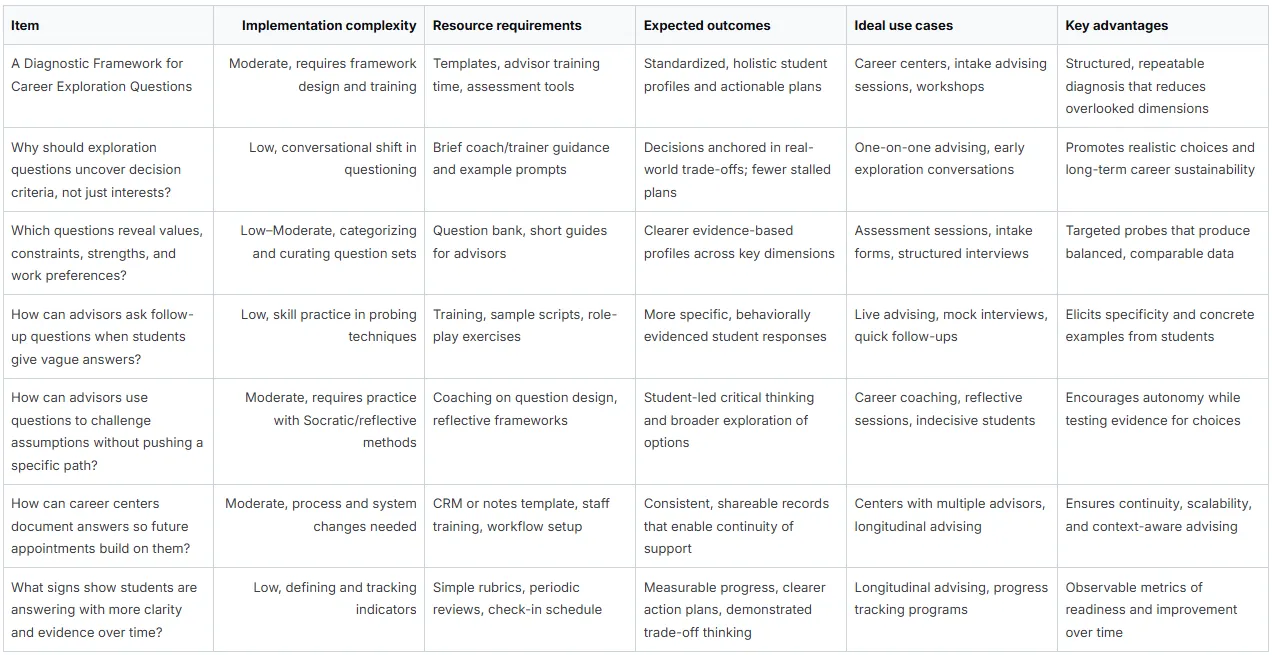
How do these questions become an institutional advising system?
Career exploration breaks down at the institutional level for a simple reason.
Advisors ask good questions, students give useful answers, and then the insight stays inside one appointment note or one advisor's memory.
A system fixes that by turning individual conversations into shared decision evidence that any trained advisor can use in the next meeting. That requires standardization, but only in the places that improve continuity.
Career centers usually get better results when they standardize four things first:
A related career advisor SOP library can help teams turn those standards into repeatable workflows instead of relying on each advisor’s personal note style.
- Question categories: Use a common framework across appointments, such as values, constraints, strengths, work preferences, and decision criteria.
- Evidence standards: Record what the student said or did that supports a conclusion. “Interested in healthcare” is weak. “Rejected bedside nursing after two shadowing experiences but stayed engaged with patient education and care coordination” is usable.
- Stage definitions: Define what counts as early exploration, active comparison, narrowed options, and decision-ready planning.
- Next-step rules: End each appointment with one tested action, such as an informational interview, a course review, a job posting comparison, or a reflection tied to a specific uncertainty.
Those choices change staffing, training, and reporting. They also make triage more accurate.
A student who lacks language for strengths needs a different intervention than a student who has two viable paths and cannot choose between salary growth and schedule control.
In practice, advisors then write narrative notes that are hard to scan, hard to compare, and almost impossible to carry across handoffs.
The better model is lighter and stricter. Ask fewer categories of questions, document them the same way every time, and revisit them as the student tests options.
Wrapping Up
Career exploration becomes stronger when every advising conversation creates usable evidence.
A practical note template should capture current options, stated decision criteria, evidence behind those criteria, assumptions that still need testing, and the next experiment.
That structure gives the next advisor a clearer starting point and helps directors review advising quality without sitting in on every appointment.
The same principle should extend beyond exploration. Hiration supports that continuity through a full-stack career readiness suite that spans Career Assessments, AI-powered Resume Optimization, Interview Simulation, LinkedIn and cover letter support, and a dedicated Counselor Module for managing cohorts, workflows, and analytics. Built within a secure, FERPA and SOC 2-compliant platform, it helps career centers carry a student’s decision logic from early exploration into resume review, internship targeting, and interview preparation.
When a new advisor can quickly see what matters to a student, what evidence supports it, what remains uncertain, and what should happen next, career exploration stops being a one-time conversation. It becomes an institutional advising system.
Career Exploration Questions for Advisors — FAQs
Why are interests alone insufficient for career exploration?
Interests rarely narrow options enough. Advisors also need to uncover values, strengths, constraints, work preferences, and decision criteria that influence career choices.
What diagnostic categories should advisors explore during appointments?
Advisors should consistently assess values, strengths, constraints, work preferences, decision criteria, supporting evidence, and next-step actions.
Why should advisors ask about decision criteria?
Decision criteria reveal how students evaluate pathways based on factors such as flexibility, income, credential requirements, location, lifestyle, and risk.
What types of questions reveal student strengths?
Questions that ask for examples from coursework, jobs, internships, leadership roles, or projects help uncover strengths supported by observable evidence.
How can advisors identify student constraints?
Advisors should ask about non-negotiables, practical limitations, financial realities, geographic preferences, and willingness to pursue additional education or training.
How should advisors respond to vague answers?
Advisors can use narrowing, contrast, and evidence questions to transform broad statements into specific examples, comparisons, and testable career hypotheses.
How can advisors challenge assumptions without directing students?
Advisors should encourage students to examine where assumptions come from, what evidence supports them, and what information might change their perspective.
Why is structured documentation important?
Structured notes help advisors track decision-making progress, support continuity across appointments, and allow different staff members to build on prior conversations.
What signs indicate a student is making exploration progress?
Students become more specific, use evidence to support choices, explain trade-offs clearly, understand realistic pathways, and complete agreed-upon next steps.
What is the biggest shift advising teams should make?
Advising teams should move from informal interest-based conversations toward standardized, evidence-driven exploration systems that improve decision quality over time.