How does Focus 2 compare to Hiration for career centers?
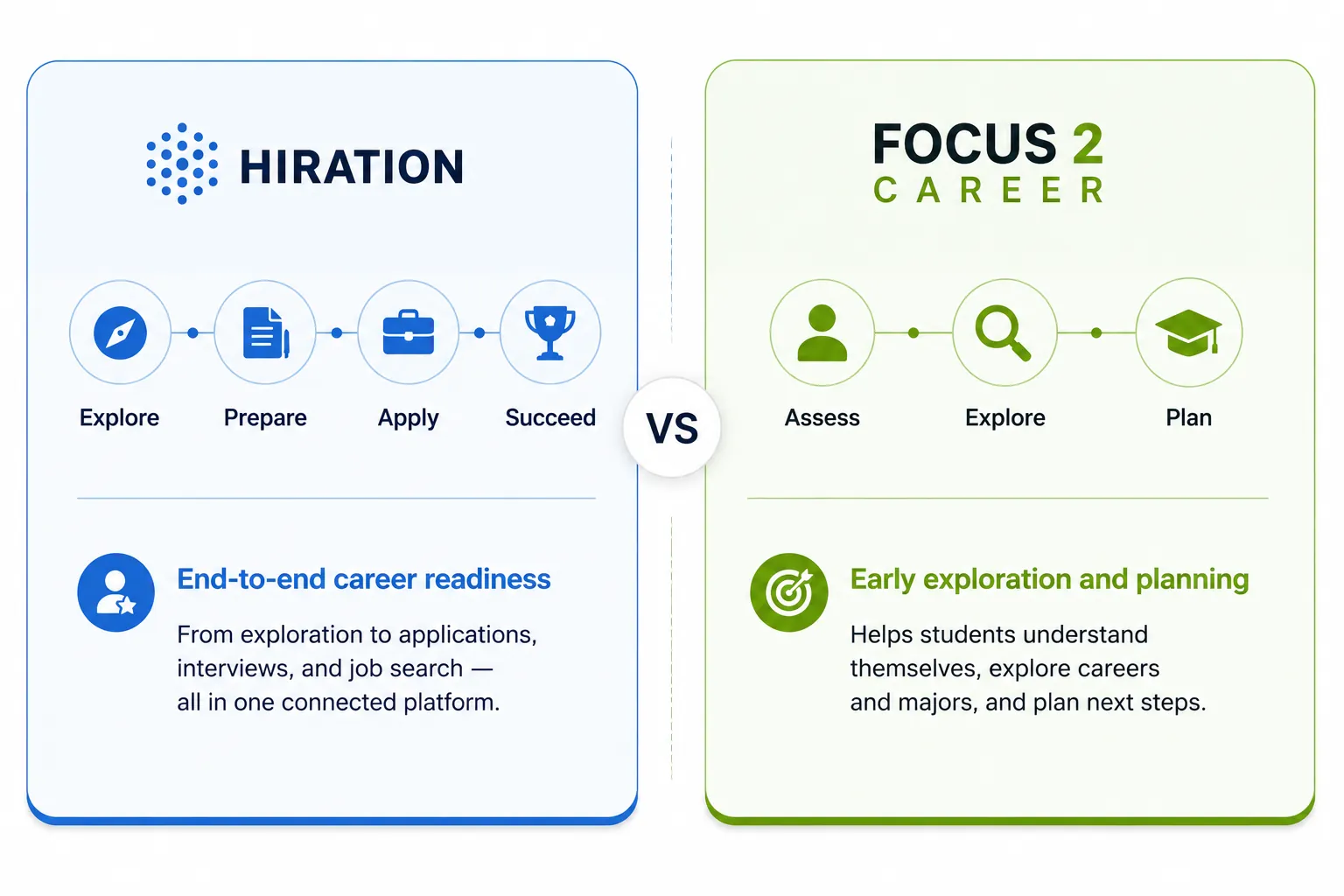
Focus 2 is strongest as a career exploration, self-assessment, major planning, and early advising platform. It helps students reflect on interests, personality, skills, values, career readiness, majors, and possible career paths. Hiration supports exploration too, but extends further into the workflows students usually need next, including resume and CV creation, AI resume review, NACE competency analysis, cover letters, LinkedIn optimization, interview practice, job discovery, job tracking, counselor review, cohort management, and readiness reporting. The main difference is that Focus 2 helps students clarify direction, while Hiration helps career centers connect that direction to applications, interviews, job search, and advisor-led intervention inside one platform.
If your career center is comparing Focus 2 with Hiration, you are probably not just asking which platform has career assessments.
You are trying to understand whether your team needs a tool for early exploration and major planning, or a broader platform that carries students into resumes, cover letters, LinkedIn, interviews, job search, counselor review, and readiness tracking.
Focus 2 is strong in assessment-based exploration, career-readiness self-reflection, major planning, and early advising conversations.
Hiration supports exploration too, but extends that work into the preparation, application, interview, job-search, and advising workflows that usually follow.
This comparison will help career centers evaluate where Focus 2 fits, where Hiration fits, and which platform better matches the student journey their team is trying to support.
Hiration vs Focus 2 at a glance
| Comparison area | Focus 2 | Hiration |
|---|---|---|
| Primary model | Career exploration, self-assessments, major selection, academic planning, and student reflection | Full career-readiness journey connecting exploration, applications, preparation, job search, and counselor action |
| Core student question | What careers or majors may fit me? | What path fits me, what gaps do I have, and how do I prepare for the next opportunity? |
| Career exploration | Strong assessment-led exploration using interests, personality, values, skills, and leisure preferences | Career Compass supports structured exploration using student inputs, quizzes, and O*NET-backed career information |
| Major planning | Strong fit for undecided students, first-year students, transfer students, and students considering a change of major | Supports career direction and action planning, but is less narrowly focused on major selection alone |
| Resume creation | Not positioned as a core resume-building platform in the reviewed material | Guided resume builder, customizable designs, institutional templates, AI review, job tailoring, and counselor feedback |
| Resume feedback | Career portfolio supports planning, but not a full AI resume-review workflow in the reviewed material | Review across 50+ parameters, WHO bullet analysis, NACE competency evidence, ATS checks, skills-gap analysis, and job matching |
| CV support | Not positioned as a distinct current workflow in the reviewed material | CV creation for academic, research, healthcare, graduate-school, international, and professional pathways |
| Cover letters | Not positioned as a core documented capability in the reviewed material | Cover-letter creation, resume-to-cover-letter generation, job tailoring, directional AI guidance, optional generation, and counselor review |
| LinkedIn support | Not positioned as a core documented capability in the reviewed material | Section-level LinkedIn review covering the headline, summary, skills, and individual experience entries |
| Interview preparation | Not positioned primarily as a mock interview platform | Role-, resume-, job-description-, admission-, and institution-assigned interviews with content, speech, and non-verbal review |
| Active job-search support | Not positioned primarily as a job discovery or job tracker platform | Job Tracker and AI-supported job discovery based on student preferences |
| AI philosophy | Assessment-led and research-driven rather than AI-first | Ethical AI designed to preserve student participation and keep institutional expectations under career-center control |
| Human review | Advisor conversations around assessment results, career matches, portfolios, action plans, and career-readiness self-reflection | Resume and interview review, assigned reviewers, cohorts, institution-defined expectations, and combined AI and human evaluation |
| Institutional workflow | Useful for early planning, advising, FYE programs, major exploration, career-readiness self-reflection, and usage reporting | Built for assignments, reviews, cohorts, engagement tracking, performance grouping, reporting, and outreach |
| Strongest fit | Institutions focused on early career exploration, undecided students, major planning, and advising conversations | Career centers seeking one connected platform across exploration, applications, interviews, job search, and counselor-led support |
Free Migration Checklist
Planning a Career Platform Switch?
Use this checklist to prepare for a career platform switch before your current contract ends. It covers notice periods, data exports, templates, rubrics, rosters, staff access, SSO, vendor questions, setup, and launch.
Download the Free Migration ChecklistWhat is the main difference between Hiration and Focus 2?
Focus 2 is primarily organized around self-discovery, career exploration, and academic decision-making. Hiration connects those early career questions to a wider readiness workflow that continues into applications, interviews, job search, and counselor action.
Focus 2 begins with reflection.
Students complete assessments, review results, explore careers, connect career options to majors, save interests, build a portfolio, and create an action plan. That makes it useful when a career center or advising team needs students to slow down and think through possible directions before preparing for jobs.
Hiration starts with a broader operating problem.
Students may need to explore careers, but they also need to act on that exploration. They need to identify gaps, create resumes, build CVs, tailor applications, write cover letters, improve LinkedIn profiles, practice interviews, discover opportunities, and receive feedback.
That changes the role of the platform.
Focus 2 helps students answer:
What careers or majors may fit me?
Hiration helps students continue into:
What should I build, improve, practice, submit, track, and review next?
Focus 2 is strongest at the front end of career development. Hiration is built to carry the student from exploration into visible readiness actions.
How do Hiration and Focus 2 approach AI differently?
Focus 2 is built around structured assessment and career reflection, while Hiration is built around Ethical AI that supports student agency, evidence-based preparation, institutional control, and a clear division between what technology should handle and what career professionals should guide.
In Focus 2, students complete assessments, review career matches, explore majors, save possible paths, and use those outputs in advising conversations. Its public positioning is not centered on generative AI, automated resume or cover-letter review, or AI-led job preparation.
That can be useful for institutions that want a traditional career-planning environment centered on reflection and advising.
Hiration uses AI to extend advising capacity while keeping the career center in control of how readiness is developed and evaluated, which reflects the broader guardrails career centers need for AI in student job preparation.
The platform is designed to work with the student rather than around the student. The student provides experience, evidence, judgment, and reflection. AI provides structure, feedback, practice, and scalable guidance. The career center controls the standard, resources, review points, and intervention workflow.
For example:
- When a resume bullet lacks evidence, Hiration can ask the student contextual questions before helping improve it.
- When a job description contains a missing skill, the platform can identify the gap without encouraging unsupported claims.
- When a cover letter needs improvement, AI can provide directional guidance instead of replacing the full document.
- When a student completes an interview, counselors can define the answer expectations used for evaluation.
This keeps AI from becoming an uncontrolled writing or scoring layer.
The distinction is important for career centers. Focus 2 uses a structured assessment model to guide exploration. Hiration uses AI to extend advising capacity while keeping the career center in control of how readiness is developed and evaluated.
Which platform supports more of the student journey?
Hiration supports a more complete progression from career uncertainty to active job preparation. Focus 2 is strongest in early exploration, major planning, and advising conversations.
| Student stage | Focus 2 | Hiration |
|---|---|---|
| Self-discovery | Interests, personality, values, skills, and leisure-interest assessments | Career inputs, quizzes, resume data, and profile information |
| Career exploration | Career matches, occupation database, career profiles, and saved careers | Career Compass with structured exploration and O*NET-backed career information |
| Major planning | Connects careers with academic majors, especially useful for undecided students | Supports career direction and readiness planning, but is not limited to major choice |
| Career portfolio | Saves assessment results, careers, majors, goals, notes, reflections, and action plans | Tracks readiness activity across resumes, interviews, applications, jobs, and counselor workflows |
| Readiness evidence | NACE career-readiness self-assessment, student reflection, action planning, and portfolio documentation | Resume evidence, NACE analysis, WHO bullet quality, ATS readiness, interview feedback, and student-action data |
| Resume creation | Not a primary documented workflow | Guided resume and CV creation, institutional templates, advanced editing, and downloads |
| Application tailoring | Not a primary documented workflow | Job-description matching across resumes, cover letters, and interview preparation |
| LinkedIn preparation | Not a primary documented workflow | Section-by-section profile review and optional evidence-based rewriting |
| Interview preparation | Not a primary documented workflow | Multiple interview pathways, adaptive conversations, interview codes, and institution-defined evaluation |
| Job-search activity | Career exploration and planning support | Job Tracker and AI-supported opportunity discovery |
| Staff intervention | Advisor conversations around assessments, portfolios, and plans | Performance grouping, assigned activities, review workflows, engagement tracking, and direct outreach |
The distinction is continuity.
A student may use Focus 2 to understand possible career paths and majors. That is useful. But once the student needs to prepare for an internship, apply to a role, build a resume, tailor a cover letter, practice an interview, or receive counselor feedback, the workflow usually has to move elsewhere.
Hiration is structured so that career exploration, career documents, application tailoring, interview practice, job-search support, and advisor intervention can operate as parts of the same journey, reducing the kind of fragmentation that often weakens career platform adoption.
That reduces the risk of students receiving disconnected advice from separate tools that do not share context or institutional standards.
Which platform offers stronger career exploration and planning?
Focus 2 has a clear strength in structured career exploration and major planning.
Hiration’s distinction is that exploration can flow directly into skill gaps, applications, interviews, job search, and counselor workflows.
What Focus 2 provides
Focus 2 is designed around the idea that students should understand themselves before making academic and career decisions.
Its exploration model includes assessments across:
- Work interests
- Personality
- Skills
- Values
- Leisure interests
Focus 2 also includes Career Planning Foundations and an “Am I Career Ready” module, where students can self-assess their proficiency across the eight NACE competencies and reflect on how they are developing each competency.
The platform combines those inputs to produce career recommendations. Students can explore occupations, review related majors, save options, build a portfolio, and create an action plan.
This is especially useful for:
- First-year students
- Undecided students
- Students changing majors
- Transfer students
- Academic advising teams
- Student Success Centers
- First-Year Experience programs
- Career counselors supporting early-stage exploration
Focus 2 also helps institutions connect career exploration with academic planning. That makes it relevant when the student’s immediate decision is not “Which job should I apply to?” but “Which major or direction should I consider?”
What Hiration provides
Hiration’s Career Compass also supports students who are still exploring.
Students can use career inputs, quizzes, and O*NET-backed information to discover possible paths, compare options, understand role requirements, and identify gaps.
The difference appears after the student identifies a possible direction.
A student can move from career exploration into:
- Resume building
- CV creation
- Resume review
- NACE competency visibility
- Skill-gap analysis
- Cover letter creation
- LinkedIn optimization
- Job discovery
- Interview practice
- Counselor review
This makes exploration more actionable.
A student does not only leave with a list of possible careers. They can begin preparing for those careers inside the same environment.
Focus 2 is highly relevant when exploration and major choice are the main institutional need. Hiration becomes more relevant when the career center wants exploration to connect with readiness, applications, and advising workflows.
Which platform offers the stronger application-material workflow?
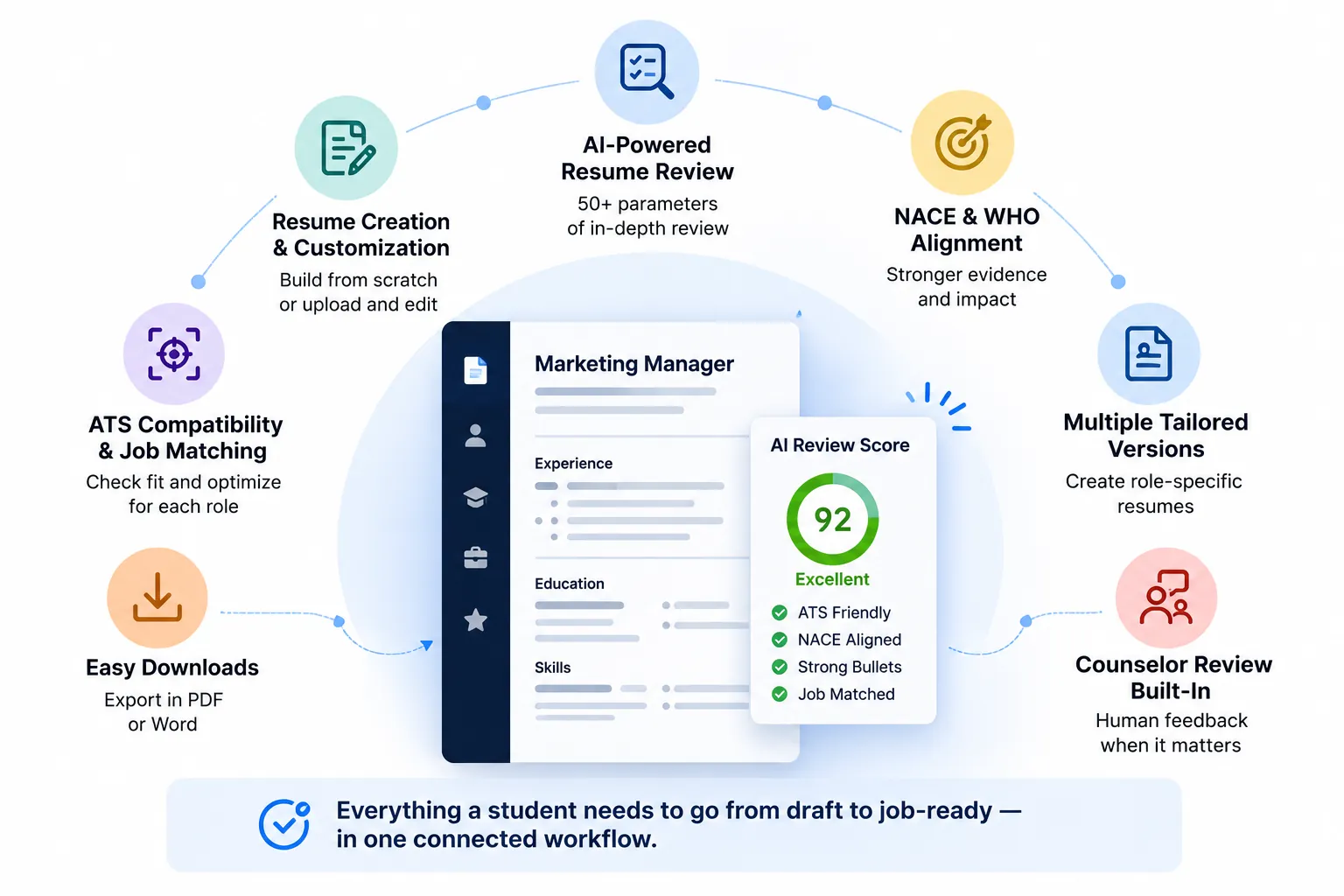
Hiration offers the stronger application-material workflow because resume creation and review, ATS compatibility, NACE competency analysis, WHO bullet feedback, job tailoring, cover letters, LinkedIn review, downloads, and counselor review are native parts of the platform.
Focus 2’s Career Portfolio can support planning and documentation, including saved goals, achievements, and in some implementations, career documents.
However, their public data does not position Focus 2 as a native AI resume builder, resume reviewer, ATS checker, job-description optimizer, cover-letter builder, or LinkedIn optimizer.
The distinction matters.
A student may understand their interests and identify a possible career path, but still struggle to explain experience clearly. They may not know how to write bullets, show evidence, present projects, connect coursework to a target role, or tailor a resume to a job description.
Hiration supports that process more directly.
Students can:
- Start from scratch or upload an existing resume
- Use customizable, ATS-friendly designs
- Add and organize resume sections
- Download resumes in PDF or Word format
- Use institution-specific templates where configured
- Review the resume across 50+ parameters
- Check ATS compatibility
- Compare the resume with a job description
- Identify present and missing skills
- Create multiple tailored versions
- Submit the resume for counselor review
The review goes beyond surface-level formatting.
It examines structure, skills, sections, bullet quality, action language, quantification, repetition, job fit, and evidence. That makes the feedback more useful for students who do not yet know why their resume is weak.
WHO bullet analysis
Hiration evaluates resume bullets through the WHO framework:
- What did the student do?
- How did the student do it?
- Outcome: What changed or resulted from the work?
A weak bullet may say:
“Helped organize student event.”
That sentence gives a task, but it does not explain scope, method, collaboration, tools, audience, or result.
A stronger bullet may explain what kind of event the student supported, how they coordinated logistics, who they worked with, how many people attended, and what outcome the event produced.
Hiration can identify which part is missing and guide the student to improve the bullet.
The student is not asked to accept a fabricated achievement. The platform can prompt the student to provide the missing substance before helping rewrite the point.
NACE competency review
Hiration’s NACE Skill Analysis can evaluate whether a resume demonstrates the eight NACE career-readiness competencies:
- Career & Self-Development
- Communication
- Critical Thinking
- Equity & Inclusion
- Leadership
- Professionalism
- Teamwork
- Technology
The system separates competencies into:
- Demonstrated
- Not clearly shown
It can also show feedback and resume evidence behind the assessment.
That creates a more useful advising conversation than a general resume score alone.
A resume cannot prove that a student has mastered leadership or communication in every real-world setting. But it can show whether the student has communicated credible evidence of those competencies.
That distinction is important.
Hiration embeds NACE review into the process of improving the resume. It helps students understand whether the document shows the readiness skills their institution is trying to develop.
Focus 2 helps students identify possible career paths. Hiration helps them build the application document needed to pursue those paths.
How do cover letter, CV, and LinkedIn tools compare?
Hiration provides native cover letter, CV, and LinkedIn workflows. Focus 2 is not publicly positioned as a native cover-letter builder, LinkedIn optimizer, or AI application-material review platform in the reviewed sources.
This matters because students do not experience career readiness as separate tasks.
A student’s career direction should shape the resume. The resume should inform the cover letter. The cover letter should align with the target role. The LinkedIn profile should reinforce the same professional story. Interview answers should draw from the same evidence.
When these activities sit in separate tools, students often receive fragmented guidance.
Hiration connects them.
Cover letters
Hiration allows students to create cover letters from scratch or generate a cover letter from an existing resume.
Students can:
- Use customizable templates
- Choose a design aligned with the resume
- Paste a job description
- Identify relevant and missing skills
- Tailor the document to the role
- Download the cover letter in PDF or Word format
- Submit it to a counselor for review
The resume-to-cover-letter workflow reduces blank-page friction while keeping the application documents aligned.
The AI can also provide directional guidance. Instead of rewriting the entire letter for the student, it can explain what the student should add, clarify, or strengthen.
That gives career centers flexibility. AI can support the writing process without removing the student’s responsibility for the final content.
CV creation
Hiration also supports CV creation.
This gives institutions a distinct pathway for students pursuing:
- Academic opportunities
- Graduate or professional programs
- Research roles
- Teaching positions
- Healthcare pathways
- International opportunities
- Publication- or project-intensive careers
A CV may need sections for education, research, publications, teaching, certifications, academic achievements, projects, and professional experience.
Not every student needs only a resume. Hiration’s CV support allows career centers to serve students across more academic and professional pathways.
LinkedIn profiles
Hiration’s LinkedIn Profile Reviewer evaluates the profile section by section.
It can review areas such as:
- Headline
- About section
- Skills
- Experience entries
- Profile completeness
- Section quality
- Recruiter visibility opportunities
Students can receive an overall score, recommendations, examples, supporting resources, and a downloadable report. Where appropriate, they can use resume-based rewriting support and copy revised profile sections.
This creates consistency between the resume, LinkedIn profile, cover letter, and interview stories.
Focus 2 helps students understand possible directions. Hiration helps students build the professional materials required to pursue those directions.
How do the interview capabilities compare?
Focus 2 is not primarily positioned as an interview-practice platform. Hiration includes structured interview practice, assigned interviews, admission interviews, resume-based interviews, job-description-based interviews, and conversational interviews.
This distinction becomes visible once students move from exploration to opportunity pursuit.
A student may use Focus 2 to identify a possible career, connect it to a major, and create an action plan. But when that student needs to prepare for an internship interview, job interview, admission interview, or role-specific selection process, the workflow needs a different layer of support.
Hiration provides that layer through interview practice workflows career centers can assign, review, and track.
Students can practice through:
- Role-based interview practice
- Resume-based interview practice
- Job-description-based interview practice
- Assigned interviews from the career center
- Admission interview practice
- Category-driven interview practice where configured
- Conversational interview practice
The review does not only check whether the student answered the question.
It can evaluate:
- Answer relevance
- Structure
- Depth
- Missed information
- Speech clarity
- Pace
- Pitch variation
- Filler words
- Eye contact
- Posture
- Screen position
- Body language
The report helps students understand what went well, what weakened the answer, and what a stronger version could include.
Assigned interviews and Start via Code
Hiration also supports Start via Code.
A career center can create or assign a specific interview and share a simple code with students. The student enters the code, sees the interview summary, starts the attempt, or continues an incomplete attempt.
This is useful for:
- Classes
- Workshops
- Career events
- Assignments
- Employer-prep events
- Targeted campaigns
- Program-specific readiness work
The operational value is simple: students reach the right practice experience without searching through the platform or building an interview themselves.
Counselor-defined expectations
Hiration also allows counselors to define interview expectations.
That means the career center can guide how the AI evaluates a student’s answer. The evaluation can be based on the institution’s expectations rather than only a generic model.
For example, a career team may want an answer to show:
- STAR structure
- Technical accuracy
- Role-specific evidence
- Program competencies
- Industry knowledge
- Communication quality
- Course learning outcomes
This makes interview practice more useful for formal assignments, career courses, workshops, and cohort-based interventions.
Focus 2 helps students clarify where they may want to go. Hiration helps them practice how they will present themselves when they pursue that direction.
How do counselor and administrative workflows compare?
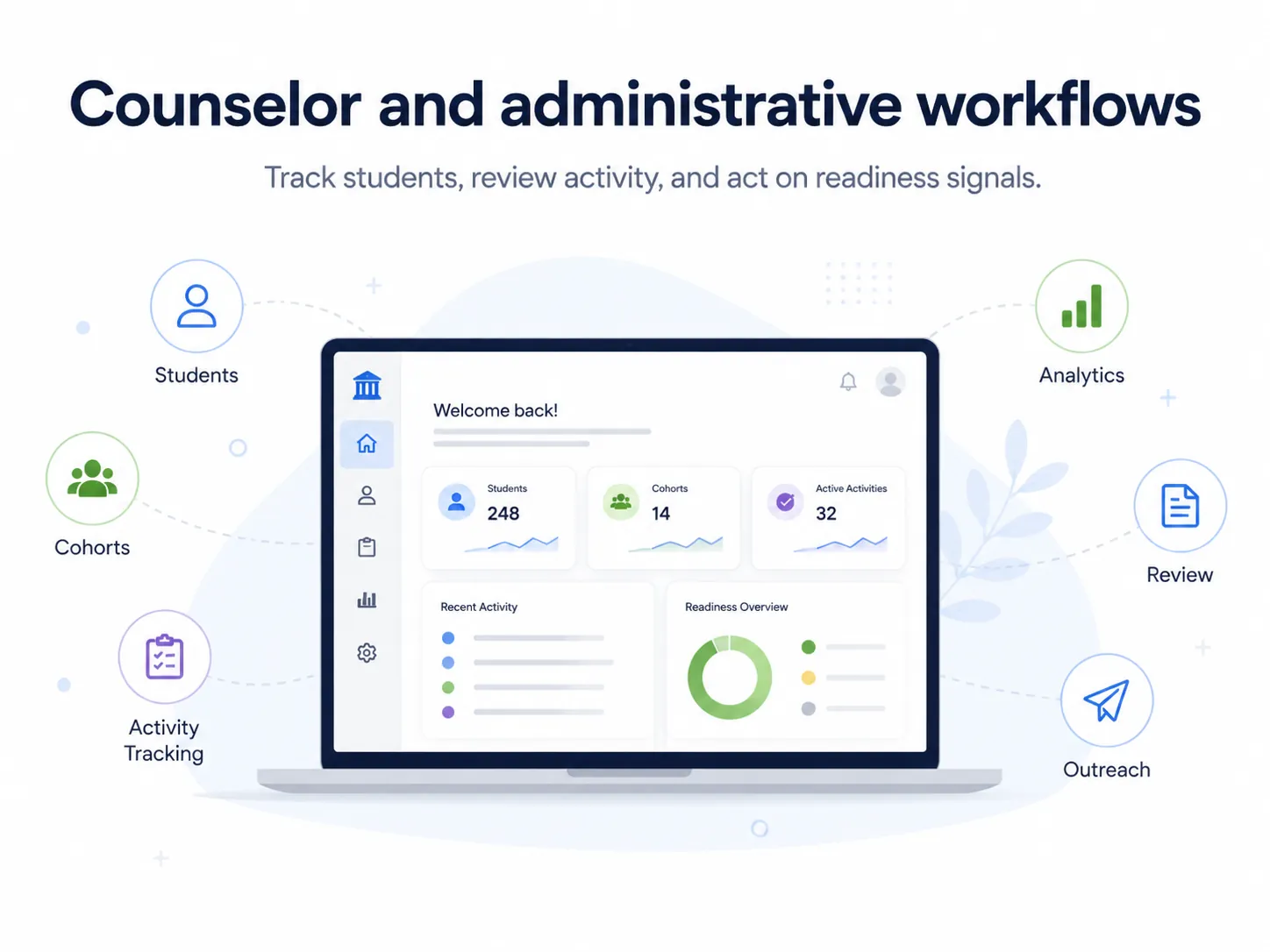
Focus 2 supports advising conversations around assessment results, career portfolios, and action plans, and its administrative tools can provide user results, aggregate usage reports, multiple administrator access, and customization options. Hiration supports advisor workflows across a wider range of readiness activities, including resumes, interviews, cohorts, assignments, reviews, analytics, and outreach.
Focus 2 fits naturally into early advising.
Students complete assessments, save career options, build portfolios, and create action plans. Advisors can use those outputs to guide conversations about majors, career paths, goals, and next steps.
That makes Focus 2 useful as a structured conversation starter.
Hiration is designed to support the operational side of career services as well.
Career centers can use Hiration to:
- Manage students
- Create cohorts
- Assign activities
- Track engagement
- Review resumes
- Review interviews
- Monitor student performance
- Identify students who need help
- Contact students from the platform
- Track product usage
- Report on readiness actions
This is the difference between using a platform to support advising conversations and using a platform to manage readiness workflows.
Like any useful career center dashboard, the workflow should help teams answer practical questions:
- Which students signed up?
- Who created a resume?
- Who downloaded it?
- Who started an interview?
- Who completed it?
- Who checked the interview review?
- Which students are below a defined score?
- Which cohort needs follow-up?
- Which students should receive outreach before an event or deadline?
Hiration gives career teams more ways to act on those signals.
The platform can group students who fall below a defined performance threshold and allow admins to contact them directly. That moves the team from reporting to intervention.
Focus 2 helps advisors discuss where a student may be headed. Hiration helps advisors see what the student has completed, where they may be struggling, and what action may be needed next.
Which platform offers the stronger consolidation case?
Hiration offers a stronger consolidation case because it brings exploration, resumes, CVs, cover letters, LinkedIn, interviews, job tracking, AI-supported job search, counselor review, assignments, and reporting into one connected environment.
Many career centers already operate with fragmented tools.
One platform may handle assessments. Another may handle resumes. Another may support interview practice. Another may manage jobs. Advisors may then track follow-up manually through spreadsheets, emails, appointments, or internal notes.
That fragmentation affects both students and staff.
Students have to rebuild context across tools. Advisors have to piece together what happened. Directors receive activity data that may not show whether students are actually moving through meaningful readiness steps.
Focus 2 reduces uncertainty at the exploration stage. It gives students structured assessments, career matches, major connections, a portfolio, and an action plan.
Hiration reduces fragmentation across more of the journey.
A student can:
- Explore careers
- Compare possible paths
- Identify readiness gaps
- Build a resume
- Build a CV
- Review resume quality
- Improve weak bullets
- Check NACE competency evidence
- Tailor a resume to a job description
- Generate a cover letter
- Improve a LinkedIn profile
- Practice interviews
- Discover jobs
- Track opportunities
- Submit work to a counselor
- Receive feedback
- Continue through assigned activities
For staff, that creates one environment for tracking adoption, reviewing work, identifying students who need support, and taking action.
The value is not simply the number of features. The value is that the features are connected around the student journey and the career center’s workflow.
What should career centers compare before choosing?
Career centers should compare Focus 2 and Hiration based on the actual student journey they need to support.
A feature checklist can make the decision too shallow. The real question is where the institution needs the platform to begin and how far it needs the platform to carry students.
Career services teams should ask:
- Is the main need career exploration, application preparation, or both?
- Are students mostly undecided, actively applying, or spread across both groups?
- Does the platform support students after they identify a direction?
- Can students build resumes and CVs inside the platform?
- Can students tailor resumes to specific job descriptions?
- Does the platform support cover letters and LinkedIn profiles?
- Does it include mock interview practice?
- Can the career center assign interviews, resumes, or activities to cohorts?
- Can staff contact those students from the same environment?
- Can the platform track meaningful readiness actions, not only logins?
- Does it support job discovery or job tracking?
- Does it reduce the number of disconnected tools students must use?
- Does it help the career center scale support without removing human judgment?
- What security, accessibility, and compliance documentation is available?
- How easily can the platform fit into courses, workshops, advising models, and placement cycles?
The clearer the institution is about the intended workflow, the easier the decision becomes.
If the goal is primarily assessment-driven exploration and major planning, Focus 2 has a clear role.
If the goal is to connect exploration with resumes, cover letters, LinkedIn, interviews, job search, counselor review, cohorts, and reporting, Hiration covers more of the operating model.
Which platform is the clearest fit?
The clearest fit depends on what the career center wants the platform to do.
| Institutional priority | Clearer fit |
|---|---|
| Assessment-based career exploration | Focus 2 |
| Major exploration and academic planning | Focus 2 |
| Support for undecided students | Focus 2 |
| First-Year Experience career planning | Focus 2 |
| Career portfolio for reflection and advising | Focus 2 |
| Advisor conversations around interests and possible paths | Focus 2 |
| Career exploration connected to readiness actions | Hiration |
| Resume and CV creation | Hiration |
| AI resume review and bullet-level feedback | Hiration |
| Job-description-based resume tailoring | Hiration |
| NACE competency visibility from student documents | Hiration |
| ATS compatibility review | Hiration |
| Cover letter development | Hiration |
| Resume-to-cover-letter workflow | Hiration |
| LinkedIn profile optimization | Hiration |
| Role-based and resume-based mock interviews | Hiration |
| Job-description-based interview practice | Hiration |
| Assigned interviews for classes, workshops, or cohorts | Hiration |
| Admission interview practice | Hiration |
| Conversational interview practice | Hiration |
| Counselor-defined evaluation criteria | Hiration |
| AI plus human review | Hiration |
| Job discovery and job tracking | Hiration |
| Cohort management and student intervention | Hiration |
| Cross-product readiness visibility | Hiration |
| One connected career-readiness workflow | Hiration |
Final verdict: Hiration or Focus 2?
Focus 2 is the stronger specialist when the primary requirement is assessment-based career exploration, major planning, and early advising support for undecided or first-year students.
Hiration is the stronger institutional platform when the goal is to support more of the student journey, connect exploration with application and interview preparation, maintain counselor control over AI, and manage career-readiness activity through one operating environment.
For a career center purchasing a targeted career exploration and academic planning tool, Focus 2 deserves consideration.
For a career center trying to reduce fragmented tools while extending consistent support across exploration, resumes, CVs, cover letters, LinkedIn profiles, interviews, job search, and advising, Hiration presents the more complete model: one that uses AI to scale support without removing student agency, critical thinking, or counselor control.
Intrigued? See what that model looks like in practice with a Hiration walkthrough built around your student journeys, advising workflows, institutional rubrics, and current technology stack.
Hiration vs Focus 2 — FAQs
What is the main difference between Hiration and Focus 2?
The main difference is platform scope. Focus 2 is primarily built for self-assessment, career exploration, major planning, and early advising conversations. Hiration supports exploration but also connects students to resumes, CVs, cover letters, LinkedIn profiles, interviews, job discovery, job tracking, counselor review, cohort workflows, and readiness reporting.
Is Focus 2 a strong career exploration platform?
Yes. Focus 2 is a strong fit for institutions that need structured assessments, career reflection, major exploration, career-readiness self-assessment, saved career options, student portfolios, and action plans for early-stage advising.
Where does Hiration have the clearest advantage over Focus 2?
Hiration has the clearest advantage when a career center wants one connected platform that carries students beyond exploration into application preparation, interview practice, job search, counselor review, cohort tracking, and targeted student outreach.
How do Hiration and Focus 2 approach AI differently?
Focus 2 is built around structured assessment and career reflection rather than generative AI-led job preparation. Hiration uses Ethical AI to extend advisor capacity while keeping students responsible for their evidence and career centers in control of standards, rubrics, resources, review points, and intervention workflows.
Which platform supports more of the student journey?
Hiration supports more of the student journey because it connects exploration with resume building, CV creation, cover letters, LinkedIn optimization, interview practice, job discovery, job tracking, counselor feedback, cohort management, and readiness analytics. Focus 2 is strongest at the front end of career development.
Which platform is better for career exploration and major planning?
Focus 2 is the stronger specialist for assessment-based career exploration, major planning, and early advising. It helps students reflect on interests, personality, skills, values, leisure interests, career readiness, majors, and possible career paths before they move into application preparation.
How does Hiration support career exploration?
Hiration’s Career Compass supports exploration by helping students use career inputs, quizzes, and O*NET-backed information to discover possible paths, compare options, understand role requirements, identify gaps, and move from exploration into resume development, job discovery, and interview preparation.
Which platform offers stronger resume and application support?
Hiration offers stronger resume and application support because resume creation, CV creation, AI resume review, ATS checks, NACE competency analysis, WHO bullet feedback, job-description tailoring, cover letters, LinkedIn review, downloads, and counselor review are native parts of the platform.
Does Focus 2 include native resume, cover letter, and LinkedIn tools?
Focus 2 can support planning and documentation through its portfolio and advising workflows, but it is not publicly positioned as a native AI resume builder, resume reviewer, ATS checker, cover-letter builder, job-description optimizer, or LinkedIn optimization platform in the reviewed blog context.
How does Hiration help students improve weak resume bullets?
Hiration uses the WHO framework to evaluate whether each resume bullet explains what the student did, how they did it, and what outcome resulted. When evidence, method, scope, or impact is missing, the platform can prompt the student for more context before helping improve the bullet.
Does Hiration support NACE career-readiness competencies?
Yes. Hiration’s NACE Skill Analysis can evaluate whether a resume clearly communicates evidence of the eight NACE career-readiness competencies, including career and self-development, communication, critical thinking, equity and inclusion, leadership, professionalism, teamwork, and technology.
How do the cover letter, CV, and LinkedIn tools compare?
Hiration provides native cover letter, CV, and LinkedIn workflows. Students can create cover letters, generate cover letters from resumes, tailor documents to job descriptions, build CVs for academic or research pathways, and review LinkedIn profiles section by section. Focus 2 is more focused on exploration and planning than application-material development.
Which platform offers stronger interview preparation?
Hiration offers stronger interview preparation because it includes role-based, resume-based, job-description-based, assigned, admission, category-driven, and conversational interview practice. Career centers can also assign interviews, use Start via Code workflows, define answer expectations, review submissions, and track completion.
Does Focus 2 support interview practice?
Focus 2 is not primarily positioned as an interview-practice platform in the reviewed blog context. It is more relevant for assessment-based exploration, major planning, career reflection, portfolios, and action plans.
How do counselor and administrative workflows compare?
Focus 2 supports advising conversations through assessment results, career portfolios, action plans, usage reports, administrator access, and customization options. Hiration supports a wider operating workflow with cohorts, assignments, resume review, interview review, counselor comments, engagement tracking, readiness analytics, low-score identification, and student outreach.
Which platform offers the stronger consolidation case?
Hiration offers the stronger consolidation case because it brings exploration, resumes, CVs, cover letters, LinkedIn, interviews, job tracking, AI-supported job search, counselor review, assignments, reporting, and outreach into one connected environment. Focus 2 is more concentrated on exploration and academic planning.
What should career centers compare before choosing between Focus 2 and Hiration?
Career centers should compare whether the main need is career exploration, application preparation, interview readiness, job search, or a connected workflow across all of those stages. They should also evaluate whether the platform supports resumes, CVs, cover letters, LinkedIn, mock interviews, cohorts, counselor review, readiness actions, outreach, compliance, and integrations.
Which career centers are a better fit for Focus 2?
Focus 2 is a better fit for career centers, advising teams, student success centers, and first-year programs that primarily need assessment-based career exploration, major planning, career-readiness self-reflection, student portfolios, and early advising support.
Which career centers are a better fit for Hiration?
Hiration is a better fit for career centers that want one connected platform across career exploration, resumes, CVs, cover letters, LinkedIn, interviews, job discovery, job tracking, counselor review, student outreach, cohort workflows, and readiness reporting.