Most career centers operate in a state of controlled chaos, with high student-to-advisor ratios making consistent, high-impact advising nearly impossible.
This inconsistency directly impacts student outcomes and the graduate employment metrics universities now depend on.
A Career Advisor SOP Library, or a Standard Work Guide, solves this by creating an operational backbone that turns scattered individual efforts into a unified, measurable system.
This guide provides a framework for building one, covering core workflows from resume reviews to appointment routing.
How Do You Develop a Resume Review SOP?
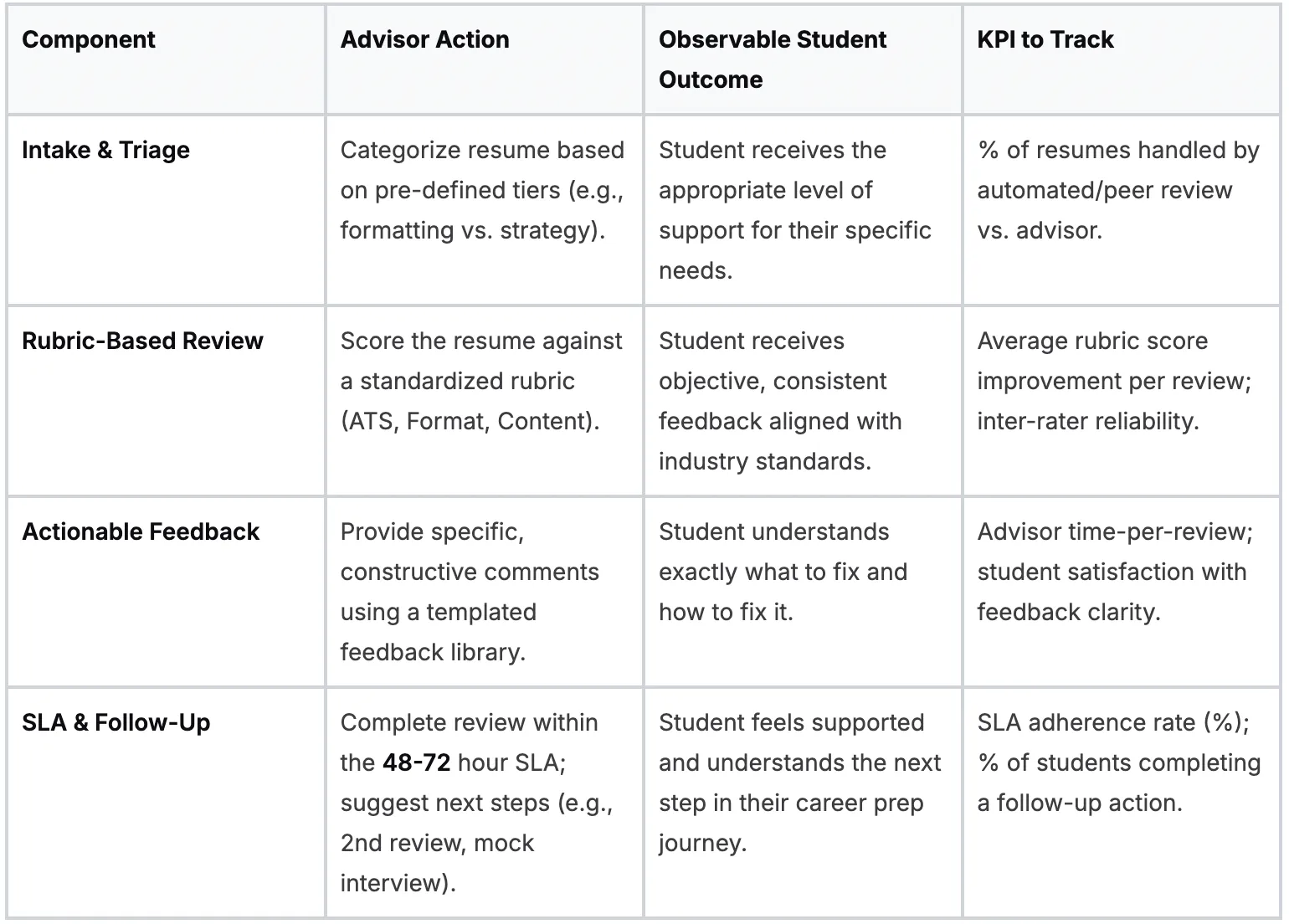
A robust resume review SOP moves your team from inconsistent critiques to a predictable, scalable operation. It requires four components: a defined review rubric, a triage workflow to segment requests, a library of templated feedback for common errors, and a clear service-level agreement (SLA). This system ensures every student receives high-quality feedback while optimizing advisor time.
Define the Review Rubric
A standardized rubric is the foundation of a consistent review process, ensuring every resume is measured against the same quality bar.
The rubric must be built on three pillars: ATS compatibility, formatting/readability, and content quality.
For example, an engineering rubric would weigh technical projects heavily, while a liberal arts rubric might focus more on the articulation of transferable skills.
This approach aligns evaluation with employer expectations for a student's target industry.
The rubric should score specific elements like keyword alignment, visual balance, use of action verbs, and quantifiable achievements.
Establish a Triage Workflow
Not all resumes require the same level of attention. A triage workflow prevents experienced advisors from spending hours on basic formatting fixes when other students have complex strategic needs.
This system, detailed in our guide on the Resume Triage Framework for career centers, sorts incoming resumes into categories that dictate the next action.
- Tier 1 (Automated/Peer Review): Documents with significant formatting errors or low ATS scores are routed to an AI tool or a trained peer advisor for initial cleanup.
- Tier 2 (Standard Advisor Review): Resumes with solid formatting but content needing improvement (e.g., strengthening bullet points) are sent to a generalist advisor.
- Tier 3 (Senior Advisor/Specialist): Reserved for documents for niche industries, graduate school applications, or students with complex work histories requiring specialized strategic advice.
Create Templated Feedback
To accelerate reviews without sacrificing quality, a library of pre-written comments for common mistakes is essential.
Instead of retyping the same advice on using action verbs, advisors can insert a detailed, pre-approved comment.
According to the World Economic Forum, with 60% of global employers prioritizing skills-based hiring, providing scalable, high-quality feedback is critical.
Resume Review SOP Framework
This framework outlines the core components of a resume review SOP, from initial triage to final feedback, designed to standardize quality and efficiency.
Set a Service-Level Agreement (SLA)
A public-facing SLA manages student expectations and creates a performance benchmark.
A realistic SLA for most centers is 48–72 business hours - responsive enough for students on a deadline while accommodating demand surges.
This SLA must be communicated clearly on the career center website, in the appointment booking system, and in automated confirmation emails to reduce student anxiety and prevent excessive follow-up inquiries.
Also Read: 7 Career Coaching Case Note Templates for Structured Advising
What Should a Mock Interview SOP Include?
An effective mock interview SOP creates a standardized, developmental experience that prepares students for real-world scenarios. It must include four elements: mandated pre-session preparation, a structured interview protocol using behavioral questions, a standardized evaluation rubric, and a clear post-session feedback and follow-up loop. This structure transforms a practice run into a measurable improvement in student competence.
Pre-Session Preparation Guidelines
An impactful mock interview begins with a mandatory intake form students must complete at least 48 hours prior to the appointment.
This diagnostic tool requires the student to submit the target job description, the resume used for the application, and 2-3 specific areas where they feel least confident.
This allows the advisor to move beyond generic questions and simulate the actual interview, turning the session into a focused coaching opportunity.
Structured Interview Protocol
Consistency is crucial for fair evaluation. The SOP must define a clear protocol centered on behavioral questions that require students to use the STAR (Situation, Task, Action, Result) method.
Instead of asking, "Tell me about your leadership skills," the protocol should prompt, "Describe a time you led a project with a tight deadline..." This forces students to provide concrete evidence of their skills.
Hiration can supplement this by generating industry-specific behavioral questions for advisors.
Standardized Evaluation Rubric
A standardized evaluation rubric is non-negotiable for providing objective, actionable feedback.
This tool provides a framework to assess performance across key competencies, often derived from employer feedback and NACE guidelines.
You can see how to design one in this guide to building a mock interview rubric for career advisors.
For example, the career center at the University of California, Berkeley, uses rubrics to assess students on criteria like clarity of STAR responses, content relevance, and professional presence, using a 1-5 scale to provide evidence-based feedback.
Post-Session Feedback and Follow-Up
The debrief unlocks the real value of the mock interview. The SOP must formalize a multi-step follow-up process.
- Provide a recording: Giving the student a link to the session video enables powerful self-assessment.
- Deliver structured feedback: The debrief should start with a positive observation, provide constructive criticism tied to the rubric, and end with an encouraging summary.
- Send a follow-up email: Within 24 hours, a templated email should recap the feedback, attach the completed rubric, and link to targeted resources (e.g., a guide to the STAR method).
Also Read: Career Coaching Session Agenda Template for Scaling Student Support
How Can You Standardize Advisor-Student Follow-Up?
Standardizing advisor-student follow-up requires a system of templated communications tied to pre-defined triggers, managed within a centralized platform. This ensures no student interaction becomes a dead end, transforming disconnected meetings into a cohesive developmental journey. It replaces unreliable, ad-hoc outreach with a dependable, scalable system that reinforces advising value and encourages continued engagement.
Establish a Trigger-Based Communication Cadence
A trigger-based SOP eliminates guesswork and ensures every student receives timely, relevant information.
This approach creates a predictable and supportive pathway for ongoing engagement. The SOP should map a clear sequence:
- Trigger 1 (Within 2 Hours): Post-Appointment Summary. An automated email recaps key discussion points, outlines action items, and attaches shared resources.
- Trigger 2 (3 Days Later): Resource Nudge. A targeted email contains links to relevant tools based on the appointment topic.
- Trigger 3 (2 Weeks Later): Progress Check-In. A short email asks about progress on action items and invites a follow-up meeting if needed.
Centralize Interaction Documentation
Continuity of care is impossible if advising notes are scattered. A core component of the follow-up SOP is the mandatory logging of all student interactions in a centralized system (e.g., CRM or career services management platform).
This allows any advisor to access a student's full history, understand previous feedback, and build upon prior work rather than starting from scratch.
Purdue University’s coordinated care network exemplifies this model, using a unified record of student interactions to enable proactive, informed support across departments.
Create and Refine Follow-Up Templates
Templates are the engine of a scalable follow-up strategy.
Using perfect follow-up email templates and best practices from a shared library ensures consistent and effective communication.
These templates should be customizable with personalization tokens and cover various scenarios, from post-appointment summaries to re-engagement campaigns.
You can find examples in these student outreach templates for career services. Regularly review open and click-through rates to refine templates and improve engagement.
What Does an Effective Workshop Preparation SOP Look Like?
An effective workshop SOP creates a proactive, repeatable system for delivering high-quality programming at scale. It is built on four pillars: a master planning template for logistics, a central library for content, a promotion checklist for marketing, and a post-event assessment protocol for iteration. This framework guarantees consistency and prevents common logistical failures.
Master Planning Template and Logistics
The foundation of a workshop SOP is a master planning template that serves as the single source of truth for all logistical details.
This checklist-driven document prevents common failure points by standardizing preparation. It should cover:
- Venue and Tech: Room booking confirmation, AV equipment checks, and software verification (e.g., Zoom links).
- Materials and Supplies: A checklist for printing handouts, ordering refreshments, and preparing sign-in sheets or QR codes.
- Staffing and Roles: Clearly defined roles for the lead presenter, support staff, and a designated tech troubleshooter.
Centralized Content Repository
A centralized content repository - a shared drive holding the most current, university-branded slide decks, handouts, and activity sheets is essential for message consistency.
This repository solves the problem of advisors using outdated or conflicting materials and accelerates prep time.
For example, every "Resume Basics" workshop should start with the same core slide deck, which the presenter can then customize with industry-specific examples.
Standardized Promotion Checklist
A promotion checklist establishes a standard marketing timeline and communication plan to maximize attendance.
The checklist should map out a multi-channel schedule: announce the event via the career center newsletter and Handshake three weeks out, send targeted emails to relevant student groups two weeks out, and push reminders on social media during the final week.
This systematic approach ensures marketing is consistent and timely.
Post-Event Assessment and Iteration
The final piece is a post-event assessment protocol to gather standardized student feedback and track key metrics.
According to the ACRL Academic Library Trends and Statistics Survey, by 2026, an estimated 92% of academic support services will use digital tools for student prep, a significant increase from 45% in 2010, highlighting the shift toward data-informed practices.
At Wake Forest University, the career services team uses data from post-workshop assessments to iterate on programming, analyzing feedback and attendance trends to refine content and meet student needs.
Using our workshop scripts for career advisors can also help elevate delivery.
How Should Appointment Routing and Triage Be Standardized?
Standardizing appointment routing requires a tiered triage system that matches student needs to the appropriate level of support. This involves sorting requests into three buckets: Tier 1 for quick questions (peer advisors, AI tools), Tier 2 for standard appointments (generalist advisors), and Tier 3 for complex needs (specialists). This protects senior advisors' time and ensures students receive the right help faster.
Building a Tiered Triage System
An effective triage SOP depends on a smart intake form that uses conditional logic to diagnose student needs and sort them into the correct tier before booking.
For example, a student selecting "resume review" would be asked if their primary issue is formatting or strategic content.
A formatting request would be routed to a tool like Hiration or a peer advisor drop-in hour (Tier 1), while a strategic request would lead to an appointment with a generalist advisor (Tier 2).
Implementing Conditional Logic for Routing
The intake form acts as a digital gatekeeper, performing initial sorting to guide students to the most appropriate resource immediately.
This prevents a senior advisor from spending 30 minutes on a question a peer advisor or FAQ could resolve in five.

Arizona State University exemplifies this model at scale, using a centralized intake process to efficiently match its large, distributed student body with the right advisor, significantly reducing wait times. A robust triage SOP must define:
- Tier 1 Resources: What can be handled by AI, peer advisors, or FAQs (e.g., resume formatting, career fair schedules).
- Tier 2 Appointments: The scope of a standard appointment (e.g., mock interviews, LinkedIn reviews).
- Tier 3 Specialists: Who handles complex cases (e.g., CPT/OPT, niche industries) and the referral process.
Frequently Asked Questions
This section addresses common challenges career services professionals face when implementing a Career Advisor SOP Library.
- How Do We Get Buy-In From Experienced Advisors Resistant to SOPs?
Frame the SOP library as a tool to protect their time for high-impact work, not as a script for micromanagement. Emphasize that standardizing routine tasks (Tier 1 inquiries) frees them to focus on complex, strategic advising (Tier 3) where their expertise is most valuable. Involve them in the development process by asking them to lead the creation of SOPs in their areas of expertise. This turns potential resistance into ownership and ensures procedures reflect proven practices. - What Is the First SOP a Career Center Should Develop for the Quickest Impact?
Start with a Resume Review SOP that defines your triage and initial feedback process. This task is high-volume, repetitive, and a significant drain on advisor time. Standardizing it provides immediate efficiency gains. A triage workflow can route documents with simple errors to peer advisors or AI tools like Hiration, and creating templated feedback for the top 10 common mistakes can cut review time per document by 30-40%. This quick win builds momentum for developing more complex SOPs. - How Do You Keep an SOP Library Updated and Relevant?
An SOP library requires a formal review and update protocol. Assign clear ownership for each SOP to a subject matter expert responsible for monitoring industry trends and technology changes. Implement a mandatory annual review cycle for all SOPs, with a more agile quarterly check-in for procedures tied to fast-moving topics like AI tools or social media recruiting. Use your career services management platform to track SOP usage and gather advisor feedback to create a data-informed improvement loop.