How can career centers create a consistent and scalable advising decision framework?
Career centers can build a scalable advising framework by defining clear triage rules, segmenting students based on observable signals, and routing them through structured intervention pathways. By combining decision logic with escalation criteria and equity checks, advising becomes more consistent, measurable, and aligned with institutional outcomes.
Career advising in many universities still relies on individual judgment, which leads to inconsistent student support and uneven outcomes.
Different advisors often interpret the same student needs differently, making it harder to deliver a reliable, scalable experience across the campus.
That inconsistency becomes a larger institutional problem.
Career centers must show measurable impact, but without standardized decision logic, scaling support, allocating resources, and tracking outcomes becomes difficult - especially with high student-to-advisor ratios and widespread decision challenges.
This guide outlines how to build a structured career advising decision framework, including triage rules, student segmentation, intervention pathways, and escalation criteria - so advising becomes consistent, measurable, and scalable.
What Is a Career Advising Decision Framework?
A Career Advising Decision Framework is a rules-based operating model for determining who gets what kind of career support, when, and through which channel. It turns advising from a series of individual judgments into a consistent service design that can be audited, improved, and scaled across a campus.

Many teams already operate with an implicit framework. It’s just usually implicit.
Advisors notice urgency, infer readiness, and decide whether a student needs quick tactical help or deeper decision support.
The problem is that unwritten logic creates uneven service, especially across large populations and distributed staff teams.
Why a formal model matters
The historical roots are strong. The framework aligns well with Tiedeman and O'Hara's 1963 career development stages of Inquire, Inform, Integrate, which still map cleanly to how students move from exploration to decision.
That matters because the advising challenge is not theoretical. The same source notes that 30-40% of undergraduates face moderate-to-high career decision difficulties, while typical U.S. counselor-to-student ratios run from 1:500 to 1:1000.
That combination changes the job. Advisors can’t treat every student as a blank slate in a one-off appointment model. Centers need predefined routing logic.
Practical rule: If two experienced advisors would route the same student to different next steps, the issue usually isn’t advisor quality. It’s missing decision criteria.
Also Read: How can career centers use a structured coaching session agenda to scale advising and improve student outcomes?
What the framework must include
A usable model usually has four moving parts:
- Entry signals such as intake responses, class standing, major status, and prior engagement
- Decision rules that classify need and complexity
- Intervention pathways that match students to self-service, group, or individual support
- Escalation triggers for cases that require counselor judgment or cross-campus referral
Teams in other operational environments have used comparable logic for years. The same design principles behind build a lead qualification framework apply here.
Define observable signals, set thresholds, and route scarce human attention where it changes outcomes.
For career centers building a system-level model, this companion resource on a career center strategy framework is useful because it places advising logic inside broader staffing and service design decisions.
Also Read: How can career centers build ethical systems for AI, equity, compliance, and governance?
How Do You Design Triage Rules and Student Segments?
Start with observable signals that predict advising need, then build a small number of segments tied to action. The best triage rules don’t ask students to diagnose themselves. They use behavior, progression, and known friction points to sort students into cohorts that lead to different interventions.

A common mistake is segmenting only by class year. First-year, junior, and graduate student categories are administratively easy, but they rarely tell you enough about advising complexity.
A first-year student with clear goals and high follow-through needs a different pathway than a senior who has attended workshops but still can’t act on what they know.
Build segments around action problems
One of the most useful segmentation insights comes from latent profile analysis showing that 34% of diverse first-year students struggle to translate career knowledge into action, a pattern associated with low social support and engagement.
That’s an operationally important segment because these students often look “engaged enough” on paper while still stalling.
Practical segments often include:
- Exploratory students who haven’t declared direction and need structured inquiry
- Knowledge-action gap students who understand advice but don’t execute
- Job-ready students who need speed, feedback cycles, and employer-facing polish
- High-need students whose barriers are too complex for standard workflow
Use rules your staff can maintain
Good triage logic is boring by design. It should be simple enough for front-desk staff, peer coaches, and advisors to apply the same way.
For example:
- Progression signals can include whether a student has declared a major, completed an intake, or engaged with core resources.
- Behavioral signals can include repeated starts without completions, missed follow-through, or multiple requests on the same unresolved issue.
- Artifact signals can include resume review patterns, mock interview usage, or the absence of any employer-facing materials close to recruiting windows.
That’s where a dedicated resume triage framework becomes useful. Resume quality isn’t just a document issue.
It’s often an early signal of whether a student needs tactical edits, career target clarification, or a more serious advising intervention.
Students rarely arrive labeled by need. The framework has to infer need from what they do, what they avoid, and what repeatedly fails to move forward.
What Does the Decision Logic and Intervention Pathway Look Like?
Decision logic should connect each student segment to a default support tier, then reserve one-on-one advising for exceptions, complexity, and high-stakes decisions. A strong pathway model blends automation, group-based support, and counselor time instead of assuming every problem belongs in an appointment.
The practical test is simple. Can an advisor explain why a student was routed to a workshop, a tool, or an individual session without relying on instinct alone?
A tiered intervention rubric
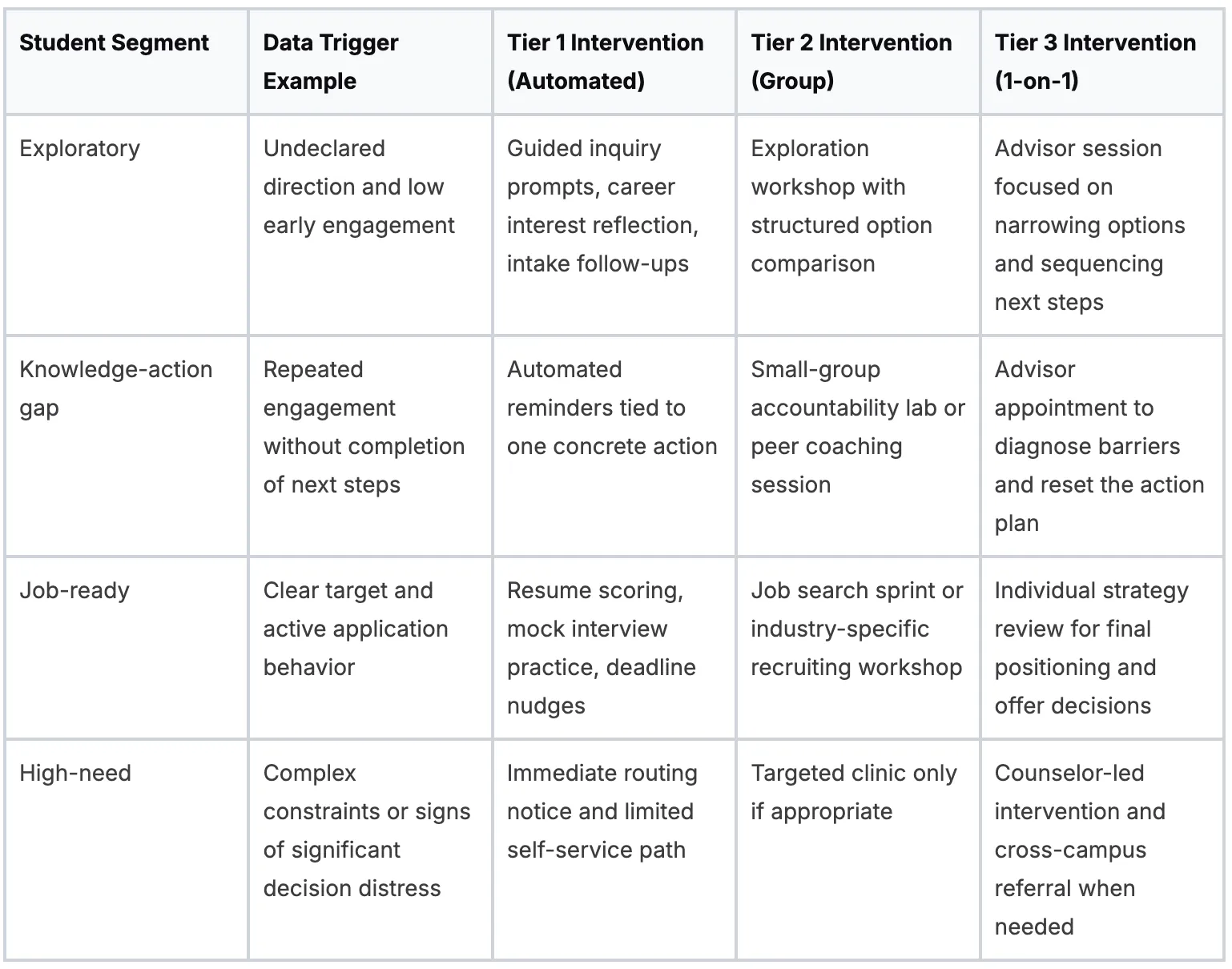
This kind of model works well when paired with a tiered student support approach.
The operational benefit is less about efficiency alone and more about consistency. Students with similar signals receive comparable support regardless of which advisor or office they encounter first.
When to use advanced decision models
For advanced students, especially graduate students, doctoral students, and high-achieving undergraduates facing non-obvious trade-offs, simple readiness logic isn’t enough.
The Three Axes of Success model helps advisors structure decisions around Wealth, Autonomy, and Meaning, and validations show 2-4x better long-term career impact compared with unstructured guidance.
That model is especially useful when students are choosing between paths that are all viable but optimized for different outcomes.
Industry research, doctoral study, public interest work, and entrepreneurial routes can all make sense. The advising task is to make the trade-offs explicit.
Also Read: 7 Career Coaching Case Note Templates for Structured Advising
What Are the Criteria for Escalation and Human Intervention?
Escalation criteria are predefined indicators that a student should move out of standard workflow and into counselor-led support. They protect advisor time by making high-touch advising intentional rather than accidental, and they protect students by ensuring serious barriers aren’t left inside a self-service queue.

Many centers treat escalation as a breakdown. It’s the opposite.
A framework without clear escalation rules usually overloads advisors with low-complexity work while missing students whose barriers are emotional, structural, or identity-linked.
What should trigger human review
The strongest escalation triggers are narrow and observable:
- Repeated failed progress after standard interventions
- Complex constraint profiles such as visa sponsorship concerns, major-life circumstance shifts, or competing institutional requirements
- High decision anxiety or other signs that the student is not functioning well inside self-directed tasks
- Equity-sensitive barriers where context changes what “readiness” means
A 2022 National Youth Employment Coalition survey highlighted the need for mental wellness support in advising for underserved youth, and the same race-grounded discussion points to decision-making anxiety as a barrier for 58.5% of students in some studies.
That’s exactly the kind of condition that belongs in an escalation protocol.
Escalation should be written as a service standard, not left as advisor heroics.
Staff capability matters as much as routing logic
Named institutional models prove useful here. Indiana University built an Advising & Career Framework that treats role clarity, training completion, dashboards, and cross-functional expectations as part of service quality.
Toraighyrov University offers a different signal from the academic side, showing that structured career development coursework can reduce core decision-difficulty clusters.
New York Institute of Technology appears in the verified benchmark set as a source for practical staffing and outcome reference points used in best-practice framing.
If escalation rules are going to work, staff need a common operating procedure.
This resource on standard operating procedures for advisor workload is useful because it translates “someone should handle this” into actual handoffs, time expectations, and ownership.
How Do You Integrate Equity Checks Into the Framework?
Equity checks belong inside the framework’s logic, dashboards, and review cycle.
They should test who gets routed where, who stalls in low-touch channels, and whether certain student groups are disproportionately classified as “not ready” when the underlying issue is access, support, or institutional design.
The operational risk is easy to miss. A clean triage model can still reproduce inequity if it treats low engagement as student disinterest rather than a signal of belonging, confidence, timing, or competing obligations.
Audit the routing, not just the outcomes
Teams should regularly review questions like these:
- Who remains in exploratory status too long
- Which groups receive repeated nudges but rarely convert to action
- Where one-on-one advising is concentrated, and where it is absent
- Which intervention pathways produce movement for some students but not others
Underserved-student research proves more useful here as a design warning than as a slogan.
Race-grounded advising work makes clear that standard frameworks often assume privileged exposure to opportunity and don’t sufficiently account for contextual readiness.
In practice, that means the same “self-service first” rule may be appropriate for one student and counterproductive for another.
Also Read: How should career centers design intake questionnaires to improve advising outcomes?
Build equity checks into case review
An equity audit becomes real when staff use it in supervision and service reviews.
A workable pattern looks like this:
- Pull routing data by student population and segment.
- Compare intervention completion patterns across groups.
- Review sample cases where students remained stuck despite multiple standard touches.
- Adjust rules, language, and handoff thresholds.
A framework becomes more equitable when it changes who gets help early, not when it only explains disparities after graduation.
Also Read: How can career centers scale group advising without sacrificing student outcomes?
Wrapping Up
Building a structured advising framework is only part of the shift.
Sustaining it requires systems that can consistently capture signals, apply decision logic, and route students without adding operational strain on your team.
Many career centers are starting to explore platforms that bring these pieces together - combining assessments, resume and interview support, and workflow management into a single system that supports both students and staff.
Hiration is designed to fit into this model, helping teams operationalize advising logic while maintaining visibility into student progress and outcomes.
The goal is to your team a system that makes your time more intentional and your impact more measurable.
Career Advising Decision Framework — FAQs
What is a career advising decision framework?
It is a rules-based system that determines what type of support a student receives, when they receive it, and through which channel, making advising more consistent and scalable.
Why do career centers need a structured advising framework?
Without standardized decision logic, advising becomes inconsistent across staff, making it harder to scale support, allocate resources, and demonstrate measurable outcomes.
What are the key components of an advising framework?
A strong framework includes entry signals, decision rules, student segments, intervention pathways, and escalation criteria to guide consistent advising decisions.
How should career centers segment students?
Students should be segmented based on observable behaviors and needs, such as exploration stage, execution gaps, readiness level, and complexity of barriers.
What is triage in career advising?
Triage is the process of using defined signals and rules to route students to the appropriate level of support, such as self-service tools, group programs, or one-on-one advising.
When should students be escalated to counselor-led support?
Escalation should occur when students show repeated lack of progress, face complex constraints, experience decision anxiety, or require context-sensitive guidance.
Why is a tiered intervention model important?
A tiered model ensures that advisor time is focused on high-impact cases while lower-complexity needs are handled through scalable channels like workshops or digital tools.
How can career centers integrate equity into advising frameworks?
Equity can be built in by auditing routing patterns, monitoring engagement across student groups, and adjusting intervention rules to address access and support gaps.
What are common mistakes in advising frameworks?
Common mistakes include relying on intuition instead of rules, segmenting only by class year, lacking escalation criteria, and failing to track consistent performance data.
What is the biggest benefit of a structured advising framework?
The biggest benefit is consistency, enabling career centers to deliver reliable support at scale while improving measurement, resource allocation, and student outcomes.