How can career centers use structured case note templates to improve advising continuity and measure student progress?
Career centers can improve advising continuity by using structured case note templates that document student context, advisor analysis, measurable outcomes, and time-bound next steps. Instead of simply recording that a meeting happened, strong case notes create a system of record that supports follow-up, tracks progress over time, and generates clearer institutional evidence of advising impact.
Most career center case notes are written to document that a meeting happened - not to capture what actually changed because of it.
As a result, advising outcomes remain invisible, follow-ups break down across advisors, and leadership lacks credible data to understand impact beyond appointment volume.
This gap matters at an institutional level.
Without structured, outcome-oriented documentation, career centers cannot track student progress over time, identify trends across populations, or demonstrate their contribution to retention, career readiness, and post-graduation outcomes.
What should be a source of strategic insight becomes an administrative record with limited value.
This guide breaks down how to transform case notes into a measurable system of record. It covers what high-impact notes look like, how to document outcomes instead of activities, how to structure follow-ups for continuity, and real examples across common advising scenarios.
Career Coaching Case Note Template
| Case Note Field | What to Document | Example |
|---|---|---|
| Student Context | Class year, major, appointment reason, target role, career goal, or primary concern | Junior, Biology major, exploring healthcare administration roles |
| Starting Point | What the student brought into the meeting, including materials, progress, or barriers | Resume lists lab experience but does not connect skills to operations or patient-care settings |
| Advisor Assessment | Observations, diagnosis, strengths, gaps, or readiness concerns identified during the session | Strong analytical experience but weak role targeting and limited employer-facing language |
| Intervention | What occurred during the appointment, including resources reviewed, coaching provided, or decisions made | Reviewed two healthcare administration job postings and identified recurring employer keywords |
| Student Action | Specific task, milestone, or deliverable the student agreed to complete | Revise three resume bullets and identify five target employers by Friday |
| Advisor Action | Follow-up support, review commitment, referral, or resource the advisor will provide | Review revised resume within 48 hours and share additional healthcare employer resources |
| Follow-Up | Date, trigger event, communication plan, or next appointment | Follow-up appointment scheduled for 11/15 ahead of internship application deadlines |
| Outcome Signal | Evidence that progress should be visible at the next review point | Updated resume, completed employer target list, and documented advising follow-up |
What distinguishes a high-impact case note from a weak one?
A high-impact case note is a strategic asset that documents observable outcomes and future actions, whereas a weak note is a passive, descriptive log of a conversation. Weak notes state what was discussed (e.g., “Student is interested in marketing”). In contrast, a strong note captures the student's initial state, the advisor's analysis, and a time-bound, measurable action plan, enabling continuity of care and institutional data collection.
This distinction is critical for demonstrating advising efficacy beyond simple appointment counts.
For instance, a weak note might read:
"Met with Maria, a sophomore, about her resume. Reviewed formatting and provided a template. She will update it and re-upload."
This note is a record of an event but offers no analytical value. A strong note, however, provides a clear, defensible record of the intervention:
Client: Maria G., Sophomore, Undeclared Date: 10/28/2024
- Session Focus: Resume transformation from activity list to evidence of skill.
- Subjective: Maria stated her resume feels like a "laundry list" of part-time jobs and clubs and doesn't know how to connect it to internship opportunities.
- Objective Analysis: Current resume lists roles (e.g., "Cashier," "Club Treasurer") but lacks quantifiable achievements or skill-based language. It would likely fail an Applicant Tracking System (ATS) scan for roles requiring "project management" or "data analysis."
Action Plan:
- Reframe Experience: Translate "Club Treasurer" role into specific skills: "Managed a $5,000 annual budget, forecasted expenses, and presented quarterly financial reports to an executive board.
- Quantify Achievements: For the "Cashier" role, add metrics: "Processed over 200 daily transactions with 99.8% accuracy.
- Follow-up: Maria to submit revised resume by 11/04 for asynchronous review before the upcoming career fair application deadline.
This structured approach, drawing from SOAP (Subjective, Objective, Assessment, Plan) note methodology common in healthcare, transforms a simple resume review into a documented, outcome-oriented coaching intervention.
According to NACE, framing student experiences through a competency lens is crucial for demonstrating career readiness, a task this note structure directly supports.
Also Read: Career Coaching Session Agenda Template for Scaling Student Support
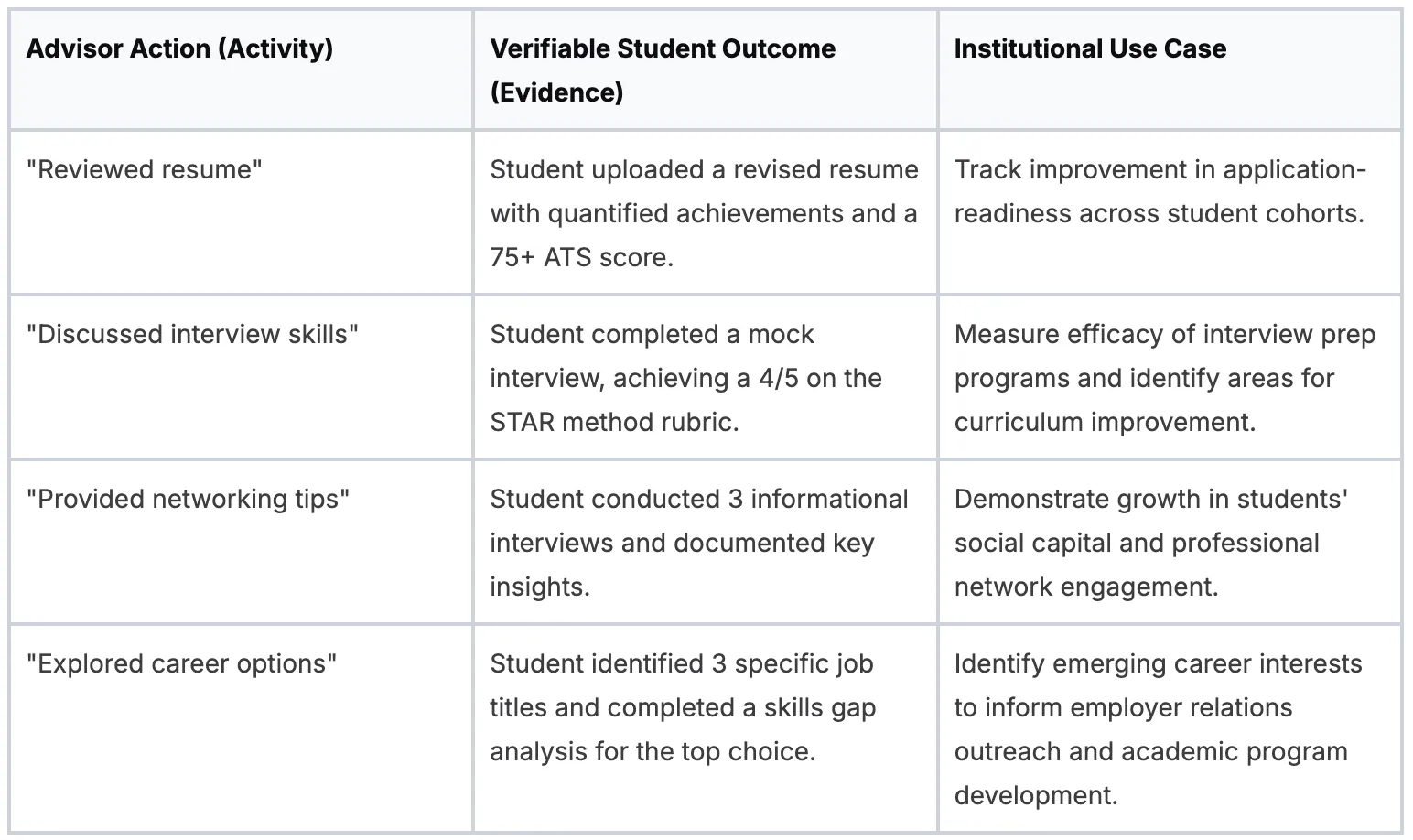
How can advisors document outcomes, not just activities?
Advisors can document outcomes by shifting their note-taking focus from the process of the meeting to the products and progress generated. This involves documenting concrete deliverables (e.g., a revised resume draft), behavioral commitments (e.g., student will conduct three informational interviews), and a baseline for future measurement (e.g., initial low confidence score on networking).
This creates a longitudinal record of student development that can be aggregated for institutional reporting.
For example, instead of noting "Discussed networking strategies," an outcome-focused note would state:
Action Plan:
- Network Scaffolding: Co-created a list of 5 alumni in the student’s target industry (Biotech) using the university’s alumni database.
- Tool Deployment: Drafted a networking email template together during the session. Student will send emails by EOD Friday.
- Outcome Tracking: Student will log responses and any scheduled informational interviews in the platform. Goal: One informational interview scheduled within 2 weeks.
This method provides verifiable evidence of progress.
At Wake Forest University, their "College to Career" courses emphasize creating tangible career portfolio assets.
A case note aligned with this philosophy would document the creation of those assets (e.g., "Completed LinkedIn 'About' section draft focused on personal branding narrative") as direct outcomes of an advising session.
Also Read: What Scripts Should Advisors Use for Difficult Student Scenarios?
How should case notes be structured to ensure effective follow-up?
To ensure effective follow-up, case notes must be structured with a dedicated, non-negotiable "Next Actions" or "Plan" section. This section should detail specific, time-bound tasks for both the student and the advisor. Each action item should be clear enough that any other CSP could understand and take over the case without needing a verbal handoff. This structure mitigates student drift and creates accountability.
A follow-up-ready note closes with a section like this:
Follow-Up Plan:
- Student Action: Send updated resume draft to advisor@university.edu by 11/15 for review before the application deadline for the [Company Name] internship.
- Advisor Action: Review draft and provide feedback via platform messaging within 48 hours of receipt.
- Next Appointment: Scheduled for 11/29 to conduct a mock interview focused on the [Company Name] job description.
This approach is crucial in large-scale operations.
A system of clear, transferable case notes is not a luxury but a necessity for providing consistent service.
When notes contain explicit follow-up triggers, they can be integrated with a Career Services Management (CSM) platform to automate reminders, ensuring that action items do not fall through the cracks.
This transforms the case note from a static record into an active component of the student engagement workflow.
Career Coaching Case Notes Examples
- Career Transition & Skills Pivot Case Note
Client: Clara M., Junior, Mechanical Engineering Date: 10/26/2024 Session Focus: Career pivot from ME to UX Design.
- Subjective Assessment: Clara expressed frustration with the lack of human-centered focus in her ME coursework. She discovered UX through a guest lecture and feels it aligns with her desire to "design for people."
- Objective Analysis: Mapped ME project experience to the UX design process. Identified strong analytical and systems-thinking abilities. Gaps identified in user research methods, wireframing tools (Figma), and portfolio development.
Action Plan:
- Skill Building: Enroll in online UX certificate (e.g., Coursera's Google UX Design Certificate).
- Portfolio Project: Develop a personal project redesigning a campus app, applying newly learned skills.
- Follow-up: Schedule mock interview in 6 weeks to practice new career narrative and UX-specific questions.

2. First-Generation Student Network Building Case Note
Client: David R., Sophomore, Finance (First-Generation) Date: 11/02/2024 Session Focus: Overcoming networking anxiety and building social capital.
- Subjective Assessment: David shared feelings of being "behind" peers whose parents work in finance and expressed anxiety about initiating conversations with professionals.
- Objective Analysis: Lack of existing professional network and uncertainty around professional etiquette. Strengths in resilience and work ethic are not yet framed as professional assets.
Action Plan:
- Network Scaffolding: Identify 3 alumni on LinkedIn in target firms using the university's alumni tool. Co-draft a networking email template.
- Confidence Building: Practice a 30-second personal pitch for informational interviews.
- Community Connection: Connect David with the campus's "First-Gen Trailblazers" student group.
- Follow-up: Check-in scheduled in 2 weeks to review outreach attempts. Goal: one informational interview.
Also Read: How should career centers design intake questionnaires to improve advising outcomes?

3. Internship-to-Full-Time Conversion Case Note
Client: David L., Senior, Finance Date: 07/15/2024 (Internship Mid-point) Session Focus: Strategy for converting summer internship to full-time Analyst offer.
- Subjective Assessment: David reports positive informal feedback but is unsure how to proactively position himself for a full-time offer.
- Objective Analysis: Contributed to two major client portfolios, developing models that identified a 4% cost-saving opportunity. Has not yet networked beyond his direct team.
- Action Plan: Impact Story Development: Create a "brag sheet" with 3-5 key, quantified achievements. Strategic Networking: Request 15-minute coffee chats with the VP of his group and one senior analyst in the next 3 weeks.
- Follow-up: Schedule session 2 weeks before internship end to prepare for final performance reviews. Students can review common intern interview questions to practice articulating their value.
Also Read: Career Center Reporting Templates: Monthly, Quarterly & Annual Formats

4. Executive Presence Development Case Note (MBA Student)
Client: Alex T., Full-Time MBA Date: 11/05/2024 Session Focus: Developing leadership communication for management consulting interviews.
- Subjective Assessment: Alex feels confident analytically but anxious about "sounding like a leader." Peer feedback suggests communication is too tactical, not strategic.
- Objective Analysis: 360-feedback from a leadership course confirms a tendency to "get lost in the weeds." A recorded mock interview showed a 5-minute answer to a behavioral question, focusing on process over impact.
Action Plan:
- Executive Communication: Practice the "Pyramid Principle" (start with the answer first) for case interview responses.
- Case Study Storytelling: Reframe three project examples to highlight strategic decision-making and business impact.
- Follow-up: Schedule a series of four mock interviews to practice conciseness and strategic framing. Developing this skill is a key part of learning how to build executive presence.
The note-taking structure remains consistent: subjective assessment, objective analysis, and a time-bound action plan.
At Clemson University, the Center for Career and Professional Development uses a competency-based approach; their advisors' notes could be structured to track a student's self-assessed vs. demonstrated progress in specific NACE competencies.
This turns each note into a data point for measuring institutional effectiveness in skill development.
Creating suitable headshots for platforms like LinkedIn is another practical step often documented in notes focused on digital presence.
Also Read: How can career services teams systematically identify and close student skill gaps in 2026?
What Should Advisors Avoid Including in Case Notes?
- Avoid unnecessary personal details that do not affect career support.
- Do not include speculative labels or judgments.
- Avoid sensitive health, disability, immigration, financial, or family details unless directly relevant and institutionally appropriate.
- Use observable language instead of assumptions.
- Document student-stated concerns separately from advisor observations.
- Keep notes professional enough that another advisor could read them and continue support.
- Follow institutional FERPA, data retention, and case management policies.
Example:
Avoid: Student is lazy and anxious about networking.
Use: Student reported avoiding networking outreach because they are unsure how to initiate conversations with alumni. Advisor co-drafted outreach message and scheduled follow-up.
Wrapping Up
When case notes are structured to capture outcomes, actions, and progress over time, they stop being documentation, and start becoming infrastructure.
They enable continuity across advisors, surface patterns across student populations, and give leadership a clear, defensible view of impact.
But building this system manually is difficult to sustain at scale. It requires consistent note structures, reliable follow-ups, and a way to translate individual interactions into institutional data.
This is where the right systems can make a difference.
Hiration brings together career assessments, AI-powered resume and interview modules, and a dedicated counselor workspace to manage cohorts, workflows, and analytics - all within a FERPA and SOC 2-compliant environment. When case notes, student activity, and outcomes live in one place, they become easier to track, act on, and report.
The goal isn’t just better documentation. It’s a system where every advising interaction contributes to measurable student progress, and a clearer picture of career center impact.
Career Coaching Case Notes — FAQs
What makes a career coaching case note high-impact?
A high-impact case note captures what changed during the session, what the advisor observed, and what happens next. It documents outcomes and action steps rather than simply listing what was discussed. :contentReference[oaicite:1]{index=1}
Why are weak case notes a problem for career centers?
Weak notes only confirm that a meeting happened. They make follow-up harder across advisors, reduce continuity of care, and limit the center’s ability to track advising impact beyond appointment volume. :contentReference[oaicite:2]{index=2}
How should advisors document outcomes instead of activities?
Advisors should record concrete outputs such as revised resume drafts, networking targets, confidence baselines, skill gaps identified, and specific behavioral commitments the student agreed to complete after the session. :contentReference[oaicite:3]{index=3}
What sections should every structured case note include?
A strong structure should include the session focus, the student’s stated challenge, objective advisor analysis, and a clear follow-up plan with time-bound action items for both the student and the advisor. :contentReference[oaicite:4]{index=4}
Why are next-step sections so important in advising notes?
A dedicated next-step section reduces student drift, improves accountability, and makes it easier for any advisor to continue support without needing a verbal handoff or additional discovery. :contentReference[oaicite:5]{index=5}
How do structured case notes support institutional reporting?
When notes are outcome-oriented and consistent, they become usable data. Career centers can identify patterns across student populations, track progress over time, and connect advising work to larger goals like retention, readiness, and post-graduation outcomes. :contentReference[oaicite:6]{index=6}
Can case notes help different advising scenarios stay organized?
Yes. The same structure can be applied across scenarios such as career pivots, internship conversion, first-generation student networking, or executive presence coaching, while still capturing the specific context and action plan for each student. :contentReference[oaicite:7]{index=7}
What is the long-term value of using standardized case note templates?
Standardized templates turn case notes into infrastructure. They make advising more consistent, improve follow-up quality, and help career centers build a clearer, defensible record of measurable student progress. :contentReference[oaicite:8]{index=8}