How does Hiration help career centers sustain adoption and student engagement?
Hiration helps career centers move beyond platform access by connecting technology to the workflows students and staff already use. Instead of treating launch as the finish line, Hiration supports ongoing adoption through contextual activation, live and recorded walkthroughs, usage visibility, workflow alignment, account check-ins, and practical guidance tied to institutional priorities. This approach helps career centers introduce the right feature at the right time, reduce repeated staff effort, identify engagement gaps, and make the platform part of everyday student support rather than another tool students are expected to remember on their own.
Career centers do not need another platform that students open once and forget.
They need technology that supports the full student journey while fitting the realities of lean teams, busy academic calendars, placement cycles, and competing priorities.
Hiration has spent almost a decade working in career technology. Our experience supporting nearly 100 leading universities has taught us that platform adoption depends on far more than product access.
A career platform can have strong features and still remain underused. It can be fully configured, introduced during onboarding, and made available to every student, yet struggle to become part of the institution’s regular workflow.
The difference usually comes down to what happens after launch.
Read on to see how our experience has shaped the way we do things differently, from onboarding and engagement to workflow alignment and long-term adoption, so career services teams receive the support they need to make the platform work in practice.
| Where adoption often breaks down | What career centers experience | What Hiration does differently |
|---|---|---|
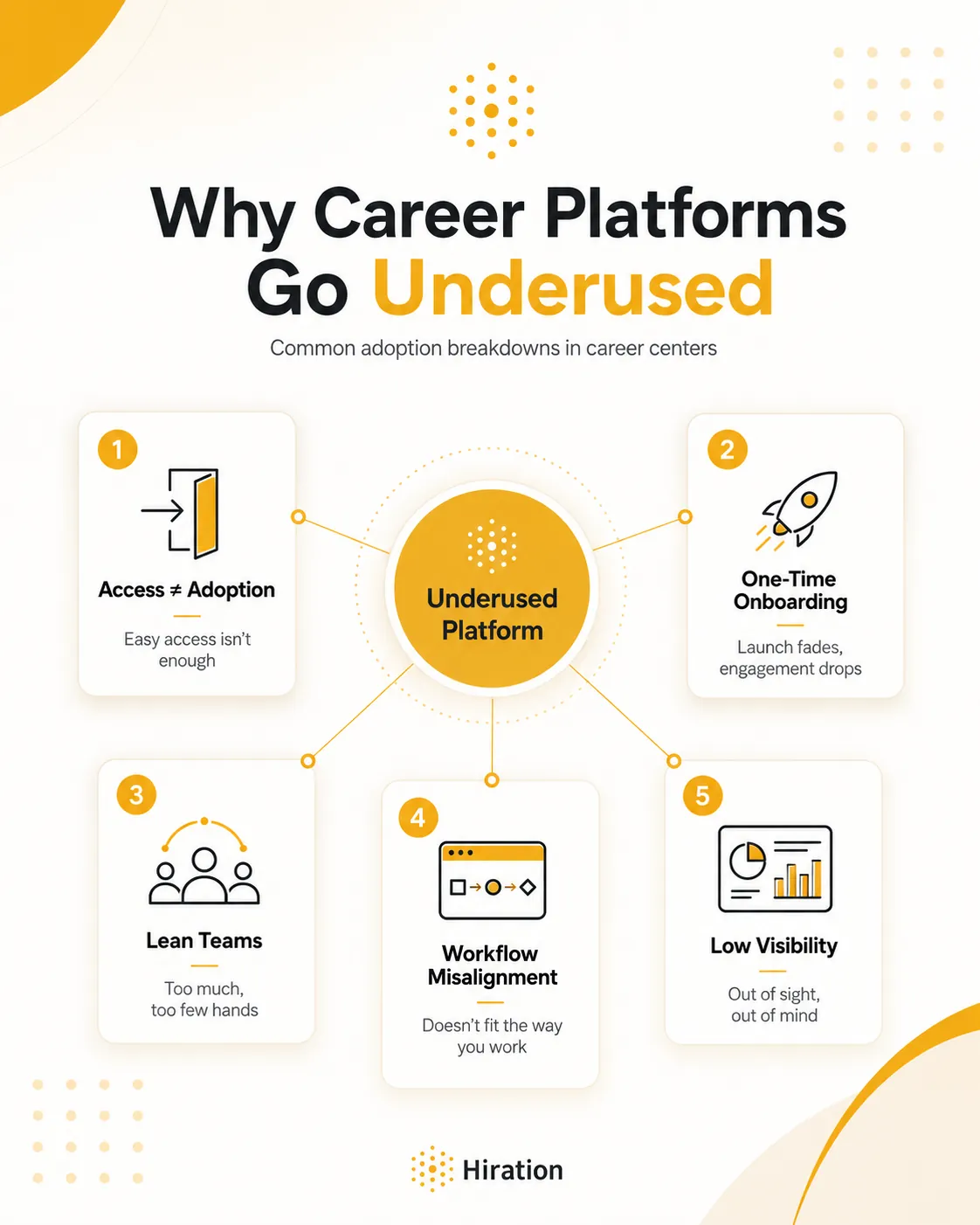
| Access is mistaken for adoption | Students log in once but do not return | We connect usage to immediate student needs |
| Every feature is introduced at once | Students and staff do not know where to begin | We focus on the most relevant workflow first |
| The platform sits outside existing processes | Advisors return to familiar manual methods | We align activation with institutional priorities |
| Career teams lack usage visibility | Staff cannot identify where engagement is falling | We track activity and help teams respond |
| Support ends after onboarding | Questions and adoption barriers remain unresolved | We continue guiding institutions after launch |
| Staff carry the full promotion burden | Lean teams struggle to maintain momentum | We provide walkthroughs, resources, and structured follow-up |
What does career platform underuse look like after launch?
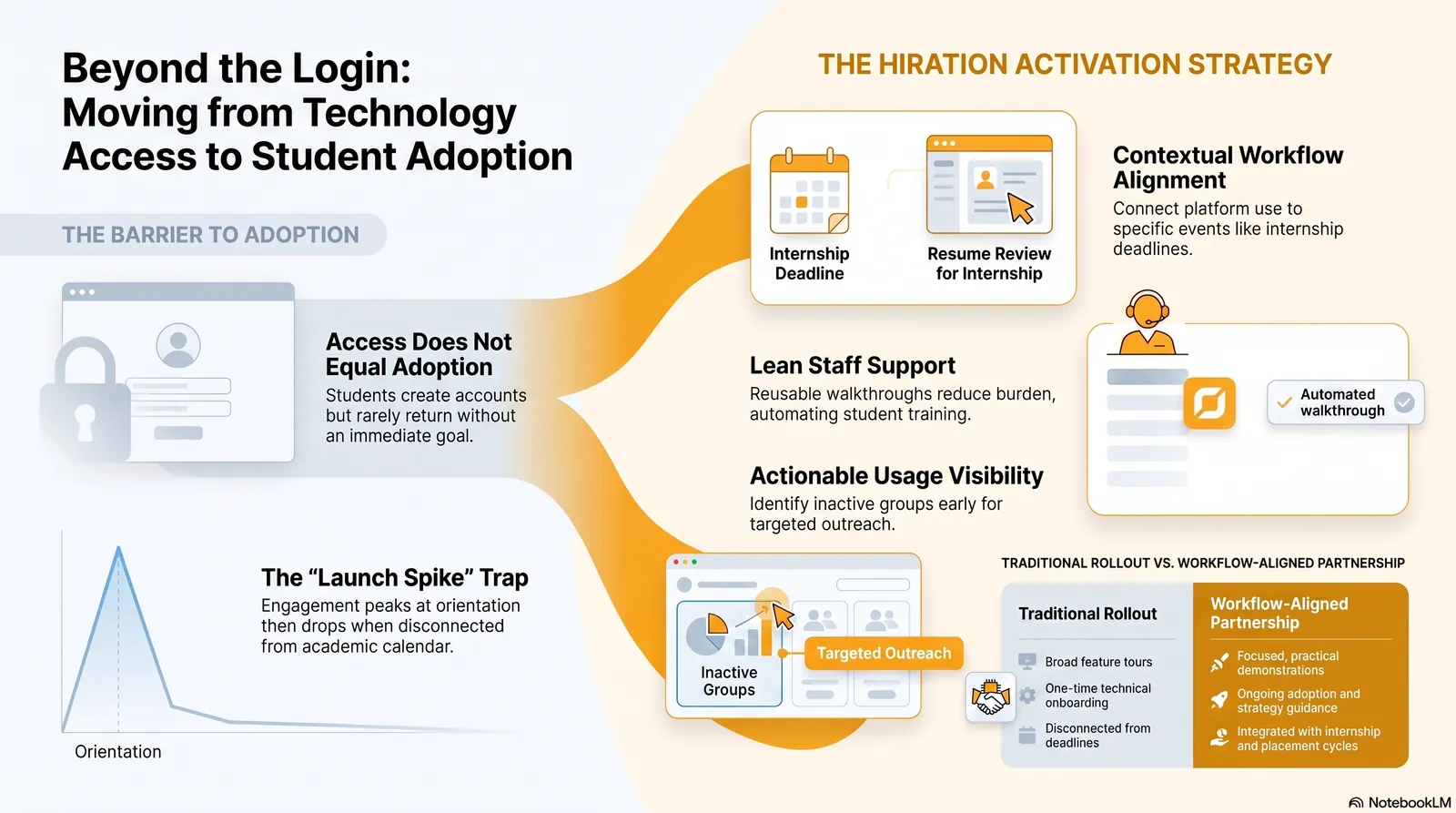
Career platform underuse is not always an empty dashboard. Sometimes, students create accounts and complete one activity but never return. In other cases, usage spikes after a launch session and gradually declines. Some institutions introduce several capabilities, but students continue using only the most familiar feature.
Weak adoption and low engagement often reinforce each other. When the platform remains outside regular career-center workflows, students receive fewer reasons to return.
When students stop participating, staff may become less likely to integrate the platform into future programming.
We have also seen situations where students were using the platform, but the career center assumed engagement was low because staff lacked a clear view of activity.
Underuse can therefore appear in several ways:
- Students create accounts without developing a repeatable usage habit.
- Engagement rises around launch and drops soon afterward.
- Students use one feature while ignoring the rest of the platform.
- Platform activity remains disconnected from appointments, workshops, and classroom partnerships.
- Staff do not know which students are active and which need additional outreach.
- Career teams have access to the platform but lack time to explore its full value.
- Usage becomes concentrated around one short period instead of continuing across the student journey.
In our experience, low activity does not always mean students do not see value in the platform. It may mean the platform was introduced at the wrong time, the first action was unclear, or the institution lacked the capacity to maintain momentum.
That distinction changes how adoption problems should be addressed.
The answer is not always another promotional email. Sometimes, the platform needs to be reintroduced through a more relevant workflow.
Why does providing platform access not automatically create student engagement?
Access may produce a first login. Adoption gives the platform a defined place within the institution. Engagement gives students a reason to return.
Students still need to understand why the platform is relevant now, what they should complete, and how that action supports an immediate career goal.
This is where many launches lose momentum.
A student may hear that a platform includes resume support, LinkedIn optimization, interview preparation, and several other tools. But when everything is introduced at once, the student is left to decide where to begin.
Most students will not independently explore every available capability. Career teams often behave similarly. When staff are already managing appointments, employers, workshops, reporting, and student outreach, they are unlikely to spend hours discovering every possible workflow on their own.
Our experience has shown that practical demonstrations perform better than broad feature explanations.
A focused session showing students how to strengthen a resume before an application deadline is easier to act on than a general tour of the entire platform.
A LinkedIn optimization walkthrough before a networking event gives students a clear reason to participate. Interview practice becomes more relevant when students are preparing for active opportunities.
Sustained usage usually needs four elements:
| Adoption requirement | What it clarifies |
|---|---|
| A timely reason | Why should the student use the platform now? |
| A clear first action | What should the student complete? |
| A visible benefit | What will improve after completing it? |
| A defined next step | What should the student do afterward? |
Without these elements, access remains passive.
That is why we do not view account creation as adoption or a first login as sustained engagement. The more meaningful question is whether the institution has created a repeatable pathway that brings students back when the platform can help them move forward.
How does Hiration connect platform activation to student engagement?
Career centers do not operate through one fixed workflow throughout the year.
Their priorities change with internship cycles, placement drives, employer events, application periods, graduation timelines, and academic schedules. A platform rollout that ignores those cycles can struggle even when the technology itself is useful.
We have seen institutions complete implementation while platform usage remained limited because the career team was focused on active placement activity. Once the platform was reintroduced through an immediate need, engagement improved.
This has taught us to make activation contextual.
Contextual activation is where adoption begins to translate into engagement. The career center gains a practical way to introduce the platform, while students gain a timely reason to participate.
| Current institutional priority | Relevant Hiration workflow |
|---|---|
| Resume preparation | Resume building, formatting, and review |
| Internship applications | Resume improvement and application readiness |
| Networking preparation | LinkedIn profile optimization |
| Interview season | Mock interview practice and preparation |
| Placement activity | Resume refinement and interview readiness |
| Off-season student development | Foundational career preparation |
| Advisor-led initiatives | Structured student completion and follow-up |
The idea is not to ask career centers to promote everything all year, but to identify which workflow is most relevant at a particular moment and make that the entry point.
This also makes student communication easier. “Use the platform” is vague. “Complete your resume review before next week’s internship application session” is specific.
Students are more likely to engage when the platform is connected to a deadline, workshop, appointment, employer event, or active career goal.
How does Hiration reduce the adoption & engagement burden on lean career-center teams?
Career centers are being asked to support large student populations with limited staff capacity.
A small team may be responsible for individual advising, employer engagement, workshops, events, reporting, faculty partnerships, placement coordination, and student communication.
Even when the team sees value in a career platform, it may not have the time to repeatedly train students or promote every feature.
We have seen this across institutions of different sizes.
That's why, our adoption model respects staff capacity. We strive to make student activation easier without creating another recurring operational burden for lean teams.
Hiration supports adoption and student engagement through:
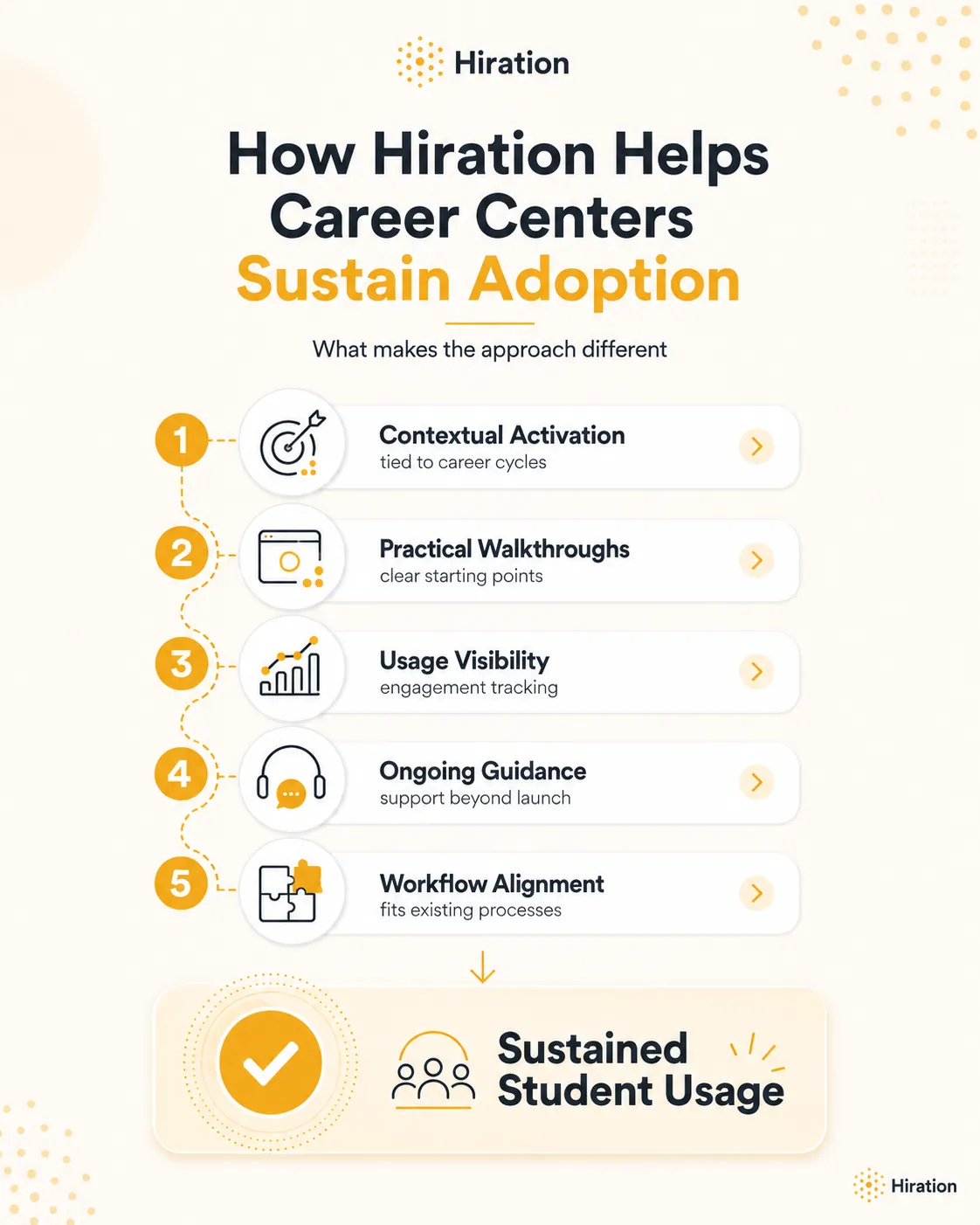
- Live walkthroughs focused on immediate workflows
- Recorded walkthroughs that teams can share with students
- Structured trackers for questions and ongoing requests
- Regular account check-ins
- Clear updates on pending issues
- Practical explanations instead of feature-heavy presentations
- Support tailored to current institutional priorities
- Guidance on where additional engagement may be needed
Recorded resources are especially valuable for lean teams. Advisors do not need to repeat the same explanation for every student group. They can share a walkthrough before a workshop, assignment, or application cycle.
Live demonstrations also help staff quickly understand how a workflow can be used without requiring them to independently explore every feature.
The career center still plays an important role in communicating expectations and connecting the platform to institutional programming. Our role is to make that process easier to manage.
How does usage visibility help career centers strengthen student engagement?
Career centers cannot address an engagement problem they cannot see.
Usage visibility is not only a way to report on platform adoption. It helps career teams understand where student engagement is building, where it is weakening, and where a timely intervention may be useful.
A total login number may indicate that students accessed the platform, but it does not always reveal whether usage continued, which students remained inactive, or whether a particular initiative produced meaningful participation.
Our account management work includes reviewing student activity, engagement patterns, and overall usage trends. This helps us understand which accounts are active, which may need additional attention, and where a focused intervention could help.
Better visibility allows career teams to move beyond assumptions.
Instead of saying:
“Students do not seem to be using the platform.”
The team can begin asking:
- Which students have started?
- Which students have not yet engaged?
- Did activity increase after a workshop?
- Has participation declined since launch?
- Which workflow is receiving the most attention?
- Is there a particular group that needs a reminder?
- Should a feature be reintroduced before an upcoming deadline?
This turns platform data into an engagement tool. Career teams can move from broad reminders to more relevant actions based on what students have or have not completed.
Once staff can see what is happening, they are more likely to send targeted reminders, organize a focused session, or reconnect platform activity with an upcoming student need.
Data alone is not enough, though.
A usage report should lead to a decision. The useful question is not simply whether engagement is high or low. It is what the institution should do next.
Why does Hiration continue guiding institutions after onboarding?
Onboarding can introduce the platform, but it cannot account for every future student need, staffing change, or career-center priority.
Sustained adoption requires the institution to keep finding relevant places for the platform within its work. Sustained engagement requires students to keep encountering it at moments when the support is useful.
These are not the same thing.
Institutional priorities change after launch. New staff may become involved. Student participation may fall. A feature that was not relevant during onboarding may become important later in the year.
We have learned that career centers often need more than technical support. They need a partner who can help simplify capabilities, identify practical use cases, monitor engagement, and keep adoption from becoming an afterthought.
Our ongoing support can include:
- Reviewing whether activity has continued after launch
- Reintroducing workflows when they become relevant
- Running focused demonstrations
- Sharing recorded guidance
- Tracking questions and unresolved requests
- Reviewing engagement patterns
- Adapting support to institutional priorities
- Gathering feedback through regular conversations
- Helping teams translate platform activity into next steps
Some of the most useful feedback does not appear during formal reviews. It surfaces during regular conversations when staff discuss what students are doing, where internal processes are slowing implementation, or which workflows need to be explained differently.
That continuity is central to our approach.
We do not consider adoption and engagement complete because user accounts have been created. We stay involved because platform usage changes throughout the academic and recruitment cycle.
How does workflow alignment turn adoption into student engagement?
Workflow alignment operates on both sides. It makes adoption easier for staff because the platform fits familiar processes and expectations. It also makes engagement easier for students because the platform appears within workshops, appointments, assignments, and preparation activities they already understand.
Every career center has its own operating model.
Institutions may use different resume formats, review standards, administrative structures, job portals, communication systems, or internal processes. A platform that expects every institution to work in exactly the same way can create unnecessary friction.
Over the years, universities have approached us with different requirements.
Some have needed specific resume margins, headings, layouts, or formatting conventions. Others have required different levels of administrator access or greater internal visibility into student activity.
These requests may appear small, but they can strongly influence adoption.
When a platform reflects familiar institutional practices, staff can introduce it more confidently. Students also receive guidance that feels connected to the expectations they already hear from their career center.
Workflow alignment requires questions such as:
- Does the platform support the institution’s preferred resume structure?
- Can administrators see the information they need?
- Can the platform complement existing systems?
- Can students move through the workflow without unnecessary steps?
- Can staff explain the process using familiar institutional language?
- Does the rollout fit current workshops, appointments, and programming?
Many career centers already manage several tools. They may use an ATS, a job portal, internal trackers, and learning systems alongside career-readiness technology.
Adding another disconnected destination can create more fragmentation.
Our approach is to understand where Hiration fits within the institution’s existing environment and reduce the friction between platform activity and career-center workflows.
Which practices support both institutional adoption & student engagement?
Across almost a decade in career technology and nearly 100 university partnerships, we have repeatedly seen a common pattern.
Adoption and student engagement is stronger when the platform is easy to understand, connected to an immediate need, visible to staff, and supported after launch.
The following practices have consistently helped institutions build stronger usage:
| Practice | How it supports adoption | How it supports engagement |
|---|---|---|
| Task-specific walkthroughs | Gives staff a repeatable activation method | Gives students a clear starting point |
| Activation tied to career cycles | Fits the institution’s operating calendar | Creates a timely reason to participate |
| Recorded resources | Reduces repeated staff training | Gives students on-demand guidance |
| Usage visibility | Helps teams manage implementation | Shows where re-engagement may be needed |
| Regular account check-ins | Keeps adoption from fading after launch | Supports timely activation around new needs |
| Institution-specific alignment | Makes the platform easier to embed | Creates a more familiar student experience |
| Focus on core workflows | Prevents staff from promoting everything at once | Reduces uncertainty about what students should do first |
One of the clearest lessons is that more features do not automatically lead to more usage.
Advanced capabilities can remain untouched if students and staff do not understand when to use them. In many cases, adoption becomes stronger when institutions begin with one clear workflow, build confidence, and expand from there.
Career centers often value reliability, clarity, visibility, and reduced manual effort more than feature volume alone.
That is why we focus on turning Hiration’s capabilities into clear, repeatable workflows that career teams can embed into their programs and students can return to as their needs evolve.
What should career centers ask before investing in another platform?
Career centers should evaluate more than what a platform can demonstrate during a sales conversation.
They should also examine what will happen after purchase.
Questions about student activation and engagement
- What gives students a reason to return after their first login?
- Can platform use be connected to immediate career goals?
- Can inactive students or groups be identified?
- What support exists when engagement begins to decline?
- Can students access relevant workflows at different points in their journey?
Questions about staff workload
- How much manual promotion will the career center need to manage?
- Are reusable walkthroughs and resources provided?
- Can the platform support large student populations without adding repeated staff work?
- What responsibilities remain with the institution after onboarding?
Questions about visibility
- What can career teams see about student activity?
- Can staff identify inactive groups?
- Can reporting support targeted outreach?
- Will the vendor help interpret engagement patterns?
Questions about workflow alignment
- Can the platform reflect institutional resume standards or evaluation expectations?
- How will it work alongside existing systems?
- Can administrative access be adapted to institutional needs?
- Can the platform support workshops, appointments, and classroom initiatives?
Questions about ongoing support
- What happens after implementation?
- How frequently will the account team remain involved?
- Does support include adoption guidance or only technical troubleshooting?
- What happens when student engagement declines?
- Can the activation approach change as institutional priorities shift?
These questions reveal whether a platform is designed to become part of the institution’s operating model or simply made available for students to discover independently.
From platform access to institutional adoption & engagement
Almost a decade in career technology has taught us that adoption does not happen simply because a platform has been purchased, and engagement does not continue simply because students have been given access.
Adoption gives the platform a place within the institution. Engagement gives it a meaningful place within the student journey.
Both depend on students encountering the right workflow at the right time, career teams understanding what is happening, and support continuing after launch.
That is what Hiration does differently.
We do not simply provide access to career technology and leave institutions to manage adoption or student engagement alone.
Hiration works alongside career centers to connect the platform to student needs, staffing realities, institutional processes, and changing priorities throughout the year.
We understand that a career platform should not become another tool students are expected to remember. It should become part of how the institution shows up for them when they need support most.
If your career center is looking for a platform that does more than launch well, we would be glad to show you how Hiration can become part of your everyday student-support model.
Book a walkthrough to see what that partnership could look like for your institution.
Hiration Adoption & Engagement — FAQs
What does career platform underuse look like after launch?
Platform underuse is not always an empty dashboard. It can look like students creating accounts but not returning, usage rising after launch and then declining, students using only one feature, or platform activity staying disconnected from appointments, workshops, classroom partnerships, and application cycles.
Why does platform access not automatically create student engagement?
Access gives students a login, but it does not always give them a reason to return. Students need to understand why the platform is relevant now, what action they should take, and how that action connects to an immediate career goal such as a resume deadline, interview, networking event, or internship application.
What is the difference between adoption and engagement?
Adoption gives the platform a defined place within the institution’s workflows. Engagement gives students a meaningful reason to use it repeatedly. A platform may be adopted by a career center but still need stronger student engagement if students are not returning at the moments when the tool can support their progress.
How does Hiration connect platform activation to student engagement?
Hiration connects activation to engagement by helping career centers introduce the platform through timely workflows. Instead of asking students to explore every feature at once, the platform can be tied to immediate needs such as resume reviews before an application deadline, LinkedIn optimization before a networking event, or interview practice before recruiting season.
What is contextual activation?
Contextual activation means introducing the platform when it connects to a specific student need, deadline, event, workshop, assignment, or career goal. This makes the first action clearer for students and helps career centers avoid promoting every capability all year without a specific reason for students to participate.
How does Hiration reduce the adoption burden for lean career-center teams?
Hiration supports lean teams through live walkthroughs, recorded walkthroughs, structured trackers, regular account check-ins, practical explanations, issue updates, and guidance tied to current institutional priorities. These resources help staff activate students without having to repeatedly train every group or promote every feature manually.
Why is usage visibility important for career centers?
Usage visibility helps career centers understand which students have started, which groups remain inactive, whether participation increased after a workshop, which workflows are receiving attention, and where targeted reminders or reintroductions may be needed. It turns platform data into a practical engagement tool.
Why does Hiration continue guiding institutions after onboarding?
Onboarding can introduce the platform, but student needs, staffing realities, academic calendars, placement cycles, and institutional priorities change throughout the year. Hiration continues supporting institutions so workflows can be reintroduced, engagement patterns can be reviewed, and platform use can stay connected to current career-center priorities.
How does workflow alignment support adoption and engagement?
Workflow alignment helps the platform fit the institution’s existing processes, language, standards, and student-support model. When a platform reflects familiar resume expectations, administrative needs, workshop formats, appointment flows, and communication practices, staff can introduce it more confidently and students can understand how to use it.
What practices help career centers sustain platform adoption?
Strong adoption is usually supported by clear entry points, timely workflows, reusable walkthroughs, staff visibility, regular account support, targeted reminders, and alignment with existing career-center programming. Adoption becomes stronger when career centers begin with one clear workflow, build confidence, and expand usage over time.
What should career centers ask before investing in another platform?
Career centers should ask what gives students a reason to return, how much manual promotion staff must manage, what activity data the team can see, whether inactive groups can be identified, how the platform fits existing workflows, and what support continues after implementation.
What makes Hiration’s adoption approach different?
Hiration does not treat launch as the end of the partnership. Its approach focuses on helping career centers connect the platform to student needs, staffing realities, institutional workflows, usage patterns, and changing priorities throughout the year so the technology becomes part of everyday student support.