What conversation scripts help advisors handle difficult student scenarios effectively?
Career advisors can handle difficult conversations more effectively by using structured frameworks such as CALM for anxiety, data-driven gap analysis for unprepared students, evidence-based reality testing for overconfidence, scaffolding for language barriers, and test-and-learn experiments for undecided students. These scripts turn emotional reactions into measurable progress within each advising session.
Career advising conversations can stall quickly when students are anxious, unprepared, overconfident, unsure of their direction, or struggling to explain themselves clearly.
For advisors, the challenge is not just saying the right thing. It is turning a difficult moment into a clear next step the student can actually complete.
That requires structure. This guide gives career center advisors five practical scripts for common difficult advising conversations, along with follow-up actions, progress checks, and language to avoid.
Career Advising Scripts at a Glance
Use this table to choose the right script based on the student’s behavior, emotion, or barrier.
| Student Scenario | Advisor Goal | Script Framework | What Progress Looks Like |
|---|---|---|---|
| Highly Anxious Student | Reduce overwhelm and create one manageable next step | CALM: Connect, Ask, Label, Map | Student names one specific fear and completes one micro-action |
| Unprepared Student | Move from blame or avoidance to evidence-based action | Data-First, Plan-Second | Student compares current materials against role requirements and identifies gaps |
| Overconfident Student | Ground confidence in concrete proof and performance evidence | Reality-Test with Evidence | Student produces a scored behavioral answer, resume example, or proof point |
| Student with Language Barriers | Build functional confidence for interviews, networking, and high-stakes conversations | Scaffold and Rehearse | Student practices one clear, usable career story |
| Undecided Student | Replace pressure to choose with low-risk exploration | Test and Learn | Student completes one low-cost career experiment |
The goal is not to make every advisor sound the same; it is to give advisors a reliable structure when the conversation becomes emotionally charged, vague, or difficult to move forward.
How can advisors script conversations with highly anxious students?
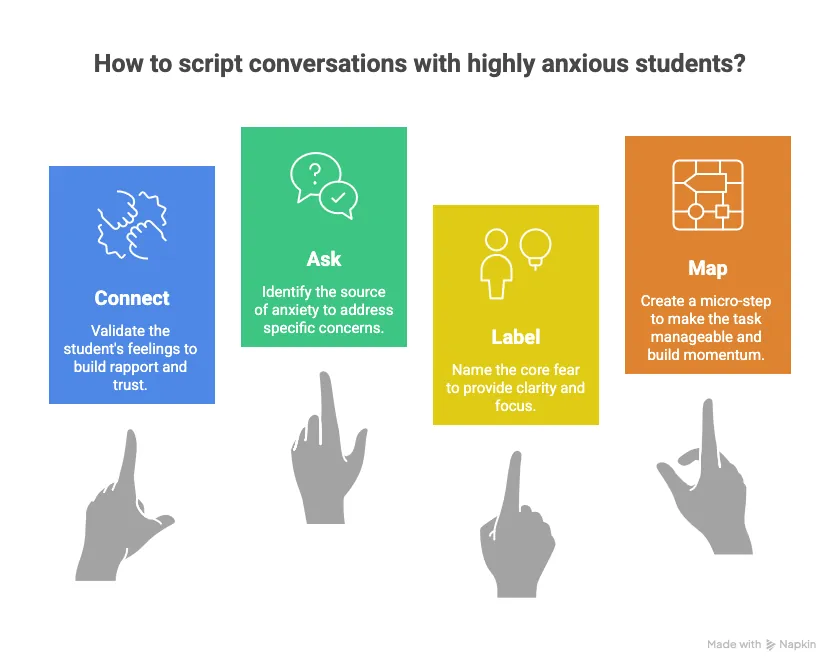
Advisors should use the CALM framework: Connect with their feeling, Ask about the source, Label the core fear, and Map a micro-step. This reframes anxiety from a barrier into a diagnostic tool. Rather than offering premature reassurance, this script validates the emotion and channels it into a single, manageable action, preventing cognitive overload and building momentum.
Anxiety often stems from a student's perception of overwhelming uncertainty.
According to a study from the American College Health Association, 65.7% of students reported experiencing overwhelming anxiety.
A generic "don't worry" response is ineffective. The CALM script provides a structured alternative.
- Connect: "It sounds like this process is causing a lot of stress. That's a completely normal reaction given how much is on the line."
- Ask: "When you think about the job search, what is the one part that feels most daunting right now? Is it the resume, the interview, or something else?"
- Label: "So, the core fear is that you'll get to an interview and not know how to answer the questions. It's a fear of being put on the spot and looking unprepared."
- Map: "Let's tackle just that. For the next 15 minutes, we are going to practice just one common question: 'Tell me about yourself.' That's it. What do you think?"
What to listen for
Listen for the actual source of anxiety. Students often describe the whole process as overwhelming, but the real blocker may be one of these:
- fear of rejection
- fear of interviews
- fear of choosing the wrong path
- fear of disappointing family
- fear of being behind peers
- fear of not having enough experience
- fear of networking
Once the core fear is clear, the advisor can choose a narrower intervention.
Also Read: How can career counseling reduce student anxiety?
What is the most effective script for unprepared students?
For unprepared students, use the "Data-First, Plan-Second" script. This involves presenting objective market data to create a shared understanding of the gap between their current state and their goal. It shifts the conversation from a subjective critique of their lack of preparation to a collaborative analysis of external requirements.
Students often lack a realistic understanding of the baseline requirements for entry-level roles.
NACE’s Job Outlook 2026 survey indicates that approximately 70% of employers now use skills-based hiring practices, prioritizing demonstrated abilities over degrees or job titles to identify stronger, more diverse candidates.
An unprepared student with a generic, non-skills-focused resume is therefore functionally invisible. Instead of saying "You need to do more," show them the data.
"I pulled up three typical job descriptions for the 'Marketing Coordinator' roles you're targeting. Let's look at the 'must-have' qualifications together. I'm seeing 'experience with Google Analytics' and 'proficiency in HubSpot' in all three. Our task is to build a plan to get those specific skills on your resume. Where should we start?"
This script avoids blame and immediately frames the situation as a strategic challenge.
It provides concrete evidence of the gap and pivots directly to a collaborative planning session.
Progress is verified through a jointly created action plan document listing specific courses, projects, or certifications the student will complete.
At Clemson University's Center for Career and Professional Development, advisors use a similar data-driven approach, tying student action plans to labor market insights from tools like Lightcast, with completion tracked in their student information system.
What to listen for
Listen for whether the student is:
- unclear on target roles
- applying too broadly
- missing required skills
- underselling relevant experience
- relying on coursework without translating it
- confusing interest with readiness
- trying to skip preparation steps
How should advisors manage conversations with overly confident students?
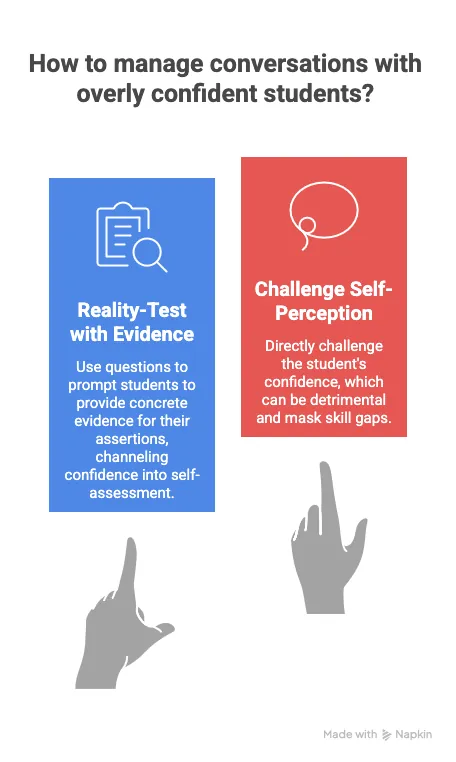
With overly confident students, advisors should use the "Reality-Test with Evidence" script. This involves asking questions that prompt the student to provide concrete evidence for their assertions of readiness. It channels their confidence into a self-assessment against objective, employer-defined standards, rather than directly challenging their self-perception.
Overconfidence can be as detrimental as under-confidence, as it often masks significant skill gaps.
Research from Cornell University on the Dunning-Kruger effect shows that individuals with low competence often overestimate their ability.
The goal is not to deflate the student, but to ground their confidence in provable skills.
Student: "I'm a great communicator. I'll have no problem with interviews."
Advisor: "That's great to hear, as communication is the top skill employers seek. Let's put that to the test so you can prove it. How would you handle this common behavioral question: 'Describe a time you had to persuade a team to adopt your idea.' What was the situation, what was your specific action, and what was the result?"
This script leverages their stated confidence ("Let's put that to the test") and immediately introduces a standard, structured assessment framework (Situation-Action-Result).
What to listen for
Overconfident students may:
- speak in generalities
- use “we” without explaining their role
- lack measurable or specific results
- confuse personality traits with evidence
- dismiss feedback too quickly
- struggle when asked follow-up questions
The advisor should use the student’s own performance as the feedback mechanism.
Verification: The outcome is verified by the quality of the student's response, which can be scored against a behavioral interview rubric. This artifact, the recorded or transcribed answer, provides a clear baseline for coaching.
Also Read: How Career Services Can Improve Outcomes for Neurodivergent Students?
What Script Works for Students With Language Barriers?
Advisors should use a "Scaffold and Rehearse" script. This involves breaking down communication tasks into smaller components, providing simplified language and model phrases, and using repetition and practice within the session. It focuses on building functional fluency for specific, high-stakes career scenarios like interviews or networking.
For students with low English proficiency, the fear of making grammatical errors can be paralyzing.
The focus should shift from perfect fluency to clear, confident communication on key topics.
According to a report by the American Council on Education, international students often cite communication barriers as a major hurdle in their job search.
"Instead of trying to perfect all your English, let's focus on mastering the 3 most important stories for your job search: (1) your 'Tell me about yourself' story, (2) your top skill story, and (3) your 'Why this company' story. Today, we will only work on story #1. I'll provide a simple template, and we will practice it together until it feels natural."
This script narrows the focus to manageable tasks, reduces cognitive load, and emphasizes rehearsal.
Providing a template (the scaffold) gives the student a concrete structure to build upon.
What to listen for
Listen for:
- whether the student can explain the core idea
- whether the structure helps reduce hesitation
- whether the answer is too long
- whether the student uses words they understand
- whether the student can repeat the answer with more confidence
- whether grammar concerns are blocking clarity
The advisor should prioritize clarity over complexity.
Verification: Progress is verified by the student’s ability to deliver the rehearsed story with increasing confidence and clarity during the session.
The University of Washington's Career & Internship Center provides dedicated workshops for international students that use this scaffolding method, tracking success through mock interview performance and student self-efficacy surveys.
Also Read: How Career Centers Can Guide International Students Through Interviews?
What script works for students who are confused or undecided about their career path?
For confused students, use the "Test and Learn" script. This reframes career exploration from a single, high-stakes decision into a series of small, low-cost experiments. It shifts the student's mindset from "I need to find the perfect passion" to "I need to gather data about what I like and dislike."
Career indecision is a common developmental stage, but it often feels like a personal failure to students.
Data from the National Survey of Student Engagement (NSSE) consistently shows that a significant portion of first- and second-year students are undecided.
The script must normalize this uncertainty and provide a clear, action-oriented process.
"It's completely normal to feel undecided; in fact, most students change their minds. The goal isn't to pick a forever career today. The goal is to run a small experiment. Based on your interest in [X], what is one small step you could take this month to test it? Could you do one informational interview, join one student club, or watch one 'day in the life' video? Let's pick one."
This script validates their feeling, lowers the stakes, and proposes concrete, time-bound actions.
It introduces the language of experimentation ("test it," "run an experiment"), which is less intimidating than "choosing a major."
What to listen for
Listen for:
- fear of choosing wrong
- pressure from family or peers
- lack of exposure to career options
- too many interests
- no concrete experience
- confusion between major and career path
- avoidance caused by uncertainty
Verification: The outcome is verified by the student's completion of the agreed-upon experiment and the artifact of their reflection. The advising team at Wake Forest University uses a similar "prototyping" model, asking students to document their experimental outcomes and share what they learned in follow-up appointments, creating a portfolio of exploration.
Also Read: How to Prepare First-Generation Students for Career Fairs?
What Should Advisors Avoid Saying in Difficult Career Conversations?
Advisors should avoid language that minimizes emotion, blames the student, challenges identity directly, or creates pressure to decide too quickly. Better language names the issue, reduces the task size, and turns the conversation toward evidence, practice, or a concrete next action.
Use this table as a quick coaching reference.
| Student Situation | Avoid Saying | Say Instead |
|---|---|---|
| Anxious Student | “Don’t worry.” | “Let’s identify the one part that feels most overwhelming.” |
| Unprepared Student | “You should have started earlier.” | “Let’s compare the role requirements with what your materials currently show.” |
| Overconfident Student | “You’re not ready.” | “Let’s test that with one employer-style question.” |
| Student with Language Barriers | “Your English needs work.” | “Let’s practice the three stories you’ll need most.” |
| Undecided Student | “You need to choose a path.” | “Let’s run one small experiment before making a bigger decision.” |
The “say instead” column works because it keeps the student engaged. It does not ignore the problem, but it avoids making the student defensive or ashamed.
Wrapping Up
Strong advising is about building repeatable systems that consistently move students from confusion to action, from intent to evidence.
When advisors have the right scripts and the right infrastructure, every interaction can produce measurable progress.
Hiration’s full-stack career readiness suite supports this exact model; combining career assessments, AI-powered resume optimization, interview simulations, and a dedicated counselor module to manage cohorts, workflows, and analytics in one place.
It gives career centers the tools to operationalize structured advising, track outcomes, and scale personalized support across thousands of students - securely and in alignment with FERPA and SOC 2 standards.
The result is simple: fewer stalled conversations, more verified student progress, and a career center that can clearly demonstrate its impact.
Advising Scripts for Difficult Student Conversations — FAQs
Why do career advisors need structured conversation scripts?
Structured scripts ensure advising conversations consistently produce clear actions and measurable progress rather than relying on intuition, which can lead to inconsistent outcomes across students and advisors.
What framework helps advisors support highly anxious students?
The CALM framework—Connect, Ask, Label, and Map—helps advisors acknowledge student emotions, identify the root concern, and guide them toward one manageable action that builds confidence and momentum.
How should advisors approach students who arrive unprepared?
Advisors can use a data-first approach by reviewing job market requirements together and identifying specific skill gaps. This reframes the conversation from criticism to collaborative planning based on real employer expectations.
What is the best way to handle overly confident students?
Instead of challenging confidence directly, advisors can ask students to demonstrate their skills through structured prompts or mock interview questions, allowing evidence to reveal strengths and areas for improvement.
How can advisors support students with limited English proficiency?
Advisors should use scaffolding techniques—breaking communication tasks into smaller parts, providing model phrases, and practicing key stories such as “Tell me about yourself” to build functional fluency for interviews.
What approach works for students who feel completely undecided about their career?
A “test-and-learn” strategy reframes career exploration as a series of small experiments such as informational interviews, club participation, or short research tasks, allowing students to gather real data about their interests.
How can advisors verify progress during advising sessions?
Progress can be verified through tangible artifacts such as revised resumes, mock interview recordings, written action plans, or reflection notes that demonstrate movement from discussion to concrete outcomes.
How do structured advising methods improve career center outcomes?
When advising conversations follow repeatable frameworks, career centers can scale support, reduce stalled conversations, and generate consistent evidence of student development across thousands of advising interactions.