What do recruiters really want in 2026, and how should career centers coach students differently?
Recruiters now prioritize scannable resumes, skills-based LinkedIn visibility, quantified interview answers, and proof of real-world impact over GPA or generic applications. Career centers can improve outcomes by coaching students around recruiter behavior, using data-backed advising, and building repeatable systems that turn career readiness into measurable evidence.
If you’re a career advisor helping students prepare for recruiting, one of the hardest parts is correcting assumptions about what employers actually notice.
Students may focus on resume templates, GPA, or application volume, while recruiters are increasingly evaluating something more specific: proof of skills, relevant experience, communication, role alignment, and whether a student can explain what they have actually done.
That makes recruiter expectations a practical coaching issue for career centers. Advisors need to understand which signals matter across resumes, LinkedIn profiles, interviews, projects, GPA, and AI-assisted applications so they can direct students toward evidence rather than polish alone.
This guide breaks down what recruiters look for in college students in 2026 and shows how career advisors can translate those expectations into resume reviews, interview coaching, LinkedIn guidance, and job-search preparation.
Recruiter Signals at a Glance
Use this table to help students understand the difference between what they think recruiters value and what recruiters actually evaluate.
| What students may focus on | What recruiters are actually evaluating | What advisors should coach |
|---|---|---|
| Finding the perfect resume template | Whether relevant experience, skills, and results are easy to identify | Clear structure, role relevance, and evidence-based bullets |
| Keeping GPA front and center | Whether the student can demonstrate readiness through skills and experience | Projects, internships, campus work, coursework, and accomplishments |
| Listing as many skills as possible | Whether the student can prove where and how those skills were used | Connect each important skill to a specific example |
| Making LinkedIn look polished | Whether the profile communicates professional direction and relevant evidence | Headline, skills, projects, experience, and role alignment |
| Giving polished interview answers | Whether the student can explain their actions, decisions, results, and learning | Specific stories with clear ownership and reflection |
| Applying to more jobs | Whether the application is relevant to the particular opportunity | Target roles, tailor materials, and research employers |
| Using AI to produce application materials quickly | Whether the candidate’s claims remain accurate, specific, and defensible | Use AI for preparation without replacing the student’s evidence or voice |
What do recruiters look for in college students in 2026?
Recruiters are looking for evidence that students can apply skills in real situations. That means resumes, LinkedIn profiles, interviews, and applications all need to move beyond claims and show proof.
According to NACE, 70% of employers report using skills-based hiring, up from 65% the previous year.
NACE also found that employers use skills-based hiring most often during interviews and screening, and that GPA screening has declined from 73% of employers in 2019 to 42% in Job Outlook 2026.
For career advisors, the message is clear: students need to learn how to prove skills, not just name them.
A student should not write “strong communicator” and stop there. They should show how they explained a complex idea, wrote a report, presented to a group, handled a customer issue, trained a peer, or coordinated communication across a team.
The same applies to teamwork, problem-solving, leadership, technology, and professionalism. Recruiters want examples that help them imagine how the student will perform in the workplace.
Basically, across different stages of recruiting, the format may change, but the underlying signals are similar. Career advisors should help students build evidence around five areas:
- Skills evidence: Can the student show where they actually used the skills the employer needs?
- Relevant experience: Can they connect internships, campus jobs, coursework, projects, research, leadership, or other experiences to the role?
- Role alignment: Does the application make it clear why this student fits this particular opportunity?
- Communication: Can the student explain their contribution, decisions, and results clearly?
- Professional judgment: Can they research employers, use AI responsibly, tailor their approach, and defend the claims they make in their application?
Students do not need identical evidence for every employer. They need to understand which signals a particular role requires and select the strongest examples they already have.
Also Read: Which campus recruiting signals should career centers track to stay ahead in 2026?
What do recruiters look for in a student’s projects and portfolio?
For students without extensive internship or professional experience, projects and portfolios can provide another way to demonstrate the same evidence recruiters are looking for elsewhere in the application.
Career advisors should encourage students to go beyond simply displaying the finished project. A strong project entry should make it easy to understand the problem the student worked on, their specific contribution, the skills or tools they used, and what they produced, improved, discovered, or learned.
The evidence will vary by field. It might include a design portfolio, GitHub project, research paper, marketing campaign, case analysis, engineering project, writing sample, presentation, or substantial course project.
The coaching question is the same as it is for a resume: What does this example prove about the student's ability to do the work the employer needs?
What resume formatting best practices should career advisors teach students?
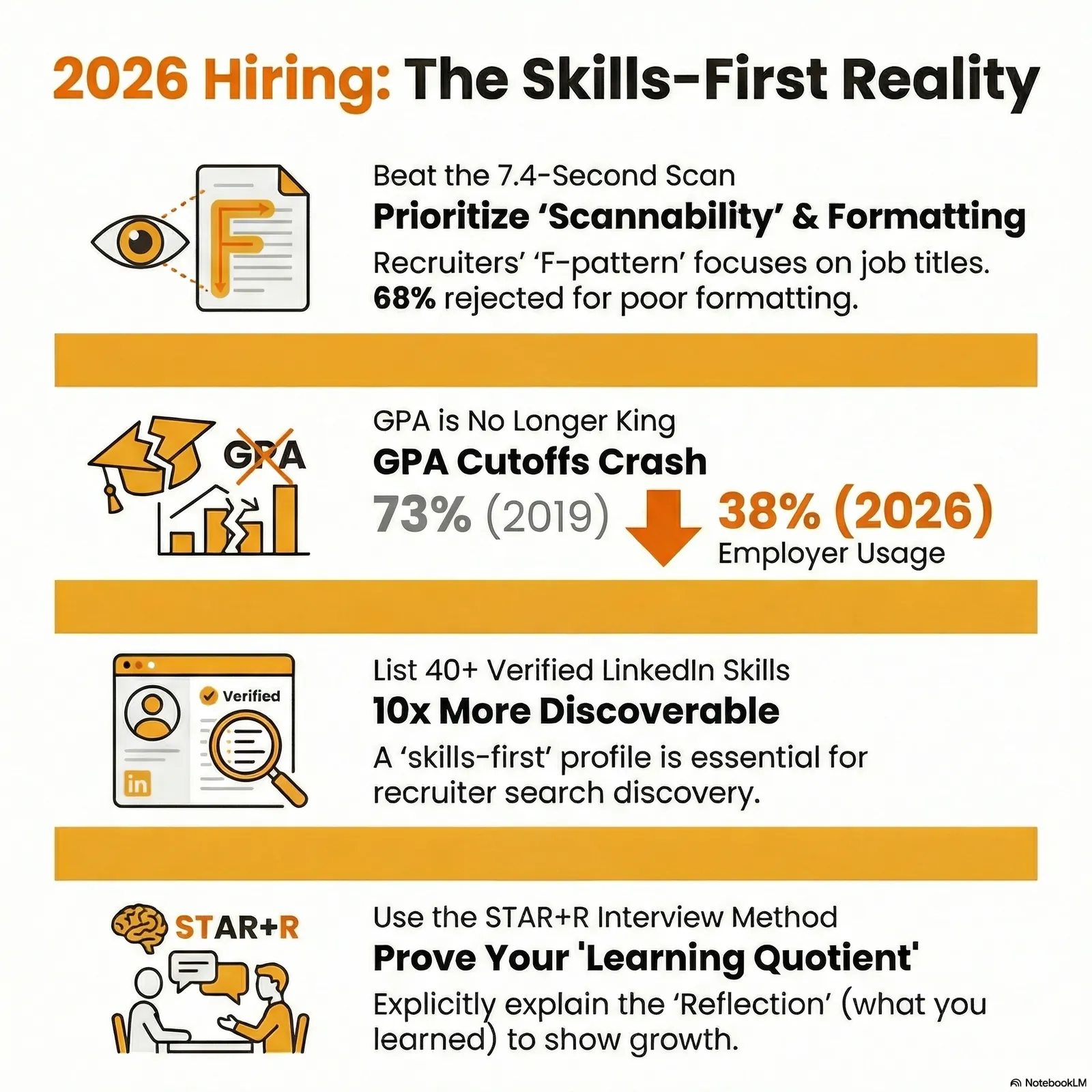
Recruiters prioritize "scannability" over aesthetics, spending just 7.4 seconds on an initial review. Advisors must steer students toward a single-column, reverse-chronological layout that highlights impact via the X-Y-Z formula. This ensures that the most relevant keywords and measurable results hit the recruiter’s "F-pattern" eye path immediately.
According to The Ladders’ Eye-Tracking Study, recruiters focus almost exclusively on job titles and company names on the left-hand side of the page.
If a student uses a "creative" double-column layout, they risk their best content being ignored during the initial 7.4-second scan.
To win, students need to adopt the Google X-Y-Z Formula: "Accomplished [X] as measured by [Y], by doing [Z]".
Furthermore, Jobvite’s 2024 Recruiter Nation Report notes that 83% of recruiters prioritize tailored resumes, yet 68% of hiring managers will reject a candidate for poor formatting alone.
Career advisors should coach students to prioritize:
- a single-column layout
- clear section headings
- reverse-chronological experience
- consistent dates and formatting
- strong action verbs
- relevant keywords from the job description
- measurable or specific outcomes
- bullets that emphasize contribution and impact
NACE’s Job Outlook 2026 Spring Update found that employers reviewing Class of 2026 resumes want evidence of teamwork, problem-solving, and communication skills, with more than half of respondents citing 10 or more skills they value.
NACE also emphasized that students need to show examples, not simply list skills.
Resume Coaching Checklist for Advisors
Use this checklist during resume reviews:
- Can the recruiter understand the student’s target direction within the first few seconds?
- Are the most relevant experiences easy to find?
- Does each bullet show action and result?
- Are skills connected to real projects, jobs, courses, or leadership roles?
- Does the resume match the target role without keyword stuffing?
- Is the formatting simple enough for both humans and systems?
- Does the student prove readiness rather than rely on broad claims?
Student exercise
Ask the student to choose one job description and highlight five recurring skills or requirements. Then ask them to revise three resume bullets so each one connects to one of those requirements through a real example.
Also Read: Resume Triage Framework for Career Services: Advisor Checklist
What do recruiters check first on a student’s LinkedIn profile?
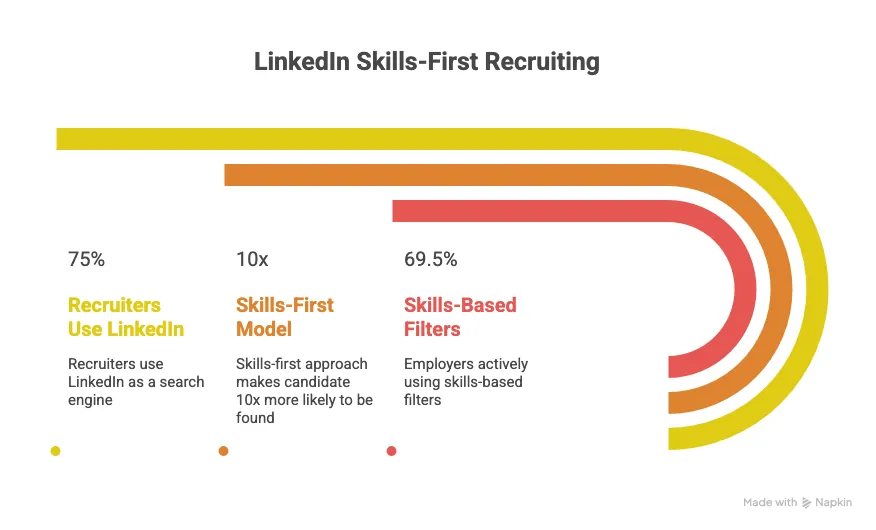
Recruiters use LinkedIn as a search engine, prioritizing the "Skills" section and mutual connections to filter candidates before even clicking "See more" on a summary. Since 75% of recruiters now use a "skills-first" model, a profile without at least 40+ verified skills is essentially invisible to their search algorithms.
According to LinkedIn’s Future of Recruiting 2025 Report, a "skills-first" approach makes a candidate 10x more likely to be found by recruiters.
When coaching, emphasize that recruiters don't "read" profiles, they filter them.
NACE’s Job Outlook 2026 reveals that 69.5% of employers are actively using these skills-based filters to find "durable skills" like adaptability.
If a student’s LinkedIn doesn't align with the specific technical stack or soft skills listed in the job description, they won't even appear in the search results of LinkedIn Recruiters.
That does not mean students should stuff their profiles with every possible skill. It means LinkedIn should support the same story their resume and applications are telling.
Career advisors should help students align five profile areas:
1. Headline: The headline should communicate direction, not just student status. Example:
Weak:
“Student at ABC University”
Stronger:
“Marketing Student | Interested in Brand Strategy, Consumer Research & Digital Campaigns”
2. About section: The About section should briefly explain what the student is studying, what kinds of problems they are interested in, and what evidence supports that direction.
3. Skills section: The skills section should reflect target roles. Students should prioritize skills that appear repeatedly in job descriptions and that they can actually support with examples.
4. Experience and projects: Experience sections should not simply repeat job titles. They should include bullets showing contribution, tools used, outcomes, and transferable skills.
5. Activity and credibility: Students can use LinkedIn to follow employers, comment thoughtfully, connect with alumni, and share relevant projects or portfolio work. The goal is not to become a content creator. The goal is to make their professional direction more visible.
LinkedIn Review Checklist for Advisors
Ask:
- Does the headline show a target direction?
- Does the About section explain interests and strengths clearly?
- Do the listed skills match the student’s intended roles?
- Are projects, campus jobs, internships, or leadership experiences described with evidence?
- Is the profile consistent with the resume?
- Does the student have a plan for using LinkedIn to research employers and connect with alumni?
Also Read: How Can Career Advisors Make Students More Visible on LinkedIn?
Which interview behaviors hurt student candidates most?
While technical skill gets the interview, "soft" dealbreakers like a lack of eye contact or failing to provide a "Reflection" in their answers end the process. Recruiters are now looking for the "STAR+R" method, where students explicitly explain what they learned from a situation, proving a high "Learning Quotient" (LQ).
According to a RecruitBPM, 67% of interviewers will reject a candidate for failing to make eye contact, and 47% of interview failures are linked to insufficient company research.
Beyond etiquette, the structure of the answer is king.
NACE’s Job Outlook 2026 data shows that 87% of employers apply skills-based assessments during the interview.
If a student can’t quantify their impact (e.g., "Increased social engagement by 20%"), they are viewed as "unprepared" by 66% of managers, according to Deloitte.
The biggest interview weaknesses are usually not dramatic mistakes. They are common patterns:
- vague answers
- too much “we” and not enough personal ownership
- no clear result
- no connection to the role
- weak employer research
- rambling structure
- lack of reflection
- generic AI-generated phrasing
Career advisors can teach students to use a STAR+Reflection structure:
- Situation: What was the context?
- Task: What needed to be done?
- Action: What did the student personally do?
- Result: What changed because of the action?
- Reflection: What did the student learn, and how does it apply to the role?
The reflection piece is important because it shows growth. Recruiters want to know whether students can learn from experience, adapt, and apply judgment in a new workplace.
Interview Red-Flag Checklist
Watch for:
- answers that describe the team but not the student’s role
- examples with no measurable or meaningful outcome
- stories that do not connect to the job description
- answers that sound memorized but shallow
- no evidence of employer research
- poor pacing or lack of structure
- weak follow-up when asked probing questions
Student exercise
Ask the student to answer this question:
“Tell me about a time you solved a problem.”
Then ask three follow-up questions:
- “What was your specific role?”
- “What options did you consider?”
- “What changed because of your work?”
If the student cannot answer those follow-ups, the story needs more depth.
Also Read: How should career advisors evaluate mock interviews in 2026?
Does GPA still matter in entry-level hiring?
GPA can still matter in certain industries, employer filters, scholarships, graduate programs, or competitive pipelines. But it is no longer the dominant signal students often assume it is.
NACE reports that GPA screening has declined significantly: in 2019, nearly three-quarters of employers screened by GPA, while only 42% do so in Job Outlook 2026.
Advisors should not tell students that GPA is irrelevant. That would be too broad. A better message is:
GPA can support your application, but it cannot replace skill evidence.
Students with strong GPAs should still show projects, internships, leadership, work experience, and problem-solving examples.
Students with lower GPAs should not assume they are disqualified from every opportunity. They need to build and communicate evidence that shows readiness.
NACE’s Job Outlook 2026 Spring Update also emphasizes experiential learning. Employers value internships, co-ops, campus work, and apprenticeships because they help students build real workplace evidence.
Which recruiting assumptions should career advisors correct?
Students can misunderstand recruiter expectations in several ways beyond GPA. They may assume their major determines which roles they can pursue, that AI-generated materials are automatically stronger, or that submitting more applications is always the best way to improve their odds.
Career advisors can use these assumptions as coaching opportunities by redirecting the conversation toward skills, evidence, role alignment, and targeted preparation.
Plus, many students still believe their major dictates their career path. In practice, most employers are far more flexible.
Around 60.9% report that they hire across majors as long as the candidate demonstrates the required skills.
There is also a growing belief that AI-generated resumes make the job search faster and easier. Recruiters are seeing the opposite effect.
According to NACE, over half say that mass AI applications make the process harder to evaluate, not easier, because they blur genuine candidate signals.
Finally, many students assume that applying to more roles automatically improves their chances. In reality, outcomes are driven by precision, not volume.
Targeted applications, especially those supported by referrals, are 4x more likely to convert into interviews and offers than large volumes of generic submissions.
| Student Myth | Recruiter Reality | Advisor Coaching Move |
|---|---|---|
| “My GPA is my main selling point.” | GPA may matter in some filters, but employers increasingly prioritize demonstrated skills, experiences, and outcomes. | Help students translate coursework, internships, projects, and leadership into role-relevant competency evidence. |
| “My major decides my career path.” | Many employers hire across majors when transferable skills and readiness align with role demands. | Teach students to identify, articulate, and market transferable skills effectively. |
| “More applications means better odds.” | High-volume, untargeted applications often reduce response rates and weaken strategy. | Coach strategic application targeting, stronger alignment, and higher-quality submissions. |
| “AI can write my resume for me.” | Generic AI-generated content can reduce authenticity, precision, and recruiter trust. | Teach responsible AI-assisted drafting combined with human editing, personalization, and evidence validation. |
| “Networking means asking for a job.” | Effective networking is primarily about relationship-building, learning, and context gathering. | Train students in informational interviewing, alumni outreach, and strategic professional relationship development. |
Also Read: NACE Competencies Guide: How to Measure and Prove Student Readiness
How should students use AI without weakening their signal?
AI is becoming part of early-career work, but students need to use it carefully. The goal is not to outsource their career story. The goal is to use AI to improve preparation while preserving accuracy and authenticity.
NACE’s Job Outlook 2026 Spring Update found that demand for AI skills in entry-level jobs has nearly tripled since fall 2025.
More than one-third of entry-level jobs now require AI skills, 28% of employers seek early-career talent who can use AI at work, and nearly 60% assign interns projects involving AI tools and skills.
That makes AI literacy a career readiness issue. Students should know how to use AI to research roles, identify skill gaps, practice interview answers, and improve drafts. But they should also know where AI can hurt them.
AI can weaken applications when students:
- submit generic resumes
- invent experience
- use language they cannot defend in interviews
- over-optimize for keywords
- remove their own voice
- mass-apply without targeting
- fail to verify claims or employer information
Career advisors can teach a simple rule:
Use AI to clarify, draft, and practice. Do not use AI to fabricate, replace judgment, or erase your actual experience.
AI Job Search Checklist for Students
Use AI to:
- summarize job descriptions
- identify repeated skills
- compare your resume to a target role
- brainstorm stronger bullet wording
- practice interview questions
- generate questions to ask employers
- prepare for networking conversations
- identify possible skill gaps
Do not use AI to:
- invent achievements
- exaggerate experience
- submit unedited materials
- create identical applications for every role
- answer interview questions with stories that are not yours
- skip employer research
Student exercise
Ask students to paste a job description into an AI tool and request the top five skills the employer appears to value. Then have students manually identify one real experience that proves each skill. The final output should come from the student’s evidence, not the AI tool’s imagination.
Also Read: AI in Career Services: Benefits, Limits, and Ethical Best Practices
How can career advisors teach students what recruiters actually look for?
Career advisors can make recruiter expectations easier for students to understand by turning abstract advice into visible evidence.
Rather than simply telling students to “show more skills” or “be more prepared,” use job descriptions, recruiter-view comparisons, mock interviews, and evidence-mapping exercises to show them what stronger candidate signals actually look like.
The goal is to help students connect what employers ask for with specific evidence from their own experiences.
Actionable Tactics:
1. Use a recruiter-view demo
Show how recruiters scan resumes quickly. Display two resumes side by side: one with dense formatting and vague bullets, another with clear structure and evidence. Ask students which one is easier to understand in 10 seconds.
2. Run a LinkedIn search exercise
Ask students to search for entry-level roles in their field and collect recurring skills from 10 job descriptions. Then compare those skills with their LinkedIn profile and resume.
3. Use reverse mock interviews
Let the student play recruiter. Give a vague, rambling answer and ask them what they learned about the candidate. Then repeat with a specific, evidence-based answer. This helps students understand why structure matters.
4. Create a skills evidence map
Ask students to list five target skills from a job description. For each one, they must provide:
- one experience
- one action they took
- one result or takeaway
- one resume bullet
- one interview story
5. Replace “apply more” with “apply smarter”
Have students compare two application strategies:
- 50 generic applications
- 10 targeted applications with tailored resumes, alumni outreach, and employer research
Then discuss which one is more likely to generate interviews.
6. Teach proof before polish
Students often want to polish language before they have clarified substance. Advisors should reverse that order. First, identify the evidence. Then improve the wording.
Advisor Script: Helping Students Shift Their Mindset
Use this when students are focused on the wrong signal.
Student: “I’m worried my GPA is not high enough.”
Advisor: “GPA can matter for some employers, but it is not the only signal recruiters use. Let’s look at the role you want and identify the skills the employer is actually asking for. Then we’ll find examples from your coursework, job, projects, or campus experience that prove those skills.”
Student: “I just need a better resume template.”
Advisor: “A clean format helps, but the bigger issue is what the recruiter can understand quickly. Let’s make sure your strongest experience, skills, and results are easy to see in the first few seconds.”
Student: “I used AI to write my resume, so I think it’s done.”
Advisor: “AI can help with drafting, but recruiters still want your real evidence. Let’s check whether every bullet is accurate, specific, and something you can explain in an interview.”
Also Read: How can career centers identify and close career readiness gaps in students at scale?
Wrapping Up
The gap between what students believe and what recruiters reward is real.
Many students still optimize for templates, GPA, and application volume, while recruiters increasingly look for evidence of skills, relevant experience, role alignment, and authentic examples.
Career advisors can close that gap by translating hiring expectations into practical coaching.
That means helping students build scannable resumes, align LinkedIn profiles with target roles, prepare stronger interview stories, understand the changing role of GPA, and use AI without weakening their signal.
Hiration supports this kind of evidence-driven career readiness through a full-stack platform that spans career assessments, AI-powered resume optimization, interview simulation, LinkedIn preparation, and counselor workflows.
The dedicated Counselor Module helps career teams manage cohorts, track student progress, and deliver structured support within a secure, FERPA- and SOC 2-compliant environment.
When students understand what recruiters actually check, they stop preparing for an outdated hiring model and start building the proof employers need to see.
What Recruiters Really Want in 2026 — FAQs
How should career advisors coach students on resume formatting in 2026?
Advisors should prioritize scannability over design by recommending single-column, reverse-chronological resumes with measurable impact statements, so recruiters can quickly identify titles, results, and relevant keywords in the first scan.
Why do recruiters reject “good” resumes so quickly?
Recruiters often reject resumes when formatting is hard to scan, the content is not tailored to the role, or achievements are vague. A resume can look polished but still fail if it does not show clear impact and job-specific relevance.
What do recruiters check first on a student’s LinkedIn profile?
Recruiters usually filter by skills, keywords, and location before reading the full profile, which means students need strong skills alignment, complete sections, and job-relevant language to show up in recruiter searches.
Which interview behaviors act as immediate disqualifiers?
Common disqualifiers include weak eye contact, vague or unstructured answers, poor company research, and failure to explain measurable outcomes or lessons learned from past experiences.
What is the biggest misconception students have about the 2026 job market?
Many students still believe GPA or application volume is the main driver of success, but recruiters increasingly reward demonstrated skills, relevant projects, targeted applications, and evidence of real-world readiness.
How should career centers explain “skills-first hiring” to students?
Career centers should show students that employers now search and assess for skills, behaviors, and impact evidence first, so resumes, LinkedIn profiles, and interview answers must all reflect the same skill-based narrative.
What is the best way to break through student advice fatigue?
Use data points that challenge student assumptions, such as recruiter scan time or declining GPA cutoffs, and pair those stats with practical demonstrations so students can see how recruiters actually evaluate candidates.
How can career centers turn recruiter insights into repeatable student outcomes?
Career centers can build repeatable outcomes by standardizing advising around recruiter behavior, using structured resume and interview frameworks, and tracking progress across resumes, LinkedIn, and mock interviews over time.