How can career centers teach professionalism in ways that improve real student outcomes?
Career centers can teach professionalism more effectively by translating it into observable workplace behaviors, embedding it across advising and programming, and using structured simulations and feedback to assess application. The strongest systems move beyond etiquette workshops toward repeatable readiness frameworks that develop communication, accountability, judgment, and adaptability over time.
Professionalism is no longer just about etiquette. Career centers now have to help students demonstrate it through visible behaviors: clear communication, follow-through, feedback receptivity, accountability, and sound workplace judgment.
That matters because professionalism gaps can affect internships, employer relationships, job offer conversion, and student confidence.
A student may have strong technical skills, but struggle when expectations are unclear, feedback is direct, or workplace norms are unspoken.
This guide explains how career centers can define professionalism, teach it through concrete behaviors, embed it across advising and programming, and assess whether students can apply it in real workplace situations.
What does professionalism mean in today’s hiring context?
In the modern workplace, professionalism is defined as the consistent demonstration of personal accountability, ethical behavior, and the ability to work productively within a diverse team. It has shifted from "office etiquette" to "human-centric reliability." According to NACE, it is the ability to act with integrity and preparedness while maintaining a positive personal brand.
The definition now emphasizes agility and agency. With 70% of employers now using skills-based hiring according to the NACE Job Outlook 2026 report, professionalism is viewed as a "meta-skill."
It's the wrapper that makes technical skills credible. Employers look for "digital professionalism" - the ability to maintain focus in hybrid environments and communicate nuance through screens.
It’s less about following a handbook and more about owning one’s professional development and impact.
Also Read: 6 Activities Career Centers Can Use to Build Student Professionalism

Which professionalism gaps are career centers seeing most often?
Career centers are witnessing a significant "Proficiency Chasm" between student self-perception and employer reality. While students feel they are ready, employers cite major deficits in conflict resolution, feedback receptivity, and "managing up." According to NACE’s 2025 Perception Gap research, 78.1% of students believe they are proficient in communication, but only 53.5% of employers agree, a staggering 24.6% gap.
| Competency | Student Self-Rating | Employer Rating | The "Chasm" |
|---|---|---|---|
| Professionalism | 87% | 48% | 39% |
| Communication | 78.1% | 53.5% | 24.6% |
| Critical Thinking | 79% | 55% | 24% |
The most common "blind spot" is feedback resilience. Many Gen Z graduates view constructive criticism as a personal indictment rather than a professional tool.
Additionally, "unwritten rules" like understanding communication hierarchy or when to use "discretion" are often missed because they aren't explicitly taught in the classroom.

How can career centers translate professionalism into observable behaviors?
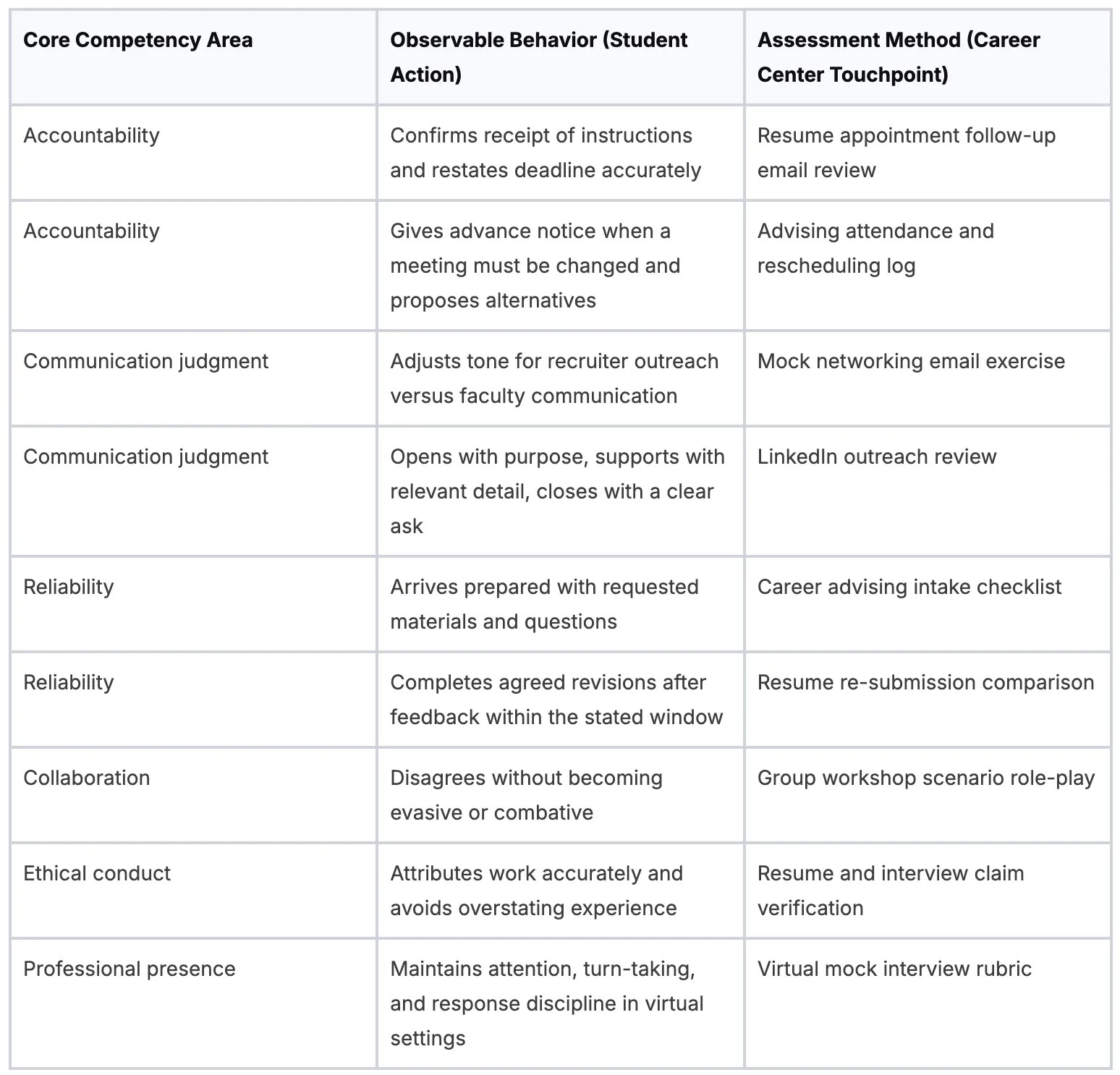
To make professionalism teachable, you must move from abstract nouns to concrete verbs. This involves breaking down a competency like "Integrity" into specific actions like "admitting a mistake before it’s discovered" or "citing sources accurately."
SUNY Westchester Community College translates career-readiness competencies into “Sample Behaviors,” which can make abstract definitions easier for students to connect to their own actions and experiences.
Another example is, University of South Florida (USF), where they use a "Career Readiness Badge" system that requires students to:
- Identify context-appropriate dress for different industries.
- Demonstrate "active listening" by nodding and summarizing during mock interactions.
- Practice "managing up" by asking for clarifying instructions before a deadline stalls.
By using a 4-level scale (Awareness, Developing, Proficient, and Advanced), advisors can move students from simply knowing what professionalism is to proving they can execute it under pressure.
How can professionalism be embedded across advising, courses, and programming?
Professionalism shouldn't be a "Friday workshop" topic; it must be "baked in" to the student experience through a scaffolded approach. This means integrating career readiness into the syllabus, campus jobs, and employer-led simulations. According to the University of West London, a "spiral curriculum" that revisits these skills throughout a student’s four-year journey is most effective.
- In Advising: Move from "checklist" meetings to "career coaching" sessions where advisors use Socratic questioning to help students reflect on their professional identity.
- In Campus Jobs: UConn’s Work+ program treats campus employment as a career-readiness experience, not just a campus job. Supervisors are positioned as mentors who help students connect their work to transferable skills, with the program emphasizing consistent supervisory practices and feedback across student employment roles.
- In Courses: Partner with faculty to include "professionalism rubrics" for group projects, grading students on their communication and follow-through just as much as their content.

How should advisors coach communication, follow-through, and workplace norms?
Advisors should coach these skills using scenario-based learning and "unwritten rule" transparency. Instead of telling a student to "be professional," coach them through a specific conflict. According to Indeed’s Guide to Workplace Coaching, using the Socratic method allows students to discover solutions themselves, which builds long-term autonomy.
Key Coaching Tactics:
- The 24-Hour Rule: Coach students to respond to all professional inquiries within 24 hours to demonstrate reliability.
- The "Managing Up" Script: Provide templates for how to ask for help: "I'm at a roadblock with [Task X]. I’ve tried [Y] and [Z]. Can we spend 5 minutes clarifying the next step?"
- Digital Decorum: Explain the "unwritten" culture of communication, when an email is better than a Slack message and why "camera-on" is often a sign of respect in remote meetings.
How can career centers assess professionalism through simulations and feedback?
Assessment must move beyond self-reporting to third-party validation and evidence-based artifacts. Digital badges, employer evaluations, and virtual simulations provide the "proof" that 65% of employers are now seeking. According to Colorado State University, virtual job simulations allow students to experience real-world tasks and receive expert feedback without the risk of a real job.
Actionable Assessment Tools:
- Virtual Simulations: Use platforms like Forage or Parker Dewey to let students complete "micro-internships" that test their professionalism in a controlled environment.
- 360-Degree Feedback: Have students rate themselves on a NACE rubric, then compare it to a supervisor's rating from their internship. The "delta" between those scores is where the real learning happens.
- Digital Portfolios: Encourage students to curate artifacts like a project management plan or a professional email thread, that demonstrate their follow-through and judgment.
Also Read: How Do You Turn Faculty & Alumni into a Career Readiness Network?
Wrapping Up
Teaching professionalism works best when it moves beyond reminders and into repeated practice. Students need clear expectations, real scenarios, structured feedback, and enough opportunities to connect workplace behaviors with career outcomes.
For career centers, the challenge is making that support consistent across advising sessions, courses, workshops, campus jobs, and employer-facing programs.
That requires both a strong teaching framework and the right systems to track readiness at scale.
Hiration supports that broader career-readiness journey through career assessments, AI-powered resume optimization, interview simulation, and a dedicated Counselor Module for managing cohorts, workflows, and analytics, all within a secure, FERPA and SOC 2-compliant platform.
Teaching Professionalism to Students — FAQs
What does professionalism mean in today’s hiring environment?
Professionalism now centers on accountability, communication, ethical behavior, adaptability, and reliable workplace execution rather than traditional etiquette alone.
Why are professionalism gaps a growing concern?
Employers increasingly report skill gaps in communication, feedback receptivity, and workplace judgment, which can negatively affect hiring and retention outcomes.
How can career centers make professionalism teachable?
By converting abstract competencies into observable actions such as response time, follow-through, meeting etiquette, and conflict management.
What are the most important professionalism behaviors to teach?
Key behaviors include communication clarity, accountability, managing feedback, time management, digital professionalism, and ethical decision-making.
How should professionalism be integrated into student development?
Professionalism should be scaffolded across advising, coursework, workshops, campus jobs, and employer-facing experiences rather than treated as isolated instruction.
What advising strategies work best for professionalism coaching?
Scenario-based coaching, reflection, communication scripts, and direct practice with workplace norms help students internalize professional expectations.
How can career centers assess professionalism?
Assessment is strongest when using simulations, employer feedback, digital portfolios, and behavior-based rubrics instead of self-reporting alone.
Why are simulations useful for professionalism training?
Simulations provide safe, structured environments where students can practice real workplace behaviors and receive measurable feedback.
What is digital professionalism?
Digital professionalism includes communication tone, responsiveness, meeting behavior, virtual etiquette, and online reputation management in hybrid workplaces.
What is the biggest strategic shift career centers need?
Career centers must move from professionalism as advice to professionalism as a measurable readiness system integrated across the student lifecycle.