What guardrails do career centers need for AI use in student job preparation?
Career centers need clear guardrails that position AI as a structural assistant rather than a substitute for student judgment or lived experience. Effective guardrails focus on preventing copy-paste misuse, detecting hallucinated or unverifiable claims, protecting student data, and ensuring students can explain and defend every AI-assisted resume bullet or interview answer. When advisors remain in the loop and AI is used for critique, gap analysis, and practice rather than authorship, centers can scale support while preserving authenticity and hiring credibility.
Students are bringing AI into resumes, cover letters, LinkedIn profiles, interview prep, and outreach messages faster than many advising workflows were built to handle.
The real risk is not AI use itself, but unchecked AI output: polished claims with weak evidence, inflated skills, generic language, and privacy mistakes.
This is no longer just a coaching issue. It affects student credibility, employer trust, advising quality, and the institution’s ability to guide responsible AI use at scale.
This guide covers how advisors can review AI-generated career materials, spot risky content, recommend safer prompts, teach privacy rules, and draw a clear line between helpful AI support and misrepresentation.
What Mistakes Do Students Make When Using AI for Job Prep?
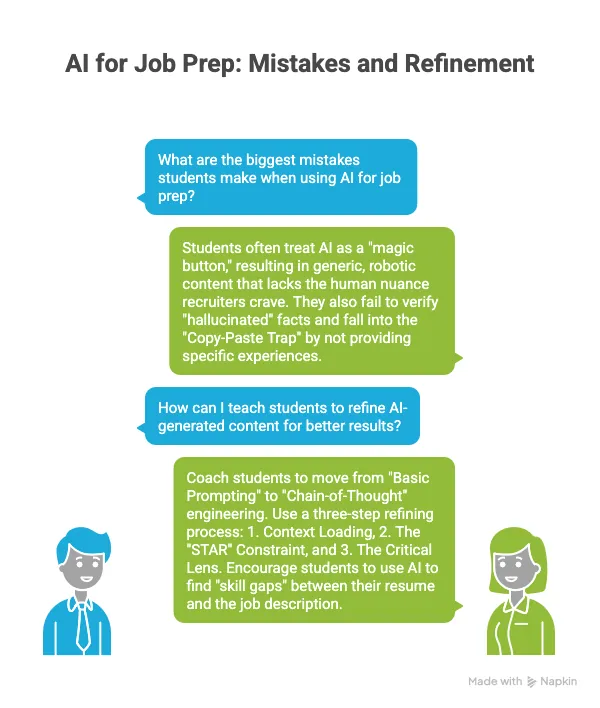
Students often treat AI as a "magic button," resulting in generic, robotic content that lacks the human nuance recruiters crave. According to the NACE 2025 Student Survey Report, while only one-third of seniors use AI, those who do primarily use it for cover letters (64.8%) and resumes (61.6%), often failing to verify "hallucinated" facts.
The "Copy-Paste Trap" is the most dangerous. Students frequently prompt AI to "write a resume for a marketing intern" without providing specific experiences.
This leads to hallucinations - where the AI invents credentials the student doesn't have.
Furthermore, Handshake's 2025 State of the Graduate report notes that applications per job have increased by 30%, meaning a generic AI resume is even more likely to be buried under a mountain of high-quality, personalized applications.
Common Misuse Indicators:
- The "Vague Verb" Syndrome: Using words like "leveraged," "facilitated," or "spearheaded" without any quantifiable data.
- Skill Over-Stacking: Listing every software mentioned in a job description despite only having "watched a tutorial" once.
- The Formatting Nightmare: Students often paste AI text into templates that break ATS (Applicant Tracking Systems) because of hidden formatting symbols.
| Student AI Use Case | Common Misuse | Advisor Coaching Move |
|---|---|---|
| Resume Bullets | Generic achievement claims with no evidence, scope, or outcomes | Ask the student for a project, tool, metric, responsibility, or measurable outcome before rewriting |
| Cover Letters | Polished but vague paragraphs that could apply to any role | Tie each paragraph to one real experience, motivation, or employer-specific connection |
| Interview Answers | Memorized AI-generated scripts that sound unnatural or collapse under follow-up questions | Ask the student to explain the example out loud in their own words before refining structure |
| LinkedIn Summaries | Buzzword-heavy positioning with no supporting evidence | Replace adjectives and claims with specific work examples, projects, or interests |
| Job Matching | Blindly trusting AI role suggestions without evaluating fit | Compare recommendations against the student’s skills, interests, constraints, and readiness level |
| Outreach Messages | Robotic networking copy with no context or authentic reason for connecting | Add context, a specific reason for reaching out, and one realistic human ask |
| Skill Lists | Inflated tools, technologies, or competencies the student cannot explain or demonstrate | Separate skills into “used,” “learning,” and “proficient” categories |
The biggest warning sign is content that sounds impressive but cannot survive a follow-up question.
For example:
“Leveraged cross-functional collaboration to drive strategic outcomes.”
That may sound professional, but it does not tell the advisor what the student actually did.
A better advisor response is:
“What was the project? Who did you work with? What did you produce? What changed because of your contribution?”
That moves the student from AI language back to real evidence.
Also Read: How to give resume feedback in 5 minutes?
How Can Advisors Review AI-Generated Career Materials?
Advisors need a fast review process because AI-generated content can look clean at first glance. The goal is not to rewrite everything for the student. The goal is to identify where the content needs more truth, evidence, voice, or role alignment. A simple 15-minute AI review workflow can work across resumes, cover letters, LinkedIn profiles, interview answers, and outreach messages.
1. Start with a truth check
Ask:
“Is every claim in this draft accurate?”
If the student cannot verify a claim, remove it.
Watch for invented metrics, exaggerated leadership, unfamiliar tools, inflated skill levels, or responsibilities the student did not actually hold.
2. Run an evidence check
Ask:
“Where is the proof?”
Every strong resume bullet, cover letter paragraph, or interview answer should connect to something real: a project, class assignment, internship, campus job, student organization, research experience, volunteer role, or measurable task.
3. Check the student’s voice
Ask:
“Would you say this in an interview?”
If the language sounds too formal, too corporate, or unlike the student, revise it. The content does not need to sound casual, but it should sound explainable.
4. Check role fit
Ask:
“Does this match the opportunity the student is targeting?”
AI often produces general job-search language. Advisors should help students connect the material to a specific role, employer, industry, graduate program, or competency.
5. Check privacy
Ask:
“What information did the student put into the AI tool?”
Students should not paste sensitive personal information, confidential employer documents, private academic records, or identifying details into public AI tools.
6. Set one revision task
End the review with one clear next step.
For example:
“Before our next appointment, revise these three bullets by adding the project name, tool used, and result.”
That gives the student a practical path forward instead of a vague warning to “make it more specific.”
According to NACE AI Bootcamp experts, AI is most effective at pattern matching - identifying missing keywords, rather than writing the narrative itself.
Encourage students to use AI to find the "skill gaps" between their resume and the job description.
What does a good AI-to-Advisor edit look like?
An advisor-approved edit takes a "flat" AI statement and injects specific, verifiable evidence. AI is great at structure but terrible at "the truth." You must teach students to "interrogate" the AI's output. Below is an example of how to guide a student through an edit.
| Feature | Raw AI Output | Advisor-Refined Version |
|---|---|---|
| Resume Bullet | Collaborated with a team to improve social media engagement and managed accounts. | Increased Instagram engagement by 22% over 3 months by implementing a new video-first content strategy using Adobe Premiere Pro. |
| Cover Letter Hook | I am writing to express my strong interest in the Marketing Intern position at your esteemed company. | When I saw [Company Name]’s recent campaign on sustainable packaging, I recognized the exact type of data-driven storytelling I’ve been practicing at [University Name]. |
| Interview Answer | I am a hard worker who always meets deadlines and enjoys working in teams. | In my junior-year capstone, I managed a team of 5. When a member fell ill, I reallocated tasks using Trello to ensure we met our 24-hour deadline. |
| LinkedIn Summary | Motivated business student with strong leadership, communication, and analytical skills seeking opportunities in consulting. | Business student interested in consulting, market research, and problem-solving roles. Recent projects include analyzing customer survey data, building competitor research summaries, and presenting recommendations for a campus business case project. |
According to PARWCC's 2026 Guide, employers are becoming more selective, seeking "very specific skills that deliver immediate value." The refined versions above show proof, whereas the AI version only shows claims.
Also Read: What are the top 5 career services benchmarks every center must track?
What Should Advisors Say When Students Bring AI-Generated Content?
Students may feel embarrassed to admit they used AI, especially if they think the advisor will judge them. The advisor’s tone matters. A good response should normalize responsible AI use but make the review standard clear.
When the content sounds generic, say:
“Let’s pause before editing the wording. Which part of this actually happened, and where can we add proof?”
When the student used AI to inflate skills, say:
“If an employer asked you to explain this tool or skill in an interview, what example would you use?”
When the student copied an AI-generated interview answer, say:
“This gives us a structure, but it does not yet sound like your experience. Let’s replace the generic claim with a real situation.”
When the student is unsure whether AI use is acceptable, say:
“Use AI for brainstorming, structure, and feedback. Do not let it invent facts, exaggerate experience, or replace your judgment.”
When the student’s cover letter sounds too polished, say:
“The tone is professional, but the reader still needs to see why this role connects to your actual background.”
When the student’s resume bullet sounds inflated, say:
“The wording is strong, but now we need to make sure the evidence is just as strong.”
This keeps the conversation constructive.
The message is not “AI is bad.” The message is “AI output still needs advising.”
Also Read: How to build a skills first goal setting workshop?
What AI Prompts Can Advisors Safely Recommend to Students?
Students often get poor AI output because they ask AI to do the wrong job. Instead of asking AI to “write my resume,” students should ask it to review, organize, question, or compare information they provide.
Advisors can share prompts that keep the student in control.
Resume review prompt
“Review the resume bullet below for clarity and specificity. Do not add new facts. If the bullet needs more detail, ask me questions before rewriting it.”
Job description comparison prompt
“Compare this job description with my resume. Identify missing skills, repeated keywords, and areas where my resume needs stronger evidence. Do not claim skills or experience I have not listed.”
Interview prep prompt
“Create five practice interview questions for this role. After each question, give me a structure for answering, but do not write the full answer for me.”
Cover letter prompt
“Help me organize a cover letter using only the experiences I provide. Do not invent achievements, metrics, motivations, or personal stories.”
LinkedIn prompt
“Suggest ways to make this LinkedIn About section clearer and more specific. Keep my tone natural and do not add skills I did not mention.”
Networking message prompt
“Improve this outreach message so it sounds clear, respectful, and specific. Keep it under 100 words and do not make the request sound too formal or automated.”
Skill-gap prompt
“Review this job description and identify the top skills it emphasizes. Then compare them with the skills I listed and separate them into three groups: skills I have used, skills I am learning, and skills I should not claim yet.”
These prompts reduce the risk of hallucinated content because they restrict the AI’s role.
They also teach students a better habit: AI should ask for missing context instead of filling gaps with fiction.
Also Read: How can career centers build ethical systems for AI, equity, compliance, and governance?
What Privacy Rules Should Career Centers Teach Students?
AI job prep can create privacy risks when students paste too much information into public tools. Career centers should give students simple, repeated rules.
Advise your students not paste the following into public AI tools:
- Social Security numbers
- Student ID numbers
- Home addresses
- Phone numbers, unless required and appropriate
- Personal health information
- Immigration documents
- Financial aid records
- Full transcripts with identifying information
- Confidential employer documents
- Private internship assignments
- Unreleased research data
- Recommendation letters
- Login credentials
- Names and contact details of references
Students should remove identifying details before asking AI for feedback. For example, they can replace a name, address, phone number, or employer-specific confidential detail with a placeholder.
A safe advisor line is:
“Before you paste anything into an AI tool, ask whether you would be comfortable putting that same information into a public website. If not, remove it or use an approved campus tool.”
Career centers should also clarify which tools are institutionally approved, if any. Students need to know the difference between a public AI tool, a campus-supported tool, and a platform with institutional privacy protections.
AI Readiness Self-Assessment for Career Teams
AI rules only work when they are clear across leadership, staff, tools, and student support. Use this 7-10 minute self-assessment to see whether your team’s AI approach is Scattered, Developing, or Aligned, and which operating area to fix first.
- 7-10 minutes
- 6 operating areas
- 3 readiness levels
Where Should Advisors Draw the Line Between AI Support and Misrepresentation?
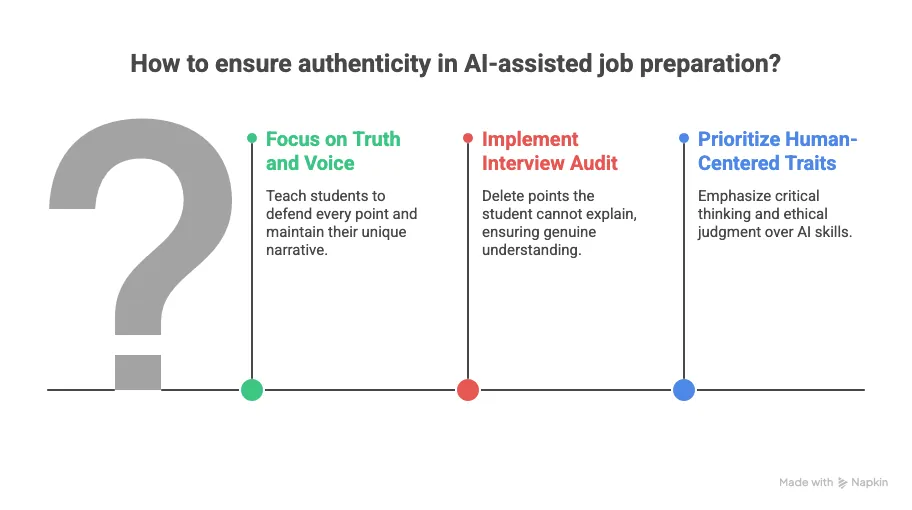
The line should be drawn at truth, voice, and ownership. AI support is acceptable when it helps students organize, review, practice, or improve material based on their real experience. AI use becomes risky when it invents facts, inflates skills, erases the student’s voice, or produces claims the student cannot explain.
| Acceptable AI Use | Risky AI Use |
|---|---|
| Brainstorming role-specific keywords | Adding skills the student does not actually have |
| Structuring a rough resume bullet | Inventing metrics, responsibilities, or achievements |
| Creating practice interview questions | Memorizing fake interview stories or experiences |
| Summarizing a job description | Misrepresenting fit for a role |
| Checking grammar and clarity | Replacing the student’s voice entirely |
| Suggesting cover letter structure | Writing motivations the student does not genuinely hold |
| Reviewing a LinkedIn summary for clarity | Adding credentials, tools, or certifications the student lacks |
| Helping draft an outreach message | Sending mass messages that sound automated or impersonal |
| Identifying possible skill gaps | Claiming proficiency after only minimal exposure |
| Asking what details are missing | Filling missing details with invented content |
A useful test is the interview audit.
Ask the student:
“If an interviewer asked about this bullet, could you explain exactly what you did, how you did it, and why it mattered?”
If the student cannot answer, the bullet is not ready.
The same test works for cover letters, LinkedIn summaries, and interview scripts.
Students should never submit career materials they cannot defend in conversation.
Wrapping Up
AI is now part of student job prep, but responsible use still needs coaching.
Students can use AI to organize rough notes, compare resumes with job descriptions, practice interview questions, and improve clarity. But the final material must still be truthful, specific, and student-owned.
Career centers can make that standard clear by teaching students how to check AI output for truth, evidence, voice, role fit, and privacy.
The strongest AI-assisted career materials do not sound synthetic. They sound like a clearer, sharper, better-supported version of the student’s real experience.
For career centers that want to support this work at scale, Hiration brings the broader student journey into one platform, with Career Assessments, AI-powered Resume Optimization, Interview Simulation, and more, along with a separate Counselor Module to manage cohorts, workflows, and analytics within a secure, FERPA and SOC 2-compliant platform.
AI can speed up drafting. Career centers still provide the judgment that makes student career materials credible.
AI in Student Job Prep — FAQs
What is the most common way students misuse AI in job preparation?
Students often treat AI as a one-click solution, copying generic outputs without supplying real experience or verifying accuracy, which leads to robotic language and hallucinated claims.
Why is copy-pasting AI content risky for students?
Copy-pasted AI content frequently invents skills, lacks specificity, and produces language recruiters increasingly recognize as synthetic, reducing credibility and interview success.
How should advisors coach students to use AI more effectively?
Advisors should guide students to use AI for critique, structure, and gap identification using methods like STAR constraints and targeted prompts, rather than asking AI to write final narratives.
What does “human-in-the-loop” mean for AI use in career services?
Human-in-the-loop means advisors review, challenge, and refine AI outputs, ensuring all content is truthful, role-relevant, and defensible in interviews.
What privacy guardrails should career centers enforce?
Career centers should prohibit students from entering personally identifiable information into public AI tools and educate them on the permanence and risks of data exposure.
How can advisors detect over-reliance on AI in resumes?
Indicators include vague verbs without metrics, over-stacked skill lists, overly polished but generic language, and student inability to explain how or why a bullet point exists.
Where should career centers draw the authenticity line with AI?
The line should be drawn at truth and voice. If a student cannot verbally defend an AI-assisted claim, it should be removed, regardless of how well it reads on paper.