How can career centers turn case competitions into scalable career readiness programs?
Career centers create greater value from case competitions when they integrate them into advising, employer engagement, competency assessment, and post-event reflection rather than treating them as standalone events. Structured program design, standardized rubrics, equitable participation, advisor follow-up, and measurable outcomes help transform competitions into repeatable career readiness experiences that generate stronger evidence of student learning and recruiting preparedness.
Case competitions give students a structured way to demonstrate critical thinking, teamwork, decision-making, and communication under pressure.
Yet many institutions still treat them as stand-alone events rather than part of a broader career readiness pathway.
For career centers, the opportunity is to connect competition design with advising, employer engagement, competency assessment, and recruiting preparation.
The strongest programs build in equitable recruitment, clear rubrics, targeted coaching, reflection, and post-event translation into resumes and interview stories.
This guide explains how career centers can design, integrate, measure, and scale case competitions as a repeatable career readiness program.
How Do Case Competitions Translate into Career Readiness Skills?
Case competitions work because they compress the behaviors employers want into a short cycle of analysis, collaboration, decision-making, and communication. Students don't just practice skills.
They produce proof of those skills in conditions that resemble real work more than most classroom assignments do.
That matters because career readiness isn't built only through exposure.
It's built through observable behavior, feedback, and reflection. In a strong competition, students must sort incomplete information, disagree productively, make trade-offs, and defend a recommendation to an external audience.
A useful visual for staff training and student framing sits below.

According to AACSB International, research synthesized by AACSB shows students in case competitions demonstrate significant improvement in applying concepts to unstructured problems, with effect sizes of d ≈ 0.45-0.65.
The same body of work notes that the 24-48 hour cycle mirrors decision-making in roles like consulting and product management, and that students receive authentic, market-aligned feedback from industry judges.
What students actually practice
The strongest programs map competition phases to employer-valued competencies instead of treating the event as a stand-alone activity.
- In analysis, students interpret messy inputs and identify what matters.
- In teamwork, they divide work, manage friction, and align around a recommendation.
- In presentation, they move from academic explanation to executive communication.
- In feedback, they learn to revise quickly rather than defend every choice.
Practical rule: If a competition experience can't be translated into a resume bullet and an interview story, the program hasn't finished its career development job.
Why this format is different from ordinary co-curricular programming
Most workshops help students understand what employers want. Competitions force students to perform those expectations in public.
That distinction is why these programs often become a strong bridge between classroom learning and recruiting outcomes.
Students leave with examples that sound closer to workplace narratives than class project descriptions. They can say what they analyzed, what constraints they worked under, what recommendation they made, and how external judges responded.
What doesn't work
Career centers often overstate the value of participation alone. That's the wrong frame.
A weak competition program produces vague student takeaways such as “improved teamwork” or “gained presentation skills.”
A strong one captures evidence: the business problem, the role the student played, the recommendation delivered, the feedback received, and the next advising action. That's the difference between a nice event and a career readiness accelerator.
How Can Career Centers Design an Effective Case Competition Program?
An effective program starts with institutional intent.
Before choosing format, timeline, or sponsor, decide what the competition is supposed to do: deepen employer engagement, create scalable experiential learning, support a specific academic program, or widen access to high-impact experiences across majors.
The opportunity set is broader than it used to be.
According to the 2019 ERIC study on student learning in business case study competitions, the number of global case competitions grew from 13 in 2011 to 22 in 2016 and continued rising. That growth gives career centers more external models and partnership pathways to build from.

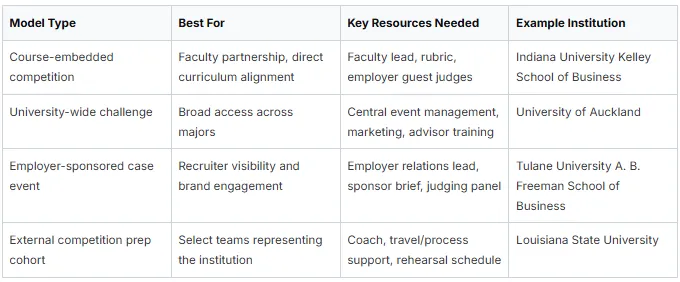
A broader planning lens often helps, especially if you're building this into an institution-wide strategy. For that, our guide on career center strategy framework is useful.
Which design choices matter most
Four decisions shape most downstream outcomes.
First, case source. Faculty-developed cases can align tightly with coursework. Employer-sponsored cases increase relevance and recruiter engagement. Publicly available cases are easier to launch but can feel less distinctive if overused.
Second, timeline. A short sprint creates energy and realism. A multi-week model gives students more room for coaching and iteration. If your equity goal is broad participation, a slightly longer runway usually works better than a pure overnight format.
Third, judging rubric. Don't let judges score based on general impressions alone. Use criteria that separate analysis quality, feasibility, stakeholder awareness, teamwork, and presentation effectiveness.
Fourth, post-event advising. The event is only half the program. Build advising follow-up into the design before launch.
What a solid operating model looks like
A practical sequence usually includes:
- Define the case brief with a real decision, not a trivia problem.
- Recruit intentionally across majors, class years, and student networks.
- Form teams with structure, not first-come self-selection only.
- Train judges on the rubric and expected feedback style.
- Schedule reflection within days, while details are still fresh.
Don't confuse prestige with design quality. A campus competition with clear coaching, strong rubrics, and disciplined follow-up often produces better student outcomes than a loosely managed national event.
What named university examples show
Indiana University Kelley School of Business illustrates the value of course-connected case work. The transferable lesson is simple: faculty integration raises the floor on preparation and makes assessment easier.
University of Auckland matters for a different reason. Its role in tracking global growth highlights that case competitions aren't isolated campus traditions. They're part of a larger higher-ed ecosystem, which means students can progress from internal to regional to international opportunities.
Tulane University's A. B. Freeman School of Business shows how competitions can serve as employer-facing showcases, not just student activities. Career centers can adapt that by designing sponsor packages around judging, networking, and talent identification rather than logo placement alone.
What Are Best Practices for Integrating Competitions into Advising?
Advisors should treat case competitions as raw material that must be translated into recruiting language.
The most useful advising move is to break the experience into decision points, actions, and outcomes so students can turn a team event into credible resume bullets, interview stories, and networking conversations.
Too many students stop at “Participated in a case competition.”
That line wastes the signal. Employers care less about the event title than about what the student performed under pressure.
Use a translation workflow, not a generic reflection
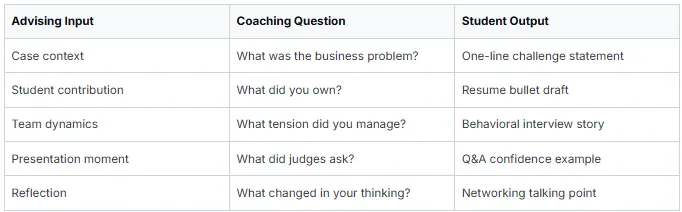
A simple advising sequence works well:
- Reconstruct the problem. Ask what business issue the team had to solve.
- Clarify the student's role. Push beyond “we” until you know their contribution.
- Identify trade-offs. Good stories involve constraints, disagreement, or uncertainty.
- Capture feedback. What did judges challenge, confirm, or redirect?
- Convert to output. Update resume bullets, LinkedIn language, and interview examples.
Here are advisor prompts worth keeping at your desk:
- Problem prompt: “What was ambiguous or difficult about the case?”
- Action prompt: “What analysis or recommendation did you personally lead?”
- Team prompt: “Where did your team disagree, and how did you resolve it?”
- Communication prompt: “What did you have to explain clearly to a non-student audience?”
- Reflection prompt: “What would you do differently if you had one more round?”
Build artifacts immediately after the event
The strongest centers schedule a short follow-up appointment or group debrief within a week. That's when students still remember assumptions, deadlines, and feedback details.
A simple translation template can help:
What works better than listing participation
A student who says “competed in a marketing case competition” sounds passive.
A student who says they analyzed a brand problem, built a recommendation, responded to judge questions, and revised based on feedback sounds employable.
That's why post-event advising belongs in the program budget and staffing plan. Without it, the competition remains developmental, but much of its labor market value stays invisible.
How Can We Measure the ROI of Case Competition Programs?
ROI should be measured as a balanced scorecard, not a participation report.
The right model tracks who joined, what skills they demonstrated, how employers engaged, and whether participation is associated with stronger recruiting outcomes and faster movement through the career readiness pipeline.
The strongest external benchmark in this area is employability.
According to the Journal of Education for Business study on employability benefits, 54% of case competition participants secured a role within six months, versus 33% of a matched non-competing cohort. That 21 percentage-point advantage is one of the clearest available signals for leadership conversations about ROI.

Track four categories, not one
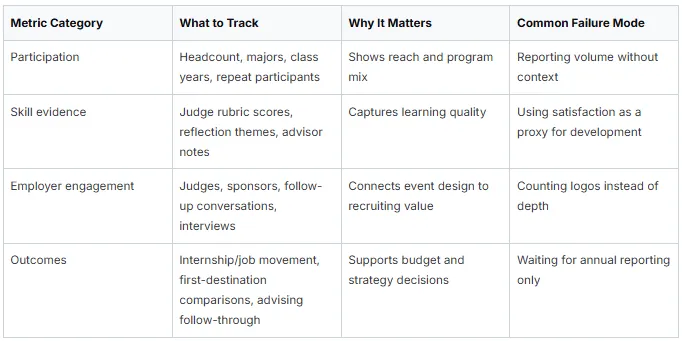
A mature program can also connect competition participation to resume quality reviews, mock interview completion, and employer touchpoints.
For leaders building that kind of reporting stack, our guide on showing career center ROI and impact in higher ed is a useful adjacent resource.
What to report to deans and provosts
Senior leaders usually don't need a long narrative. They need a concise answer to four questions:
- Who participated
- What they practiced
- Which employers engaged
- What happened next
A competition program earns credibility when it can show movement from event participation to advisor action to recruiting outcome.
What not to overclaim
Avoid presenting competitions as the sole cause of employment gains. Students who opt in may already be more engaged, more confident, or better connected.
That doesn't weaken the case for investment. It means your reporting should focus on association, student development evidence, and program contribution.
Centers that stay disciplined here tend to build more trust with faculty and administrators.
How Can Technology Help Scale and Assess These Programs?
Technology helps when it removes manual friction and preserves evidence.
The most useful systems handle registration, team formation, communication, rubric capture, follow-up tasks, and advising visibility so the competition becomes part of the student's readiness record rather than a stand-alone event.
The screenshot below reflects the kind of connected workflow many centers are trying to build.

A practical guide on career center tech stack can help teams decide what belongs in the core system and what can remain event-specific.
Where tech adds the most operational value
Most centers don't struggle to host one competition. They struggle to run several well, across terms, audiences, and employer partners.
Technology is most valuable when it supports:
- Structured intake, including interest area, major, prior experience, and availability
- Team formation rules, especially if you want diversity of discipline or class year
- Judge scoring capture, so feedback isn't trapped in paper rubrics or email threads
- Automated nudges, such as prompts to book advising, revise resumes, or reflect on the experience
- Cohort analytics, which let staff compare engagement and follow-through across events
What to avoid
Don't add a separate platform if staff still end up re-entering attendance, notes, and outcomes into spreadsheets. That creates more work, not less.
Also avoid systems that treat competitions only as event registrations.
If the data can't connect to advising activity and student readiness artifacts, leadership will still struggle to see institutional value.
How Do We Ensure Equitable Access to These High-Impact Experiences?
Equitable access doesn't happen through open registration alone.
Career centers need to reduce information barriers, confidence barriers, time barriers, and selection bias so case competitions don't become another opportunity captured mainly by students who already know how to utilize campus resources.
That design question matters because access to experiential learning is uneven.
According to the 2023 ERIC study on college readiness among underserved students, underserved students often have fewer opportunities for experiential learning. In practice, that means centers should assume some students need orientation, coaching, and structural support before they can benefit from the event.
Where inequity usually shows up
The most common access barriers are operational, not philosophical.
- Recruitment language can sound elite or insider-oriented.
- Team formation can favor students who already know each other.
- Event timing can exclude students balancing work or caregiving.
- Preparation norms can reward prior exposure rather than potential.
What inclusive design looks like in practice
A better model includes several layers:
- Demystify early. Run short intro sessions that explain what a case competition is, how teams work, and what students gain.
- Create low-stakes entry points. Offer beginner competitions before sending students into selective or external events.
- Support participation logistics. If possible, address transportation, meals, or timing conflicts that make attendance harder.
- Assign teams intentionally. Don't rely only on self-assembled teams that replicate existing networks.
- Train judges and coaches. Make sure evaluation rewards clarity, analysis, and growth, not polished insider language alone.
The equity question isn't whether every student starts at the same level. It's whether the program gives more students a fair chance to enter, learn, and be seen.
How to spot whether your model is drifting
If the same student profile dominates every competition, the program may be efficient but not institutionally aligned.
Review who hears about the event first, who applies, who gets selected, and who returns.
Some of the strongest hidden talent on campus won't self-nominate for a competition that sounds like it belongs only to honors students, business majors, or polished presenters. Career centers can change that through design.
Wrapping Up
Case competitions create more institutional value when career centers connect program design, employer involvement, advising follow-up, competency assessment, and outcome tracking.
This turns a single event into a repeatable readiness pathway with clearer evidence of student development.
Hiration offers a full-stack career readiness suite spanning Career Assessments, AI-powered Resume Optimization, Interview Simulation, LinkedIn and cover letter support, and more. Its dedicated Counselor Module also helps career centers manage cohorts, workflows, student progress, and analytics within a secure, FERPA and SOC 2-compliant platform.
For career centers expanding experiential learning, the priority is to connect each competition to the advising and readiness systems students use before and after the event.
Case Competition Framework — FAQs
Why should career centers invest in case competitions?
Case competitions allow students to demonstrate analytical thinking, teamwork, communication, decision-making, and problem-solving in realistic scenarios that closely resemble professional work.
How do case competitions support career readiness?
Students develop observable evidence of employer-valued competencies by solving complex problems, collaborating under time constraints, presenting recommendations, and responding to external feedback.
What are the key elements of a successful case competition program?
Strong programs include clear learning objectives, structured coaching, standardized judging rubrics, equitable recruitment, employer engagement, advisor follow-up, and measurable learning outcomes.
How should advisors help students after a competition?
Advisors should help students translate their experience into resume bullets, LinkedIn updates, interview stories, networking conversations, and future development goals while the experience is still fresh.
How can employers participate beyond judging?
Employers can sponsor cases, mentor teams, provide structured feedback, participate in networking activities, identify talent, and strengthen recruiting relationships throughout the program.
What metrics should career centers use to evaluate case competitions?
Useful measures include participation, competency development, employer engagement, advising follow-up, recruiting outcomes, student reflections, and progression through career readiness milestones.
How can technology improve case competition management?
Technology can streamline registration, team formation, judge scoring, communication, advising referrals, reflection activities, and reporting while connecting participation to broader career readiness records.
How can career centers improve equitable participation?
Centers can reduce participation barriers through intentional outreach, beginner-friendly competitions, structured team formation, accessible scheduling, and coaching that supports students with varying levels of prior experience.
Why is post-event advising essential?
Without structured reflection and coaching, students often struggle to communicate what they accomplished. Advising helps convert the experience into clear evidence of career readiness.
What makes a case competition program sustainable?
Sustainable programs combine repeatable operating processes, employer partnerships, advisor workflows, standardized assessment, integrated technology, and outcome reporting that demonstrate long-term institutional value.