What should career centers look for in an AI resume review platform?
Career centers should look for AI resume review platforms that go beyond formatting checks and deliver role-specific, bullet-level feedback with consistent scoring. The right system should improve review quality, reduce repetitive workload, support team workflows, provide performance analytics, and meet higher-ed privacy standards while still keeping counselors central to decision-making.
Resume review is one of the most important services career centers offer, but it is also one of the hardest to scale well.
Teams are expected to review large volumes of resumes, personalize feedback across majors and target roles, and maintain consistent quality, all while protecting counselor time for higher-value advising.
That challenge is not just about speed. Students need feedback that goes beyond formatting and helps them improve relevance, clarity, and alignment with real hiring expectations.
Counselors, meanwhile, need a system that reduces repetitive work without removing the human judgment that makes career guidance effective.
That is where AI resume review can help. The right platform does not replace counselors. It helps career centers review more resumes with greater consistency, provide more targeted feedback, and build workflows that are easier to manage across teams.
This guide explains what career centers should look for in an AI resume review platform, where AI adds the most value, and how Hiration helps higher ed teams improve resume support at scale.
Why manual resume review breaks at scale in career services
Manual resume review works well in small volumes. It becomes much harder to sustain when student demand rises and teams need to deliver both quality and speed.
Most career centers run into the same pressures. Counselors spend time repeating the same core feedback across resume after resume. Students often submit documents with different goals, backgrounds, and target roles, which means the review process cannot be fully standardized. Review quality may also vary depending on counselor experience, workload, or familiarity with a specific field.
That creates a difficult tradeoff. Career centers can try to move faster, but that may reduce the depth and quality of feedback. They can try to personalize every review, but that can quickly overwhelm staff capacity.
AI resume review helps solve that tension. It can handle repetitive analysis, apply consistent review parameters, and surface improvement areas quickly, allowing counselors to focus more of their time on judgment, coaching, and student context.
AI Readiness Self-Assessment for Career Teams
AI resume review only works at scale when the team behind it has clear standards, governance, staff confidence, and visibility. Use this 7-10 minute assessment to see where your approach stands, what is missing, and which operating area to fix first.
- 7-10 minutes
- 6 operating areas
- 3 readiness levels
What an AI resume review platform should actually do
Not every AI resume review tool is built for career centers. A strong platform should do more than scan for keywords or provide generic feedback. It should support both student outcomes and team operations.
Here is what career centers should look for.
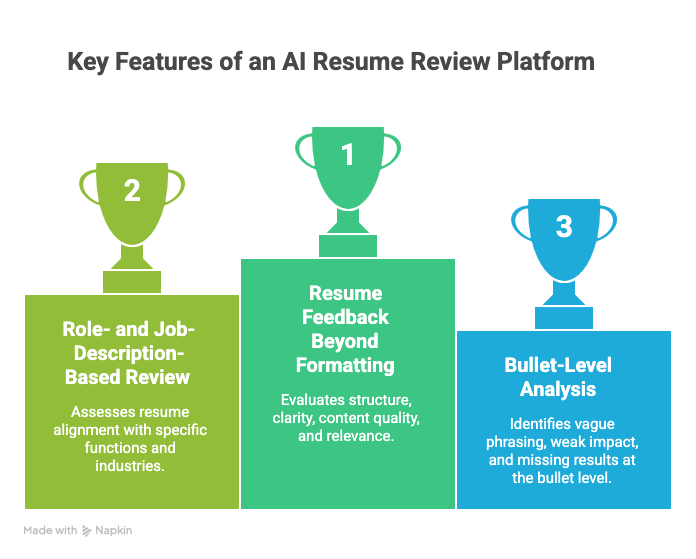
1. Resume feedback that goes beyond formatting
A strong platform should evaluate more than surface presentation. It should help students improve structure, clarity, content quality, and relevance to the kinds of roles they are targeting.
2. Role- and job-description-based review
Students are not applying to the same kinds of jobs. A useful platform should help reviewers assess how well a resume aligns with specific functions, industries, and sample job descriptions.
3. Bullet-level analysis
The most valuable resume feedback often happens at the bullet level. Career centers need a system that can help identify vague phrasing, weak impact, missing results, and opportunities to improve relevance.
4. Standardized scoring and review consistency
Different reviewers should not produce wildly different standards for the same student. A platform should support more consistent evaluation so career centers can improve quality across the team.
5. Workflow support for managers and reviewers
Career centers need more than document review. They also need reviewer assignment, student grouping, submission tracking, notification systems, and visibility into workload.
6. Reporting and performance analytics
A useful platform should help managers understand turnaround time, review activity, student progress, and operational bottlenecks.
7. Privacy readiness for higher ed
Student data handling matters. Career centers need a vendor that can speak clearly about data privacy, deletion workflows, and compliance expectations in higher education.
How Hiration helps career centers scale resume review
Hiration’s AI Resume Review platform is designed to help career centers improve both review quality and operational efficiency. Instead of treating resume feedback as a one-off manual task, it gives teams a more structured and scalable way to support students.
How Hiration improves feedback quality
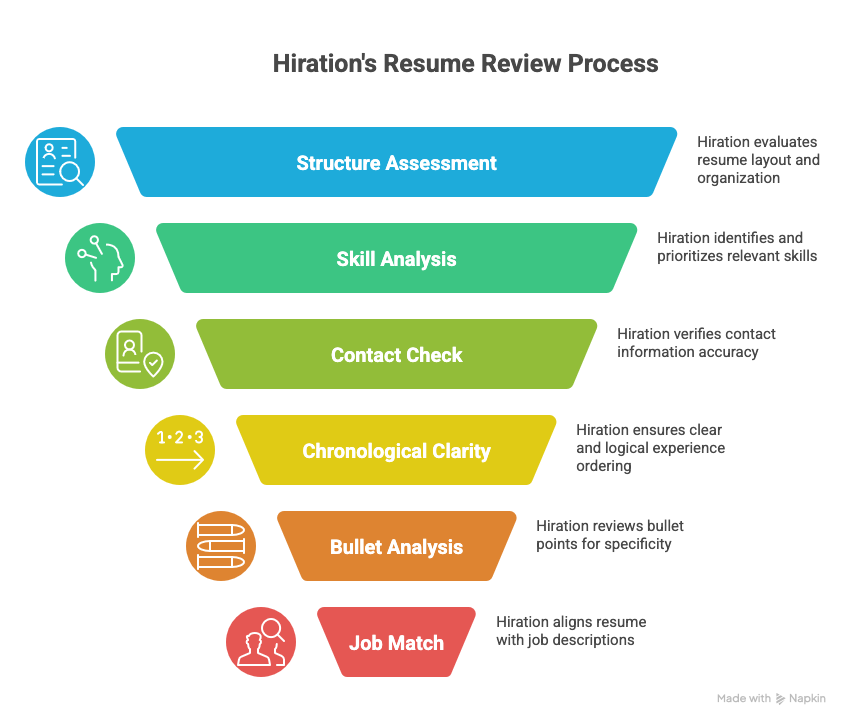
Structure assessment
Hiration evaluates the overall structure of a resume, including layout choices, resume length, section usage, and how effectively skills and experience are presented. That helps students improve readability while giving counselors a faster starting point for deeper conversations.
Skill-level analysis
Students often struggle to understand which skills matter most for their target roles. Hiration identifies relevant skills and helps surface which ones are more critical, making feedback more useful than a general suggestion to “add more skills.”
Contact information checks
Small issues can create unnecessary friction in the job search. Hiration checks whether core contact information is present and professionally presented, including phone number, email address, and LinkedIn profile.
Reverse-chronological clarity
A resume should make a student’s experience easy to follow. Hiration helps ensure that the career narrative is clear, logically ordered, and easier for reviewers and recruiters to understand quickly.
Bullet-level analysis
This is one of the most valuable parts of the platform for career centers. Hiration reviews individual bullets and helps identify where content is too vague, too generic, or not aligned enough to the student’s intended role. That gives students more actionable feedback and helps reviewers move faster without lowering standards.
Job match analysis
Career centers work with students targeting many different functions, industries, and employers. Hiration’s job match feature allows reviewers to use sample job descriptions to evaluate how well a resume aligns with the qualifications and expectations of a specific role. That makes feedback more targeted and helps students move from a general resume to a more competitive one.
Where AI helps most, and where counselors still matter
AI can speed up resume review, improve consistency, and surface issues that are easy to miss at scale. It is especially strong at handling repetitive analysis, identifying structural problems, and flagging opportunities to improve alignment with a target role.
Counselors still play the more important role in interpretation and coaching. They understand student context, motivation, identity, and readiness in ways software cannot. They are also better positioned to guide students through decisions about how to present experiences, how to tell a stronger story, and how to prioritize changes based on the student’s real goals.
That is why the strongest model for career centers is not AI instead of counselors. It is AI supporting counselors, so teams can spend less time on repetitive edits and more time on high-value advising.
Also Read: AI in Career Services: Benefits, Limits, and Ethical Best Practices
How Hiration supports career center operations
A resume review platform should not stop at student-facing feedback. Career centers also need tools that help teams manage delivery across larger student populations.
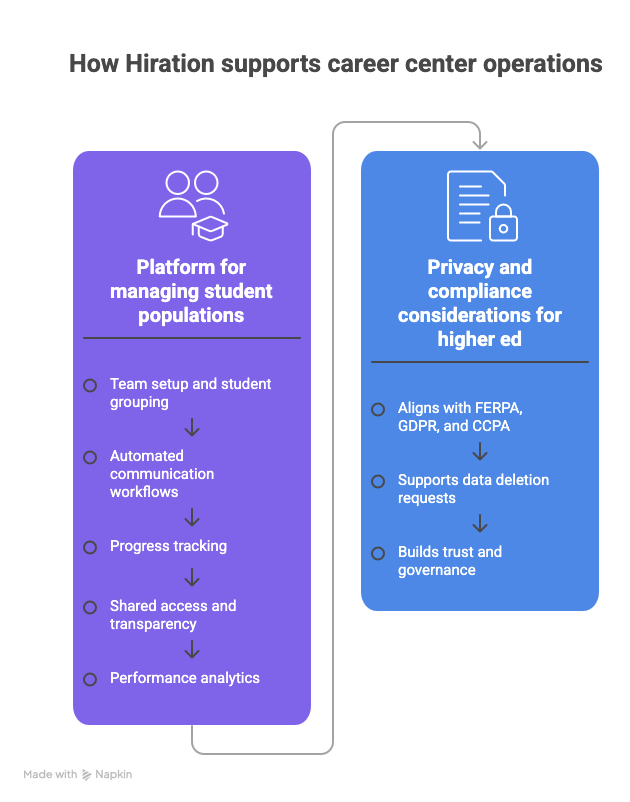
Team setup and student grouping
Hiration allows managers to set up teams and assign reviewers to specific student groups. Cohorts can be organized around criteria such as field of study, graduation year, or other segmentation needs.
Automated communication workflows
Once students are added, automated email workflows help bring them onto the platform and keep the process moving. Reviewers are notified when resumes are submitted, which supports a steadier workflow without extra administrative chasing.
Progress tracking
Managers get visibility into submission timelines, review scores, reviewer assignments, and workload distribution. That makes it easier to identify delays and rebalance work when needed.
Shared access and transparency
A centralized platform creates a shared space for both students and career services teams. That can improve visibility, reduce fragmentation, and make it easier to manage the overall review process.
Performance analytics
Hiration helps managers track metrics such as average review time, feedback activity, and review status. Those insights can support better resource allocation and help teams improve service delivery over time.
Also Read: Can One Tool Replace Five? Consolidating Career Services Tech Stack
Privacy and compliance considerations for higher ed
Privacy is a core concern for universities evaluating AI tools. Hiration approaches AI Resume Review with a focus on responsible data handling and higher-ed expectations. The platform aligns with FERPA, GDPR, and CCPA requirements and supports requests related to data deletion.
For career centers, that matters because AI adoption is not just about capabilities. It is also about trust, governance, and choosing tools that can operate responsibly in an educational environment.
What career centers should ask before choosing an AI resume review platform
Before adopting any AI resume review solution, career centers should ask a few practical questions:
- Does the platform provide feedback that is useful at both the structural and bullet level?
- Can it support role-specific or job-description-based review?
- Does it improve consistency across different reviewers?
- Can managers track workflow, workload, and student progress?
- Is the privacy approach clear enough for higher ed decision-makers?
- Does the platform support counselors rather than trying to replace them?
Those questions help separate lightweight tools from platforms that can actually support career services operations.
Conclusion
AI resume review works best when it is part of a larger career readiness system, not a disconnected point solution.
Career centers need tools that help students improve specific documents, but they also need a broader way to support exploration, preparation, and progress across the full journey.
Hiration supports that bigger picture with a full-stack career readiness suite that includes Career Assessments, AI-powered Resume Optimization, Interview Simulation, and a dedicated Counselor Module for managing cohorts, workflows, and analytics.
All of it sits within a secure, FERPA and SOC 2-compliant platform built to help career teams scale support without losing the human guidance that makes it valuable.
As student needs grow and expectations around career outcomes rise, platforms that connect readiness, feedback, and team operations can make career services more consistent, efficient, and impactful.
AI Resume Review for Career Centers — FAQs
Why is resume review difficult to scale in career centers?
Resume review requires personalized feedback across different roles and student backgrounds. As volume increases, maintaining both speed and quality becomes difficult without overloading counselors.
How does AI improve resume review workflows?
AI can handle repetitive analysis, apply consistent review standards, and quickly identify improvement areas, allowing counselors to focus more on coaching and student-specific guidance.
What kind of feedback should an AI resume tool provide?
A strong tool should provide structural feedback, role-specific insights, and detailed bullet-level analysis to improve clarity, impact, and alignment with target job roles.
Why is job-description-based review important?
Students apply to different roles, so feedback must be tailored. Job-based review helps ensure resumes align with specific industry expectations and hiring criteria.
How does AI help maintain consistency across reviewers?
AI applies standardized scoring and evaluation criteria, reducing variation between reviewers and ensuring more consistent feedback quality across the team.
What operational features should career centers look for?
Platforms should support reviewer assignment, student grouping, submission tracking, notifications, and workload visibility to help teams manage large-scale review processes efficiently.
What role do counselors play when using AI resume review?
Counselors interpret AI feedback, provide context, guide decision-making, and help students refine their narratives, making their role more strategic rather than repetitive.
How should career centers evaluate AI resume review platforms?
Centers should assess feedback depth, role alignment, consistency, workflow support, analytics, and privacy standards to determine whether the platform can support both student outcomes and operations.
Why is privacy important when using AI in resume review?
Career centers handle sensitive student data, so platforms must meet higher-ed privacy expectations, including compliance with regulations like FERPA and clear data handling practices.
What is the ideal role of AI in career services?
The ideal role of AI is to support, not replace, counselors by improving efficiency, consistency, and scale while keeping human judgment central to student guidance.