How should career centers evaluate AI mock interview platforms?
Career centers should compare AI mock interview platforms on how well they support the full institutional interview-preparation process, not only how realistic the simulation feels. The strongest platforms combine relevant student practice with cohort-based assignments, advisor-ready feedback, completion and performance visibility, accessible student experiences, privacy controls, and integrations that fit campus systems.
If your career center is considering an AI mock interview platform, the real risk is not choosing a tool with fewer features. It is choosing one that students try once, advisors cannot use easily, and leadership cannot connect to readiness progress.
Live mock interviews remain valuable, but they are difficult to provide at scale. Generic video practice can expand access, yet it may leave career teams with limited control over assignments, limited visibility into student progress, and little evidence to use during advising.
Universities therefore need to evaluate more than the quality of the interview simulation. Student relevance, cohort assignments, advisor review, analytics, accessibility, privacy, integrations, and implementation all affect whether a platform becomes part of career services or another underused tool.
This guide explains how career centers can compare AI mock interview platforms through a higher-ed lens and identify what matters before selection, implementation, and campus-wide adoption.
What should career centers look for in an AI mock interview platform?
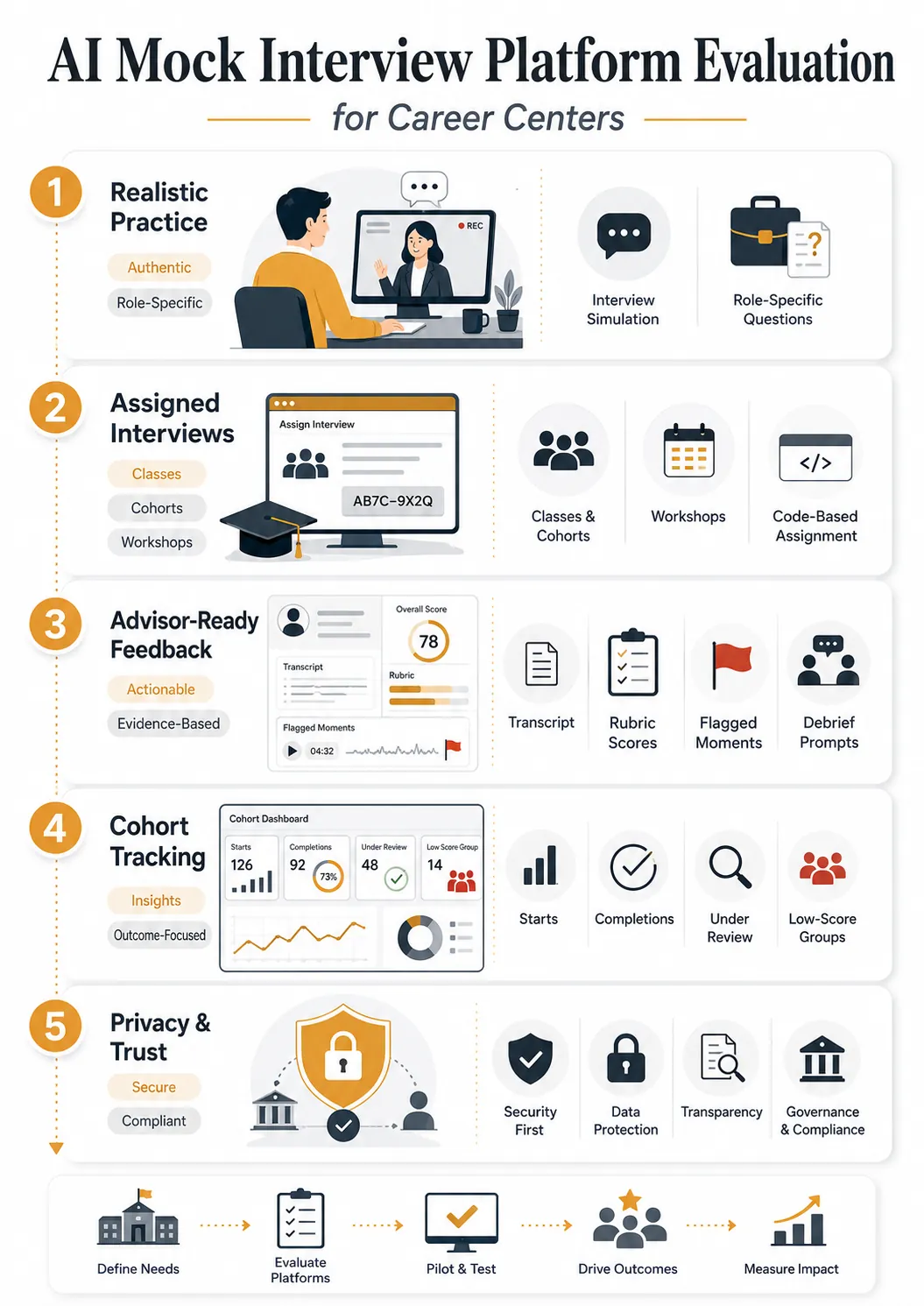
Career centers should evaluate AI mock interview platforms based on workflow fit, not just the quality of the simulation. The strongest platforms help students practice, help advisors review performance efficiently, and help teams track whether interview preparation is happening across the right student groups.
A platform that only lets students record answers may be useful for individual practice, but it does not automatically solve the larger higher-ed problem. Career centers need repeatable practice pathways, assigned activities, advisor-ready feedback, and visibility into student progress.
| Higher-ed need | What the platform should support | Why it matters |
|---|---|---|
| Scalable student practice | Students can complete realistic mock interviews asynchronously | Expands access beyond appointment availability |
| Role-specific preparation | Questions can align to job descriptions, roles, resumes, industries, programs, or interview categories | Makes practice feel relevant instead of generic |
| Career-center assignments | Staff can assign interviews by class, cohort, workshop, event, or campaign | Helps move usage beyond self-service |
| Rubric-based review | Feedback is organized around answer quality, communication, evidence, role fit, and delivery | Gives advisors a consistent coaching language |
| Advisor debrief workflow | Staff can review feedback, transcripts, scores, and flagged gaps without watching every full recording | Makes appointments more focused |
| Cohort-level visibility | Teams can track starts, completions, review checks, low-score groups, and adoption by cohort | Helps identify students who need support |
| Governance and trust | The platform explains data use, scoring logic, access controls, and privacy handling | Reduces adoption and compliance risk |
This is where AI mock interview platforms differ from general interview practice tools. The value is not only that students get more practice. The value is that practice becomes structured, reviewable, assignable, and measurable.
How should career centers distinguish AI mock interviews from video practice tools?
AI mock interview platforms should create an interactive simulation and structured evaluation, not just a playback file. A video practice tool records a response for self-review. A stronger AI interview system can generate role-relevant questions, adapt the practice experience, evaluate student responses, and produce feedback that an advisor can use.
The distinction matters most in student behavior. With a static recording tool, students often re-record until they like how they sound.
That has value for presentation practice, but it does not fully recreate the pressure of responding in sequence, recovering from a weak answer, or adjusting to a follow-up question.
A 2025 qualitative study of AI-driven mock technical interviews found that many participants described the experience as realistic and helpful, with increased confidence and stronger articulation of problem-solving decisions.
The same study also noted challenges around conversational flow and timing, which is a useful reminder that AI interview tools should be evaluated carefully rather than adopted as a black box.
For career services, realism is only one part of the decision. Students do not need another generic content library. They need rehearsal conditions that resemble an employer conversation, and advisors need evidence they can turn into coaching.
A practical distinction looks like this:
- Video practice helps students watch themselves answer.
- AI mock interviews help students experience a structured simulation.
- Advisor-ready AI interview platforms help career centers assign, review, track, and improve interview readiness at scale.
That last layer is the one higher-ed teams should pay closest attention to.
What interview use cases should the platform support?
A higher-ed AI mock interview platform should support more than one generic job interview. Students prepare for different goals, and the practice environment should reflect that.
Some students need internship interviews. Some need full-time job interviews. Some need graduate or admission interviews.
Some need role-specific preparation tied to a job description. Others need practice based on the resume they have already built or the program they are enrolled in.
Career centers should look for platforms that support multiple pathways, such as:
- Role-based interview practice
- Resume-based interview practice
- Job description-based interview practice
- Assigned interviews from the career center
- Admission interview practice
- Category-driven interview practice where configured
This matters because the interview need is rarely the same across campus. A first-year student exploring career paths does not need the same practice as an MBA student preparing for consulting interviews, a nursing student preparing for clinical interviews, or a graduate student preparing for an admissions conversation.
The platform should let career teams match the practice to the student’s context instead of pushing every student into the same question bank.
What should the AI mock interview workflow look like?
A strong higher-ed workflow should not stop after the student receives an AI score. The score is only useful if it leads to a better coaching conversation, a better second attempt, or a clearer intervention from the career center.
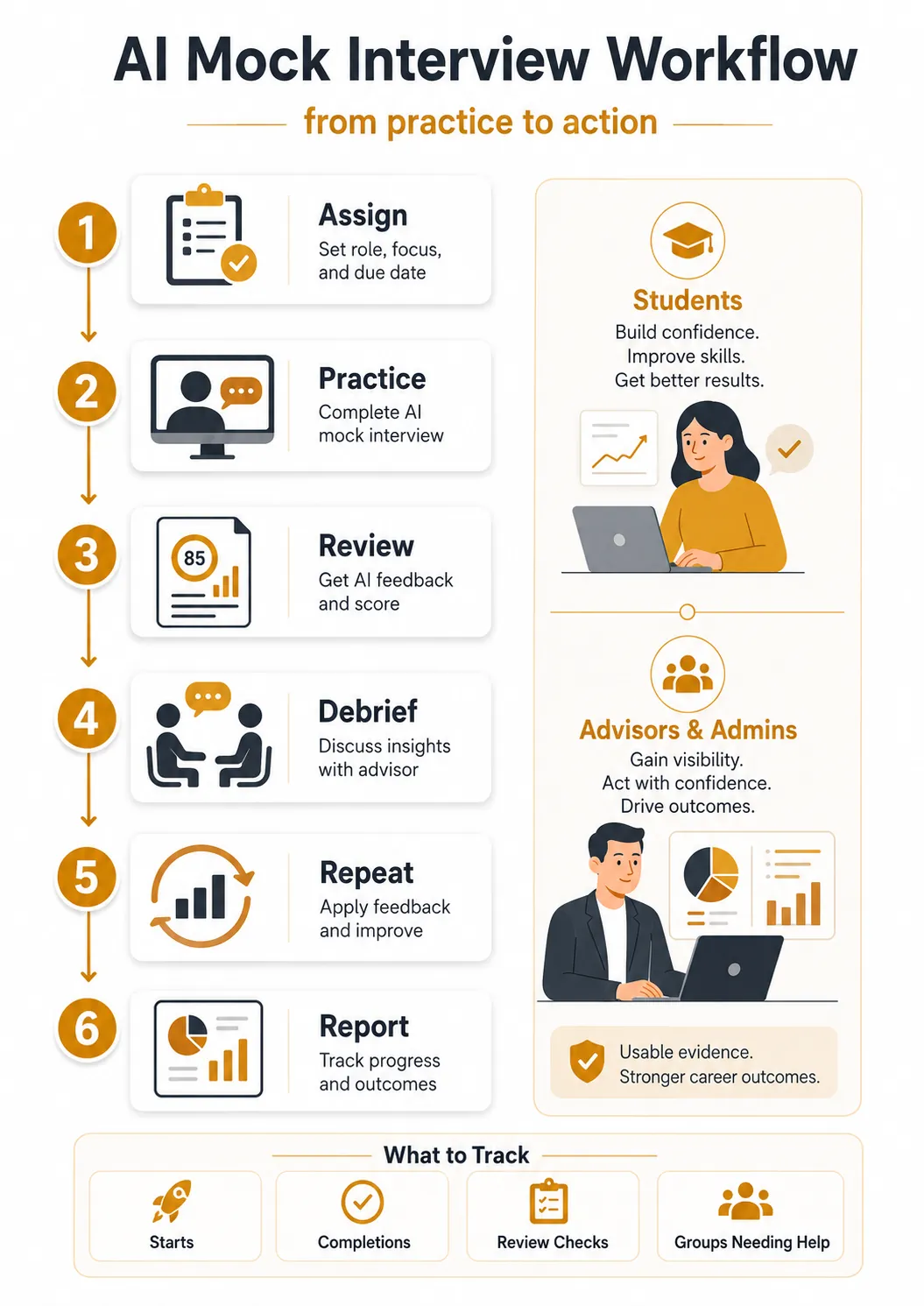
A practical workflow looks like this:
- Assign the practice: Tie the mock interview to a course, internship milestone, employer event, workshop, recruiting cycle, or advising requirement.
- Set the context: Ask the student to select or upload the relevant role, resume, job description, admission goal, or interview category.
- Run the simulation: The platform asks relevant questions and records the student’s responses.
- Generate the review: The system gives feedback the student can check after the interview.
- Surface advisor-ready evidence: Advisors review scores, answer patterns, transcripts, or flagged areas instead of watching the entire recording from start to finish.
- Debrief with the student: The advisor focuses on the most important gaps, such as answer structure, evidence, relevance, confidence, or role alignment.
- Assign the next rep: The student repeats one answer or completes another interview after feedback.
- Track cohort patterns: The center monitors who started, completed, checked the review, improved, or still needs support.
This is the workflow career centers should be buying for. The AI is not replacing the advisor. It is preparing the student and organizing the evidence so the advisor can spend less time on first-round basics and more time on judgment, credibility, and fit.
How can career centers assign AI interview practice without creating more friction?
Assignment design is one of the biggest factors in adoption. If students have to discover the tool on their own, usage often concentrates among the students who were already motivated. If the tool is embedded into a class, event, campaign, or advising milestone, it reaches a wider group.
Career centers should look for simple ways to direct students to the right interview experience.
One useful model is a code-based assignment flow. A career team can give students an interview code for a specific class, workshop, event, assignment, or campaign.
The student enters the code, sees the interview summary, continues an incomplete attempt if needed, and starts the assigned practice without searching through the platform.
That kind of flow is useful for:
- Career courses
- Internship-preparation programs
- Employer events
- Mock interview nights
- Graduate-program preparation
- Student-athlete career programming
- First-generation student support
- Targeted outreach campaigns
- Faculty-assigned practice
The adoption question is not simply, “Does the platform have AI interviews?” It is, “Can the career center get the right students into the right practice experience at the right moment?”
How can AI interview platforms be integrated into campus systems?
Campus integration works when career services plan across three areas at once: technical access, advisor workflow, and data governance. If even one of those is weak, adoption drops.
Students will not use a tool that is hard to access. Staff will not trust outputs they cannot interpret. Faculty will not assign practice if the workflow is unclear. Legal or IT teams may push back if privacy terms are vague.
A practical technical review should ask:
- Can students access the tool through institutional credentials?
- Can practice be assigned through a course, cohort, event, or campaign?
- Can students resume incomplete attempts?
- Can advisors see completion and performance data without manual spreadsheet work?
- Can staff identify students who need additional support?
- Can the center communicate with students based on platform activity?
- Can reporting show meaningful career-readiness actions, not just logins?
One common procurement mistake is evaluating only the student interface. A platform can look polished and still fail on campus because staff cannot assign practice, track completion, review outputs, or act on performance gaps.
For teams comparing multiple systems, this is where a broader career center tech stack review can help.
The question is not whether a tool is impressive in a demo. The question is whether it fits the way your office assigns work, reviews student progress, supports advisors, and reports value.
What accessibility and procurement questions should career centers ask?
Platform selection often extends beyond the career center. Accessibility teams, IT, information security, procurement, legal teams, and other campus stakeholders may need to review the system before it can be adopted or assigned broadly.
Career teams can reduce surprises later by checking these requirements during the evaluation stage rather than after selecting a preferred platform.
Accessibility
Ask whether the vendor can provide current accessibility documentation, such as a VPAT or Accessibility Conformance Report where applicable.
Career centers should also understand how students using assistive technologies will navigate the interview experience, access questions and feedback, review transcripts or captions where available, and complete required activities.
Accessibility should be evaluated across the complete student journey, not only the login page.
Identity and access
If institutional authentication is required, confirm how students and staff access the platform and what technical work is involved.
Questions may include:
- Does the platform support the institution's required authentication approach?
- Can student and staff permissions be managed separately?
- Can access be organized by cohort, program, course, or another institutional grouping?
- What implementation support is required from campus IT?
Security and data governance
Career teams should understand what student information enters the platform, where it is stored, who can access it, how long it is retained, and what administrative controls are available.
The career center should also be able to explain what the AI evaluates and how staff are expected to interpret the resulting feedback.
Implementation and support
Ask who owns implementation on both sides, what needs to be configured before launch, how staff are trained, and what support is available after students begin using the platform.
A technically capable platform can still struggle with adoption if the launch depends on unclear ownership or leaves career teams to design the entire implementation themselves.
The procurement question is therefore broader than, “Can this tool run an AI mock interview?” Career centers need to know whether the platform can move through institutional review and still be practical for students, advisors, administrators, and campus partners once it is approved.
How should advisors use AI feedback in a debrief?
Student performance should be evaluated through a shared rubric where AI handles first-pass observation and advisors handle interpretation. The platform should identify patterns in communication, evidence use, structure, role alignment, and delivery. The advisor then turns those patterns into a coaching conversation.
That division of labor is the most useful operational shift.
Advisors do not need AI to simply tell a student to “be more confident.” They need the platform to surface where the student avoided the question, gave weak evidence, missed the employer’s intent, rambled too long, or failed to connect the answer to the role.
A strong debrief usually has three moves:
- Validate the evidence: Show the student the exact answer segment or feedback category.
- Name the gap: Clarify whether the issue is content, structure, relevance, confidence, or delivery.
- Assign the next rep: Have the student redo one answer or complete another interview with a narrower improvement goal.
A useful advisor prompt might sound like this:
“Your answer became stronger once you named the constraint and explained the decision you made. Let’s rebuild the first half so you get to that evidence sooner.”
That keeps the advisor in the role of coach, not just interpreter of software output.
For centers that want a stronger advisor-facing structure, this mock interview rubric and feedback guide for career advisors is a useful companion reference.
How can AI interview practice support faculty and program partners?
Faculty buy-in improves when AI interview practice supports course outcomes they already care about. That means career centers should not position the platform only as a career-center add-on. It can also support oral explanation, applied reflection, discipline-specific communication, and confidence with professional language.
Cal State Fullerton offers a useful higher-ed example. In 2025, the university announced an AI-powered mock interview bot called GT: Generative Practice Interview Trainer, funded by a $150,000 grant.
The project was designed to give students realistic practice for professional interviews, and faculty planned to pilot the tool with 90 students across all eight colleges before wider dissemination.
The university also noted that instructors could customize the bot using course content such as textbook chapters, lecture notes, or capstone assignments.
The lesson for career centers is not that every campus needs to build its own tool. The lesson is that adoption becomes stronger when interview practice connects to a real academic or professional context.
Good faculty-aligned use cases include:
- A business communication course assigning role-based interviews
- An engineering program requiring technical explanation practice
- A health sciences program preparing students for clinical interviews
- A graduate program assigning admission or fellowship interviews
- A capstone course requiring students to explain project decisions
- A career course requiring one baseline interview and one revision attempt
Students are more likely to engage when the practice feels connected to their field, their assignment, or their next opportunity.
What should a strategic implementation plan include?
A workable implementation plan starts small, inside a defined student population, with a narrow use case and named staff owners. Broad launch emails rarely create sustained usage. Faculty-embedded pilots, advisor-led follow-up, and event-based assignments usually work better.
Start with one cohort where interview readiness is urgent and measurable.
Good pilot groups include:
- Internship-seeking juniors
- Business, engineering, health, or technology students entering recruiting cycles
- Graduate students preparing for employer-facing interviews
- Students in a required career course
- Students attending an employer event or career fair
- Students below a defined readiness score
- Students who completed resume work but have not practiced interviews
Keep the pilot structured. Require one baseline interview, one review check, one improvement action, and one debrief or second attempt. That gives the career team enough evidence to judge whether the platform changes student behavior or just creates another login.
Student messaging should focus on task value, not AI novelty.
Better messaging sounds like:
- “Complete one practice interview before the employer fair.”
- “Use the assigned interview code before your advising appointment.”
- “Practice with questions tied to your target role.”
- “Review your feedback, then redo one answer before the debrief.”
- “Bring your transcript and feedback summary to your coaching session.”
This is clearer than telling students to “explore the AI interview tool.”
What metrics demonstrate practical value from AI mock interviews?
Career centers should measure practical value by combining student activity, readiness signals, advisor efficiency, and cohort-level action. The mistake is trying to prove direct causation to job offers too early. A stronger first step is to show whether the platform expands access to structured practice and gives staff better evidence for coaching.
| Metric category | What to track | Why it matters |
|---|---|---|
| Student activation | Students assigned, students started, students completed | Shows whether the tool is reaching the intended cohort |
| Practice quality | Interview completed, review checked, repeat attempt completed | Shows whether students are using feedback, not just attempting once |
| Advisor workflow | Students arriving with feedback, transcripts, or scores before appointments | Shows whether debriefs are becoming more focused |
| Student support | Students below a defined score, common answer gaps, groups needing attention | Helps staff prioritize outreach |
| Cohort adoption | Usage by class, program, campaign, workshop, or event | Shows whether adoption is distributed or limited to self-motivated students |
| Reporting value | Completion trends, improvement areas, advisor follow-up actions | Gives leadership evidence beyond login counts |
For Hiration specifically, the product capabilities that matter here are not limited to interview practice. Career teams can track meaningful actions such as interview started, interview completed, interview review checked, students below a defined score, student groups needing attention, and product adoption by cohort or group. That gives the center a clearer view of whether students are only signing up or actually completing career-readiness steps.
The stronger ROI narrative is not “the AI scored students well.” It is:
- More students completed structured interview practice before important recruiting moments.
- Advisors spent more time on coaching and less time reviewing full recordings.
- Staff could identify students who needed support before they requested help.
- Career teams could reach out to students based on readiness signals.
- Leadership could see practice completion and improvement patterns by group.
For institutional reporting, this companion guide on showing career center ROI can help translate platform activity into leadership language.
What privacy and trust questions should career centers ask?
AI interview tools are high-trust systems because they evaluate how students communicate, explain experience, and present themselves. That means career centers should ask how the platform handles data, scoring, transparency, and student records before making it part of a required experience.
Research on trust in AI notes that trust, distrust, and appropriate reliance are complex, and that the connection between explainability and trust is not always straightforward. In other words, simply adding an AI explanation does not automatically make users trust the system.
For career centers, that means the platform should be explainable in plain language.
Ask vendors:
- What data is stored?
- How long is it stored?
- Who owns student interview data?
- Can students see and understand their feedback?
- Can staff audit scoring categories?
- Can advisors override or contextualize AI feedback?
- How does the platform support FERPA-aligned handling of student records?
- What controls exist for assigned interviews, admin access, and cohort reporting?
- Are scores used for coaching only, or can they affect course/program decisions?
If your campus cannot explain the scoring model or student data flow clearly, do not make the tool part of a required student experience.
Where does Hiration fit into this evaluation?
For career centers evaluating AI mock interview platforms, Hiration is built around the broader workflow career teams usually need: practice, feedback, assignment, review, tracking, and action.
Students can prepare through different interview pathways, including role-based, resume-based, job description-based, assigned, admission, and category-driven interview practice where configured. That flexibility matters because students are not preparing for one generic interview.
Career teams can also guide students into the right practice experience through assigned interviews and Start via Code workflows. This is useful for classes, workshops, events, assignments, targeted interview practice, and career center campaigns.
The key value is not only that students attempt an interview. Students can check their review after the interview and understand how to improve.
For career teams, that creates a stronger advising loop: students practice first, advisors review evidence, and the next conversation starts from actual performance instead of guesswork.
Hiration also supports admin visibility. Career teams can track interview starts, completions, review checks, low-score groups, and adoption by cohort or group. Admins can identify students below a defined performance threshold and contact those students from the platform, helping teams move from reporting to action.
That is the distinction career centers should look for. The platform should not only give students a place to practice. It should help the institution assign practice, monitor readiness, identify gaps, and support students before they fall behind.
Plus, Hiration is built around a connected model. It supports students with career assessments, resume and CV building, AI-powered resume review, cover letters, interview practice, job tracking, and AI-supported job search.
It supports career teams with student management, assignments, cohort tracking, review workflows, reporting, admin visibility, and outreach.
To see how this workflow can work for your students, advisors, and reporting needs, book a Hiration walkthrough built around your interview-prep use cases, cohorts, and career center workflows.
AI Mock Interview Platforms — FAQs
What should career centers look for in an AI mock interview platform?
Career centers should look for workflow fit, not just interview simulation quality. A strong platform should help students practice, allow staff to assign interviews, generate advisor-ready feedback, support debriefs, and track whether interview preparation is happening across the right cohorts, courses, programs, and recruiting cycles.
How are AI mock interview platforms different from video practice tools?
Video practice tools mainly let students record and review their answers. AI mock interview platforms can create a structured simulation, ask relevant questions, evaluate responses, generate feedback, and help advisors use the results for coaching and follow-up.
What interview use cases should an AI mock interview platform support?
A higher-ed AI mock interview platform should support multiple use cases, including role-based interviews, resume-based interviews, job description-based interviews, assigned interviews, admission interview practice, and category-driven practice where configured.
What should the AI mock interview workflow look like?
A strong workflow should let career teams assign the practice, set student context, run the simulation, generate a review, surface advisor-ready evidence, support a debrief, assign the next practice attempt, and track cohort-level patterns over time.
Why does interview assignment design matter?
Assignment design affects adoption. If students have to discover the tool on their own, usage may stay limited to already motivated students. When interview practice is tied to a class, workshop, event, advising milestone, campaign, or recruiting cycle, it can reach more students at the right moment.
What is a code-based AI interview assignment flow?
A code-based assignment flow lets career teams give students a specific interview code for a class, workshop, event, assignment, or campaign. Students enter the code, see the assigned interview, continue incomplete attempts where supported, and start the right practice without searching through the platform.
How can AI mock interviews be integrated into campus workflows?
Integration should cover technical access, advisor workflow, and data governance. Career centers should check whether students can access the platform easily, staff can assign and review practice, advisors can see completion and performance data, and reporting can show meaningful readiness actions instead of only logins.
How should advisors use AI feedback in an interview debrief?
Advisors should use AI feedback as first-pass evidence, not as the final judgment. A useful debrief validates the feedback with specific answer evidence, names the gap, and assigns the next practice step so the student knows exactly what to improve.
How can AI interview practice support faculty and program partners?
AI interview practice can support faculty and program partners when it connects to course outcomes, discipline-specific communication, applied reflection, employer preparation, graduate-program readiness, or capstone work. Adoption is stronger when the practice feels connected to a real academic or professional context.
What should an AI mock interview implementation plan include?
A practical implementation plan should start with a defined student group, a narrow use case, named staff owners, one baseline interview, one feedback review, one improvement action, and one debrief or second attempt. This helps the career center judge whether the platform changes student behavior.
What metrics show value from AI mock interviews?
Career centers should track activity, readiness signals, advisor efficiency, and cohort-level action. Useful metrics include interviews started, interviews completed, feedback reviews checked, students below a defined score, improvement after practice, adoption by cohort, and targeted outreach based on performance gaps.
What privacy questions should career centers ask about AI interview tools?
Career centers should ask what data is stored, how long it is retained, who owns student interview data, whether students can understand their feedback, whether staff can audit scoring categories, how FERPA-aligned handling is supported, and whether scores are used only for coaching or for program decisions.
Should AI interview feedback replace advisor coaching?
No. AI interview feedback is most useful when it handles first-pass observation and helps organize evidence. Advisors should still interpret the feedback, account for context, coach students through gaps, and decide what kind of follow-up support is needed.
Where does Hiration fit among AI mock interview platforms?
Hiration fits as a broader interview-readiness and career-readiness platform. It supports role-based, resume-based, job description-based, assigned, admission, and category-driven interview practice where configured, while also helping career teams assign practice, track completions, review feedback, identify low-score groups, and contact students who need support.
How does Hiration support career teams beyond interview practice?
Hiration connects interview preparation with career assessments, resume and CV building, AI-powered resume review, cover letters, job tracking, AI-supported job search, student management, assignments, cohort tracking, counselor review workflows, reporting, admin visibility, and outreach.