How can career centers use exploration activities to improve student decision-making?
Career centers can improve exploration outcomes by treating activities as evidence-generating interventions rather than engagement events. Informational interviews, job shadowing, internships, career fairs, assessments, mentorship, and projects become more valuable when students capture evidence about tasks, environments, skills, and fit, then translate those insights into one clear next decision or action.
Most career centers already offer plenty of career exploration activities for college students. The problem is not access.
It is that many activities produce attendance, enthusiasm, and photos for reports, but very little evidence that a student now understands work options better or can make a stronger decision.
That gap matters operationally.
If a center cannot show what changed after an activity, it becomes harder to defend staffing, improve programming, or explain how exploration contributes to first-destination outcomes.
This guide reframes 10 common activities as evidence-generating interventions.
It shows which activities fit students at different levels of clarity, how to run them in low-time formats, what signs indicate real learning, and how to convert every activity into one concrete next action.
How Can Career Centers Use Informational Interviews to Generate Career Evidence?
Informational interviews work when students treat them as field research, not networking theater.
A good conversation should help a student test assumptions about tasks, advancement, work environment, and required skills. If the student leaves with only inspiration, the activity was pleasant but incomplete.

A common failure mode is overemphasizing outreach etiquette and underemphasizing evidence capture.
Students ask broad questions like “What do you do?” and “Do you like your job?” Then they can't compare one role with another.
Career teams should require a short debrief that forces comparison across three dimensions: core tasks, work context, and entry route.
What to ask and what to capture
Use a question set that surfaces specifics. Our guide on career exploration advisor framework can help teams move students beyond generic curiosity into role-level evidence.
Have students document:
- Task evidence: What does this person spend time doing each week?
- Environment evidence: Is the work structured, client-facing, independent, deadline-driven, or ambiguous?
- Skills evidence: Which abilities matter most at entry level?
- Mismatch evidence: What part of the job would drain or frustrate the student?
- Entry evidence: What experiences helped this person break in?
At William & Mary, career exploration exercises often push students to reflect on values, strengths, and “perfect world” work conditions.
That model is helpful here because students shouldn't just record what a professional said. They should compare it against their own preferred conditions.
Practical rule: If a student can't answer “What did I learn that changed my target list?” the interview produced contact, not evidence.
In appointments, this can be a ten-minute exercise. Ask the student to rank the role before the interview, then rank it again after. The movement matters more than the score.
How Does Job Shadowing Translate into Actionable Career Insight?
Job shadowing is useful because it lets students see the pace, interaction, and workflow of a role up close, making it less about career inspiration and more about reality testing.
Students should leave able to say, with examples, whether the role's daily conditions fit how they want to work.
Students often report that a role sounded appealing until they saw the interruptions, documentation load, customer interaction, or meeting volume. That's exactly why shadowing matters.
For career centers building experiential touchpoints into a broader readiness model, our guide on career readiness curriculum mapping can help connect job shadowing with structured advising, reflection, and outcome tracking.
What students should observe
A shadow day needs an observation guide. Otherwise students fixate on the host's personality or the employer's brand rather than the work itself.
Ask them to record:
- Task pattern: What repeated tasks define the role?
- Attention pattern: Does the work require deep focus, rapid switching, or constant responsiveness?
- Interaction pattern: Who does this person spend time with?
- Constraint pattern: What seems difficult, tedious, or high-pressure?
- Fit judgment: Which parts of the day felt energizing or draining to observe?
For students who can't spare half a day, use shorter, structured alternatives. Our guide on overview of job shadowing opportunities can help students identify accessible formats and prepare better.
A practical institutional example is Northeastern University's long-standing use of experiential pathways as a bridge between classroom and work.
Career teams can adapt that principle without a full co-op structure by offering two-hour shadows, alumni-hosted virtual observation sessions, or faculty-arranged site visits tied to reflection prompts.
A shadowing experience only counts if the student can compare “what I expected” with “what I actually saw.”
How Do Internships Serve as a Definitive Career Exploration Activity?
Internships are often overvalued as resume lines and undervalued as diagnostic tools. Their real exploration value is not participation alone.
It is the quality of evidence a student can collect about tasks, pace, supervision, and skill fit under real operating conditions. That distinction matters for career services leaders.
If it is treated as an evidence-generating intervention, advisors can use it to help students confirm direction, rule out poor-fit paths early, and identify the next experience they need.
A useful framework is pre-during-post.
Before the internship, require students to write down three hypotheses:
- Role expectation: What work do you believe will fill most of your week?
- Skill demand: Which abilities do you expect the employer to reward?
- Work setting preference: What kind of manager, team cadence, and feedback style do you think you will prefer?
During the internship, collect short check-ins rather than waiting for a final reflection.
Students should log concrete observations about where time went, which assignments created energy or resistance, and what conditions helped them perform well.
The goal is to capture evidence while details are still fresh, not after memory has cleaned up the uncomfortable parts. After the internship, advisors should push for decision-quality reflection:
- Expectation gap: What turned out differently than expected?
- Strength evidence: Which tasks felt natural, and which required disproportionate effort?
- Environment fit: Did the student do better with structure, ambiguity, collaboration, or independent execution?
- Target revision: Should the student go deeper into this path, adjust role targets, or test an adjacent function next?
The University of Cincinnati’s co-op model shows the value of repeated workplace testing.
Most institutions cannot replicate that scale, but they can adopt the principle by asking students to turn each internship into a decision memo, advising discussion, or portfolio artifact that captures what changed.
That is where many programs lose value. Employer evaluations usually measure professionalism and contribution. Exploration requires a second layer: what the student learned about fit.
For students still trying to secure the opportunity, our guide to an internship resume for college students is a practical support asset.
Any internship can produce signal, but not all internships produce the same signal density. A loosely structured internship may still help a student rule out a work setting or clarify a preferred manager style.
What Is the Most Effective Way to Use a Career Fair for Exploration?
Career fairs work best when students use them to classify opportunities, not just collect swag or ask who's hiring.
For exploration, the fair should help students compare functions, industries, and employer expectations in a compressed setting, then narrow where to investigate further.

The best fair strategy for unclear students isn't “talk to as many employers as possible.” It's “test a hypothesis.” For example, compare a nonprofit employer, a consulting firm, and a healthcare system on training, teamwork, pace, and entry roles.
A better assignment than attendance
Instead of giving credit for showing up, require a short comparison artifact. Students should leave with evidence on:
- Role families: Which functional areas appeared across employers?
- Entry points: What titles are realistic for their class year?
- Skill signals: What language did recruiters repeat?
- Environment clues: Which employers described teamwork, travel, service, analysis, or autonomy differently?
At Michigan State University and many peer institutions, fair prep often includes target employer lists and elevator pitches. That's useful, but exploration improves when prep includes comparison prompts and post-fair reflection.
Students who need tactical support can use our guide's college career fairs guide to prepare questions and follow-up messages.
A quick advisor move after the fair is to ask, “Which employer changed how you think about this field?” If the student can't answer, they probably attended as a spectator.
How Should Students Select Certifications to Guide Career Exploration?
Certifications help students explore careers when the credential is used as a low-risk test of actual work content. They're less useful when students collect badges disconnected from target roles, hiring demand, or real skill application.
In this context, many centers overgeneralize. Interest inventories might suggest a broad field, but program choices improve when they're anchored in local labor market demand.
According to the Lumina Foundation, career exploration is most effective when tied to occupation-specific labor market data rather than generic interest inventories.
Also read: Our guide on skills gap analysis for advisors for connecting certifications, job descriptions, and upskilling plans to career advising.
How to keep certifications exploratory instead of performative
A student considering data analytics, digital marketing, IT support, or project management can use an introductory certification or workshop to test tolerance for the field's tools and logic.
Use this screen:
- Demand fit: Does the credential connect to local employer demand?
- Role fit: Which occupations value this credential?
- Task fit: Will the student perform representative work while learning it?
- Proof fit: Can the student produce a project, portfolio piece, or workflow example afterward?
Career centers can adapt that by pairing each certification recommendation with a “why this helps you test the field” note, not just “this looks good on a resume.”
For students documenting credentials clearly, our article on listing certifications on a resume is useful.
Students updating their professional presence may also care about professional AI headshots for LinkedIn, though presentation should come after role clarity, not before.
Advisor lens: A certification is exploration only if it helps answer “Is this kind of work worth testing further?”
How Can Industry Panels Move Students from Passive Listening to Active Exploration?
Industry panels become useful when students listen for contrast, not consensus. The point isn't to hear inspiring stories.
It's to identify how different professionals entered a field, what their work involves, and where the field contains multiple sub-pathways.
Panels fail when they rely on polished biographies and broad advice.
They work better when moderators ask about surprises, weekly tasks, student misconceptions, and what entry-level work actually looks like.
What to change in panel design
A stronger panel format includes role contrast. Don't invite four people with nearly identical backgrounds. Invite professionals from the same broad field but different functions, work settings, or stages of experience.
For example:
- Public health panel: hospital operations, community outreach, policy analysis, health data
- Media panel: agency account management, content strategy, production, audience analytics
- Environmental careers panel: field work, compliance, sustainability reporting, GIS support
At the University of California, Berkeley and similar institutions, alumni panels often work well because students can identify with non-linear paths.
What peers can adapt is the follow-up structure. Require each student to name one role they want to explore further and one role they want to deprioritize.
A fast version works in orientation or first-year seminar.
Run a twenty-minute panel clip or live segment, then give students five minutes to sort what they heard into tasks, environments, and skills. That simple move converts listening into evidence.
What Is the Correct Way to Use a Career Assessment?
Career assessments are useful only when they produce a testable next step. Too many students treat the report as an answer key, and too many advisors reinforce that mistake by spending the whole appointment interpreting labels.
The better use is narrower and more practical. Assessment results give students a starting hypothesis about fit.
Used well, an assessment helps a student name patterns they have struggled to articulate. Used poorly, it creates false certainty.
A strong match on paper means little if the student has never examined the daily tasks, pace, supervision style, or labor market realities attached to that work. The advising move is simple. Convert assessment themes into evidence questions.
How to use assessment results well
Debrief the results through four filters:
- Tasks: Which problems does the student want to work on repeatedly?
- Environments: Which settings fit their tolerance for structure, ambiguity, collaboration, pace, and visibility?
- Skills: Which strengths do they want to use every week, not just claim in an interview?
- Values: Which work conditions make effort feel worthwhile over time?
Then require translation. If an assessment suggests counseling, marketing, or operations, the student should identify two or three roles that fit the pattern and one activity that can test each option.
That might mean an informational interview, a job shadow, a relevant student project, or a targeted employer conversation. The assessment does not close the loop. It sets the agenda for exploration.
Florida State University's career decision tradition is useful here because it pairs self-knowledge with occupational knowledge rather than treating them as interchangeable. That is the operational standard career teams should use.
Start with the student's patterns. Validate those patterns against real work. Then decide whether to pursue, refine, or rule out an option.
One question improves the quality of almost every assessment debrief: what evidence would change your mind? Students who can answer that question are less likely to cling to a flattering result and more likely to treat exploration as a disciplined process.
Don't ask, “What career did you get?” Ask, “Which two occupations are now worth testing?”
How Can Mentorship Programs Be Structured to Ensure Career Exploration?
Mentorship supports exploration when the relationship is designed around inquiry and accountability, not vague encouragement.
Students need more than access to alumni. They need a structure that helps them test options, reflect on fit, and make time-bound decisions.
Unstructured matching programs often produce warm introductions and little else. Students don't know what to ask, mentors default to broad advice, and nobody captures what changed.
A better design is a short sequence with clear prompts and one expected output after each conversation.
A simple structure that scales
Use a three-meeting arc:
- Meeting one: Career story and role comparison
- Meeting two: Skills, hiring expectations, and common misconceptions
- Meeting three: Student decision check, next step, and accountability date
Each meeting should end with one written takeaway:
- Changed assumption: What does the student now see differently?
- Evidence gained: What did they learn about tasks, environments, or skills?
- Action selected: What will they do before the next conversation?
At Penn State and many large alumni networks, scale comes from templates rather than improvisation.
Career centers can borrow that principle even with a smaller employer base by using mentor guides, student prep sheets, and a required reflection form.
Mentorship is especially important for students with work, family, or commute constraints who may miss in-person events. Flexible virtual mentoring often does more for those students than a well-attended panel they can't get to.
When Is a Research or Capstone Project an Effective Exploration Tool?
Research and capstone projects are strong exploration tools when they expose students to role-relevant ambiguity, collaboration, deadlines, and communication. They let students learn by doing, which is often more revealing than hearing about a field secondhand.
The key is translation. Students frequently complete substantial academic projects and still don't know what the work says about their career fit.
Advisors need to help them interpret the project as evidence within a broader career readiness curriculum map, connecting preferred tasks, work style, and industry interest to measurable readiness outcomes.
What projects reveal that students often miss
A capstone can reveal whether a student likes:
- Problem framing: defining messy issues
- Analysis: handling data, evidence, or technical complexity
- Coordination: managing stakeholders and timelines
- Presentation: communicating findings to non-experts
- Iteration: revising work based on critique
At Olin College, project-based learning often gives students a clearer sense of whether they prefer design, client interaction, technical execution, or team leadership.
Similar insights emerge at many institutions with community-engaged capstones, but only if someone helps students name them.
A good advisor question is, “If I watched you during this project, when would I have seen you most engaged?” That usually surfaces more honest evidence than asking what the student “liked.”
For career centers, this is a strong collaboration point with faculty. A short reflection prompt inside the capstone course can generate useful exploration data without creating a separate workshop.
How Does Career Counseling Synthesize All Exploration Activities?
Career counseling turns scattered experiences into decisions. It helps students compare evidence across interviews, panels, classes, internships, and assessments, then choose what to test next.
Without synthesis, students often accumulate activities but still feel unclear.
That makes counseling the operating layer of an exploration system. Counseling is where centers can adapt exploration to those realities.

What good synthesis looks like in practice
In a short appointment, counselors can sort student evidence into three buckets:
- What the student has learned about tasks
- What the student has learned about environments
- What the student has learned about skills they want to use or build
Then convert the conversation into one next action. Not five. One.
That action might be a second informational interview in a contrasting role, a short virtual shadow, a labor market check on two occupations, or a targeted resume revision for an internship search. The value of counseling isn't only emotional support. It's decision quality.
A useful script in appointments, classes, or orientation sessions is simple: What did you learn, what changed, and what will you do next? If the student can answer all three with specifics, exploration is working.
Career Exploration Activities: 10-Point Comparison
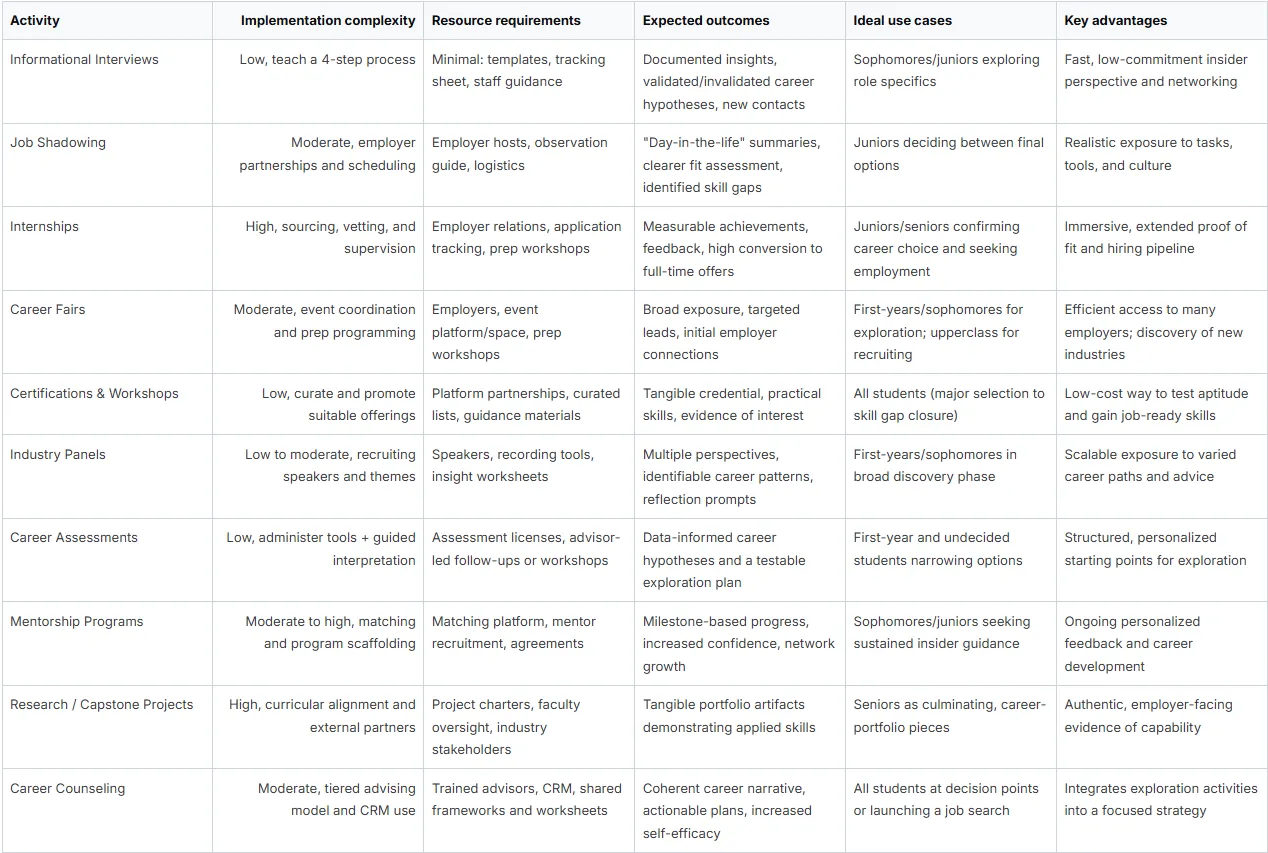
Integrating Activities into a Scalable Career Readiness System
The challenge is not choosing the “best” career exploration activity. It is building a system where each activity serves a clear diagnostic purpose, captures usable evidence, and moves the student toward one next decision.
Strong career centers do not treat attendance as the main outcome. They track changed understanding, narrowed options, validated interests, and follow-through.
That shift also improves institutional storytelling. A fair, panel, assessment, or appointment becomes easier to defend when staff can show what students learned and what they did next. The strongest evidence usually isn't a satisfaction score.
A strong activity produces a student who can compare options clearly, rule out poor-fit paths earlier, and pursue better-aligned opportunities with more confidence.
Keep the framework simple: every activity should capture a hypothesis, observation, reflection, and next action, especially in short formats like orientation, seminars, advising, or async modules.
Three operational practices make this scalable:
- Use a shared reflection language: tasks, environments, and skills.
- Standardize evidence capture: one short form after interviews, shadows, panels, fairs, and internships.
- Require one next action: a second conversation, a project, a labor market review, a resume revision, or an application step.
Named institutions already model parts of this. William & Mary shows the value of structured reflection. Northeastern University demonstrates the power of experience-rich learning.
University of Cincinnati illustrates why repeated workplace exposure improves decision quality.
For teams building this into a broader readiness system, our guide on career readiness curriculum mapping can help connect exploration activities with staged milestones, campus touchpoints, and measurable outcomes.
For reporting, the career center dashboard framework can help teams document movement beyond event attendance.
Wrapping Up
The goal is not to add more career exploration activities to an already crowded calendar. It is to make each activity easier to interpret, document, and connect to a student’s next decision.
As programs scale, scattered spreadsheets and one-off forms make it harder for advisors to see student progress clearly.
A stronger system connects assessments, reflections, resume quality, interview readiness, and cohort outcomes in one view, so teams can act on the evidence instead of chasing it.
This is where a structured career readiness platform can help. Hiration brings Career Assessments, AI-powered Resume Optimization, Interview Simulation, LinkedIn support, and counselor workflows into one system, with a separate Counselor Module to manage cohorts, workflows, and analytics in a FERPA and SOC 2-compliant environment.
For career centers, the real value is not simply automation. It is giving advisors a clearer view of student progress so they can spend more time on synthesis, judgment, and decision-making support.
That is the standard worth aiming for: not more activity, but better evidence.
Career Exploration Activities — FAQs
What is the biggest mistake career centers make with exploration activities?
Many activities measure attendance and satisfaction but fail to capture whether students gained evidence, narrowed options, or improved decision quality.
How should informational interviews be used for exploration?
Students should treat informational interviews as field research by documenting tasks, work environments, required skills, entry pathways, and role fit.
What makes job shadowing valuable?
Job shadowing helps students observe real workflows, interaction patterns, work conditions, and daily realities that are difficult to understand through research alone.
Why are internships effective exploration tools?
Internships allow students to test assumptions about tasks, supervision, pace, work environments, and skill fit under real workplace conditions.
How should students approach career fairs for exploration?
Students should compare industries, functions, employer expectations, and entry pathways rather than focusing only on job openings or employer interactions.
What is the best way to use career assessments?
Assessments should generate testable career hypotheses that students validate through interviews, projects, job shadowing, employer conversations, or internships.
How should mentorship programs support exploration?
Mentorship conversations should focus on role comparison, assumption testing, skills expectations, and structured reflection rather than general encouragement.
Can academic projects support career exploration?
Yes. Research and capstone projects often reveal preferences for problem-solving, analysis, collaboration, leadership, communication, and work style.
What role does career counseling play in exploration?
Career counseling helps students synthesize evidence gathered from activities, compare options, identify patterns, and choose meaningful next-step actions.
What is the biggest strategic shift career centers need?
Career centers must move from activity-focused programming toward evidence-based exploration systems that capture learning, improve decision quality, and guide student action.