How can career centers turn faculty and alumni into a scalable career readiness network?
Career centers can scale impact by deputizing faculty and alumni as trained “force multipliers”: embedding career readiness into coursework, running structured alumni micro-mentoring and experiential programs, using low-friction outreach asks, incentivizing participation through recognition and plug-and-play resources, and operating a hub-and-spoke governance model that tracks engagement and outcomes consistently.
If you work in a university career center, you already know the math doesn't work in your favor. You are likely managing an impossible student-to-advisor ratio.
You simply cannot be everywhere at once.
To scale your impact, you need force multipliers.
By deputizing your faculty and alumni, you transform your career center from a standalone office into an institution-wide ecosystem.
Here is exactly how top-tier career services professionals (CSPs) are building these engines, backed by the latest data and real-world program structures.
How can faculty actively drive career readiness in the classroom?
Faculty drive career readiness by seamlessly integrating professional development into their existing curriculum. Instead of adding extra work, they embed NACE competencies into syllabi, host alumni guest speakers, and assign career-focused projects like resume building. This approach democratizes access to career preparation for all students.
You cannot rely on students opting into career services. You have to meet them where they already are: the classroom.
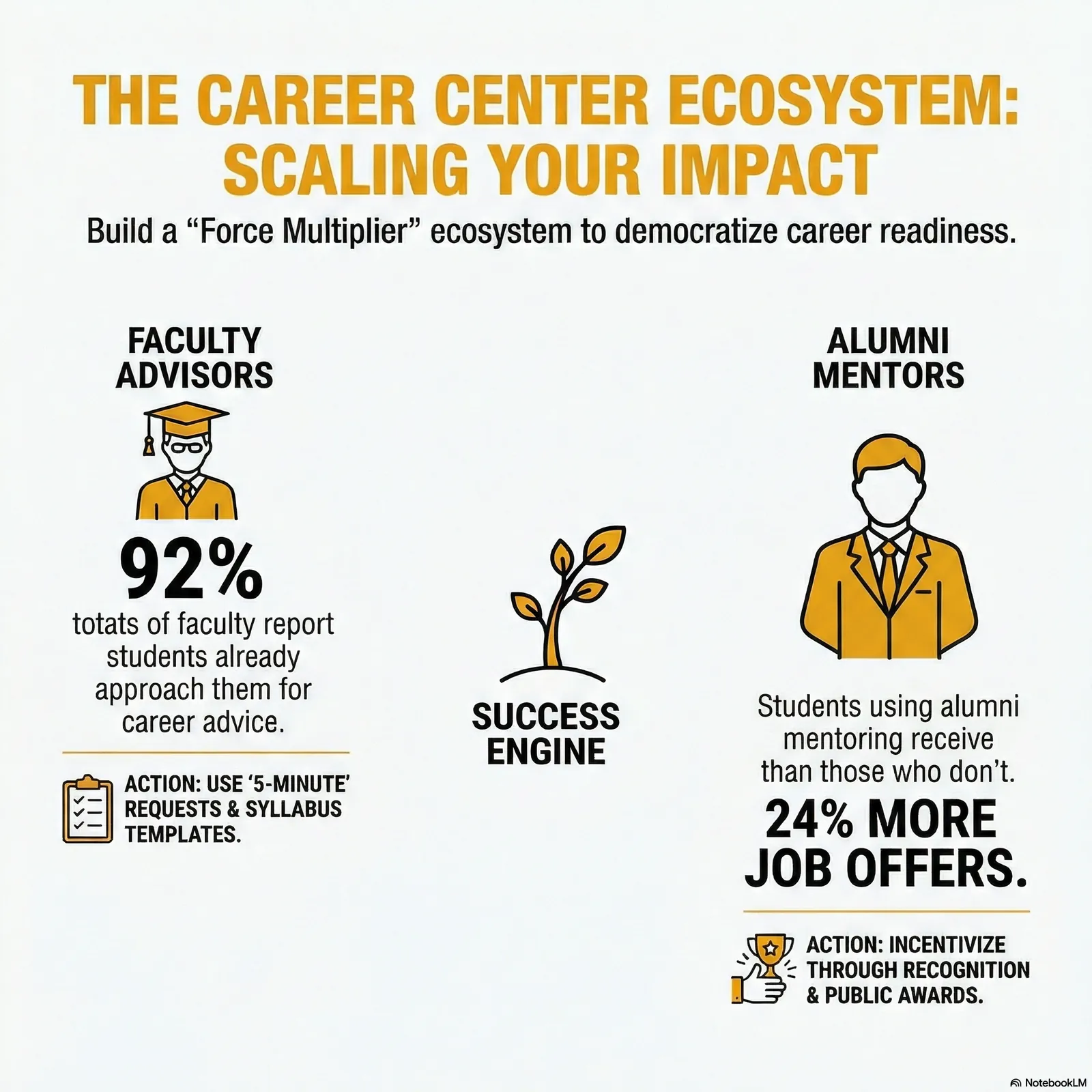
According to a 2024 report by the National Association of Colleges and Employers (NACE), a staggering 92% of faculty report that students ask them for career advice.
Furthermore, 63% of faculty said alumni reached out to them for career guidance. Faculty are already doing the work; they just need your framework.
Some institutions are already doing this.
For example, Elon University’s Student Professional Development Center's "Faculty Career Champions" bridge the gap by integrating career-related assignments directly into courses and partnering with CSPs to invite employers into the classroom.
And Oregon State University’s Career Development Center runs a 6-week cohort-based program that trains faculty to view career readiness through an inclusive lens, specifically identifying barriers for first-generation and low-income students.
How Should Career Centers Map Faculty and Alumni Roles?
Career centers should map faculty and alumni roles by contribution type, not by broad enthusiasm. Some partners can mention career relevance in class. Others can review student materials, speak about industry expectations, or support recurring cohorts. Clear role design prevents informal support from becoming unmanageable.
| Network Role | Best Contribution | Career Center Support Needed | Student Outcome |
|---|---|---|---|
| Faculty Champion | Reinforce career relevance inside courses through assignments, examples, and classroom discussions. | Syllabus language, assignment prompts, referral guide, and simple faculty resources. | Students connect coursework to transferable career skills. |
| Alumni Volunteer | Share role insight, review student materials, or participate in targeted career events. | Clear ask, evaluation rubric, scheduling support, and defined expectations. | Students better understand real-world job expectations and hiring standards. |
| Alumni Mentor | Provide short-term guidance around a clearly defined career or job-search goal. | Matching criteria, conversation guide, timeline, and participation boundaries. | Students gain direction, confidence, and practical next steps. |
| Employer-Alumni Connector | Explain hiring context, recruiting timelines, workplace culture, and industry expectations. | Briefing materials, talking points, event structure, and communication support. | Students understand how hiring works within a target field. |
| Department Liaison | Coordinate faculty, alumni, and career center touchpoints within an academic program. | Shared calendar, reporting template, communication plan, and ownership guidelines. | Career readiness becomes more consistent and visible across the program. |
| Career Center Owner | Set standards, train contributors, coordinate activities, and track outcomes. | Governance framework, supporting technology, contributor training, and analytics. | The partnership network remains scalable, consistent, and measurable over time. |
This keeps the program from becoming a loose volunteer list.
Each person knows what they are being asked to do, what they are not being asked to do, and how their contribution connects to student readiness.
Also Read: Why Your Faculty Partnerships Fail to Scale (& How to Fix It)
What Roles Should Faculty Play Without Becoming Career Advisors?
Faculty should help students see the career relevance of academic work, recognize when students need support, and route them to the right career center resources. Their role is to reinforce and refer, not replace professional advising.
Faculty can contribute in practical ways:
- Add a career relevance note to a syllabus
- Connect one assignment to NACE career readiness competencies
- Invite students to reflect on skills built in a project
- Refer students to resume, interview, or exploration support
- Invite alumni or employers into a course
- Flag recurring student career questions to the career center
- Encourage early engagement before senior year
- Share role pathways connected to the major
- Use a standard career center referral statement in Canvas or LMS pages
Faculty should not be expected to handle every job-search question.
They may be well positioned to discuss graduate school, field norms, academic pathways, research experience, and discipline-specific opportunities. They may be less comfortable advising on salary negotiation, resume mechanics, interview strategy, or job-search platforms.
NACE’s faculty report found that students most often ask faculty about jobs connected to their major and graduate school, while mechanics such as resume help and job-search process support are less common. That distinction helps career centers design better referral pathways.
A simple faculty referral line can help:
“This assignment gives you evidence of communication, problem-solving, and teamwork. If you want help turning it into resume or interview language, the career center can help you translate it for employers.”
That keeps faculty in their lane while moving students toward career action.
Also Read: 8 Plug-and-Play Career Assignments to Embed in Any Course
What Roles Should Alumni Play Beyond Occasional Panels?
Alumni should help students understand real roles, industry expectations, hiring signals, and early-career transitions. Their value is strongest when the interaction is specific, structured, and tied to a student action.
Career centers can use alumni for:
- Role exploration conversations
- Flash resume or LinkedIn feedback
- Mock interview practice
- Industry expectation sessions
- Career story recordings
- Short-term mentoring
- Employer introductions where appropriate
- Portfolio or project feedback
- Career fair preparation
- First-90-days workplace advice
The key is to avoid vague alumni engagement.
A broad panel called “Careers in Business” may inspire students, but it may not produce action.
A better alumni touchpoint asks students to leave with something concrete:
- One target role to research
- One resume bullet to revise
- One networking message to send
- One interview story to improve
- One employer question to ask
- One skill gap to address
- One next appointment to book
CASE’s alumni engagement framework organizes engagement across four modes: philanthropic, volunteer, experiential, and communications. For career centers, the most relevant modes are often volunteer and experiential because they create direct student interaction and career learning.
That does not mean every alumni activity needs to become a mentorship program.
A 20-minute role conversation, a one-time project review, or a short flash-feedback session can be enough when the purpose is clear.
How Can Career Centers Build a Faculty and Alumni Contribution Ladder?
A contribution ladder helps career centers give faculty and alumni multiple ways to participate without asking everyone for a major commitment. It also helps the team grow involvement over time, moving partners from light-touch support to sustained collaboration only when they are ready.
| Level | Faculty Example | Alumni Example | Best Use Case |
|---|---|---|---|
| Level 1: Signal | Mention career relevance, transferable skills, or industry applications during class. | Share one career story, workplace lesson, or role insight through a panel, video, or short event. | Build awareness and normalize early career thinking. |
| Level 2: Refer | Direct students to a career center resource, workshop, or advising appointment. | Point students toward a relevant role, event, networking opportunity, or career resource. | Encourage early action and increase service engagement. |
| Level 3: Reinforce | Add a career reflection prompt, assignment, or skill-identification activity to coursework. | Review one resume, LinkedIn profile, portfolio artifact, or networking message. | Provide low-risk opportunities for skill practice and feedback. |
| Level 4: Engage | Host an employer, alumnus, or industry professional for a classroom discussion or project review. | Participate in flash-feedback sessions, mock interviews, networking office hours, or panel discussions. | Support applied career readiness and authentic employer interaction. |
| Level 5: Partner | Co-design a recurring course touchpoint or embedded career-readiness activity with the career center. | Support an ongoing student cohort, industry community, mentoring program, or advisory group. | Create a sustainable, long-term career readiness pipeline. |
This ladder keeps participation realistic.
Not every faculty member needs to redesign a course. Not every alum needs to mentor students for a full semester.
A career center can start with simple contributions and build from there. The ladder also makes recruitment easier because the ask becomes specific.
Instead of saying:
“Will you partner with career services?”
Say:
“Would you be open to adding one five-minute reflection prompt to your final project so students can connect the assignment to employer-ready skills?”
Or:
“Would you join one 20-minute virtual session where students ask about your first role after graduation?”
Specific asks get better responses.
Where Should Faculty and Alumni Touchpoints Fit in the Student Journey?
Faculty and alumni touchpoints should be placed across the student journey, not concentrated only in senior year. The network works best when faculty reinforce skills early, alumni provide role context during exploration, and the career center coordinates next steps before students reach urgent job-search moments.
| Student Stage | Faculty Role | Alumni Role | Career Center Role |
|---|---|---|---|
| First Year | Connect coursework to transferable skills, career curiosity, and real-world applications. | Share “how I got started” stories and early-career experiences. | Provide exploration resources, career assessments, and simple readiness actions. |
| Sophomore Year | Refer students to internships, assessments, research opportunities, and experiential learning. | Offer role-exploration conversations and informal informational interviews. | Track early engagement and identify skill-building or exploration needs. |
| Junior Year | Embed resume, project, portfolio, or interview reflection into coursework and assignments. | Provide industry feedback, mock interview practice, and practical hiring insight. | Prepare students for recruiting cycles through coaching, workshops, and targeted support. |
| Senior Year | Reinforce recruiting deadlines, application milestones, and final-mile readiness. | Support mock interviews, referrals, networking conversations, and transition advice. | Manage job-search coaching, intervention planning, and outcome tracking. |
| Post-Graduation | Share outcome information and program feedback where appropriate. | Mentor recent graduates, participate in alumni programming, or speak with current students. | Track outcomes, maintain alumni relationships, and identify follow-up support needs. |
This map prevents the network from becoming event-driven. The point is not to hold one big alumni night or one faculty workshop.
The point is to place the right touchpoints where students need them.
A first-year student may need role exposure. A junior may need industry feedback. A senior may need interview practice and alumni perspective on the first role.
The career center coordinates the path.
Also Read: How Can Career Centers Support Seniors Without Jobs Before Graduation?
Also Read: Student Outreach Templates for Career Services: Advisor Playbook
How Should Career Centers Recruit Faculty and Alumni With Low-Friction Asks?
Career centers should recruit faculty and alumni with specific, low-lift requests that define the time commitment, student benefit, and support provided. Broad calls for partnership are easy to ignore because they sound open-ended.
Use requests that answer:
- What exactly are you asking for?
- How much time will it take?
- Who will handle logistics?
- What will students gain?
- What support will career services provide?
- Is this one-time or recurring?
Faculty outreach template
Subject: Quick career-ready add-on for [Course Name]
Hi Professor [Name],
Students in [Course Name] are already building skills employers value, especially [skill or competency].
Could I send you a 1-page prompt that helps students connect one existing assignment to career readiness language? It takes about 5 minutes to add and includes a referral note for students who want resume or interview support.
Would you be open to reviewing it?
Best,
[Name]
Alumni outreach template
Subject: 20 minutes with [Major] students?
Hi [Name],
Students in [Major/Program] are trying to understand what [role/industry] actually looks like.
Would you be open to joining a 20-minute flash-feedback session next month? Career services will handle scheduling and provide a simple question guide, so there is no prep required.
Best,
[Name]
These templates work because the ask is narrow.
The career center is not asking faculty or alumni to figure out the program. It is giving them a defined role inside the network.
How Should Career Centers Govern a Faculty-Alumni Network?
Career centers should govern the network through clear ownership, contributor roles, training expectations, referral rules, feedback tools, privacy guidance, and termly review. Without governance, faculty and alumni support can become inconsistent, duplicative, or disconnected from student outcomes.
A practical governance model should include:
| Governance Element | Why It Matters |
|---|---|
| Career Center Owner | Provides clear ownership, keeps the network aligned with institutional priorities, and prevents scattered or duplicate activity. |
| Department Liaisons | Connect academic programs with career center workflows and create reliable communication channels across campus. |
| Contributor Directory | Maintains visibility into who is active, their role, and the student populations or programs they support. |
| Contribution Tiers | Clarifies expectations for light-touch, medium-touch, and sustained involvement, making participation easier to manage and scale. |
| Referral Rules | Helps faculty, alumni, and partners route students to the right resource, event, advisor, or support channel. |
| Feedback Rubrics | Creates consistency across resume, interview, portfolio, LinkedIn, and project feedback regardless of contributor. |
| Student Privacy Guidance | Protects student information, establishes appropriate boundaries, and reduces compliance risk. |
| Communication Calendar | Coordinates requests and outreach activities, preventing overlap, volunteer fatigue, and message saturation. |
| Recognition Process | Helps sustain faculty and alumni participation through visibility, appreciation, and meaningful acknowledgment rather than relying only on stipends. |
| Termly Review | Identifies what worked, what stalled, where participation is uneven, and which areas require additional support or recruitment. |
The career center should remain the hub.
Faculty and alumni can extend reach, but the career center should set standards, manage quality, and track whether the network leads to student action.
A simple rule helps:
Faculty and alumni contribute context. Career centers manage the readiness system.
How Can Career Centers Keep Faculty and Alumni Support Consistent?
Career centers can keep support consistent by giving contributors simple tools instead of asking them to improvise. Templates, rubrics, referral language, and short briefing guides reduce confusion and help students receive aligned guidance across different touchpoints.
Useful tools include:
- One-page faculty referral guide
- Syllabus language for career readiness
- Career competency reflection prompt
- Alumni conversation guide
- Resume feedback rubric
- Mock interview feedback form
- LinkedIn review checklist
- Student preparation worksheet
- Event follow-up template
- Faculty/alumni participation tracker
For example, an alumni volunteer reviewing resumes should not have to decide what “good feedback” means alone.
The career center can provide a short rubric:
| Feedback Area | What to Check |
|---|---|
| Role Clarity | Does the student appear to know what role, industry, or opportunity they are targeting? |
| Experience Translation | Are projects, jobs, coursework, leadership, or activities explained in employer-facing language? |
| Evidence | Does the resume show clear actions, relevant skills, tools used, scope, outcomes, or impact? |
| Relevance | Are the strongest experiences and details aligned with the target role or employer need? |
| Next Step | What is one specific improvement the student should make before the next review? |
This protects quality without overburdening alumni. It also helps students receive feedback that connects back to career center standards.
Also Read: How can career centers prove ROI and institutional value to deans and senior leadership?
Wrapping Up
Scaling career readiness across an institution requires systems that make collaboration easy, measurable, and repeatable.
When faculty, alumni, and advisors are aligned with clear frameworks and resources, you turn isolated efforts into a coordinated engine that drives real outcomes.
Hiration’s career readiness suite can support this by helping students create assessed artifacts, practice interviews, and refine applications, while your team manages cohorts, tracks engagement, and reports outcomes in one secure, FERPA- and SOC 2-compliant platform.
The goal is a sustainable ecosystem where every classroom, alumni interaction, and advising touchpoint contributes to measurable career outcomes.
Faculty & Alumni Career Readiness Networks — FAQs
Why do career centers need faculty and alumni as “force multipliers”?
Student-to-advisor ratios make it impossible for career services to reach every student through appointments alone. Faculty and alumni expand reach by embedding career readiness into classrooms and creating more real-world touchpoints where students can practice and prove skills.
How can faculty drive career readiness in the classroom without adding extra workload?
Faculty can integrate career readiness by mapping existing assignments to competencies, adding plug-and-play syllabus language, inviting alumni speakers, and assigning small career artifacts (like resume bullets or project reflections) that reinforce employability skills.
What are the most effective alumni engagement models for career services?
High-impact models include structured micro-mentoring, flash mentoring weeks, alumni-in-residence programs, and industry advisory boards. The key is moving from passive networking to guided, experiential interactions that produce student progress.
How should career centers structure outreach to recruit faculty and alumni?
Use specific, low-friction asks with clear time commitments and resources included. Requests like a 15-minute mentoring call, a quick syllabus review, or a single classroom visit perform better than vague “get involved” messages.
What incentives actually work to increase participation?
Recognition and convenience are the biggest drivers. Student-nominated awards, public shout-outs, and zero-friction resources like ready-made templates and modules motivate participation even when stipends or course releases are not feasible.
How do you prevent these programs from becoming an administrative burden?
Use a hub-and-spoke governance model: career services sets standards, training, and metrics, while departments execute locally. Define eligibility, formal commitments, and clear program roles so participation stays high-quality and scalable.
What should career centers measure to prove the ROI of faculty and alumni programs?
Track engagement and outcomes, not just participation: student artifact completion, mentoring touchpoints, internship and offer rates, first-destination knowledge rates, and employer pipeline indicators for students connected to faculty champions or alumni mentors.
How can career centers operationalize a readiness network with limited staff capacity?
Standardize training cohorts, provide reusable templates and rubrics, centralize scheduling and tracking, and use systems that surface who needs deeper intervention—so faculty and alumni expand reach while staff maintains quality control.