What makes modern college career fairs more effective?
Successful college career fairs are no longer about filling rooms—they’re about driving measurable outcomes. According to NACE and Symplicity reports, the best fairs focus on data-driven matchmaking, skill-based tagging, and pre-scheduled interactions. With 45% of attending students receiving interviews and nearly 24% securing offers, today’s most impactful fairs prioritize engagement quality, employer ROI, and student readiness—creating true value for both sides of the hiring equation.
If your career center’s fairs attract students and employers but still produce uneven results, the event needs a stronger strategy.
Student preparation, employer fit, fair format, and post-event follow-through all influence whether a crowded room leads anywhere. When these elements are disconnected, students wander, recruiters meet low-fit candidates, and promising conversations lose momentum.
This guide explains how to set a clear readiness standard, match students and employers by skills, choose the right fair format, create defined next steps, and track whether conversations become applications, interviews, or offers. It gives your center a practical way to improve future fairs and show what each event produced.
Career Fair Strategy Checklist for Career Centers
Use this checklist to plan career fairs around outcomes, not just attendance.
| Strategy Area | Before the Fair | During the Fair | After the Fair |
|---|---|---|---|
| Student Preparation | Require employer research, resume refinement, LinkedIn optimization, and prioritized employer targeting lists | Provide live check-in support, rapid coaching, and navigation assistance for anxious or first-time attendees | Collect reflection data, monitor follow-up completion, and reinforce accountability for post-event action |
| Employer ROI | Confirm hiring objectives, role priorities, required skills, and ideal candidate profiles | Facilitate stronger employer-student matches based on relevant skills, majors, and expressed interests | Measure interview volume, candidate quality, employer satisfaction, and long-term recruiting outcomes |
| Skills-Based Targeting | Classify employers by functions, industries, competencies, and hiring needs | Route students based on verified skills and career goals rather than broad academic categories alone | Evaluate employer demand against student skill readiness and resulting application performance |
| Event Format | Determine whether the event should prioritize broad access, industry specialization, identity focus, regional relevance, or boutique engagement | Monitor attendee flow, employer booth traffic, and quality of employer-student interactions | Assess which format delivered the strongest engagement, interview generation, and strategic value |
| Metrics and Reporting | Establish clear success metrics before registration opens | Track attendance, employer participation, scheduled meetings, and active engagement signals | Report interviews, offers, satisfaction, follow-up rates, and correlations to first-destination outcomes |
What Outcomes Can College Career Fairs Produce?
College career fairs can contribute to interviews, job offers, stronger employer connections, and greater student confidence, but career centers need to measure those outcomes beyond attendance alone.
NACE’s 2024 Student Survey, which included more than 20,000 students, found that among students who attended a career fair, 45% reported receiving an interview offer and nearly 24% reported receiving a job offer after the fair.
These findings show that career fairs remain an important recruiting touchpoint. However, national figures should provide context, not become an automatic benchmark for every institution. Student populations, employer mix, fair format, timing, and local labor markets all influence results.
Career centers therefore need to answer four questions about their own fairs:
- Did the right students attend?
- Did students complete the preparation needed to have credible employer conversations?
- Did employers meet candidates aligned with their roles and requirements?
- Did those conversations progress to applications, interviews, offers, or other recruiting steps?
The full outcome funnel is:
Eligible students → registrations → readiness completed → attendance → meaningful employer conversations → applications → interviews → offers
If a career center measures only registrations and attendance, it can report turnout. It cannot yet show what the fair produced.
Also Read: What kind of career center events actually drive student outcomes?
How Should Career Centers Measure Employer Value From a Career Fair?
Career centers should measure employer value by whether participating organizations met relevant, prepared candidates and moved suitable students into a defined recruiting next step. Employer headcount and booth revenue show participation, but they do not show whether employers found the fair worthwhile.
Before the fair, collect the information needed to create better matches:
- roles and internships the employer is actively filling
- expected hiring volume
- priority skills and competencies
- eligible class years, majors, work authorization, and location requirements
- application deadlines and hiring timelines
- the next step students should take after meeting the employer
- the employer’s capacity to screen or interview candidates after the event
After the fair, ask employers to report:
- Qualified conversations: How many students appeared relevant to current roles?
- Candidate advancement: How many students were invited to apply, screen, interview, or complete an assessment?
- Student preparedness: Were students able to explain their skills, experience, and interest clearly?
- Role alignment: Did the student audience match the positions being promoted?
- Return intent: Would the employer participate in the fair again?
- Improvement needs: What would make the next fair more valuable?
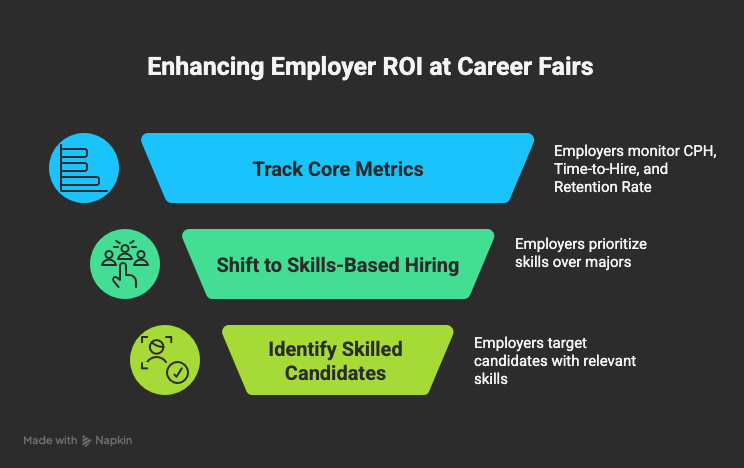
Employers may also track cost per hire, time to hire, quality of hire, and retention internally. These can provide useful downstream evidence when employers agree to share them, but career centers should not rely on metrics they cannot consistently access or attribute to a single event.
The immediate goal is to show that the fair helped employers identify credible candidates and advance them through the recruiting process.
Why should career centers target students by skills, not just majors?
Major-based targeting is useful, but it is not enough anymore. Employers are increasingly looking for evidence of skills, not just academic labels.
According to NACE’s Job Outlook 2026 survey, 70% of employers report using skills-based hiring, up from 65% the previous year. NACE also found that employers use skills-based hiring most often during interviewing and screening, with 87% using it during interviews and 65% during screening.
That should change how career centers promote career fairs.
Instead of sending only broad messages like “Business Career Fair” or “STEM Fair,” career centers can segment outreach by skills and interests. For example:
- students with Python, SQL, or data visualization skills
- students with sales, communication, or customer success experience
- students with project management or leadership examples
- students with bilingual communication skills
- students with research, lab, writing, or policy experience
This approach helps students see why a fair is relevant to them, even if their major does not obviously match an employer’s industry.
It also helps employers find stronger-fit candidates. A liberal arts student with data analysis experience may be relevant to a tech employer.
A public health student with project coordination experience may be a strong fit for consulting, nonprofit, or healthcare operations roles.
A student employee with scheduling, customer service, and conflict-resolution experience may be more prepared than they realize.
To make skills-based targeting operational, ask every participating employer to tag each role with three to five priority skills and identify any non-negotiable requirements.
Career centers can then segment outreach using evidence from student resumes, projects, coursework, employment, career interests, and completed preparation activities instead of inferring fit from major alone.
The invitation should tell students why an employer may be relevant to them.
A message such as “These employers are recruiting students with data analysis, client communication, project coordination, or bilingual communication experience” gives students a clearer reason to attend than a broad reminder about an upcoming fair.
How should career centers prepare students before a career fair?
Career centers should prepare students against a visible readiness standard rather than treating preparation as an optional resume review. Before attending, students should be able to identify relevant employers, connect their experience with specific roles, begin a professional conversation, ask useful questions, and explain what they will do after the fair.
A practical pre-fair readiness standard should require five outputs:
- Employer research: The student understands what each priority employer does, which roles are available, and what requirements apply.
- A prioritized target list: The student has selected approximately five to ten employers and organized them into priority, exploration, and practice conversations.
- Current, role-aligned materials: The student’s resume reflects relevant skills, projects, and experience. Their LinkedIn profile is also ready for employer follow-up.
- An evidence-based introduction: The student can briefly explain their career interest and support it with one relevant skill, project, job, or experience.
- A conversation and follow-up plan: The student has prepared questions, knows how to ask about next steps, and has a system for recording whom they met and what action is required afterward.
Career centers can make these outputs part of registration, a pre-fair assignment, or a preparation checklist. Students who have not completed them can be directed to a preparation lab, peer advisor, self-paced resource, or technology-supported review before the event.
For students who need career-fair expectations made more explicit, use this preparation framework for first-generation students.
If the main challenge is getting prepared students to attend, see our guide to increasing student attendance at career fairs.
What Should Career Centers Include in a Student Conversation Guide?
Career centers should give students a short conversation guide organized around role fit, skill expectations, professional development, and recruiting next steps. The purpose is not to script every interaction. It is to help students replace generic questions with prompts that show preparation and produce useful information.
Questions about roles
- What skills help someone succeed in this role?
- What does a typical day or week look like for an intern or entry-level hire?
- What kinds of projects do new hires usually work on?
- How do you evaluate candidates beyond the resume?
Questions about skills
- Which technical or professional skills are most important for this team?
- Are there specific tools, certifications, or experiences that make candidates stronger?
- How does your organization use skills-based hiring in screening or interviews?
- What examples should students be ready to share during interviews?
Questions about culture and growth
- What does early-career development look like at your organization?
- How do interns or new hires receive feedback?
- What makes someone successful in the first six months?
- How do teams collaborate across functions?
Questions about process
- What is the next step after today’s fair?
- Is there a preferred way to follow up?
- Are applications reviewed on a rolling basis?
- What timeline should students expect after applying?
Career centers can turn these questions into a one-page guide, mobile checklist, or pre-fair practice exercise. Students should still choose questions based on the employer and avoid asking something that could have been answered through basic research.
When Should Career Centers Use a Targeted Rather Than General Career Fair?
Career centers should use a targeted fair when the institution has a defined hiring goal and sufficient employer and student demand around a particular industry, skill set, pathway, location, or student population. A general fair is more appropriate when the primary goals are broad access, exploration, and exposure to a wide range of employers.
Neither format is automatically better. Choose the model based on five questions:
- What outcome is the fair expected to produce?
- Is there enough employer demand to support a focused event?
- Which student segment is most likely to benefit?
- Are participating students prepared for specialized conversations?
- Can the center measure a meaningful next step after the fair?
Targeted fairs may produce fewer registrations but stronger role alignment and higher-quality conversations.
General fairs may generate greater reach but require more navigation support, segmentation, and preparation to prevent students and employers from experiencing low-fit interactions.
Dickinson College’s Career Connections series demonstrates how smaller, curated events can create more focused student-employer conversations. Career centers do not necessarily need to replace their major annual fair.
They can supplement it with smaller events where employer demand and student interests justify a more concentrated format.
For a detailed comparison, see industry-focused versus general career fairs.
How should we actually benchmark our fair's success?
Ditch "student headcount" and "number of employers" as your primary metrics. They are vanity metrics. A successful fair is about engagement and outcomes.
Career fair success should not be measured only by student headcount or employer count. Those metrics matter, but they do not prove outcomes.
Use this table to track whether the fair created meaningful value.
| Metric | What It Measures | Formula / Data Source | Why It Matters |
|---|---|---|---|
| Registration-to-Attendance Rate | Whether registered students actually attended | Attendees ÷ registrants | Reveals event commitment levels and helps improve reminder, incentive, and attendance strategies |
| Pre-Scheduled Meeting Rate | Whether students proactively planned employer interactions | Students with scheduled meetings ÷ registered students | Measures preparation quality, intentionality, and strategic student engagement |
| Target Employer Completion | Whether students connected with priority employers | Students who met 3+ target employers ÷ attendees | Shows whether students successfully executed planned employer outreach strategies |
| Employer Conversation Quality | Employer perception of candidate fit and interaction quality | Employer post-fair surveys | Provides deeper employer ROI insights beyond traffic counts alone |
| Interviews-per-Employer | Interview opportunities generated from participation | Interviews scheduled ÷ employers attending | One of the clearest indicators of employer recruiting value and fair effectiveness |
| Student Follow-Up Completion | Whether students converted conversations into actionable next steps | Completed thank-you notes, applications, or outreach ÷ attendees | Measures conversion from networking to actual recruiting progression |
| Offer / Interview Outcomes | Downstream recruiting success after the event | Interviews and offers secured post-fair | Connects event participation directly to real employment outcomes |
| FDS Correlation | Relationship between fair participation and graduate career outcomes | FDS outcomes for attendees vs. non-attendees | Strengthens institutional proof of value and strategic event ROI |
Based on NACE guidelines and best practices, here are the benchmarks you should be tracking:
- Student Engagement Rate: What percentage of registered students pre-scheduled at least one meeting? What percentage used your app to save a "target list" of employers?
- Student/Employer Satisfaction (Qualitative): Send a 3-question post-fair survey: "Rate the quality (not quantity) of your conversations (1-5)."
- Interviews-per-Employer: This is your key employer ROI metric. Track how many "next-day" or "next-week" interviews were scheduled as a direct result of the fair.
- First-Destination Survey (FDS) Correlation: Over 80% of career centers already conduct an FDS, according to NACE. Now, use that data. Cross-reference your fair attendance list with your FDS results. Can you prove that students who attended the fair landed jobs at a higher rate or in less time than those who didn't? This is the data that gets you a bigger budget.
Also Read: What are the top 5 career services benchmarks every center must track?
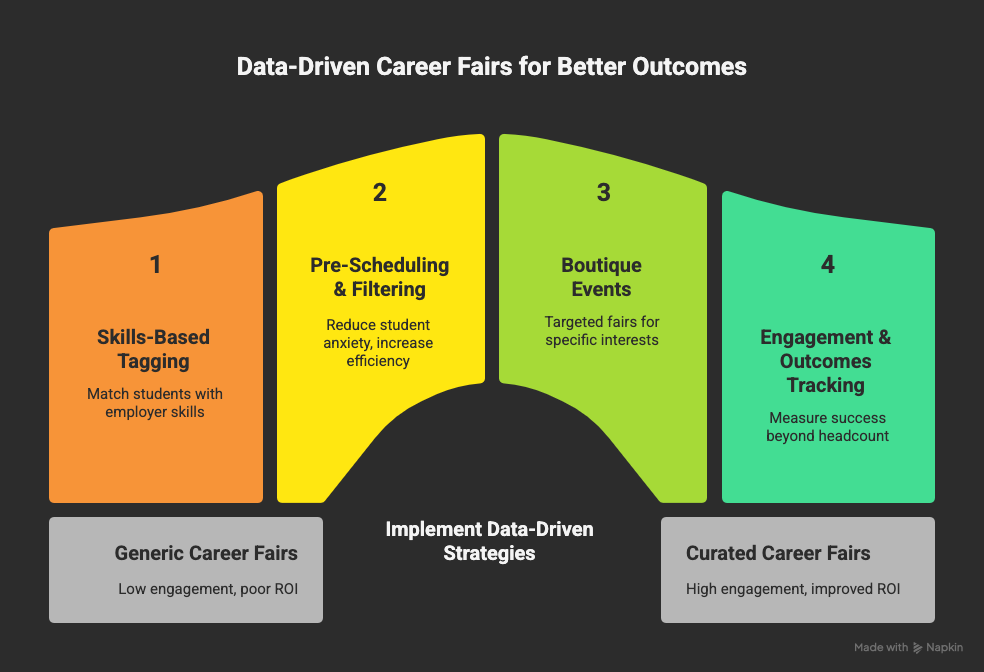
The best career fairs are no longer just logistical events; they are curated, data-driven experiences designed to produce two simple outcomes: qualified interviews for employers and quality job offers for students.
Also Read: How can career centers align their annual program calendar with hiring cycles to improve student outcomes?
What should career centers do after the fair?
The post-fair process is where many career centers lose impact.
Students leave with business cards, QR codes, and good intentions, but without structure, many do not follow up. Employers may leave with promising conversations but no clear next step. Staff may know the event felt successful but lack data to prove it.
Career centers should create a post-fair workflow that includes:
- Student follow-up reminders Send templates and deadlines for thank-you emails, LinkedIn connections, and applications.
- Employer feedback survey Ask employers to rate candidate quality, preparation, volume, and likelihood of returning.
- Interview tracking Ask employers and students whether conversations led to interviews, assessments, or follow-up meetings.
- Student reflection form Ask students what they learned, which employers they met, and what they will do next.
- Outcome review Compare attendance data with interviews, offers, internships, and first-destination outcomes where possible.
When Should Career Fair Outcomes Be Reviewed?
Career centers should use three follow-up checkpoints because interviews and offers rarely appear in the immediate post-event survey.
- Within 48 hours: Collect student reflections, employer feedback, meaningful-conversation data, and planned follow-up actions.
- After 14 to 30 days: Measure application completion, assessments, screening calls, interviews, and employer-reported candidate advancement.
- After 60 to 90 days: Collect available offer, internship, hire, employer-return, and first-destination information.
At the final review, identify where the outcome funnel weakened:
- High registrations but low attendance may indicate timing, reminders, accessibility, or perceived relevance problems.
- Strong attendance but few meaningful conversations may indicate poor matching, weak navigation, or insufficient student preparation.
- Many conversations but few interviews may indicate a gap in candidate readiness, role fit, or employer expectations.
- Interviews without offers may point to interview-preparation needs, role-alignment issues, or employer-specific selection barriers.
- Low employer return intent may indicate problems with student fit, event structure, communication, or the participating employer mix.
Changes to the next fair should be tied to the stage where evidence shows the largest drop, rather than based only on general satisfaction or staff impressions.
A strong career fair strategy does not end when the room clears. It ends when the career center can show what the event produced.
Wrapping Up
Career fairs still work when they are designed around preparation, fit, and measurable outcomes. The best fairs are no longer just logistical events.
They are structured employer engagement experiences that help students build confidence, meet relevant employers, and turn conversations into next steps.
For career centers, the opportunity is to make each fair more intentional: prepare students before they arrive, target outreach by skills, help employers meet better-fit candidates, and track what happens after the event.
At Hiration, we help career centers support that full readiness journey before, during, and after major employer engagement moments. Our platform brings together resume optimization, LinkedIn support, interview simulation, student workflows, and counselor-facing analytics so teams can prepare students at scale and measure progress more clearly.
Career teams can assign pre-fair resume, LinkedIn, and interview-preparation activities to specific cohorts, monitor completion and readiness indicators, and identify students who may need additional support before meeting employers. This gives counselors greater visibility into preparation without requiring every student to book an individual appointment.
If your next fair is about outcomes, not just attendance, the right systems can help students show up stronger, employers leave with better candidates, and career centers prove the impact of their work.
College Career Fairs — FAQ
Do career fairs still lead to real job offers?
Yes. NACE’s 2024 Student Survey found that 45% of attendees received interview offers and nearly 24% landed jobs after attending a fair—making it one of the most effective recruiting touchpoints available to career centers.
What do employers expect from modern career fairs?
Employers want measurable ROI. They evaluate fairs by cost per hire, time-to-hire, and retention rate of hires sourced through the event. Your fair should make it easy for them to meet well-matched candidates and shorten the hiring cycle.
How can career centers improve employer ROI?
Use skill-based tagging instead of filtering by major. Highlight students’ abilities—like “Python,” “Project Management,” or “Data Visualization”—and market fairs by skills to attract higher-quality, better-matched interactions.
What do students need most before attending?
Guidance and structure. Students benefit from pre-scheduling employer sessions, creating target lists, and using digital tools to plan conversations. This preparation reduces anxiety and boosts confidence, especially for first-time fair attendees.
Are large, all-industry fairs still the best model?
Not always. Smaller, focused fairs—like “Tech & Data Nights” or “Public Service Showcases”—produce deeper engagement and higher employer satisfaction. Boutique events create a more relevant, less intimidating environment for both students and recruiters.
Which metrics best define a successful fair?
Move beyond headcount. Track engagement-based metrics such as pre-scheduled meetings, post-fair satisfaction scores, interviews-per-employer, and job placement correlations via First Destination Surveys (FDS).
How can technology make fairs more effective?
AI-driven platforms can automate outreach, personalize recommendations, and measure outcomes. They help track employer ROI, student engagement, and placement impact while simplifying fair logistics for staff.
How does Hiration help career centers run better fairs?
Hiration provides an AI-powered career readiness suite that helps career centers plan, manage, and measure fair success. It enables skill-based student targeting, employer matching, and post-event analytics—all while maintaining counselor oversight and FERPA-compliant data security.