How can career centers use career development theories more effectively in student guidance?
Career centers can use career development theories as practical advising tools rather than academic background concepts. By matching theories to student needs such as interest exploration, confidence gaps, social barriers, uncertainty, or identity questions, teams can make appointments, workshops, and career education more targeted, consistent, and scalable.
Career development theories are widely referenced in career counseling, but many career centers still use them loosely or not at all.
That creates a practical problem: theories stay academic, while advisors still need better ways to help undecided students, students limited by self-doubt, and students navigating complex career questions.
For institutions, that gap affects consistency and scale. Without a shared framework, student guidance varies by advisor, workshops become less targeted, and career exploration can feel generic instead of intentional.
This guide explains 7 core career development theories, what each one helps explain, and how career centers can apply each model in advising, workshops, and career education.
What are career development theories?
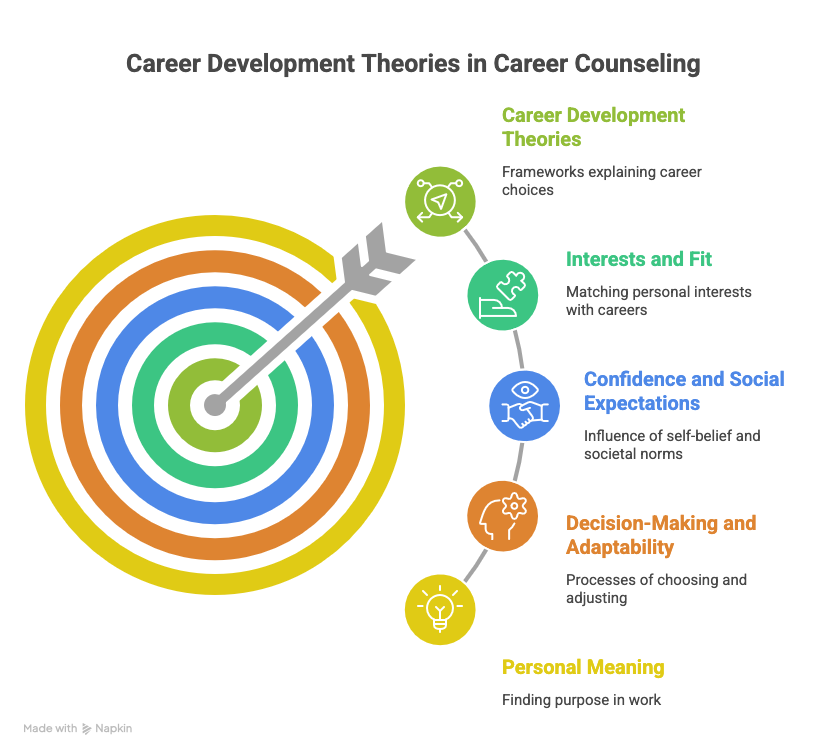
Career development theories are frameworks that explain how people explore work, make career decisions, respond to barriers, and adapt across different stages of life. In career counseling, they help advisors understand what may be shaping a student’s choices instead of jumping straight to advice.
Some theories focus on interests and fit. Others focus on confidence, social expectations, decision-making, adaptability, or personal meaning.
No single theory explains every student situation on its own. Each one offers a different lens for understanding why a student feels stuck and what kind of support may help most.
Also Read: Career Coaching Framework for Career Centers: 5 Proven Models
Why do career development theories matter in career counseling?
Career development theories matter because they help counselors understand why a student is struggling, not just what they should do next. That distinction is important. Two students can both say, “I don’t know what I want to do,” while needing completely different support.
One student may need help identifying interests. Another may be dealing with family pressure. A third may know what they want but doubt they can succeed in that path.
Without a framework, those situations can all get treated the same way.
Shared theory also helps career centers work more consistently.
Advisors can build better appointment strategies, workshops can become more targeted, and teams can create programming that reflects how students actually make decisions and develop over time.
Also Read: How can universities build professional development systems that improve career services quality?
Given below is a breakdown of the 7 career development theories every career center should know:
1. Parsons’ Trait and Factor Theory
Parsons’ Trait and Factor Theory is one of the foundational models in career guidance. At its core, it argues that good career decisions come from understanding three things clearly: your own traits, the nature of different occupations, and the relationship between the two.
That makes this theory especially useful when a student needs structure. Some students are not ready for complex identity work or long-term life design conversations.
They first need help answering more basic questions: What am I good at? What matters to me? What kinds of roles align with those patterns?
In a career center, Parsons’ model can guide early exploration. Advisors can help students identify strengths, values, interests, and preferences, then connect those patterns to specific occupations and industries.
Assessments, labor market information, and role research all fit naturally here.
Parsons works best when the student’s main challenge is turning self-knowledge into realistic career options. It is a strong starting point, but it does not explain everything.
Fit matters, but career choice is not always a purely rational matching exercise.
2. Holland’s Career Typology
Holland’s theory organizes interests into six types: Realistic, Investigative, Artistic, Social, Enterprising, and Conventional. Many career center professionals know this model through the RIASEC framework, which remains one of the most practical ways to help students talk about interests in a structured way.
The strength of Holland’s theory is that it gives students a useful language for patterns they may already feel but cannot yet describe. A student who enjoys solving analytical problems may lean Investigative.
A student drawn to helping, teaching, or counseling may lean Social. Many students fit more than one type, which makes the model especially helpful for exploring combinations and hybrid pathways.
In practice, Holland works well for students who are still exploring. It can support assessment conversations, occupational research, and career fair preparation. It can also help students see why certain environments feel energizing while others feel draining.
Career centers should avoid treating RIASEC as a label that locks students into one path. The model is most helpful when it opens doors rather than closes them.
Interest patterns should lead to exploration tasks, reflection, and experimentation, not just a list of suggested jobs.
3. Super’s Life-Span, Life-Space Theory
Super’s theory shifts the conversation from one-time career choice to career development over time. It emphasizes that career decisions are shaped by self-concept and that self-concept evolves through experience. A career is not something a person simply chooses once. It is something that develops across stages and life roles.
That perspective is especially valuable for students who feel intense pressure to make the perfect decision right away. Many students approach career exploration as if one choice will define the rest of their lives.
Super helps counselors reframe that fear. Early career decisions matter, but they are part of a longer developmental process.
This theory also highlights the different roles people hold, such as student, worker, family member, or community member, and how those roles affect decisions. A student’s career thinking is rarely separate from the rest of their life.
Career centers can use Super’s theory to normalize exploration, internships, changing interests, and evolving goals. Reflection exercises, role mapping, and developmental conversations all fit well here.
Super is especially useful when a student needs permission to see career growth as ongoing rather than fixed.
Also Read: NACE Competencies Guide: How to Measure and Prove Student Readiness
4. Gottfredson’s Theory of Circumscription and Compromise
Gottfredson’s theory explains how people begin narrowing career options long before they fully explore them. Students may rule out certain paths because of social expectations, stereotypes, family messages, status assumptions, or the belief that some careers are simply not for people like them.
That is what makes this theory so important in career counseling. Many students are not choosing from a wide-open set of options. They are choosing from a list they have already silently reduced.
Circumscription happens when students eliminate options early. Compromise happens when they give up preferred choices because those options feel inaccessible or unrealistic. Both processes can happen without the student fully realizing it.
In a career center, this theory is especially useful for students who dismiss careers quickly or speak about certain fields with language rooted in limitation.
Advisors can use exposure, questioning, examples, alumni stories, and low-risk entry points to help reopen paths that have been prematurely ruled out.
Gottfredson is particularly valuable when counselors want to address identity, social norms, and perceived barriers in a more direct way. It helps explain why some students never seriously consider options they may actually be capable of pursuing.
Also Read: How can career services improve outcomes for neurodivergent students?
5. Social Cognitive Career Theory
Social Cognitive Career Theory, often called SCCT, focuses on how career decisions are shaped by self-efficacy, outcome expectations, goals, and contextual influences. In simpler terms, it looks at what students believe they can do, what they think will happen if they try, and what factors around them make action easier or harder.
This theory is one of the most useful models for students who have interest but not confidence. A student may be curious about a field, but if they do not believe they can succeed in it, they may never take the first step.
Another student may have the skills but assume the effort will not lead to real opportunity.
SCCT gives counselors a way to work with those internal and external drivers. Instead of only focusing on interests, advisors can help students build confidence through small wins, role models, peer learning, and structured action.
They can also talk more directly about barriers, support systems, and expectations.
Career centers can apply SCCT in one-on-one advising, mentorship programs, leadership development, and confidence-building workshops.
It works especially well when the main issue is not a lack of options, but a lack of belief that success is possible.
Also Read: Career Counseling Techniques to Ease Student Anxiety in 2026
6. Krumboltz’s Planned Happenstance Theory
Krumboltz’s Planned Happenstance Theory challenges the idea that careers always follow a perfectly mapped plan. It argues that unplanned events often shape career paths and that people can develop skills that help them benefit from those events when they happen.
That idea matters because many students wait for certainty before acting. They want the perfect plan before they apply, network, attend an event, or test a new direction.
Planned happenstance offers a more realistic and more useful message: action often comes before clarity.
This theory encourages qualities such as curiosity, persistence, flexibility, optimism, and a willingness to take reasonable risks. It helps students understand that not every meaningful opportunity is predictable in advance.
Career centers can use this model with students who feel paralyzed by uncertainty or overly attached to linear planning.
Advisors can encourage exploratory action, informational conversations, event participation, short-term projects, and reflective exercises that help students notice how chance and initiative interact.
Krumboltz does not suggest that students should drift aimlessly. The point is not randomness. The point is learning how to stay open, engaged, and responsive when unexpected possibilities appear.
Also Read: How Should Career Centers Adapt Job Prep for Students with ADHD?
7. Savickas’ Career Construction Theory
Savickas’ Career Construction Theory brings a more modern, narrative-based lens to career development. Rather than focusing only on fit or stages, it emphasizes how people build careers by making meaning of their experiences, adapting to change, and shaping a life story that feels coherent.
This theory is especially useful for students whose paths do not feel linear. Some have changed majors, taken breaks, combined very different interests, or gathered experiences that seem disconnected.
Others are asking identity-driven questions that do not fit neatly into traditional matching models.
Career Construction Theory helps counselors move beyond “Which job fits you?” and into “How are you making sense of your story?” It centers adaptability, reflection, and personal meaning.
In a career center, this approach can support narrative exercises, career story work, values reflection, and conversations about purpose, identity, and long-term direction.
It is a strong fit for students who need help connecting experiences into a clearer career narrative rather than simply choosing from a list of roles.
Also Read: How Can Career Centers Better Support Interdisciplinary Majors?
Which theory fits which student situation?
Not every theory fits every student problem. That is why career centers benefit from treating theories as tools rather than abstract background knowledge.
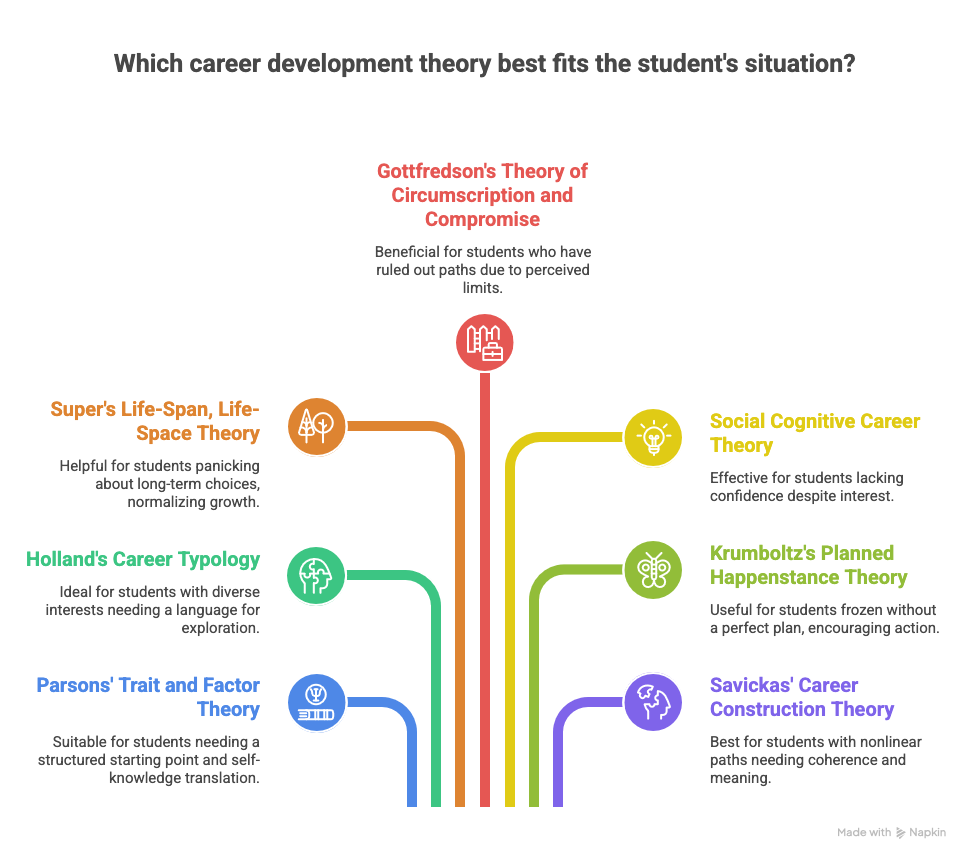
A student who feels completely lost and needs a structured starting point may benefit most from Parsons’ Trait and Factor Theory. That model helps translate self-knowledge into possible career directions.
A student who says, “I like a lot of different things, but I do not know where they point,” may be a good fit for Holland’s Career Typology. RIASEC gives them a language for interest patterns and helps turn vague preferences into clearer exploration.
A student who is panicking about making the wrong long-term choice may need Super’s Life-Span, Life-Space Theory. That perspective helps normalize growth, change, and evolving self-concept.
A student who has quietly ruled out certain paths because they seem out of reach or not socially acceptable may benefit most from Gottfredson’s Theory of Circumscription and Compromise. That model helps uncover hidden limits in the student’s decision-making process.
A student who says, “I am interested, but I do not think I could actually do it,” is often a strong fit for SCCT. Confidence, outcome expectations, and barriers are usually more central there than simple interest matching.
A student who is frozen because they do not have a perfect plan may benefit from Planned Happenstance Theory. Krumboltz helps them act, experiment, and stay open to useful opportunities.
A student with a nonlinear path or a fragmented set of experiences may respond well to Savickas’ Career Construction Theory. That framework helps them create coherence, meaning, and direction from what can otherwise feel like a scattered story.
Also Read: How Can Career Services Improve Career Outcomes for Student Veterans?
How can career centers apply career development theories at scale?
Career centers do not need to keep theory confined to counselor training or one-on-one appointments. These models become far more valuable when they shape student-facing systems and programming across the office.
Workshops can be built around theory-driven problems. A Holland-based session can support students exploring interests and career clusters. An SCCT-based workshop can focus on confidence, action, and overcoming perceived barriers.
A Krumboltz-inspired program can help students take exploratory action even without a perfect plan.
Appointment structures can also reflect theory. Intake questions can be designed to help advisors quickly identify whether a student’s main challenge is fit, confidence, identity, social limitation, or uncertainty.
That can make conversations more targeted from the start.
Group programs can be improved too. Peer mentoring, alumni panels, and reflection exercises can all be shaped by theory. A Savickas-informed session might focus on telling a stronger career story.
A Gottfredson-informed panel might spotlight professionals who broke stereotypes or entered fields that once felt inaccessible.
Shared theory also improves team consistency. When advisors use a common framework, students are more likely to receive support that feels coherent across workshops, appointments, and digital resources.
That matters even more when centers are serving large populations with limited staff time.
Wrapping Up
Career development theories are most useful when they move beyond the classroom and into daily practice.
They help career centers understand why students get stuck, which kinds of interventions fit different situations, and how to make guidance more targeted across a wide range of student needs.
A stronger theory foundation also makes it easier to scale support without making it generic. When advisors, workshops, and resources are built around clearer models, students receive guidance that feels more intentional and more relevant to their actual concerns.
Hiration helps career centers turn that guidance into action with tools for resume development, interview practice, LinkedIn optimization, and broader career readiness support.
That gives teams a way to pair strong advising frameworks with practical student-facing tools as they scale services across campus.
Career Development Theories for Career Centers — FAQs
What are career development theories?
Career development theories are frameworks that explain how people explore careers, make decisions, respond to barriers, and adapt over time. They help advisors understand what may be shaping a student’s choices before jumping straight to solutions.
Why do career development theories matter in career counseling?
They help counselors identify why a student feels stuck, not just what the student should do next. That leads to more targeted support and makes advising more consistent across the career center.
Which theory is best for students who need a structured starting point?
Parsons’ Trait and Factor Theory is often the best fit for students who need structure. It helps connect strengths, values, interests, and preferences to realistic occupations and career options.
How does Holland’s Career Typology help students?
Holland’s theory helps students understand interest patterns through the RIASEC framework. It gives them a clearer language for what energizes them and supports more focused career exploration.
When is Super’s Life-Span, Life-Space Theory most useful?
Super’s theory is especially useful for students who feel pressure to make the perfect long-term decision immediately. It helps reframe career choice as an evolving process shaped by growth, experience, and changing life roles.
What does Gottfredson’s theory help advisors uncover?
Gottfredson’s Theory of Circumscription and Compromise helps advisors identify careers students may have ruled out too early because of stereotypes, family expectations, social norms, or perceived inaccessibility.
Why is Social Cognitive Career Theory useful in career services?
SCCT is useful when students are interested in a path but lack confidence. It focuses on self-efficacy, outcome expectations, goals, and contextual barriers that shape whether students take action.
What is Planned Happenstance Theory?
Planned Happenstance Theory argues that unplanned events often shape careers and that students can benefit by developing curiosity, flexibility, persistence, optimism, and a willingness to take reasonable risks.
How does Career Construction Theory support students with nonlinear paths?
Savickas’ Career Construction Theory helps students make sense of experiences that may feel disconnected. It supports reflection, adaptability, and stronger career storytelling rooted in identity and meaning.
How can career centers apply these theories at scale?
Career centers can apply them by designing theory-informed workshops, improving intake questions, shaping appointment strategies, and building shared advising frameworks that make student support more intentional and scalable.