How can career counseling reduce student anxiety in 2026?
Career counseling in 2026 must move beyond resumes and job matching to address career paralysis driven by AI uncertainty, market volatility, and identity disruption. By focusing on AI literacy, narrative-based career construction, planned happenstance, and anxiety path reduction tools, career centers can help students regain agency, reduce overwhelm, and take consistent forward action despite uncertainty.
Career anxiety is becoming a familiar part of student advising. Many students are not just asking which job to apply for.
They are worried about choosing the wrong path, falling behind peers, competing with AI, entering an uncertain job market, or not having enough experience to stand out.
For career centers, this changes the nature of support. Resume reviews and job boards are still important, but they are not always enough for students who feel stuck, overwhelmed, or unsure where to begin.
These students often need structure, reassurance, and smaller next steps before they can take meaningful action.
This guide explains how career centers can support students with career anxiety through practical counseling techniques, AI literacy, planned happenstance, career construction, next-step planning, advisor prompts, and clear boundaries between career support and mental health care.
Why are college students experiencing more career anxiety?
Career anxiety often comes from a combination of uncertainty, comparison, financial pressure, and lack of control. Students may feel that the job market is changing faster than they can prepare for it. They may also compare themselves to peers who seem to have internships, job offers, or clear plans already in place.
AI has added another layer to this anxiety.
Students today face a unique psychological barrier called "AI Alienation," where they feel a lack of control over their professional outcomes due to algorithmic hiring and automation fears.
Some students worry that automation will reduce entry-level opportunities or make their skills less valuable. Others feel confused about how AI is being used in hiring, resumes, interviews, and screening systems.
Career centers can help by naming the anxiety without letting it define the student.
Instead of treating worry as a lack of motivation, advisors can frame it as a signal that the student needs clearer information, smaller actions, and a stronger sense of control.
Strategy 1: Turn AI anxiety into AI literacy
Many students feel anxious about AI because it makes the job search feel less human and less predictable. They may worry that algorithms will filter them out, that entry-level jobs will disappear, or that they do not know how to use AI tools responsibly.
Career centers can reduce this anxiety by shifting the conversation from AI fear to AI literacy. Students do not need to become technical experts.
They need to understand how AI is changing resumes, interviews, research, job matching, and workplace expectations.
A practical AI literacy approach can include:
- explaining how applicant tracking systems and screening tools may affect applications
- teaching students how to tailor resumes without keyword stuffing
- showing how AI can support research, interview prep, and role exploration
- helping students understand where human judgment still matters
- discussing ethical and responsible AI use in career preparation
The goal is to help students see AI as something they can learn to work with, not something that makes their effort pointless.
Colleges like Tulane University are integrating AI-fluency workshops into career counseling to help students see themselves as "AI pilots" rather than "AI victims."
Advisor prompts to use
- “What part of AI in the job search feels most unclear or stressful to you?”
- “Where do you feel you still have control in this process?”
- “What is one AI-related skill or tool that would make you feel more prepared?”
- “How can we use AI to support your preparation without replacing your own judgment?”
Also Read: What career coaching frameworks should career centers use to improve advising outcomes?
Strategy 2: Use planned happenstance to reduce pressure for a perfect plan
Some students become anxious because they think they need a fixed five-year plan before taking action. When the market feels uncertain, that pressure can become paralyzing.
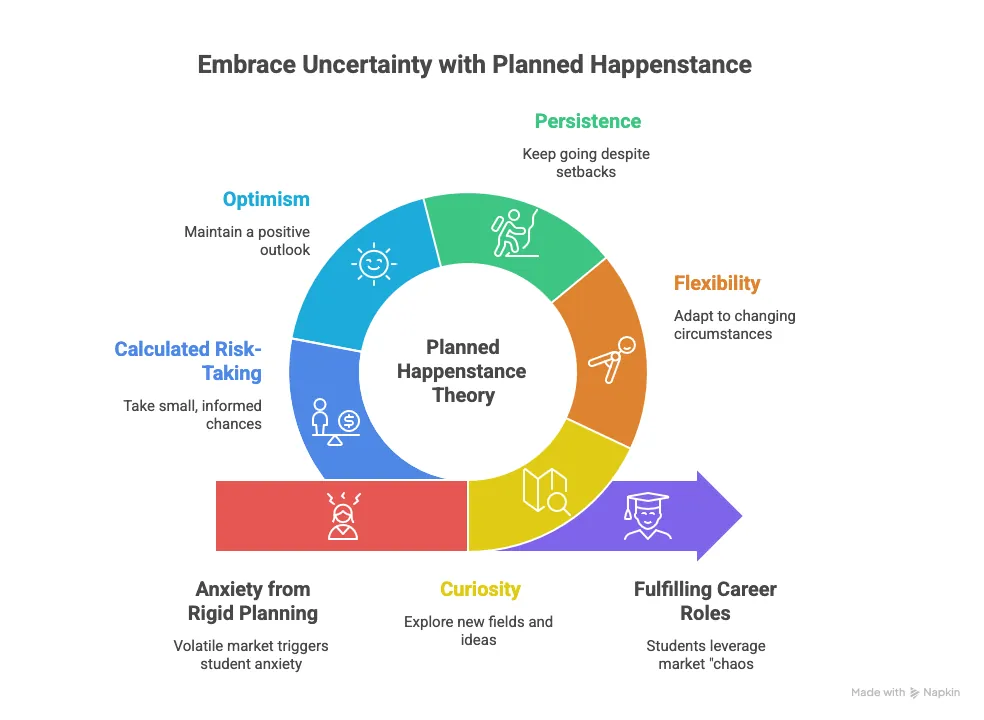
Planned Happenstance Theory (PHT) offers a more flexible approach. Instead of asking students to predict the perfect path, it helps them build habits that create opportunity: curiosity, flexibility, persistence, optimism, and willingness to take low-stakes risks.
This is especially useful for students who are waiting for total clarity before doing anything. Career advisors can help them test ideas in small ways rather than forcing a major life decision too early.
A practical exercise is the micro-risk assignment. Ask students to choose one small career action they can take this week, such as:
- messaging one alum in a field they are curious about
- attending one employer event without pressure to “network perfectly”
- applying to one role outside their usual comfort zone
- asking one professional about their career path
- trying one short project, simulation, or skills exercise
The point is not to make students act randomly. It is to help them build confidence through movement.
Advisor prompts to use
- “What is one small career action that feels slightly uncomfortable but still manageable?”
- “What could you learn from trying this, even if it does not lead to an immediate result?”
- “What is one opportunity you might discover by taking this step?”
- “How can we make this action low-risk enough that you will actually do it?”
Also Read: How career centers can support seniors without jobs before graduation?
Strategy 3: Use career construction to help students build a stronger story
Career anxiety often increases when students see their experiences as disconnected. They may have changed majors, worked unrelated jobs, taken time off, supported family, or explored several paths without seeing a clear pattern.
Career Construction Theory (CCT) helps students make meaning from those experiences. Instead of asking only, “What job matches your major?” advisors can ask, “What story is emerging from what you have done, learned, and cared about?”
This approach is useful for students who feel scattered or behind. It helps them identify themes, values, strengths, and motivations that can guide their next step.
Career advisors can use this technique by asking students to map:
- important experiences they have had
- problems they enjoy solving
- moments when they felt useful or energized
- people or communities they care about serving
- skills they keep returning to across different contexts
From there, advisors can help students translate those patterns into career language. The goal is not to create a perfect life story. It is to help students see coherence where they previously saw confusion.
According to recent ResearchGate findings, CCT interventions significantly increase "adaptive readiness" - the willingness to tackle career transitions without psychological breakdown.
Institutions like California State University (CSU) Channel Islands have operationalized this by requiring a "Career Readiness" course that focuses on professional identity as a core competency.
Advisor prompts to use
- “When have you felt most useful or engaged?”
- “What kinds of problems do people often come to you for help with?”
- “What experiences look unrelated at first but may point to the same strength?”
- “If your career story had a theme so far, what might it be?”
Strategy 4: Break career paralysis into visible next steps
Career anxiety often worsens when the next step feels too large. “Find a job” is overwhelming. “Update three resume bullets” is manageable. “Network more” is vague. “Send one message to an alum by Friday” is specific.
Career centers can reduce anxiety by helping students move from abstract goals to visible next steps. This is especially important for students dealing with analysis paralysis, comparison, or fear of rejection.
A simple next-step framework can look like this:
Step 1: Name the concern: Ask the student what feels hardest right now. Is it choosing a path, writing a resume, applying, interviewing, networking, or handling rejection?
Step 2: Shrink the action: Turn the concern into one task that can be completed in 15 to 30 minutes.
Step 3: Make progress visible: Ask the student to record what they did, what they learned, and what changed.
Step 4: Build the next action from the result: Use the outcome of the first step to decide the next one.
For example, a student anxious about networking may not be ready for a full employer event. Their first step may be drafting one outreach message. Then they send it. Then they reflect on the response. Then they try again with a second person.
This creates momentum without pretending anxiety disappears immediately.
Advisor prompts to use
- “What part of this feels too big right now?”
- “What is the smallest version of this task we can start with?”
- “What would count as progress by the end of this week?”
- “What will you do if the first attempt does not work?”
Also Read: Career Coaching Icebreakers for Students: 10 First-Session Prompts
Strategy 5: Support career anxiety without becoming the therapist
Career anxiety sits close to mental health, but career advisors are not expected to replace clinical counseling. The role of the career center is to provide structure, reflection, skill translation, and next-step support while knowing when to refer students to mental health professionals.
A useful boundary is this: career advisors can help students work through career-related uncertainty, decision-making, confidence, and preparation. When anxiety becomes severe, persistent, or connected to broader distress, a referral pathway should be clear.
Career centers can support students responsibly by:
- normalizing uncertainty without minimizing distress
- using reflective listening and motivational interviewing techniques
- helping students identify what they can control
- translating skills and experiences into evidence
- referring students when anxiety appears beyond career support
One helpful technique is skill translation. Students often feel inadequate because they do not recognize the value of what they have already done. Advisors can help them reframe coursework, jobs, caregiving, volunteering, or leadership into evidence of workplace readiness.
Advisor prompts to use
- “What part of this feels career-related, and what part feels bigger than the job search?”
- “What have you already handled that shows resilience or problem-solving?”
- “What support would make this next step feel more manageable?”
- “Would it be helpful to connect you with another campus resource while we keep working on the career side?”
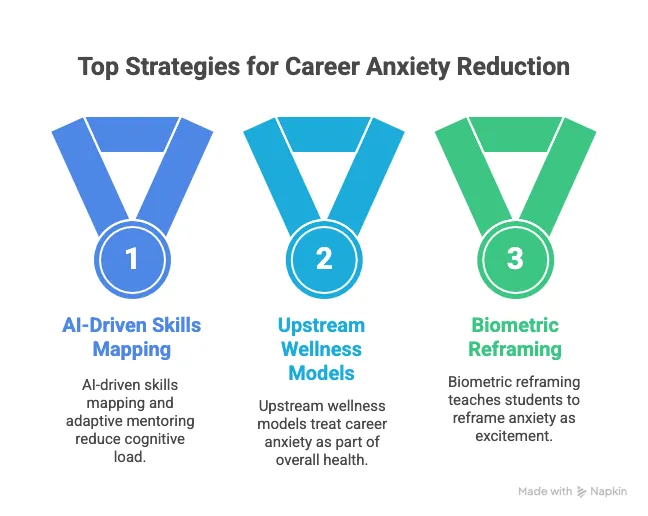
Pro-Tip: Use "Biometric Reframing." During mock interviews, teach students to reframe physical anxiety (racing heart) as "excitement for the opportunity." Research in PMC - NIH shows that subjective well-being acts as a mediator between psychological resilience and future anxiety.
Also Read: 5 strength finder exercises career centers can use for student success
A simple career anxiety coaching script for advisors
Use this short script when a student arrives overwhelmed or unsure where to begin.
Step 1: Name the feeling
“It sounds like this feels overwhelming right now, and that makes sense. There are a lot of moving pieces.”
Step 2: Separate the problem
“Let’s separate the big worry from the next action. The big worry might be your whole future. The next action only needs to be one small step.”
Step 3: Find the control point
“What part of this do you still have some control over this week?”
Step 4: Choose one action
“Let’s pick one action that is small enough to complete before our next check-in.”
Step 5: Make the outcome visible
“After you do it, write down what you learned, even if the result is not perfect. That will give us something real to build from.”
This kind of script helps advisors validate the student’s concern without letting the session stay stuck in worry.
To Sum Up
The approaches outlined here all point to the same underlying shift: career readiness in 2026 is less about certainty and more about agency.
When students can see progress, test ideas safely, and translate effort into visible skill evidence, anxiety starts to loosen its grip.
The role of the career center becomes less about answers and more about scaffolding momentum.
That’s where the right tools quietly matter.
Beyond workshops and one-to-one conversations, Hiration can help extend this work into a student’s day-to-day reality - from exploration and job matching to concrete application materials and interview practice.
Used well, technology doesn’t replace advising; it reinforces it, giving students round-the-clock structure and giving counselors a clearer way to guide cohorts and track growth.
When every next step feels tangible, “career paralysis” turns into forward motion.
Career Counseling & Student Anxiety — FAQs
What is causing increased career anxiety among the Class of 2026?
Students are experiencing anxiety due to automation, AI-driven hiring, and uncertainty around entry-level roles. This creates a loss of perceived control, often referred to as career paralysis, where students feel overwhelmed and disengaged from the job search process.
What is “AI alienation” in career counseling?
AI alienation describes a psychological response where students feel powerless over career outcomes because hiring decisions are influenced by algorithms and automation. This can reduce career self-efficacy and increase avoidance behaviors during job search activities.
How does Planned Happenstance reduce career anxiety?
Planned Happenstance encourages students to treat uncertainty as an opportunity by developing curiosity, flexibility, persistence, optimism, and calculated risk-taking. This approach reduces anxiety caused by rigid planning in volatile job markets.
What is Career Construction Theory and why is it effective?
Career Construction Theory helps students view themselves as authors of their professional story rather than candidates seeking a single “correct” job. This narrative approach builds internal stability and adaptive readiness, reducing anxiety caused by shifting labor market conditions.
How can technology reduce career-related anxiety without replacing advisors?
AI-driven tools reduce anxiety by narrowing choices, mapping skills to roles, and providing clear next steps. When used as support rather than decision-makers, these tools lower cognitive overload and help students maintain momentum between advising sessions.
How should career services address mental health boundaries?
Career professionals should use techniques like motivational interviewing and anxiety reframing while maintaining clear referral pathways to clinical counseling. Career anxiety can be addressed through skill translation and confidence-building without replacing mental health care.