How should career centers adapt job preparation for students with ADHD?
Career centers can improve outcomes for ADHD students by replacing unstructured job-search guidance with structured workflows, collaborative advising sessions, visual resume templates, and step-by-step interview preparation. By reducing executive-function barriers and emphasizing guided execution, advisors can help students translate their abilities into successful job search outcomes.
Career services teams supporting college students with ADHD often face a specific challenge: the student may understand what they need to do, but struggle to consistently turn that knowledge into action.
Resume revisions get delayed. Applications pile up. Follow-ups are missed. Interview preparation starts too late.
Standard career advice can fall short because the job search itself requires sustained planning, prioritization, organization, and task initiation.
For career teams, the question is not simply how to give better advice, but how to structure career support so students can act on it.
This guide breaks down where ADHD students may get stuck across the job search and shows how career services professionals can adapt resume support, application management, interview prep, disclosure conversations, and advising practices to make each stage easier to navigate.
What makes job prep uniquely difficult for ADHD college students?
ADHD students can struggle with the executive function demands built into the job search, particularly tasks like tracking applications, breaking down job descriptions, prioritizing next steps, and following through across multiple deadlines.
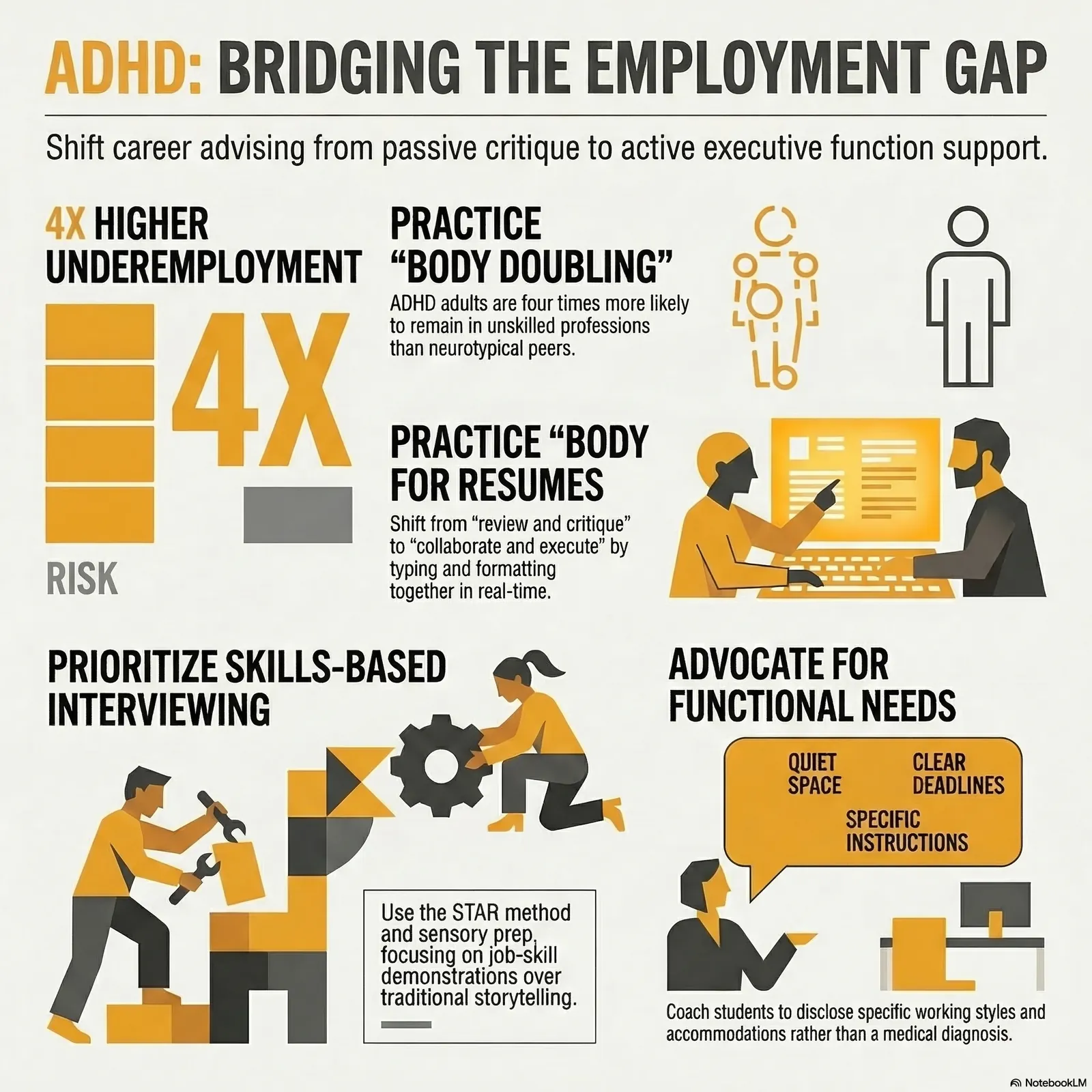
According to a comprehensive report by the Youth Futures Foundation, adults with ADHD are four times more likely to be in unskilled professions compared to a neurotypical control group.
Furthermore, data from Prospects Luminate reveals that disabled graduates experience a persistent employment gap 15 months post-graduation, frequently landing in roles with significantly lower job security.
The job hunt itself requires intense executive function. Students get quickly overwhelmed by the unstructured nature of networking, applying, and following up.
For career teams, this means looking beyond whether a student completed the task and identifying where the process is breaking down.
A missed application may reflect difficulty starting, sequencing, prioritizing, or returning to a multi-step task rather than lack of interest in finding work.
Students may even arrive at an appointment asking some version of “is it harder to get a job with adhd” because repeated difficulty with applications can start to feel like a reflection of their employability.
Career advisors can help separate the student's underlying career potential from the process barriers making the search harder to manage.
A useful starting point is to identify where those barriers occur:
| Job-search stage | Where students may get stuck | How career services can adjust support |
|---|---|---|
| Career exploration | Too many possible roles or directions | Narrow the immediate decision to a small set of options |
| Resume building | Difficulty starting or managing multiple revisions | Break revisions into defined, sequential tasks |
| Applications | Tracking deadlines, documents, and follow-ups | Use one application tracker and establish explicit next actions |
| Interview preparation | Organizing examples and recalling them under pressure | Provide structured frameworks and repeated practice |
| Follow-up | Returning to tasks after an application or interview | Schedule specific follow-up dates before the advising session ends |
Also Read: How Can Career Services Can Improve Outcomes for Neurodivergent Students?
How should career services structure job-search support for ADHD students?
Career teams can make job preparation easier to navigate by reducing the number of decisions students have to manage at once. Instead of treating resume writing, applications, networking, and interview preparation as broad assignments, advisors can convert each stage into a clearly defined next action that can be completed and reviewed.
For example, rather than ending an appointment with “finish your resume and start applying,” establish the immediate sequence:
- Revise the experience section using the feedback discussed during the appointment.
- Identify three roles that meet the student's agreed criteria.
- Complete one application before beginning the next.
- Record the deadline and next action in the student's application tracker.
The objective is not to complete every task for the student. It is to make the path between the current task and the next task visible.
A daily planner for ADHD can add another layer of structure by helping students organize these actions around deadlines and daily priorities.
Career teams can also build this structure into their broader service model. Resume resources can include clearly defined stages instead of one large checklist.
Workshops can reserve time for students to complete part of an application rather than only explaining how applications work. Advising notes can end with one or two specific actions that both the student and advisor can revisit during the next interaction.
This creates continuity between appointments and reduces the amount of planning a student must recreate each time they return to the job search.
How can career services support resume writing for students with ADHD?
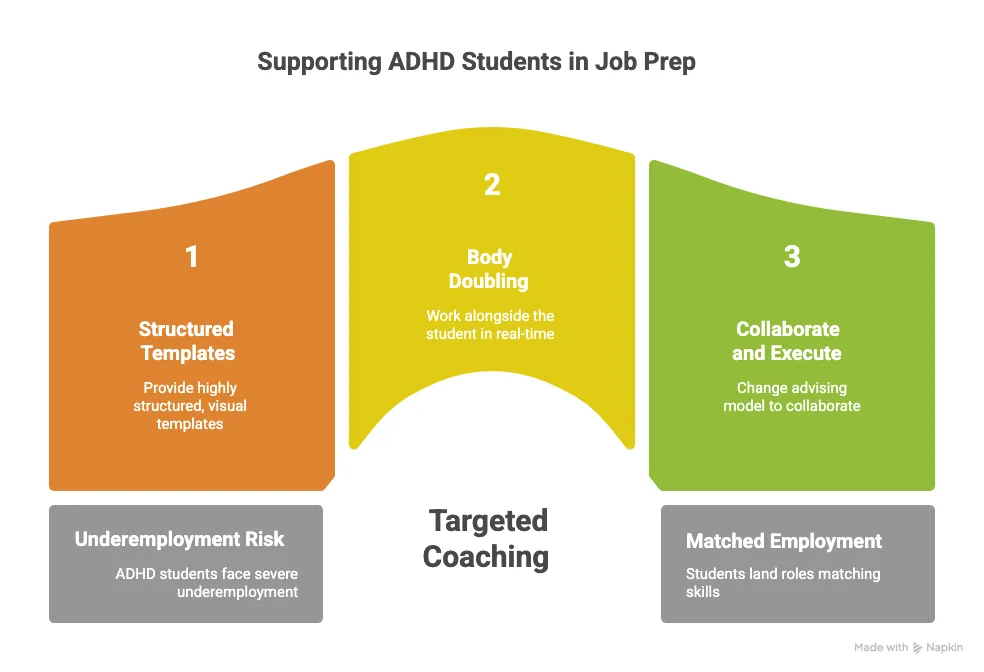
Avoid beginning with an entirely unstructured resume task. Provide structured templates, clear examples, and smaller revision stages so the student knows exactly what they are expected to work on first. When useful, advisors can also use "body doubling" by working alongside the student during part of the revision process rather than assigning every change for later.
The challenge may not be understanding what belongs on a resume. It may be turning a broad instruction like “improve your resume” into a manageable sequence of decisions and revisions.
Handing an ADHD student a checklist and telling them to fix their resume at home rarely works.
The Youth Futures Foundation report explicitly highlights that creating a good CV is one of the primary, paralyzing struggles for young people with ADHD entering the workforce.
You must change your advising model from "review and critique" to "collaborate and execute." Top colleges are already shifting their approach to provide this level of active support.
For example, according to IvyWise, Adelphi University's Bridges to Adelphi program offers intensive, individualized vocational support and mentoring rather than relying on generic drop-in resume reviews.
The same principle can be applied without requiring advisors to rewrite resumes for students. During an appointment, identify one section to improve, complete enough of the revision together for the student to understand the pattern, and then define exactly what they should complete independently.
This keeps the student actively involved while making the next step much clearer.
How can career centers help ADHD students manage job applications and follow-through?
Career centers can reduce application overload by turning the job search into a visible system rather than expecting students to remember multiple opportunities, deadlines, documents, and follow-ups. The most useful intervention is often not another application tip, but a consistent way to decide what happens next.
Start with one application tracker rather than asking students to manage opportunities across browser tabs, saved emails, spreadsheets, job boards, and notes.
At minimum, students can track the employer, role, application deadline, current status, next action, and date that action needs to happen.
Then make the application itself smaller.
“Apply to five internships this week” still leaves the student responsible for choosing the roles, comparing requirements, tailoring documents, answering application questions, submitting each application, and remembering what comes next.
Instead, an advisor might help the student:
- shortlist three roles;
- choose the first application;
- identify the resume changes required for that role;
- set a submission date;
- record the next follow-up action.
Career centers can build the same principle into workshops and drop-ins. An application session can include protected time for students to find one relevant role, begin the application, and leave with the next action already scheduled.
The goal is not to reduce expectations for ADHD students. It is to reduce unnecessary process ambiguity so that more of the student's effort can go toward evaluating opportunities, presenting their experience, and making career decisions.
What interview prep techniques actually work for neurodivergent minds?
Skip vague behavioral advice. Focus on skills-based demonstrations and strictly structure answers using the STAR method with visual aids. Conduct mock interviews focused on controlling pacing to prevent rambling, and have them practice in their exact interview outfit to minimize sensory overload on the big day.
Standard behavioral questions often trip up ADHD students because their working memory can freeze under pressure, or they may over-explain a situation.
For career teams, interview prep should therefore go beyond explaining the STAR method once. Help students identify a small bank of examples, map each example to likely question types, and practice retrieving those stories repeatedly until the structure becomes familiar.
The corporate world is adjusting to this. According to Charles Schwab's Neurodiversity at Work program, leading employers see massive success by replacing traditional behavior-based evaluations with "skills-based demonstrations", meaning they test actual job skills rather than the ability to tell a polished story.
Prepare your students for this specific type of assessment.
For traditional interviews, sensory management is key. According to Arizona State University's Career Center, advisors should advise neurodivergent students to wear their complete interview outfit for an hour every couple of days for a week prior to the interview.
This gets them completely accustomed to the physical feel and sound of the clothes, eliminating a hidden but major distraction.
Should Students Disclose ADHD During the Job Search?
There is no universal answer, but you should coach them to frame their disclosure around specific working styles rather than a medical diagnosis. Advise disclosing prior to the interview only if they require concrete accommodations, like a quiet room or written instructions for a skills test.
Disclosure remains a massive point of anxiety for students. According to the Youth Futures Foundation, while getting a diagnosis and disclosing it helps individuals feel validated and more confident in asking employers for support, many still rightfully fear negative workplace stereotypes.
Career advisors can make the conversation more concrete by separating several questions that students often treat as one:
Does the student want to disclose?
Disclosure itself is a personal decision.
Does the student need something different during recruitment?
If so, help them identify the specific barrier and the adjustment they want to request.
Are they trying to communicate a working preference rather than request an accommodation?
That conversation may focus more directly on the conditions in which they perform well.
Coach your students to advocate for what they need functionally. Instead of saying, "I have ADHD," teach them to say, "I am most productive when I receive project briefs in writing rather than verbally," or "I thrive in environments where I can block off uninterrupted focus time."
Additionally, point them toward explicitly inclusive employers.
You can leverage platforms like the Neurodiversity Career Connector, featured by the University of Pennsylvania's Career Services, which links neurodivergent candidates directly with employers from the Neurodiversity @ Work Employer Roundtable - including major companies like Microsoft, Ford, and Deloitte.
Also Read: How Can Career Centers Better Support Interdisciplinary Majors?
How should career services work with disability and accessibility teams?
Career services does not need to become the campus disability office. But students can benefit when career teams know where career preparation ends, where accommodation expertise begins, and how students can move between the two without having to navigate the process entirely on their own.
Career advisors can remain focused on job-search questions: evaluating employers, preparing applications, practicing interviews, discussing disclosure, identifying workplace preferences, and helping students communicate what they need.
Accessibility or disability-services colleagues can bring deeper expertise when questions involve formal accommodations, documentation, or disability-specific campus processes.
This is particularly useful because the transition from college to employment changes the context. A student who already knows how to request academic support may still need help thinking through what support would be useful during an interview, assessment, internship, or full-time role.
Career centers can strengthen that transition by agreeing on referral points, sharing appropriate resources, and ensuring advisors know which campus office to involve when a conversation moves beyond career coaching.
How are top universities structuring their neurodiverse career programs?
Leading institutions are moving beyond generic advising by providing more structured support around executive functioning, career preparation, and the transition into employment.
The strongest neurodivergent college programs also show career teams an important principle: support works best when career preparation is treated as an ongoing process rather than a single resume appointment close to graduation.
According to IvyWise, the University of Connecticut's Beyond Access program provides students with a dedicated strategy instructor to identify strengths and build concrete career readiness goals.
Similarly, Bellevue College's Occupational and Life Skills associate degree program embeds career preparation directly into the daily curriculum.
This hands-on, structural approach results in post-graduation employment rates that are well above the national average for workers with disabilities.
Career centers do not necessarily need a separate program to apply the same principle.
They can incorporate more structure into mainstream advising, create clearer handoffs with accessibility teams, make application and interview practice easier to repeat, and direct students toward neurodivergent jobs resources and inclusive employers when appropriate.
The broader shift is from expecting students to independently translate career advice into action to designing career support that makes each stage of that action easier to see and complete.
Also Read: How can career centers build a First Destination Survey dashboard that proves institutional value?
Wrapping Up
Supporting ADHD students in the job search requires more than standard advising.
It demands structure, guided execution, and tools that reduce the cognitive load of complex tasks like resume writing, interview prep, and application tracking.
When career centers combine thoughtful advising strategies with systems that simplify these steps, students are far more likely to translate their abilities into meaningful career outcomes.
Hiration is designed to support this kind of structured career readiness. Its full-stack suite spans the entire journey - from career assessments to AI-powered resume optimization, interview simulation, and more, while also giving counselors a dedicated module to manage cohorts, workflows, and analytics.
All of this operates within a secure, FERPA- and SOC 2-compliant environment.
With the right combination of intentional advising and supportive infrastructure, career centers can make the job search far more navigable for ADHD students and help them enter the workforce with confidence.
Career Preparation Strategies for Students with ADHD — FAQs
Why is the job search particularly difficult for students with ADHD?
Job searching requires planning, organization, prioritization, and follow-through—skills closely tied to executive functioning. Students with ADHD may struggle with these tasks, even when they have strong academic or professional potential.
What advising strategies help ADHD students complete resumes?
Advisors can provide structured templates, visual examples, and collaborative editing sessions where the resume is built together. This approach reduces task initiation barriers and helps students move forward more quickly.
Why does traditional resume feedback often fail for ADHD students?
Sending students away with a list of suggested edits requires self-management and task initiation. Many ADHD students benefit more from real-time collaboration where the advisor helps complete revisions during the session.
How should interview preparation be adapted for ADHD students?
Advisors should emphasize structured answer frameworks such as STAR, provide visual guides for organizing responses, and conduct practice interviews focused on pacing and clarity to prevent rambling or memory lapses.
Should students with ADHD disclose their condition to employers?
Disclosure decisions depend on individual circumstances. Advisors can help students frame discussions around preferred working styles and productivity strategies rather than focusing solely on the medical diagnosis.
How can career centers reduce job-search overwhelm for ADHD students?
Breaking tasks into small steps, providing structured timelines, and offering tools for tracking applications and deadlines can reduce cognitive overload and make the job search process more manageable.
What kinds of career programs support neurodivergent students best?
Programs that combine executive-function coaching, structured job preparation, mentorship, and hands-on career experiences tend to produce stronger outcomes for neurodivergent students.
How can career centers scale support for ADHD students?
Centers can scale support by combining structured advising frameworks, accessible career preparation tools, and systems that guide students through complex tasks like resume building, interview practice, and job tracking.