How can career centers improve civilian career outcomes for student veterans?
Career centers can improve outcomes for student veterans by shifting from traditional student advising to a skills-based transition model that emphasizes competency mapping, veteran-specific employer partnerships, flexible work-based learning opportunities, and post-placement mentorship. This approach helps veterans translate military leadership and operational experience into credible civilian career pathways.
Student veterans bring leadership, discipline, and years of real-world experience to campus.
Yet many still struggle to translate that experience into civilian careers.
The problem is not capability, it is alignment. Traditional career services are built for first-time job seekers, while veterans are often mid-career professionals navigating a cultural and professional transition.
This guide explores why standard advising models fall short for student veterans and how career centers can redesign their strategies to help veterans convert their experience into strong civilian career outcomes.
Why are traditional career services failing student veterans?
Standard career services often fail because they treat veterans as "non-traditional students" rather than "experienced professionals." Most CSPs focus on translating Military Occupational Specialties (MOS), but veterans frequently pursue degrees unrelated to their service. Effective support requires a "Whole-Veteran" approach that addresses cultural identity shifts and the unique stressors of civilian professional environments.
According to the Student Veterans of America (SVA) 2024 Census, roughly two-thirds of student veterans (66%) choose a field of study that is completely different from their military specialization.
This means generic MOS-to-Civilian translators are often useless.
Furthermore, 62% of student veterans are first-generation college students, compared to only 43% of traditional students, according to National University.
They lack the "hidden curriculum" of networking and corporate etiquette.
San Diego State University solved this by creating a veteran-specific orientation that focuses on "bridging" cultural gaps rather than just administrative paperwork.
Also Read: How Can Career Centers Improve Career Readiness for Transfer Students?
What Should a Student Veteran Career Support Framework Include?
A student veteran career support framework should assess military experience, current degree direction, work and family constraints, civilian role targets, skill translation, proof-building needs, employer connections, and first-role transition support. The goal is to help veterans convert existing experience into civilian career evidence instead of restarting career development from zero.
| Support Area | What Career Centers Should Assess | Student Output |
|---|---|---|
| Military Experience | Military role, responsibilities, leadership experience, technical training, certifications, and transferable skills | Civilian skill inventory |
| Current Degree Path | Whether the academic program reinforces, expands, or redirects the student's military background and career goals | Career direction map |
| Work/Life Constraints | Employment obligations, caregiving responsibilities, GI Bill or benefits timeline, commute, and scheduling realities | Flexible support plan |
| Civilian Role Target | Target role families, industries, employer types, work environments, and geographic preferences | Target role list |
| Skill Translation | How military terminology, accomplishments, and responsibilities can be reframed in employer-facing language | Resume bullets and LinkedIn language |
| Proof Building | Projects, certifications, internships, portfolios, work samples, coursework, and other evidence of civilian readiness | Civilian evidence artifact |
| Employer Connection | Access to veteran-ready employers, alumni, mentors, affinity groups, and hiring partners | Employer outreach plan |
| Transition Support | First-role fit, workplace culture adaptation, retention risks, and long-term advancement planning | 30/60/90-day transition plan |
This framework keeps career support practical.
It helps advisors avoid two common mistakes: treating military experience as self-explanatory, or treating student veterans as if they need the same entry-level support as traditional undergraduates.
Student veterans often already have experience. Career centers need to help them translate, target, and prove it.
For student veterans considering federal employment, advisors should also explain federal hiring paths and application requirements, including when questions about veterans' preference require official guidance.
How Can Advisors Translate Military Experience Into Civilian Skills?
Advisors can translate military experience by moving from military titles and acronyms to employer-facing skills, evidence, and outcomes. MOS translation tools can help, but they are not enough on their own. Student veterans also need role-family mapping, civilian examples, resume language, and interview stories that hiring managers can understand.
| Military Experience | Civilian Skill Translation |
|---|---|
| Leading a unit or team | People management, delegation, accountability, performance support, and team leadership |
| Mission planning | Strategic planning, risk assessment, prioritization, decision-making, and operational execution |
| Logistics coordination | Operations management, supply chain support, process execution, and resource coordination |
| Training junior personnel | Coaching, onboarding, instructional communication, mentoring, and workforce development |
| Equipment or systems management | Technical operations, compliance, asset management, quality assurance, and systems oversight |
| Crisis response | Judgment under pressure, adaptability, rapid problem-solving, and decision-making in complex environments |
| Cross-functional coordination | Stakeholder communication, teamwork, project alignment, and cross-department collaboration |
| Security or safety responsibilities | Risk management, policy compliance, procedural accuracy, and operational safety oversight |
| Deployment experience | Resilience, planning, ambiguity management, adaptability, and disciplined execution |
| Reporting and documentation | Data tracking, written communication, process accountability, record management, and documentation standards |
The advisor’s job is to help veterans move from internal military meaning to external employer meaning.
A phrase like “supervised squad operations” may not land clearly with a civilian recruiter.
A stronger version would be:
Led a 12-person team in high-pressure operating environments, coordinating schedules, equipment readiness, training tasks, and daily execution with zero missed compliance deadlines.
The second version gives employers something they can understand: team size, responsibility, operating conditions, and measurable performance.
Also Read: How does a 4-week job search plan help advisors coach students more effectively in 2026?
Why Is MOS Translation Alone Not Enough?
MOS translation is useful, but it is only one part of student veteran career support. Many veterans pursue civilian roles that do not directly match their military specialization, so advisors need to help them build a broader career narrative around transferable skills, target industries, degree direction, and proof of civilian readiness.
A military occupation may point to possible civilian roles, but it does not always answer:
- What does the student want now?
- Which civilian industries match their current degree?
- Which skills are strongest and most transferable?
- Which military experiences should be emphasized or minimized?
- What civilian proof does the student still need?
- How should the student explain a career pivot?
- Which employers understand veteran experience?
A veteran who worked in logistics may move into supply chain, operations, project management, business analytics, emergency management, or healthcare administration.
A veteran with technical maintenance experience may pursue engineering technology, cybersecurity, manufacturing operations, or quality assurance.
A veteran with training and leadership experience may move into human resources, learning and development, operations leadership, or program management.
The advising task is not just translation. It is positioning.
How Can Career Centers Build Skills-Based Support for Student Veterans?
Career centers can build skills-based support by mapping military experience to employer-valued competencies, then helping veterans prove those competencies through resumes, portfolios, interviews, certifications, projects, and civilian work samples. This matters because more employers are using skills-based hiring when evaluating early-career and entry-level candidates.
NACE’s Job Outlook 2026 reported that 70% of participating employers use skills-based hiring, up from 65% the prior year.
That shift is useful for student veterans because it gives career centers a clearer language for positioning experience.
NACE also defines eight career readiness competencies: career and self-development, communication, critical thinking, equity and inclusion, leadership, professionalism, teamwork, and technology.
Career centers can use those competencies to build veteran advising labs.
For example:
| NACE Competency | Veteran Experience Advisors Can Help Translate |
|---|---|
| Leadership | Supervising teams, training personnel, delegating responsibilities, and maintaining accountability under demanding conditions |
| Communication | Delivering briefings, preparing reports, coordinating across functions, and communicating clearly in high-pressure environments |
| Critical Thinking | Making decisions under pressure, assessing risk, solving complex problems, and adapting plans when conditions change |
| Professionalism | Maintaining standards, demonstrating reliability, following procedures, managing accountability, and operating with integrity |
| Teamwork | Coordinating within units, executing shared missions, collaborating across specialties, and supporting collective outcomes |
| Technology | Operating technical systems, managing equipment, using specialized platforms, and troubleshooting operational issues |
| Career & Self-Development | Planning career transitions, pursuing education, earning certifications, developing new skills, and adapting to changing environments |
| Equity & Inclusion | Working effectively with diverse teams, collaborating across cultures, and serving in environments that require mutual respect and adaptability |
A useful career center format is a competency-mapping lab.
Instead of a generic military-to-civilian resume session, the lab asks veterans to bring one military experience, one target role, and one job posting.
The student leaves with:
- 3 translated skill statements
- 2 resume bullets
- 1 LinkedIn experience update
- 1 interview story
- 1 gap to address through coursework, certification, or project work
That is more useful than telling veterans to “remove military jargon.”
How Can Career Centers Build Flexible Work-Based Learning for Student Veterans?
Career centers can support student veterans by creating flexible, paid, project-based opportunities that fit around work, family, coursework, and benefits timelines. Many student veterans cannot participate in unpaid internships or traditional summer programs, so career centers should expand options like micro-internships, employer projects, consulting sprints, and short-term paid assignments.
The SVA Census notes that approximately three-in-five student veterans are employed and work an average of 35 hours per week.
BLS also reported that in 2024, about three-fourths of employed, college-enrolled veterans ages 18 to 54 worked full time, compared with about 46% of their nonveteran peers.
That means traditional internship assumptions may not fit. Career centers should prioritize models such as:
- Paid micro-internships
- Employer-sponsored projects
- Evening or remote project work
- Short consulting assignments
- Course-embedded employer challenges
- Veteran-friendly internship cohorts
- Skills-based volunteer projects when paid options are not available
- Applied capstone projects tied to civilian industries
- Certifications paired with employer-facing work samples
Veteran students already have experience. The goal is to create civilian-sector evidence that employers recognize quickly.
For example, a veteran moving into business analytics may benefit from a short employer project that produces a dashboard, report, or process analysis.
A veteran moving into HR may benefit from a training design project.
While a veteran moving into operations may benefit from a process improvement case study.
These projects help veterans bridge the gap between military experience and civilian proof.
What Employer Partnership Models Work Best for Student Veterans?
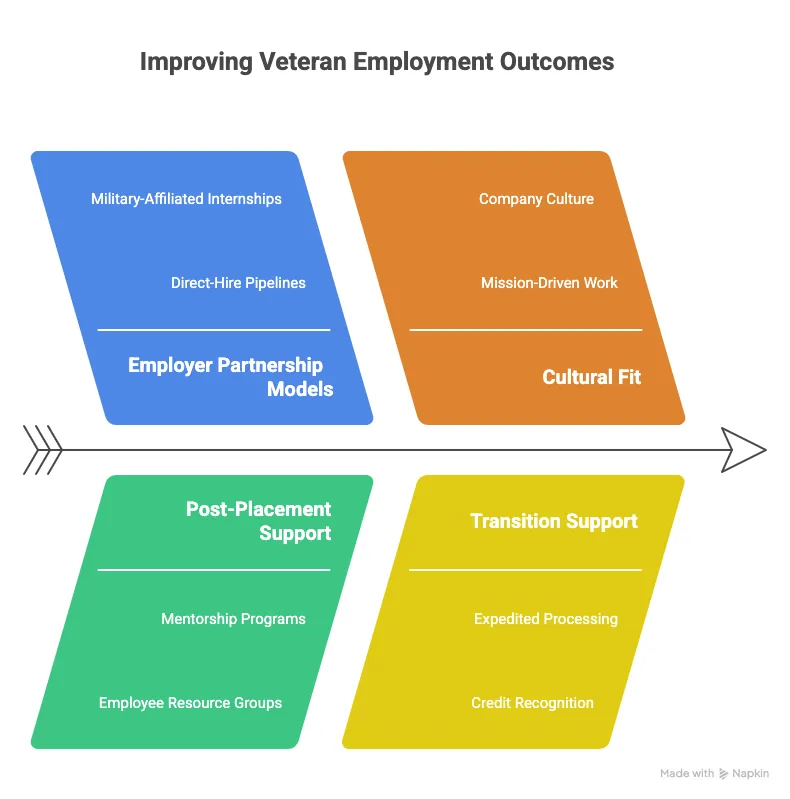
The most effective model is the "Direct-Hire Pipeline," where colleges partner with companies to create veteran-only hiring cohorts. These partnerships should include "Military-Affiliated Internships" that bypass traditional HR screenings. Real-world success at Texas A&M shows that dedicated "Corporate Veteran Liaisons" can increase veteran hiring rates by facilitating direct conversations between veterans and hiring managers.
According to the Texas Workforce Commission's 2025 Report, programs that connect military spouses and veterans directly to local business leaders through Memoranda of Understanding (MOUs) saw significantly higher retention rates.
University of Maryland Global Campus (UMGC) has excelled by providing "expedited processing" and recognizing college credit for military training, allowing veterans to reach the job market faster with relevant credentials, according to Research.com.
How Should Career Centers Prepare Student Veterans for Civilian Interviews?
Career centers should prepare student veterans for civilian interviews by helping them translate leadership, mission, teamwork, and pressure-tested decision-making into concise stories that match the target role. The goal is to help veterans avoid military jargon while preserving the value of their experience.
Veterans may be used to describing work through rank, unit, mission, or technical language.
Civilian interviews often require a different structure. Advisors should help veterans prepare for questions like:
- Tell me about yourself.
- Why are you moving into this field?
- How does your military experience connect to this role?
- Tell me about a time you led a team.
- Tell me about a time you handled pressure.
- Describe a conflict you managed.
- How do you adapt to a new environment?
- What kind of workplace helps you do your best work?
- Why this company?
- Why this role now?
A useful answer structure is:
Military context → civilian skill → role relevance → result
Example:
- Military context: “In my last role, I coordinated equipment readiness across a team of 18.”
- Civilian skill: “That required planning, documentation, communication, and follow-through.”
- Role relevance: “Those skills connect directly to operations coordination because the work depends on accurate tracking and team accountability.”
- Result: “We improved inspection readiness and reduced last-minute issues before scheduled reviews.”
This helps the student keep the strength of the military experience without forcing the employer to decode it.
Also Read: Mock Interview Rubric for Advisors: Scoring Framework & Examples
How Can Career Centers Support the First Civilian Role Transition?
Career centers can support student veterans by extending support beyond the offer. The first civilian role may involve new communication norms, different feedback styles, less hierarchy, unclear advancement paths, and questions about cultural fit. A 30/60/90-day transition plan can help veterans navigate that shift more intentionally.
| Timeline | Career Center Support |
|---|---|
| First 30 Days | Help the veteran understand workplace norms, manager expectations, communication styles, onboarding signals, team routines, and early performance expectations |
| 60 Days | Review role fit, stress points, team dynamics, feedback patterns, workload expectations, support needs, and whether the role matches the veteran’s long-term direction |
| 90 Days | Support advancement planning, mentorship connection, ERG participation, skill-development goals, retention strategy, or job-fit reassessment |
Career centers can build this into alumni or recent-graduate programming. Useful supports include:
- Veteran alumni mentors
- First-civilian-role check-ins
- Workplace communication workshops
- ERG navigation guidance
- Manager conversation scripts
- Career fit reflection tools
- Advancement planning sessions
- Referral back to campus or community resources when needed
The first civilian role matters because it can shape confidence, identity, and long-term career direction.
Veterans may secure a job but still struggle with whether the role feels meaningful, whether the culture fits, or how to advocate for growth.
Post-placement support helps career centers stay connected to the outcome beyond the first offer.
Also Read: How to Design Effective Job Search Bootcamps for Students
Wrapping Up
Helping student veterans succeed requires more than a single workshop or resume review.
It demands a coordinated system that supports skill translation, employer connections, and ongoing career development throughout the student journey.
Hiration is designed to support this kind of end-to-end approach.
Our platform brings together career assessments, AI-powered resume optimization, interview simulations, and other career readiness tools, alongside a dedicated counselor module that helps career teams manage cohorts, workflows, and analytics in one place.
Delivered through a secure, FERPA and SOC 2-compliant environment, it enables career centers to scale personalized support while keeping student outcomes at the center of the process.
When career services combine structured strategies with the right technology, they can better equip student veterans to convert their experience into meaningful, long-term civilian careers.
Career Services for Student Veterans — FAQs
Why do student veterans often struggle with civilian job transitions?
Many veterans have extensive leadership and operational experience but find it difficult to translate military roles into civilian job language that hiring managers understand.
Why do traditional career services models fall short for veterans?
Most career advising frameworks are designed for first-time job seekers. Veterans, however, are often experienced professionals navigating a complex career transition rather than starting their careers from scratch.
What advising approach works best for student veterans?
A whole-veteran advising model works best. This approach focuses on skill translation, leadership competencies, identity transition, and the cultural differences between military and civilian workplaces.
How can career centers help veterans translate military experience?
Advisors can guide veterans through competency mapping, connecting military tasks to widely recognized professional skills such as leadership, project management, problem solving, and team coordination.
What types of employer partnerships benefit student veterans most?
Direct-hire pipelines, veteran-focused hiring cohorts, and employer partnerships that include dedicated veteran recruiters or corporate veteran liaisons tend to produce the strongest employment outcomes.
Why are flexible work-based learning opportunities important for veterans?
Many student veterans work full-time while studying, making traditional internships difficult. Short-term project work or micro-internships allow them to gain civilian experience without leaving their primary job.
Why do some veterans leave their first civilian job quickly?
Cultural differences, lack of mentorship, and unclear expectations can cause early career dissatisfaction. Continued career support after graduation can help veterans adjust and remain in their roles.
How can career centers support veterans after they are hired?
Post-placement mentorship programs, alumni networks, and connections to veteran employee resource groups can help graduates navigate workplace culture and sustain long-term career growth.