What are the most effective StrengthsFinder activities career centers can run to improve student outcomes?
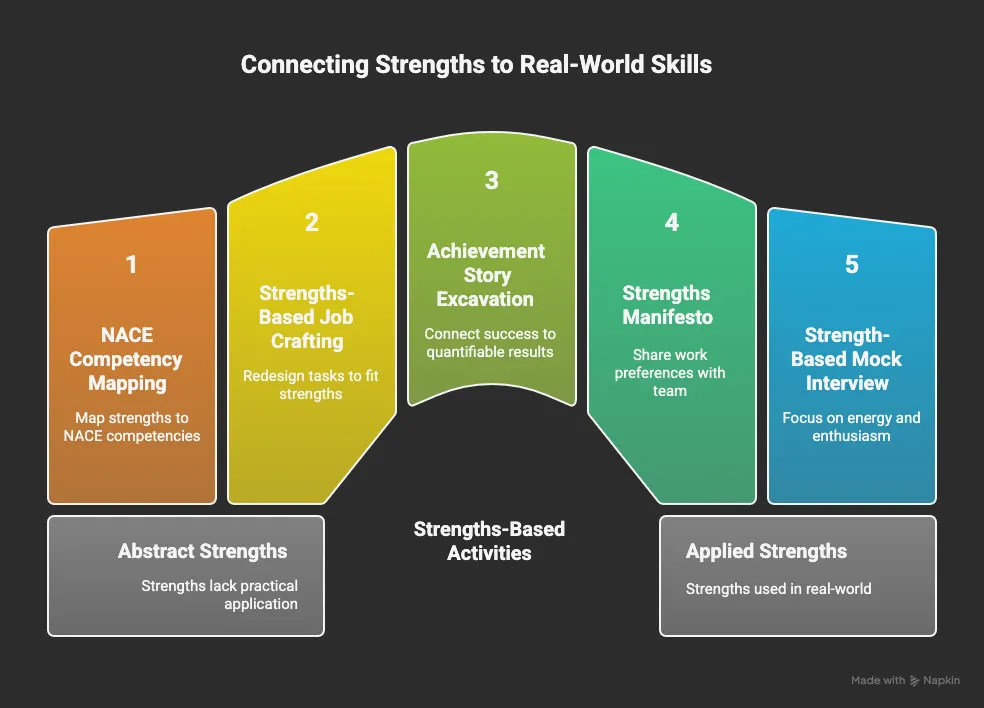
High-impact strengths programming helps students translate Top 5 themes into employer-recognized skills by mapping strengths to NACE competencies, job crafting campus roles, extracting quantifiable achievement stories, building psychological safety in teams, and practicing strengths-based mock interviews.
Helping students identify their strengths is easy.
Helping them use those strengths in a way that employers recognize, interviews reward, and campus roles actually benefit from - that’s the real challenge.
Most students can list their Top 5 themes, but they struggle to translate them into behaviors employers care about: problem-solving, initiative, collaboration, leadership, and follow-through.
Without the right structure, strengths stay abstract… and their resumes, interviews, and campus involvement stay flat.
That’s where intentional, high-impact strengths activities come in.
This guide breaks down practical, research-backed exercises you can run with students - whether one-on-one, in workshops, or inside student organizations, to help them connect their natural talents to real-world expectations, build confidence, and articulate their value with clarity.
The table below helps advisors choose the right strengths activity based on the student’s immediate career-readiness need.
| Student need | Best activity | Final student output |
|---|---|---|
| Cannot explain strengths in employer language | NACE x Strengths Matrix | Resume bullet or LinkedIn statement |
| Feels stuck in a campus job or student role | Task/Talent Remap | Job-crafting action plan |
| Gives generic interview answers | Energy Audit | 2-3 stronger behavioral stories |
| Team struggles with communication | Strengths Manifesto | Personal user manual |
| Preparing for a high-stakes interview | Domain Deep Dive | Strength-based interview response strategy |
How do we turn strengths into NACE-aligned skills?
Facilitate a NACE Competency Translation Workshop where students explicitly map their Top 5 themes to the behavioral indicators of the 8 NACE Career Readiness Competencies. This gives students the professional language needed for resumes and interviews, directly addressing the skills gap employers cite in new hires.
The Activity: The NACE x Strengths Matrix
The challenge for students is translating "I have the Learner strength" into "I can handle complex projects." This matrix closes that gap.
- Select a Core NACE Competency (e.g., Critical Thinking)
- Challenge the Student to articulate how their individual strength theme (e.g., Analytical, Ideation, or Strategic) enables the required NACE behaviors (e.g., "exercising sound reasoning to analyze issues" or "evaluating existing solutions")
- The Output: A bullet point for their resume or LinkedIn profile. For instance, a student with Input might say, "Leveraged my Input strength to gather and synthesize 20+ sources of data for a final presentation, earning the highest grade in the class," according to the principles of competency-based resume writing advised by institutions like Yale University's Office of Career Strategy.
Facilitation format
- Best for: 1:1 coaching, resume workshops, LinkedIn workshops, internship prep
- Time needed: 20-30 minutes
- Materials: CliftonStrengths results or reflection notes, NACE competency list, resume draft or LinkedIn profile
- Student output: One resume bullet, one LinkedIn sentence, and one interview talking point
- Advisor follow-up: Review whether the student’s strength is supported by a real example, not just a theme name
Also Read: How can career centers use icebreakers to reduce student anxiety in coaching sessions?
How can students job-craft their current roles?
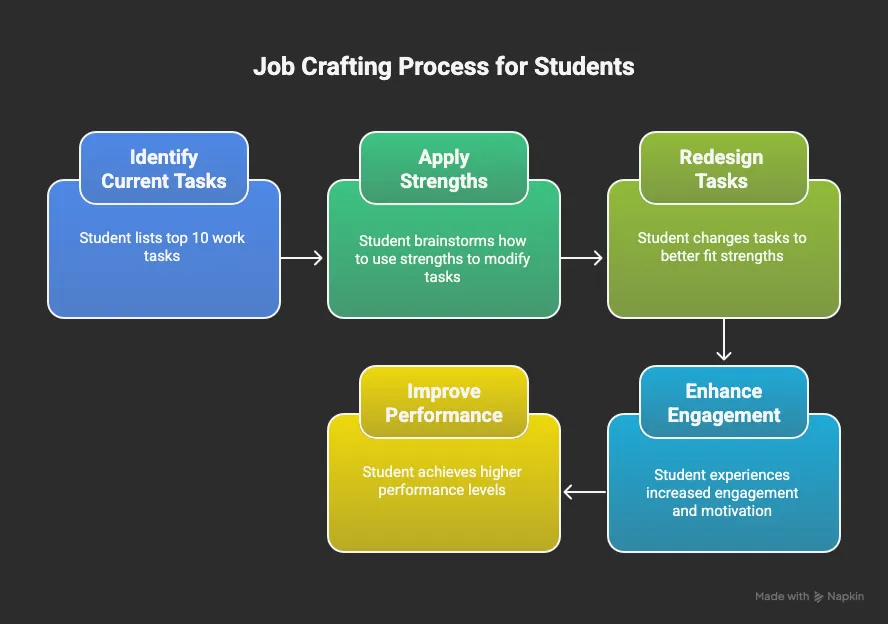
Implement a Strengths-Based Job Crafting exercise. Job Crafting is the psychological process where an individual proactively redesigns their job's tasks, relationships, and perceptions to better fit their personal strengths and motivations, leading to higher engagement and performance according to research from Wrzesniewski and Dutton.
The Activity: The Task/Talent Remap
This works well for students feeling bored or overwhelmed in a role (e.g., resident advisor, library clerk).
- List All Tasks: Student lists their top 10 current work tasks (e.g., "answer phones," "shelve books," "plan activities")
- Apply Strengths: For each task, the student identifies a different Top 5 strength and brainstorms how to apply it to change the task.Example: A student with Restorative who answers phones (a Transactional Task) might craft their role by offering to handle complicated complaint calls that others avoid. Result: They change the task from "routine answering" to "complex problem-solving." Studies show that this type of strengths-based job crafting is positively related to employee creativity and job self-efficacy, according to findings published in Frontiers in Psychology.
Facilitation format
- Best for: Student employment, campus jobs, RA training, internships, leadership roles
- Time needed: 20-30 minutes
- Materials: Current role description, task list, strengths results or reflection prompts
- Student output: A 2-week job-crafting experiment tied to one task, relationship, or role expectation
- Advisor follow-up: Ask the student what changed after the experiment and whether the new task created stronger resume or interview evidence
Also Read: How can career centers prepare students for AI-driven interviews?
How do I coach authentic, unscripted behavioral answers?
Use the Achievement Story Excavation activity. The goal is to deeply connect a student's feeling of success and energy with the resulting quantifiable accomplishment, making their interview answers authentic, spontaneous, and less like a scripted STAR method response.
The Activity: The "Energy Audit"
- Identify High-Energy Moments: Ask the student to list five accomplishments they felt genuinely energized while completing, regardless of whether it was academic or extracurricular.
- Theme Identification: Coach the student to identify the exact strengths that were activated in that moment (e.g., "I loved taking charge" = Command).
- Quantify & Translate: The final step is to refine the story into the Result-Action-Talent structure. This transforms generic stories into powerful responses. For example, instead of a simple description, the student states: "Using my Activator strength, I proposed a new social media strategy for my club that increased membership applications by 30% in one semester," which follows the highly persuasive formula of quantifying impact.
Facilitation format
- Best for: Interview prep, senior transition coaching, internship search support, confidence-building appointments
- Time needed: 25-35 minutes
- Materials: Resume draft, strengths results or reflection prompts, target role or interview question set
- Student output: 2-3 behavioral stories mapped to strengths, actions, and outcomes
- Advisor follow-up: Test whether the student can tell each story naturally without sounding scripted
Also Read: What activities can career centers use to build student professionalism?
What truly creates psychological safety in student teams?
The Strengths Manifesto (or "Personal User Manual"). This activity quickly establishes psychological safety by encouraging individuals to share how they prefer to work and what they need from others, using strengths language.
The Activity: My Strengths Manifesto
Students complete and share four short, powerful statements with their team (e.g., a student government board or capstone project team):
- You get the best of me when... (e.g., ...I have the big-picture goal and clear deadlines [Focus].)
- You get the worst of me when... (e.g., ...I am pulled into endless meetings without a clear agenda [Deliberative].)
- You can count on me to... (e.g., ...find the perfect data point or fact to support our decision [Input].)
- What I need from you is... (e.g., ...direct, candid feedback, as I appreciate efficiency [Communication].)
Facilitation format
- Best for: Student organizations, project teams, leadership retreats, peer mentor programs, RA teams
- Time needed: 30-45 minutes
- Materials: Strengths results or reflection prompts, team discussion worksheet
- Student output: A one-page personal user manual that explains working style, stress triggers, and collaboration needs
- Advisor follow-up: Revisit the manifesto after a team project, conflict, or major deadline to see whether students used it in practice
Why this works: When teams focus on strengths, they report 23% higher employee engagement and 18% increased performance in professional settings, according to Gallup research. This exercise is the college-level equivalent, building the trust needed for collaborative success.
Also Read: Workshop Scripts Advisors Can Use to Create Verifiable Student Outcomes
How do I run a high-stakes, strengths-based mock interview?
Conduct a Targeted Strength-Based Simulation focused on a specific competency domain, such as Influencing (themes like Command, Communication, Woo, Activator). Instead of what a student did, the questions focus on how they feel and what energizes them, which is a method designed to identify a candidate's natural aptitude and potential, according to TargetJobs.
The Activity: The Domain Deep Dive
- Select a Domain: Advisors must choose a domain relevant to the student's field (e.g., Influencing for sales/marketing, Strategic Thinking for consulting).
- Ask "Flow" Questions: Use rapid-fire questions that assess energy, not just history:"What do you love talking about so much that time flies by?""What do you find draining or tiresome in a team setting?""Would you rather be giving a presentation or double-checking data?"
- The Debrief: The focus of the debrief is not on right/wrong answers, but on the enthusiasm, tone, and body language the student exhibited when discussing an activity powered by their strengths, as interviewers are often trained to look for these verbal and body language clues to assess engagement and motivation, according to research from The University of Manchester Careers Service.
Facilitation format
- Best for: Mock interviews, competitive internships, sales/consulting/leadership roles, graduate program interviews
- Time needed: 30-45 minutes
- Materials: Target role description, interview question bank, strengths results or reflection prompts
- Student output: A role-specific interview strategy showing what energizes the student and how that connects to employer needs
- Advisor follow-up: Compare the student’s strongest answers against the target role’s required competencies
Also Read: Mock Interview Rubric for Advisors: Scoring Framework & Examples
Can these activities work without a formal strengths assessment?
Yes. Career centers can run these activities even if students have not completed a formal strengths assessment. If students do not have CliftonStrengths results, advisors can use reflection prompts, peer feedback, past accomplishments, favorite projects, supervisor comments, or energy audits to identify recurring behavioral patterns.
The goal is helping students notice what they repeatedly do well and connect that pattern to career-ready evidence.
Advisors can ask:
- What work do you do well without being pushed?
- What do people consistently thank you for?
- What tasks make you feel focused rather than drained?
- What role do you naturally take in group projects?
- What kind of problem do you enjoy solving?
- What feedback have you heard more than once?
This makes strengths-based coaching more flexible. It can work in a formal strengths workshop, a 15-minute appointment, an internship prep session, or a resume review.
Where can career centers use strengths activities?
Strengths activities work best when they are connected to a real student milestone. Career centers can use them in:
- First-year career exploration courses
- Career coaching appointments
- Resume and LinkedIn workshops
- Mock interview preparation
- Internship preparation programs
- Student employee training
- Resident assistant development
- Peer mentor programs
- Student organization retreats
- Leadership certificate programs
- Capstone or project-team kickoff sessions
- Senior transition programs
The format can shift based on time. In a 15-minute appointment, the advisor might translate one strength into one resume bullet.
In a workshop, students might complete a full matrix and peer-review each other’s examples. In a leadership retreat, teams might build and share Strengths Manifestos.
The strongest programming does not treat strengths as a one-time workshop. It connects strengths to visible student outputs: resumes, interviews, team communication, role decisions, and career action plans.
Wrapping Up
The real power of strengths work shows up when students can connect who they are to what they can actually do - in a resume line, an interview moment, a campus job, or a team dynamic.
When those connections click, confidence rises, opportunities open, and students start making choices that fit.
If you’re looking for tools that reinforce this kind of growth beyond the workshop - from exploration and job-matching to polished application materials and interview practice, Hiration brings those elements together in one place.
It gives students round-the-clock support, and gives counselors a clearer, more streamlined way to guide their cohorts and track progress.
Strengths help students understand themselves. The right systems help them show it.
StrengthsFinder Activities — FAQ
How do career centers turn strengths into employer-recognized skills?
Use a NACE Competency Translation workshop where students map Top 5 themes to specific NACE Career Readiness behaviors, then convert the mapping into resume bullets and interview-ready language.
What is a practical strengths activity for students with campus jobs?
Run a Strengths-Based Job Crafting exercise where students list current tasks, assign a strength to each task, and redesign how they execute the work so it becomes more engaging and more measurable.
How can students create stronger, less scripted interview stories?
Use an Achievement Story Excavation activity where students identify high-energy accomplishments, name the strengths driving the behavior, and translate the story into a quantifiable Result-Action-Talent structure.
What strengths activity improves teamwork and psychological safety?
Have teams complete a Strengths Manifesto, also called a Personal User Manual, where each student shares how they work best, what drains them, what others can count on, and what they need from teammates.
How do strengths-based mock interviews differ from traditional mock interviews?
Strengths-based interviews focus on what energizes a student and how they naturally operate, using rapid “flow” questions and debriefing enthusiasm, tone, and clarity instead of only scoring STAR structure.
Can Hiration support strengths work beyond a workshop?
Yes. Hiration supports exploration and job matching, resume and cover letter building, interview practice with feedback, and LinkedIn optimization, helping students apply strengths insights consistently across the job search.