How can career centers engage alumni beyond mentorship programs and speaker panels?
Career centers can make alumni engagement more scalable by using low-friction formats such as alumni office hours, career story series, pre-recruiting roundtables, flash-feedback sessions, and warm-introduction campaigns. These models reduce staff burden, improve student access to industry insight, and create measurable touchpoints that support career clarity, confidence, networking, and readiness.
Career centers often rely on alumni mentorship programs and speaker panels as default engagement formats, but both models can break down at scale.
Formal mentorship requires heavy matching, follow-up, and expectation management, while one-off panels often leave students listening passively without building real career clarity or connections.
That matters because alumni engagement is not just a “nice-to-have” programming add-on.
When designed well, it can expand access to industry insight, strengthen student confidence, support underrepresented students, and give career centers more scalable ways to connect students with the hidden rules of hiring.
This guide covers 5 scalable alumni engagement formats beyond mentorship and panels, plus the metrics career centers can use to measure real student value.
Why Alumni Engagement Needs More Than Mentorship & one-off speaker panels
Traditional mentorship programs require high-effort matching, while one-off panels suffer from passive student attendance and low engagement. Career centers must adopt scalable, bite-sized alumni interaction models to provide hyper-targeted, equity-driven career guidance without overloading staff resources.
Standard "sage on a stage" alumni panels yield passive listening, while formal, year-long mentorship matches frequently collapse due to asymmetrical expectations and scheduling friction.
According to data from a student engagement analysis published by uConnect, nearly 50% of college students visit their career center only once or not at all during their enrollment, and 30% never interact with it at all.
The underlying issue is not student apathy; it is structural fragmentation.
When your staff faces severe bandwidth constraints, managing high-maintenance mentorship pipelines prevents you from deploying agile, inclusive programming.
To reverse this trend, career services teams must build low-friction, high-impact experiential touchpoints that match modern workplace dynamics.
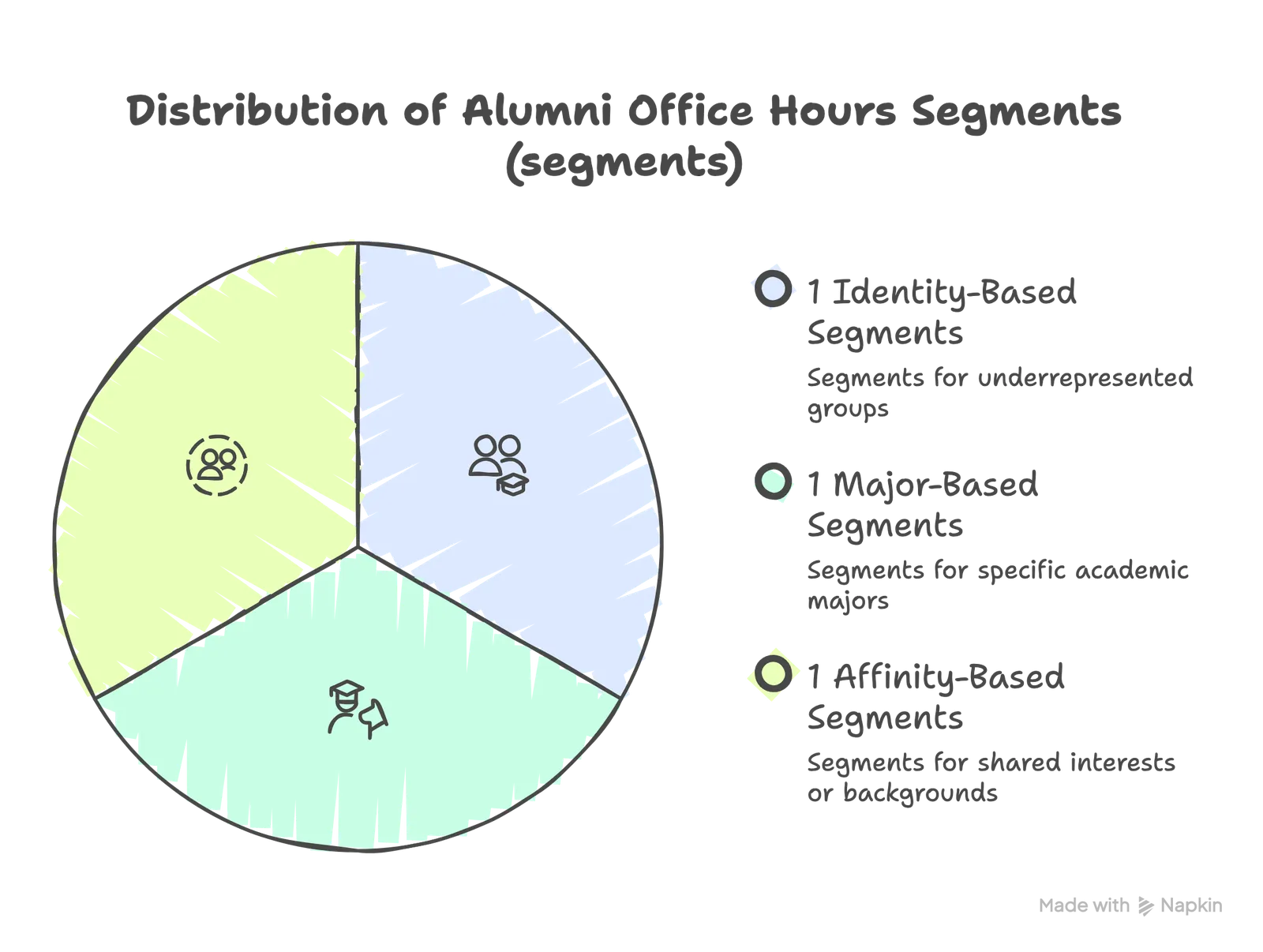
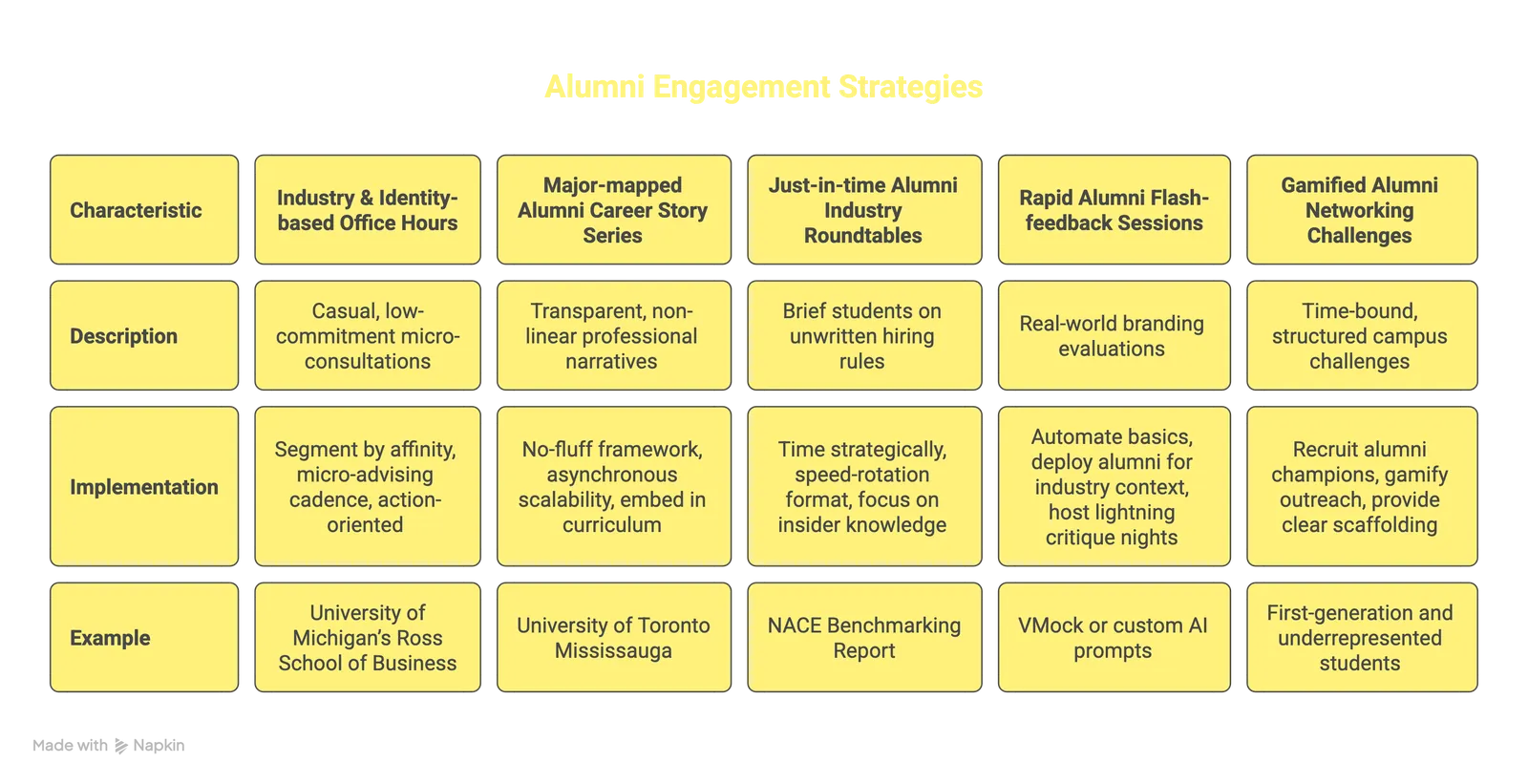
Idea 1: Industry & Identity-based Alumni Office Hours
Alumni office hours replace formal networking with casual, low-commitment micro-consultations. By offering 15-to-30-minute drop-in slots tailored to specific majors or affinity groups, career centers eliminate matching friction.
This format provides students with accessible, identity-affirming industry insights while significantly lowering the administrative burden on staff.
Alumni office hours eliminate the barriers of formal networking. Instead of forcing a student to initiate a cold LinkedIn message, you provide an open, structured space for targeted dialogue.
Implementation Playbook
- Segment by Affinity and Identity: Create specific intersections. Group alumni by identity markers or shared experiences to support historically underrepresented populations.
- Establish a Micro-Advising Cadence: Use booking platforms to let alumni claim a 2-hour monthly block divided into 15- or 20-minute rapid-fire slots.
- Keep it Action-Oriented: Frame these sessions around discrete questions (e.g., "What does a daily routine look like in corporate sustainability?").
A prime example is the University of Michigan’s Ross School of Business, which runs a dedicated Alumni Office Hours program.
Alumni work one-on-one with students on a short-term volunteer basis to tackle real-time informational interviews, career questions, or resume deep-dives.
Similarly, according to the Hiatt Career Center at Brandeis University, their "Rise Together" network intentionally segments connections into identity-focused affinity hubs (such as First-Generation Students, LGBTQI+, and Students of Color).
This structure gives students direct, low-stakes access to professionals who share their lived experiences.
Idea 2: Major-mapped Alumni Career Story Series
An alumni career story series deconstructs career uncertainty by delivering transparent, non-linear professional narratives. Delivered asynchronously via short-form videos or live Q&As, these sessions show students exactly how abstract academic majors translate into modern roles, helping them map realistic and actionable career paths forward.
Students regularly struggle to see how an abstract humanities or sciences major translates into a concrete, modern job title.
A structured career story series deconstructs this confusion by highlighting non-linear career trajectories.
Implementation Playbook
- Enforce a "No-Fluff" Framework: Instruct alumni speakers to skip the generic corporate pitch. Force them to detail a specific career pivot, an early-career failure, or the exact skills they used from their major.
- Prioritize Asynchronous Scalability: Do not limit these insights to students who can attend at 6:00 PM on a Tuesday. Record 3-minute lightning videos focused on "How I used my History degree to become a Data Analyst."
- Embed in the Curriculum: Partner with faculty to share these specific multimedia stories directly within relevant departmental newsletters or introductory course syllabi.
Look at the University of Toronto Mississauga, which hosts the Career Centre Networking Series (CCNS). This initiative brings back recent grads (1-5 years out) to share their direct journeys from university life to early professional success.
Because the programming focuses on specific academic departments, it allows current students to visualize realistic, immediate next steps for their own majors.
Also Read: How Do You Turn Faculty & Alumni into a Career Readiness Network?
Idea 3: Just-in-time Alumni Industry Roundtables Before Recruiting Cycles
Strategically scheduled two to four weeks before campus career fairs, these roundtables leverage alumni to brief students on unwritten hiring rules.
This targeted preparation builds student confidence, demystifies fast-moving application timelines, and boosts hiring outcomes right before major seasonal corporate recruiting cycles actively kick off.
Timing your alumni programming is just as important as the content itself. Standard networking events hosted mid-semester offer little value to a student staring down an intense, fast-moving recruiting deadline.
Implementation Playbook
- Time it Strategically: Align your roundtables perfectly with seasonal hiring curves. According to the NACE Benchmarking Report, 93.9% of career centers host their primary career fairs in person. Run your roundtables 14 to 21 days before these massive events.
- Utilize a Speed-Rotation Format: Divide your event space into sector-specific tables (e.g., FinTech, Healthcare, Public Policy). Move student cohorts through 15-minute rotations.
- Focus on Insider Knowledge: Task your alumni with revealing the "hidden" aspects of the application process, such as specific keywords corporate recruiters look for, or typical timeline expectations.
By positioning alumni as structural preparation partners rather than employers, you lower student anxiety and give them an insider edge before they step onto the competitive career fair floor.
Idea 4: Rapid Alumni Flash-feedback Sessions for Professional Branding
These rapid, 10-minute critique sessions match students with industry-specific alumni for real-world branding evaluations.
Instead of basic formatting checks, alumni provide market-validated feedback on technical portfolios, resumes, and LinkedIn profiles.
This setup transforms routine reviews into high-impact, dynamic networking opportunities for students.
Implementation Playbook
- Automate the Basics First: Let technology handle the first layer of resume and profile review, such as formatting, missing sections, keyword gaps, and basic clarity issues, so alumni can focus on industry-specific positioning, portfolio strength, and market relevance.
- Deploy Alumni for Industry Context: Use your human alumni network for deep, contextual positioning. A marketing student needs a creative director to critique their portfolio layout, not just an advisor checking for typos.
- Host Lightning Critique Nights: Run fast-paced "Flash Feedback" events where students sit with 3 different alumni for 10 minutes each, receiving rapid, diverse perspectives on their professional branding.
This approach lightens the administrative load on your staff and turns routine review sessions into active, organic networking opportunities where alumni frequently flag top student talent for internal roles at their own companies.
Idea 5: Gamified Alumni Networking Challenges & Warm-introduction Campaigns
This approach gamifies the traditional networking process into time-bound, structured campus challenges where students secure real connections.
By linking students with pre-vetted alumni "champions" who have explicitly opted in to open corporate doors, career centers convert abstract networking advice into tangible social capital.
Passive directories and alumni databases rarely work when left entirely to the student's own devices. Students often stall out due to imposter syndrome or a lack of clear direction.
Implementation Playbook
- Recruit Dedicated "Alumni Champions": Build a cohort of alumni who explicitly agree to accept three warm, staff-brokered student introductions per semester.
- Gamify the Outreach Process: Launch a time-bound "Networking Challenge" across campus. Give students a clear, step-by-step track: complete an informational interview workshop, draft a customized outreach template, and conduct two conversations.
- Provide Clear Scaffolding: Equip students with structured conversation scripts and conversation trackers so they can lead professional, confident discussions.
By transforming a vague networking concept into a tangible, time-sensitive challenge, you create an active pipeline of social capital.
This structure directly breaks down the barriers of the hidden job market for first-generation and underrepresented students.
What metrics should career centers use to track the ROI of alumni engagement?
Track alumni engagement ROI by shifting from lagging placement data to real-time leading indicators like repeat student attendance, connection response rates, and skill acquisition.
By monitoring these operational touchpoints alongside qualitative feedback on relationship quality, career centers can identify high-impact event formats and optimize resource allocation to maximize student career readiness.
Relying purely on annual First-Destination Surveys is a reactive strategy. To understand whether your alumni programming is moving the needle, you must capture real-time behavioral data.
As outlined in uConnect’s analysis of the higher education accountability era, career engagement serves as an institutional leading indicator for student retention, graduation rates, and long-term earnings.
| Metric Type | What to Measure | How to Track It |
|---|---|---|
| Engagement Depth | Percentage of unique versus repeat student participants across niche alumni engagement activities | Event check-in software, registration data, and career center CRM records |
| Network Velocity | Total volume of student-to-alumni connection requests and the percentage that receive responses | Mentoring platform analytics, LinkedIn follow-up surveys, or alumni networking tools |
| Skill Progression | Pre- and post-event changes in student confidence, industry understanding, and career literacy | Short digital pulse surveys deployed immediately before and after flash-feedback or mentoring sessions |
| Alumni Retention | Percentage of alumni volunteers who return for a second or third micro-engagement opportunity | Volunteer tracking systems, CRM history, and annual alumni engagement scorecards |
Stop tracking simple attendance headcounts. Focus instead on measuring true interaction density.
When you prove that micro-engagements directly increase a student’s career confidence and expand their professional network, you can confidently secure greater institutional support and external funding for your career center.
Also Read: How Career Centers Can Show ROI Through Retention, Readiness & Outcomes
Wrapping Up
Alumni engagement works best when it is connected to a broader career readiness system, not treated as a standalone event calendar.
Office hours, flash-feedback sessions, career story series, and warm-introduction campaigns can all create stronger student access to alumni insight, but the real value comes from tracking who participates, what students learn, and how those interactions shape next steps.
That is where technology can support the workflow behind the programming.
Hiration offers a full-stack career readiness suite that spans Career Assessments, AI-powered Resume Optimization, Interview Simulation, LinkedIn Optimization, and more, along with a dedicated Counselor Module to manage cohorts, workflows, and analytics within a secure, FERPA and SOC 2-compliant platform.
The goal is a more connected system where alumni insight, student readiness, and measurable outcomes work together.
Alumni Engagement Ideas for Career Centers — FAQs
Why should career centers move beyond mentorship and panels?
Formal mentorship programs can be hard to manage at scale, while one-off panels often leave students listening passively without building useful connections or career clarity.
What are alumni office hours?
Alumni office hours are short, low-commitment advising sessions where students can ask targeted questions about industries, roles, identities, or career paths.
How do alumni career story series help students?
Career story series help students understand how majors connect to real roles by showing non-linear alumni pathways, career pivots, and practical skill use.
When should alumni industry roundtables be scheduled?
Roundtables work best two to four weeks before career fairs or major recruiting cycles, when students need insider context and tactical preparation.
What are alumni flash-feedback sessions?
Flash-feedback sessions are short critique meetings where alumni provide industry-specific feedback on resumes, LinkedIn profiles, portfolios, or professional branding.
Why should technology handle basic resume review first?
Automating first-pass checks allows alumni to focus on market relevance, positioning, portfolio strength, and industry-specific feedback instead of basic formatting.
What are warm-introduction campaigns?
Warm-introduction campaigns connect students with pre-vetted alumni champions who have agreed to accept structured student introductions during a set period.
How can alumni engagement support underrepresented students?
Identity-based office hours, affinity networks, and guided warm introductions can help students access career insight and social capital they may not already have.
What metrics should career centers track for alumni engagement?
Useful metrics include repeat attendance, connection response rates, interaction density, student confidence gains, follow-up actions, and career readiness movement.
What is the biggest strategic shift in alumni engagement?
Career centers must move from passive alumni events toward structured, measurable, low-friction engagement models that connect alumni insight to student action.