What should a career center strategic plan include?
A career center strategic plan should define the priorities, goals, initiatives, owners, KPIs, targets, timelines, and review cadence that will guide the center’s work over the next 12 months and beyond. Strong plans begin with a current-state audit, connect career services to institutional goals, select three to five strategic priorities, translate those priorities into measurable outcomes, and assign ownership for implementation. Common priorities include earlier student engagement, career readiness evidence, employer access, equity and access, staff capacity, skills-based readiness, AI literacy, internship access, career communities, and leadership reporting. The plan should then become a 12-month roadmap that sequences audits, pilots, scaling, measurement, and reporting.
Career center leaders are often asked to set ambitious goals around student engagement, career readiness, employer access, and post-graduate outcomes.
The challenge is turning those priorities into a plan your team can actually execute.
This guide is designed for career services teams building or refreshing that plan. It provides a practical career center strategic plan template, examples of goals and priorities, a step-by-step planning process, real university strategic-plan examples, and a framework for measuring progress and turning strategy into a 12-month roadmap.
Career Center Strategic Plan Framework at a Glance
A practical strategic plan should make seven things visible for every priority: the goal, the initiative, the owner, the KPI, the target, the timeline, and when progress will be reviewed.
| Planning Area | Strategic Question | What to Define | Example Output |
|---|---|---|---|
| Institutional Alignment | Which university priorities should career services actively support? | Retention, enrollment value, graduate outcomes, equity goals, employer partnerships, and institutional strategy alignment | Connect sophomore career engagement to internship readiness, persistence, and long-term student success goals |
| Student Readiness | What should students be able to demonstrate at each stage of the student journey? | Career milestones, observable behaviors, readiness evidence, and developmental expectations | All sophomores complete a resume, career assessment, LinkedIn profile, and internship-search plan |
| Employer Strategy | Which employer relationships and hiring pipelines matter most? | Priority industries, regional employers, alumni employers, hiring demand, and recruiting partnerships | Build 25 active employer partners across healthcare, finance, technology, and public service sectors |
| Equity and Access | Which students are missing high-value opportunities or support? | Target student cohorts, engagement gaps, participation barriers, and intervention strategies | Increase first-generation student participation in mock interviews and employer engagement events |
| Operations and Staffing | What staffing model and operational capacity are required to execute the strategy? | Ownership, workflows, peer-support structures, automation opportunities, and staffing needs | Move first-pass resume reviews into a peer- and technology-supported workflow model |
| Measurement | How will progress, outcomes, and operational health be reviewed consistently? | KPIs, reporting cadence, ownership, dashboards, and intervention triggers | Quarterly review of engagement, readiness, internship conversion, and outcomes by academic college |
The specific targets should come from your institution's current baseline. What should remain consistent is the connection between a strategic priority, clear ownership, and a measurable way to judge progress.
What Does a Completed Career Center Strategic Plan Template Look Like?
A completed career center strategic plan should show how institutional priorities translate into measurable initiatives with clear ownership and deadlines. The example below connects three priorities to baselines, targets, responsibilities, and review schedules. All figures are illustrative and should be replaced with institution-specific data before the plan is approved.
Given below is an example of a completed strategic plan:
| Strategic priority | Baseline and annual target | Initiative and owner | Measurement and review |
|---|---|---|---|
| Earlier student engagement | Baseline: 28% sophomore milestone completion. Target: 45%. | Embed resume and internship preparation assignments in six sophomore courses. Owner: Career Education Lead. | Completed milestones by college; monthly review. |
| Employer access | Baseline: 12 repeat employer partners. Target: 20. | Develop regional and alumni employer partnerships. Owner: Employer Relations Director. | Active partnerships and opportunities generated; quarterly review. |
| Staff capacity | Baseline: 12-day initial resume review turnaround. Target: 5 days. | Introduce guided self-review and advisor escalation criteria. Owner: Operations Manager. | Median turnaround and unresolved cases; monthly review. |
How Should Career Centers Use This Template?
For each priority, record the baseline's data source, the resources required, and any dependencies such as faculty approval or technology procurement. Targets that depend on unapproved funding should be marked conditional.
At quarterly reviews, the initiative owner should recommend whether to continue, expand, redesign, or stop the activity. The director should document the decision, responsible person, and next checkpoint.
This creates an accountable planning document rather than a list of aspirations. It also gives university leadership a clear view of what the center is committing to deliver and what support those commitments require.
How Should Career Centers Create a Strategic Plan?
Career centers should create a strategic plan by moving from diagnosis to priorities, measurable goals, ownership, and implementation.
- Audit the current state. Review student engagement, service demand, career-readiness indicators, employer activity, staffing capacity, technology adoption, equity gaps, and first-destination outcomes.
- Map career services to institutional priorities. Identify where the center can reasonably support priorities such as student success, experiential learning, retention, access, graduate outcomes, or the value of the degree.
- Choose 3-5 strategic priorities. Select the areas where meaningful change over the next 12-36 months would improve student access, readiness, opportunity, or delivery capacity.
- Translate priorities into measurable goals. Instead of “increase student engagement,” specify the cohort, behavior, milestone, or outcome you want to change.
- Assign ownership, KPIs, and targets. Give every initiative an owner, baseline, target, and small set of indicators.
- Build the 12-month roadmap. Sequence what will be audited, piloted, scaled, reviewed, and reported so the strategy moves into execution.
What Goals Should Career Centers Include in a Strategic Plan?
Career center strategic goals should identify the student group or service being improved, the change expected, and how progress will be measured. Most plans can organize goals into five areas: earlier student engagement, career readiness evidence, employer access, equity, and staff capacity. Each goal should connect to an initiative the team can realistically deliver.
1. Earlier student engagement
Many career centers are moving away from senior-year urgency and toward earlier career readiness milestones. Instead of waiting for students to request help when they need an internship or full-time job, the plan should define what students should complete by the end of each year.
Example goals:
- First-year students complete a career exploration activity.
- Sophomores complete a resume milestone and internship readiness checklist.
- Juniors complete at least one mock interview or employer engagement activity.
- Seniors complete a job-search plan, application tracker, or graduate school plan.
2. Career readiness evidence
Career readiness should be measured through observable student outputs, not just participation.
Example goals:
- Increase role-aligned resume completion.
- Increase mock interview completion and improvement.
- Increase students who can articulate competency-backed examples.
- Increase LinkedIn/profile completion for target cohorts.
- Increase completion of career plans or job-search milestones.
3. Employer access and opportunity
A strategic plan should define which employer relationships matter most and how those relationships support student outcomes.
Example goals:
- Expand employer partnerships in priority industries.
- Increase interview opportunities from employer events.
- Improve employer engagement for underrepresented majors.
- Build regional and alumni employer pipelines.
- Increase internship access for students in programs with limited employer connections.
4. Equity and access
Career services should not rely only on students who already know how to find support. A strategic plan should identify which students are missing high-value services and what the center will do differently.
Example goals:
- Increase first-generation student participation in career readiness milestones.
- Increase Pell-eligible student access to paid internships.
- Reduce gaps in mock interview participation by college or student group.
- Expand proactive outreach for commuter, transfer, or working students.
- Track engagement and outcomes by student group where data is available and appropriate.
5. Staff capacity and scalable support
Strategic plans should acknowledge capacity. A goal that requires more advising, more employer outreach, more reporting, and more student engagement will fail if the staffing model and technology are not aligned.
Example goals:
- Reduce first-pass resume review time through peer or technology-supported workflows.
- Decrease appointment wait times during peak recruiting periods.
- Increase self-service completion before one-on-one advising.
- Improve advisor visibility into student progress.
- Standardize workflows for cohorts, workshops, and follow-up.
Also Read: Which benchmarks should college career centers track to measure and improve impact?
What Strategic Priorities Should a Modern Career Center Set?
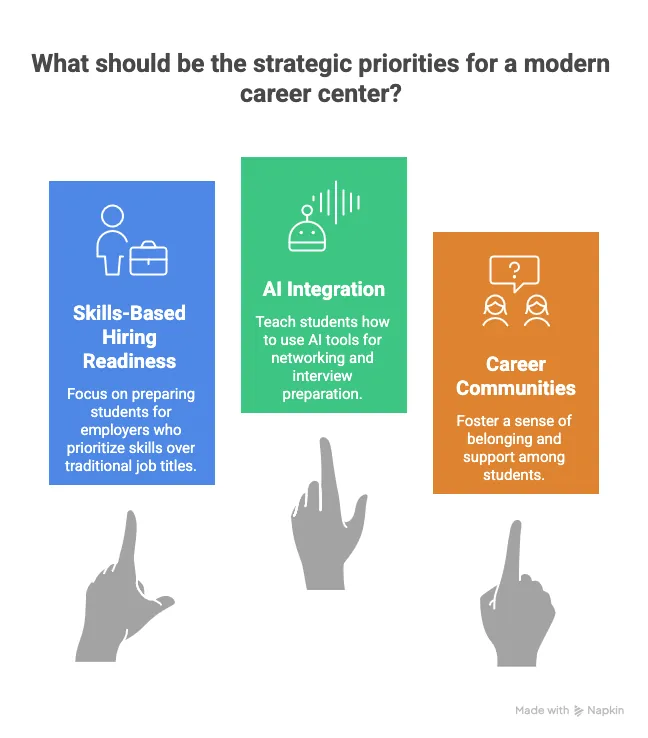
Strategic priorities should include scaling "Skills-Based Hiring" readiness, embedding AI tools into the career discovery process, and fostering "Career Communities." These priorities ensure that the center is not a siloed office but a ubiquitous campus presence that prepares students for a tech-heavy, skills-first workforce.
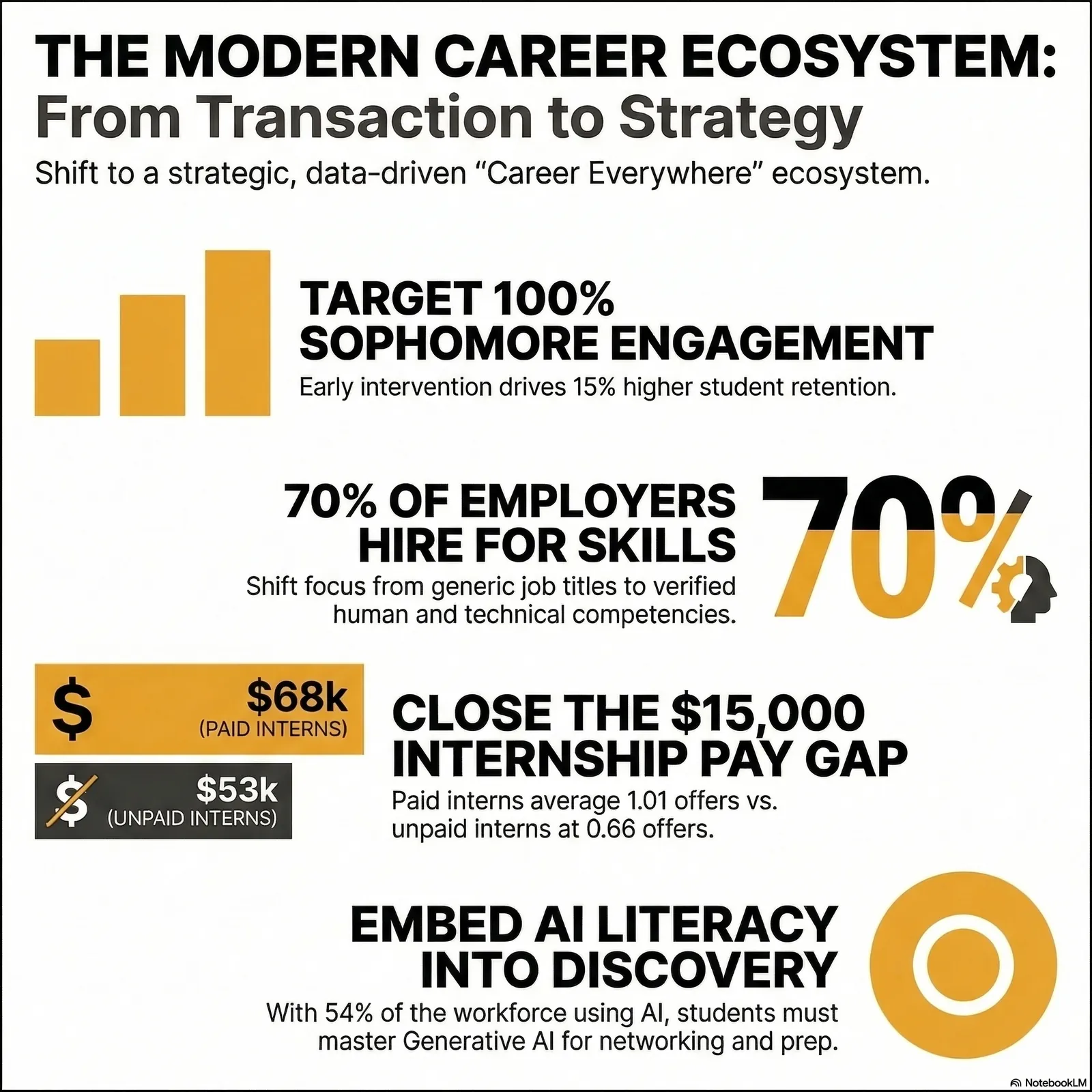
According to NACE’s Job Outlook 2026 survey, 70% of employers now use skills-based hiring practices, up from 65% just a year ago.
Priority 1: Build skills-based readiness into advising
Employers are increasingly evaluating students based on demonstrated skills, not only degrees or GPA. A career center strategic plan should therefore define how students will identify, build, and prove their skills across resumes, interviews, projects, internships, and employer conversations.
A practical initiative could be:
Skills Evidence Initiative
Every student in selected sophomore cohorts completes a skills evidence map connecting coursework, campus jobs, leadership, or projects to target roles.
Possible KPIs:
- students completing skills evidence maps
- resumes revised with skill-based bullets
- mock interview answers using competency-backed examples
- employer response rate after resume updates
Priority 2: Introduce AI literacy without weakening authenticity
AI should be part of career readiness, but it needs guidance. Students may use AI for resumes, cover letters, interview practice, and employer research, but they still need to verify, personalize, and defend every claim.
A practical initiative could be:
Responsible AI for Career Prep Module
Students learn how to use AI for job-description analysis, interview practice, and resume drafting while preserving accuracy and personal evidence.
Possible KPIs:
- students completing AI-use guidance
- students revising AI-assisted materials with advisor or rubric feedback
- students demonstrating accurate examples in mock interviews
- reduction in generic or unsupported resume claims
AI Readiness Self-Assessment for Career Teams
AI literacy belongs in a modern career center strategy, but it only works when guidance becomes clear shared standards your team can apply consistently. Use this 7-10 minute assessment to see where your AI approach stands, what is missing, and what your team should fix next.
- 7-10 minutes
- 6 operating areas
- 3 readiness levels
Priority 3: Improve internship access and affordability
Internship access should be part of the strategy because career outcomes are strongly shaped by experiential learning. The issue is not only whether students complete internships, but whether they can access high-quality, paid, relevant opportunities.
A practical initiative could be:
Internship Access and Funding Strategy
Identify majors or student groups with lower internship participation and build funding, employer, or micro-internship pathways to reduce access barriers.
Possible KPIs:
- internship participation by college and student group
- paid internship participation
- students receiving internship stipends
- employer partners offering accessible internship pathways
- internship-to-offer or internship-to-interview conversion where available
Priority 4: Build career communities or pathway clusters
Career communities help students explore careers by interest area instead of only by major. This is useful because students often pursue roles that do not map neatly to academic departments.
A practical initiative could be:
Career Communities Rollout
Create career communities around fields such as healthcare, technology, business, policy, education, creative industries, and social impact.
Possible KPIs:
- students joining career communities
- employer events by career community
- alumni mentors by pathway
- applications, interviews, or internships by community
- student movement from exploration to targeted search
Priority 5: Strengthen reporting and leadership visibility
A strategic plan should include a reporting cadence, but this page does not need to become a reporting-template page. Keep the focus on governance: who reviews progress, how often, and what decisions the data should inform.
A practical initiative could be:
Quarterly Strategic Review Cadence
Review a compact set of engagement, readiness, employer, equity, and outcome indicators with leadership each quarter.
Possible KPIs:
- quarterly review completed
- priorities adjusted based on data
- intervention plans created for stalled cohorts
- budget or staffing needs documented with evidence
Also Read: How should career center leaders structure teams, priorities, and data systems for impact?
What Do Real Career Center Strategic Plans Look Like?
Real career-center strategic plans use different priorities, but the strongest examples narrow broad ambitions into a small number of pillars and then connect those pillars to specific actions.
- Virginia Commonwealth University Career Services organizes its 2022-2026 strategic plan around four goals: Identity & Career; Career Readiness & Student Success; Collaboration & Access to Opportunity; and Sustainable Support & Intentional Growth. Each goal is broken into strategies and specific action items. See the VCU Career Services strategic plan.
- Swarthmore College Career Services describes its 2022-2025 plan as a “living” three-year plan that it revisits annually. Its pillars include embedding career development into the student experience, competency development, experiential learning, inclusive access, and partnerships. See Swarthmore's strategic plan.
- Imperial Valley College's Career Services Center says its 2024-2027 strategic plan followed a self-assessment based on NACE Professional Standards to examine strengths, improvement areas, equity practices, services, and effectiveness before setting priorities. See Imperial Valley College's strategic-plan overview.
The common pattern is not identical priorities. It is a clear line from current-state evidence → strategic priority → action → assessment and review.
Also Read: Career Center Capacity Planning: How to Manage Demand & Improve Access
How Should Career Services Align With University-Wide Outcomes?
Career services should connect its strategic priorities to institution-wide goals it can reasonably support, including student success, experiential learning, retention, graduate outcomes, access, and the value of the degree. The point is not to claim ownership of every university outcome, but to define where career services contributes and what evidence can be reported.
Look at Marquette University, which uses its Graduate First Destination Survey to report an 87% undergraduate career outcomes rate for the 2024-2025 cohort. The survey is produced jointly by the Office of Institutional Research and Analysis and the Career Center.
The strategic plan should make these connections explicit, but it should avoid overclaiming. Career services contributes to retention and outcomes, but it does not control every variable.
Also Read: Career Center Organizational Structure: How to Choose the Right Model
How Should Career Centers Measure Progress and Turn the Strategic Plan Into a 12-Month Roadmap?
Career centers should measure strategic-plan progress across the areas the plan is trying to change, including student engagement, career readiness, employer access, equity, staff capacity, and post-graduate outcomes. Each KPI should have a defined data source, owner, baseline, target, and review cadence.
Those measures should then feed directly into a 12-month roadmap that sequences what will be audited, piloted, scaled, measured, and reported. This turns the strategic plan from a set of priorities into an operating plan with clear milestones and accountability.
The table below is an example of a 12-Month Career Center Strategic Plan Implementation Roadmap.
The strategic priorities in the completed template can be implemented as connected workstreams instead of launching every initiative simultaneously.
This example assumes a July-to-June planning year, but career centers can adjust the sequence to match their academic calendar. Each quarter should end with a decision about what happens next.
| Timeline | Student engagement | Employer access | Staff capacity |
|---|---|---|---|
| Q1: July–September | Verify the 28% baseline and secure six faculty partners. | Audit existing employers and identify priority industries. | Establish turnaround baselines by request type. |
| Q2: October–December | Pilot assignments in two courses and review completion. | Begin targeted employer outreach and track opportunities. | Pilot guided resume reviews with one cohort. |
| Q3: January–March | Expand to six courses if pilot results support scaling. | Prioritize employers generating interviews or internships. | Expand successful triage procedures while monitoring quality. |
| Q4: April–June | Evaluate milestone completion against the 45% target. | Compare active partners against the target of 20. | Assess review turnaround against the five-day target. |
Initiative owners can review the operational progress monthly, with the director conducting a formal quarterly review.
If course participation increases without improvement in milestone completion, revise the assignment before expanding it. If employer meetings increase without producing student opportunities, reconsider the partnership criteria. If resume turnaround improves but unresolved cases increase, reassess the support model.
Record each decision, responsible owner, deadline, and required resources. The final quarter should produce a short evaluation of which initiatives met their targets, which need adjustments, and which should carry forward into the following year's strategic plan.
Also Read: Career Center Capacity Planning: How to Manage Demand & Improve Access
Wrapping Up
A strategic plan only works if career centers have the infrastructure to execute it at scale.
Supporting early engagement, skills-based hiring readiness, and outcome tracking requires tools that extend career guidance beyond one-on-one appointments.
Hiration helps make this possible by providing a full-stack career readiness suite - including career assessments, AI-powered resume optimization, interview simulation, and a dedicated counselor module to manage cohorts, workflows, and analytics, all within a secure, FERPA and SOC 2-compliant environment.
Book a walkthrough to see how Hiration can help your career center turn strategic priorities into measurable improvements in student engagement, career readiness, and advisor capacity.
Career Center Strategic Plan — FAQs
What should a career center strategic plan include?
A career center strategic plan should include strategic priorities, goals, initiatives, owners, KPIs, targets, timelines, data sources, review cadence, and a 12-month roadmap. It should connect career center work to student engagement, career readiness, employer access, equity, staff capacity, and post-graduate outcomes.
How should career centers create a strategic plan?
Career centers should create a strategic plan by auditing the current state, mapping career services to institutional priorities, choosing three to five strategic priorities, translating those priorities into measurable goals, assigning owners and KPIs, and building a 12-month implementation roadmap.
What should career centers audit before strategic planning?
Career centers should audit student engagement, service demand, career-readiness indicators, employer activity, staffing capacity, technology adoption, equity gaps, first-destination outcomes, and any manual work or process gaps that affect service delivery.
How many strategic priorities should a career center choose?
Career centers should usually choose three to five strategic priorities. This keeps the plan focused enough to execute while still covering the areas most likely to improve student access, readiness, opportunity, outcomes, and delivery capacity.
What goals should career centers include in a strategic plan?
Common goal categories include earlier student engagement, career readiness evidence, employer access and opportunity, equity and access, staff capacity, scalable support, internship access, skills-based readiness, AI literacy, career communities, and leadership reporting.
How can career centers set goals for earlier student engagement?
Career centers can set earlier engagement goals by defining what students should complete by class year. Examples include first-year exploration activities, sophomore resume milestones, junior mock interviews or employer engagement, and senior job-search or graduate-school plans.
How should career centers measure career readiness evidence?
Career centers should measure career readiness through observable student outputs rather than participation alone. Useful indicators include role-aligned resume completion, mock interview completion and improvement, competency-backed examples, LinkedIn or profile completion, and career plan or job-search milestone completion.
What employer access goals belong in a strategic plan?
Employer access goals may include expanding partnerships in priority industries, increasing interview opportunities from employer events, improving employer access for underrepresented majors, building regional or alumni employer pipelines, and increasing internship access for programs with limited connections.
How should equity and access appear in a career center strategic plan?
Equity and access should be built into the operating model. Career centers can track participation and outcomes by student group where appropriate, increase first-generation student engagement, expand paid internship access, reduce mock interview participation gaps, and support commuter, transfer, Pell-eligible, or working students through proactive outreach.
Why should staff capacity be part of strategic planning?
Staff capacity should be part of strategic planning because goals that require more advising, employer outreach, reporting, follow-up, and student engagement will fail if staffing, workflows, technology, and service models are not aligned with the expected workload.
What staff capacity goals can career centers include?
Staff capacity goals may include reducing first-pass resume review time, decreasing appointment wait times, increasing self-service completion before advising, improving advisor visibility into student progress, and standardizing workflows for cohorts, workshops, and follow-up.
What strategic priorities should a modern career center set?
Modern career centers should consider priorities such as skills-based readiness, responsible AI literacy, internship access and affordability, career communities or pathway clusters, stronger employer alignment, outcome visibility, and a quarterly reporting cadence for leadership decisions.
How can career centers build skills-based readiness into advising?
Career centers can build skills-based readiness by helping students identify, develop, and prove skills through resumes, interviews, projects, internships, employer conversations, and competency-backed examples. A practical initiative could require students to complete skills evidence maps for target roles.
How should AI literacy fit into a career center strategic plan?
AI literacy should help students use AI for job-description analysis, resume drafting, interview practice, and employer research while preserving accuracy, authenticity, and personal evidence. The plan should define guidance, review points, and KPIs for responsible AI use.
Why should internship access be a strategic priority?
Internship access should be a priority because experiential learning strongly affects student outcomes. Career centers should examine whether students can access paid, relevant, high-quality opportunities and whether certain majors or student groups face affordability, employer-access, or preparation gaps.
What are career communities in a strategic plan?
Career communities are pathway clusters that help students explore roles by interest area rather than only by major. They may be organized around fields such as healthcare, technology, business, policy, education, creative industries, sustainability, or social impact.
How should career services align with university-wide outcomes?
Career services should connect its priorities to institutional goals it can reasonably support, such as student success, experiential learning, retention, graduate outcomes, access, and the value of the degree. The plan should show contribution without overclaiming control over every outcome.
How should career centers measure strategic plan progress?
Career centers should measure progress across the areas the plan is trying to change, including student engagement, career readiness, employer access, equity, staff capacity, and post-graduate outcomes. Each KPI should have a data source, owner, baseline, target, and review cadence.
How should career centers turn a strategic plan into a 12-month roadmap?
Career centers should turn the plan into a 12-month roadmap by sequencing what will be audited, piloted, scaled, measured, reviewed, and reported. The roadmap should make ownership, milestones, timelines, and next decisions clear enough for the team to execute.
How can Hiration support career center strategic planning?
Hiration can support strategic execution through a full-stack career readiness suite covering career assessments, AI-powered resume optimization, interview simulation, and student preparation workflows. Its Counselor Module helps career teams manage cohorts, workflows, analytics, progress, and outreach within a FERPA and SOC 2-compliant environment.