How Can Career Centers Increase Student Attendance at Career Fairs?
Career centers can increase turnout by identifying where students disengage between hearing about the fair and arriving at it. Some students do not register because the event feels irrelevant; others register but remain unprepared or uncertain about attending. Segment promotion, involve trusted campus partners, create a manageable preparation path, remove day-of friction, and track conversion from awareness to registration, preparation, and attendance.
If your career center is struggling to get students through the door at career fairs, sending more reminders is unlikely to solve the problem.
Some students do not see employers relevant to them. Others register but stay home because they feel unprepared or are unsure what to expect.
Increasing attendance starts with identifying where students drop off between promotion, registration, preparation, and arrival.
This guide shows you how to diagnose that break, build a four-week attendance campaign, use faculty and campus partners, reduce day-of friction, and track which tactics improve turnout.
How Can Career Centers Diagnose Low Career Fair Attendance?
Career centers should diagnose the point at which student participation breaks down before adding more reminders or incentives. Low registrations, weak preparation completion, high no-show rates, and uneven attendance across student groups are different problems and require different responses.
| What You Are Seeing | Likely Break | What to Check | Best Response |
|---|---|---|---|
| Students view the event but few register | The fair’s relevance is unclear | Registration rate by major, class year, or student group | Promote specific employers, roles, skills, and reasons each group should attend |
| One college or student group is underrepresented | The event is not reaching students through trusted channels | Registration and attendance by student segment | Use faculty, academic advisers, student organizations, and campus partners |
| Students register but do not complete any preparation | The fair still feels intimidating or demanding | Resume-prep, employer-list, and workshop completion among registrants | Offer a short fair-ready plan that can be completed asynchronously |
| Registrations are healthy but no-shows are high | Logistics, scheduling, or uncertainty are preventing arrival | Registration-to-attendance rate and arrival patterns | Send calendar holds, maps, transportation details, accessibility information, and day-of reminders |
| Students attend but wander without engaging | Students arrived without a clear purpose | Target-employer saves, guided-tour participation, and student reflections | Give students a goal, employer shortlist, conversation prompts, and visible navigation support |
If the problem is that the employer mix or event format does not feel relevant, review whether an industry-specific, general, or hybrid career fair would better serve the intended student population.
What Should a Four-Week Career Fair Attendance Campaign Include?
A career fair attendance campaign should move students through a series of small commitments rather than asking them to register from a single announcement. Each phase should answer a different student question: Is this relevant to me? Should I attend? Am I ready? What should I expect when I arrive?
| Timing | Campaign Goal | Career Center Actions | Student Commitment |
|---|---|---|---|
| Four weeks before | Establish relevance | Publish participating employers, example roles, eligible class years, and the skills employers want | View the employer list and save the event |
| Two weeks before | Convert interest into registration | Send segmented employer highlights through faculty, advisers, student organizations, and campus channels | Register and save three to five relevant employers |
| One week before | Build readiness | Offer short resume, LinkedIn, employer-research, and recruiter-conversation preparation | Complete a basic fair-ready plan |
| Forty-eight hours before | Remove uncertainty | Send the location, map, transportation information, attire guidance, accessibility details, event hours, and arrival instructions | Add the fair to their calendar and choose an arrival time |
| Day of the fair | Support arrival and participation | Provide first-timer tours, peer ambassadors, conversation prompts, employer zones, and a visible help point | Check in and complete one personally relevant fair goal |
The purpose of this sequence is not to send more messages. It is to make the next action progressively easier and more relevant as the fair approaches.
How Can Pre-Fair Preparation Convert Interest Into Attendance?
Pre-fair preparation can convert interest into attendance by giving students a manageable plan for entering and navigating the event. Students do not need a perfect resume or exhaustive employer research before they can participate. They need enough preparation to understand why they are going, who they want to meet, and how to begin a conversation.
A minimum fair-ready plan should leave each student with:
- An updated resume
- Three to five priority employers
- A 20- to 30-second introduction
- Three questions they can ask recruiters
- A clear arrival and navigation plan
This preparation should be available through a mix of short workshops, asynchronous tools, peer support, and targeted advising. Students who need more specialized guidance can then receive additional support without making intensive preparation a prerequisite for everyone.
Actionable Strategies
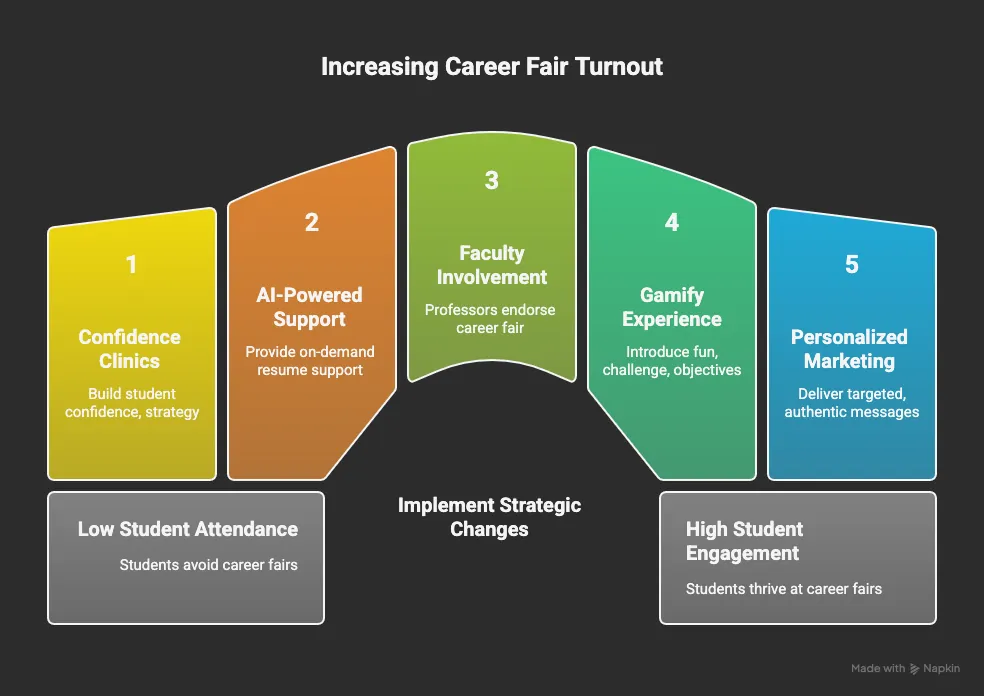
- Host "Confidence Clinics," Not Resume Reviews: Rebrand your prep sessions. Instead of just "Resume Reviews," host "Confidence Clinics" or "Career Fair Game Plan" workshops. Focus on building a strategy: how to approach a recruiter, what questions to ask, and how to follow up. Frame it around empowerment.
- Scale Preparation with On-Demand Support: Give students access to resume, LinkedIn, and interview-preparation tools outside office hours so they can complete an initial review independently. Advisors can then focus limited appointment time on employer targeting, confidence, legitimate exceptions, and the student’s career-fair strategy instead of basic corrections.
- Leverage Peer-to-Peer Power: Students often trust their peers as much as, if not more than, staff. Create a "Career Ambassador" program with trained upperclassmen. The University of Pennsylvania’s Peer Career Advisor program is a great model where students can get quick, low-stakes advice from fellow students, making the prep process far less intimidating.
Also Read: How to Prepare First-Generation Students for Career Fairs?
How Can Faculty and Campus Partners Increase Career-Fair Turnout?
Faculty and campus partners can increase turnout by making the fair relevant within spaces and relationships students already use. Career services should give each partner a specific reason their students should attend, not a generic flyer or a complete list of every employer at the event.
Different partners can activate different student groups:
| Campus Partner | What Career Services Should Provide |
|---|---|
| Faculty | Three to five employers, roles, or skill needs connected with the course or major |
| Academic advisers | Fair recommendations based on class year, academic program, and career stage |
| Student organizations | Employers and alumni connected with the group’s industry, identity, or interests |
| Residence Life | A simple first-year message explaining what students can gain even if they are not job searching |
| Cultural and identity centers | Relevant employers, affinity opportunities, accessibility information, and available support |
| International student services | Clear information about participating employers, opportunities, and questions students may want to investigate before attending |
Use trackable registration links for each partner where possible. This helps the career center determine which relationships are moving students from awareness to attendance.
Actionable Strategies
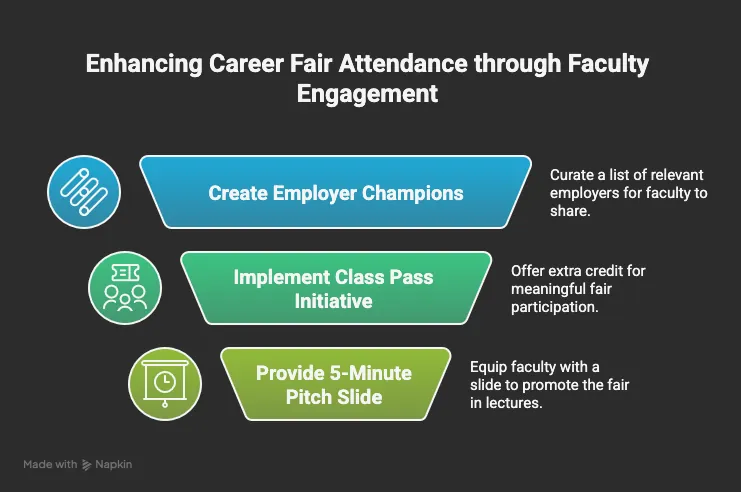
- Create Faculty Employer Briefs: Send department heads a curated list of three to five participating employers relevant to their students. Include example roles, desired skills, eligible class years, and any attending alumni. Make the information easy to paste into an LMS announcement or class email.
- Create a Course-Connected Fair Task: Give willing faculty a simple activity that connects the fair with course learning. Students might compare two employers’ skill requirements with course competencies or reflect on one employer conversation. If attendance is attached to course credit, provide an alternative for students who cannot attend.
- Provide a One-Slide Faculty Brief: Create one slide containing the event details, three relevant employers or opportunities, and a QR code linking to the targeted employer list. The slide should answer why students in that particular class should attend, not merely announce the fair.
Also Read:How Career Centers Can Build Faculty Partnerships That Scale?
How Can Career Centers Reduce Day-of Intimidation?
Career centers can make a career fair less intimidating by reducing uncertainty and giving students supported ways to enter the event. A student arriving for the first time should immediately know where to go, what to do first, and where to ask for help.
The University of Illinois Chicago College of Engineering uses First-Timer Tours to help first- and second-year students understand what happens inside a fair and become more comfortable navigating it. Career centers can adapt this model through scheduled and drop-in tours led by staff or trained student ambassadors.
Actionable Strategies
- Offer First-Timer Tours: Walk small groups through the venue, explain how recruiter conversations work, point out employer zones, and help each student choose a first booth.
- Create an Arrival Zone: Place peer ambassadors, employer maps, conversation prompts, and a visible help desk near the entrance. Where space permits, provide a quieter area where students can review their introduction or employer list before entering the main hall.
- Use Goal-Based Fair Passports: Replace a competition based on visiting the most booths with different missions based on student intent. A first-year student might speak with employers from three industries, while an internship seeker might meet three employers hiring for relevant roles.
- Provide Conversation-Starter Cards: Give students three specific questions they can adapt when approaching recruiters, such as “Which skills help interns contribute most quickly on your team?” or “What makes a student stand out after the career fair?”
- Use Peer Warm Handoffs: Position trained student ambassadors inside the fair to help hesitant students identify an employer and begin their first conversation.
These interventions give students structure without turning employer conversations into a race for prizes or check-ins.
Also Read: Career Fair Strategy for Career Centers: Preparation, ROI, and Metrics
How Should Career Centers Segment Career-Fair Promotion?
Career centers should segment promotion according to why each student group should attend. A complete list of employers may be useful after a student is interested, but it is rarely the strongest opening message. Lead with the employers, roles, experiences, or questions that make the event relevant to that particular group.
Actionable Strategies
- Send Targeted Employer Highlights: Instead of distributing the same employer list to everyone, create short selections based on academic program, skills, career interests, class year, or opportunity type. Include example roles and explain why each employer may be relevant.
- Use Trusted Campus Voices: Give faculty, advisers, student organizations, peer ambassadors, and relevant alumni ready-to-share material. An alumnus can explain what they gained from attending, while a faculty member can connect employer needs with work students are already doing in class.
- Use Social Content to Remove Uncertainty: Show the venue, check-in process, attire range, employer zones, first-timer support, and what a recruiter conversation looks like. The goal is to make the experience visible before asking students to enter it.
- Send Consent-Based Day-of Reminders: For students who have opted into SMS, app, or push notifications, send one concise reminder containing the location, event hours, arrival instructions, and employer-list link. Follow the institution’s communication and consent policies rather than relying on generalized channel open-rate claims.
Also Read: What Career Centers Should Post on TikTok and Instagram
How Should Career Centers Measure Whether Their Attendance Strategy Worked?
Career centers should measure each stage between promotion and attendance instead of looking only at total headcount. This reveals whether the problem was reach, relevance, preparation, no-shows, or uneven participation across student groups.
| Attendance Metric | Calculation or Data Source | What It Helps Diagnose |
|---|---|---|
| Employer-List View Rate | Unique employer-list viewers ÷ students reached | Whether promotion generated enough interest to investigate the fair |
| Registration Rate | Student registrations ÷ targeted student population | Whether students saw sufficient relevance to commit |
| Preparation Completion Rate | Registrants completing the fair-ready plan ÷ total registrants | Whether registered students moved from intention to readiness |
| Registration-to-Attendance Rate | Checked-in students ÷ registered students | Whether reminders, logistics, and commitment translated into arrival |
| Attendance by Student Segment | Attendees grouped by college, class year, program, or priority population | Which groups were reached or remained underrepresented |
| Campus Partner Contribution | Registrations and attendees attributed to partner-specific links | Which faculty and campus relationships influenced participation |
Compare these measures across fairs and student segments rather than treating one institution-wide percentage as a universal benchmark. Employer satisfaction, interview generation, follow-up, offers, and overall event ROI should be evaluated separately through the broader career-fair measurement framework.
Wrapping Up
Low career fair turnout is not one problem that can be solved with one more reminder. Students can disengage because they do not see relevant opportunities, do not feel prepared, do not encounter the event through a trusted campus voice, or do not know what to expect when they arrive.
Career centers can respond more intentionally by tracking the path from awareness to registration, preparation, and attendance. That makes it possible to apply the right intervention instead of adding more promotion everywhere.
Hiration supports this by giving students on-demand access to resume optimization, interview practice, and profile improvement, while also helping teams manage workflows and track engagement more effectively - all within a secure, FERPA and SOC 2-compliant platform.
When preparation becomes continuous rather than event-driven, career fairs shift from being one-off events to high-impact touchpoints in a student’s journey.
Student Attendance at Career Fairs - FAQ
Why do students skip career fairs?
Lack of confidence and uncertainty about what to say or how to approach recruiters deter attendance. First-generation and underrepresented students often face limited social capital, unclear processes, and low confidence that hinder engagement.
How does pre-fair preparation increase turnout?
Preparation reframes the event from threat to opportunity. When resumes, LinkedIn profiles, and elevator pitches feel ready, anxiety drops and students are more likely to show up and engage meaningfully with employers.
What pre-fair strategies work best?
Run “Confidence Clinics” focused on approach, questions, and follow-up; scale on-demand prep with AI so students iterate privately; and use peer advisors so students get quick, low-stakes feedback from trained upperclassmen.
How can faculty drive higher attendance?
Faculty endorsements carry outsized weight. Equip professors with curated employer lists aligned to their majors, offer a “Class Pass” extra-credit check-in task, and share a single slide with date, time, and QR to employers.
How to make a career fair feel less intimidating?
Gamify it. Clear objectives, quests, and rewards turn a static hall into an interactive experience, especially for earlier-year students who benefit from exploration without immediate job pressure.
What gamification tactics are effective?
Use a “Passport” challenge across employer zones, a live leaderboard of check-ins to create buzz, and conversation-starter cards at check-in so nervous students have specific, credible questions ready for recruiters.
Which marketing messages actually cut through?
Segment by major and send targeted employer lists with relevant roles; run alumni social takeovers for authentic previews; and deliver platform-native content students trust over generic, one-size-fits-all blasts.
What’s the most effective last-minute reminder channel?
Text messaging. SMS has a 98% open rate, far higher than typical email open rates like 26.8%, making it ideal for day-of reminders with a clear value proposition and link to the employer list.
How can first-gen and underrepresented students be better supported?
Clarify expectations and lower the social-capital barrier: provide step-by-step approaches, scripted starter questions, peer advising access, and structured tasks like the Class Pass to guide purposeful employer conversations.
What’s the core playbook to boost attendance fast?
Combine confidence-building prep, faculty activation with targeted employer alignment, and gamified, interactive elements; then amplify with segmented outreach and SMS reminders to convert interest into on-site engagement.