How can career centers prevent liberal arts underemployment after graduation?
Liberal arts underemployment can be prevented by intervening early with intentional career design, skill-stacking, and clear first-job targeting. By guiding students to pair liberal arts strengths with market-aligned skills, internships, and outcome-based narratives before senior year, career teams can help ensure the first post-grad role sets long-term direction rather than limiting future mobility.
Liberal arts students often graduate with strong writing, research, reasoning, communication, and analytical skills. The underemployment risk starts when those strengths remain too broad for employers to evaluate.
A student still needs a clear role target, applied experience, skill evidence, and language that connects academic work to hiring needs. Without that translation, the first job search can drift toward roles that do not require a degree.
For career centers, the intervention needs to start before senior-year applications.
This guide outlines a practical framework to help liberal arts students choose first-job targets, build marketable skill stacks, translate academic artifacts, use internships and portfolios as proof, and pursue roles that match their college-level potential.
Why Are Liberal Arts Students at Higher Risk of Underemployment?
Liberal arts students are at higher risk of underemployment when they graduate with broad skills but no clear role target, applied experience, or employer-facing proof. The risk is not the degree itself. The risk is entering the job market without translating academic strengths into specific roles, skills, and evidence.
The St. Louis Fed notes that underemployment can carry a long-term penalty for recent graduates.
Recent college graduates in college-level jobs earn about 88% more than workers with only a high school diploma, while underemployed recent graduates earn about 25% more.
The same analysis reports that 52% of college graduates are underemployed at initial labor-market entry, and 45% remain underemployed 10 years later.
The issue is especially relevant for liberal arts programs because many students build strong transferable skills but do not always know how those skills map to hiring categories.
A philosophy student may have strong reasoning and writing skills.
While a sociology student may understand human behavior, systems, and research methods.
But employers rarely hire for “strong liberal arts background” in the abstract.
They hire for roles such as research assistant, communications associate, policy analyst, program coordinator, admissions counselor, content strategist, UX researcher, grant writer, client success associate, or community engagement specialist.
Career centers need to help students make that translation before the first job search begins
What Is a Liberal Arts Underemployment Prevention Framework?
A liberal arts underemployment prevention framework helps students avoid first-job undermatch by setting role targets early, building marketable skill evidence, translating academic work, and applying through a college-level job filter. The goal is not to make liberal arts students less liberal arts. The goal is to make their value easier for employers to see.
| Risk Point | What Career Centers Should Do | Student Output |
|---|---|---|
| Vague Career Direction | Help students establish a realistic first-job target by sophomore or junior year through exploration, labor-market research, and advisor conversations. | 2–3 role families |
| Weak Market Evidence | Pair academic strengths with one practical, employer-recognized skill stack that students can demonstrate through projects or experience. | Skill evidence plan |
| Untranslated Coursework | Help students convert papers, projects, research, presentations, and coursework into employer-facing language and portfolio evidence. | Resume bullets and portfolio artifacts |
| Limited Applied Experience | Prioritize paid internships, campus employment, faculty research, employer-sponsored projects, service learning, or community-based work. | Workplace proof |
| Late Job Search | Begin application readiness before senior spring by building target lists, application materials, and recruiting plans early. | Target employer list and application tracker |
| Undermatch Risk | Help students define what qualifies as a degree-relevant first job and compare opportunities against that standard before accepting offers. | First-job quality checklist |
The framework gives advisors a practical way to move students from broad self-description to role-specific evidence.
Instead of telling students, “Your degree is valuable,” advisors can help them answer:
- Which first jobs use your strengths?
- Which skills do those roles require?
- What evidence do you already have?
- What evidence are you missing?
- Which experience can close the gap before graduation?
That keeps the conversation grounded in labor-market translation, not reassurance.
How can you prevent liberal arts underemployment in the first post-grad year?
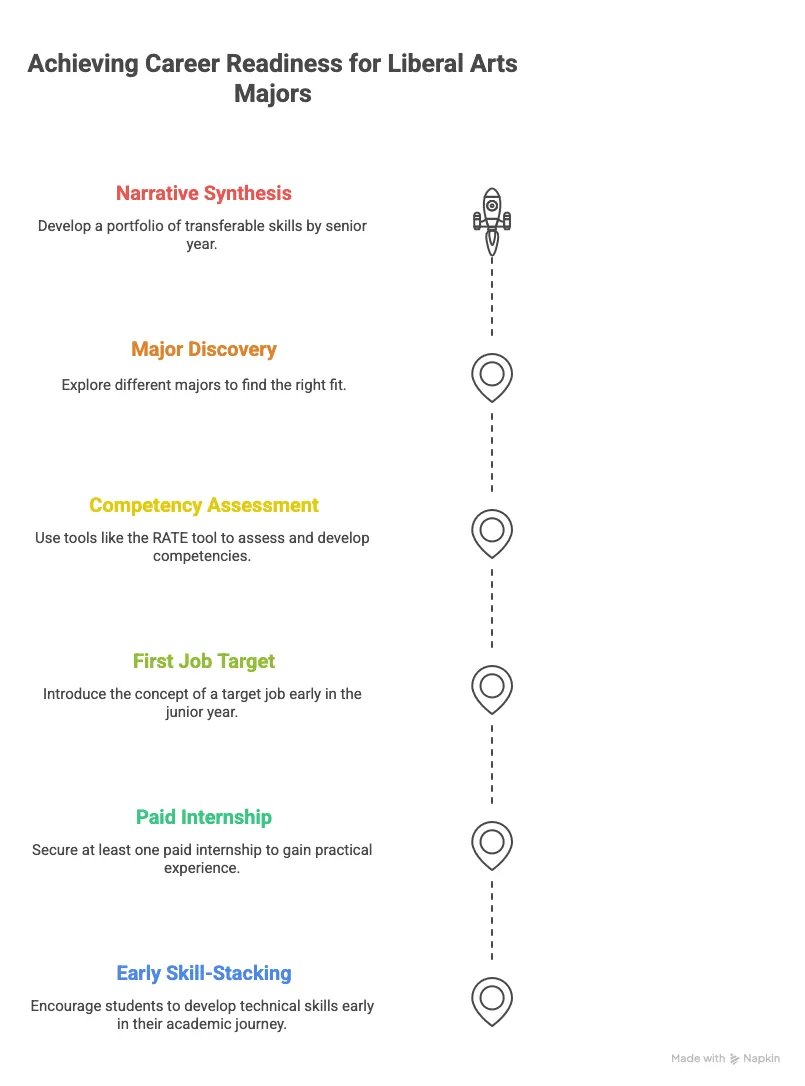
You can prevent this by shifting your students' focus from "finding a job" to "avoiding the undermatch" through early technical skill-stacking. By encouraging them to secure at least one paid internship, you increase their odds of securing a college-level role by 40%, according to NACE’s 2024 Student Survey.
The "scarring effect" of a poor first job is particularly aggressive for humanities students. Data from the St. Louis Fed (2025) shows that graduates in college-level jobs earn 88% more than those with only a high school diploma, while underemployed graduates earn only 25% more.
To combat this, you should introduce the "First Job Target" early in their junior year. Don't let them wait for graduation to see what "sticks."
Instead, guide them to use tools like the University of Minnesota’s RATE tool, which helps students self-assess their competency development. According to NACE (2025), 77% of students who used this tool felt significantly better prepared to explain their ROI to recruiters.
Also Read: How can career centers align their annual program calendar with hiring cycles to improve student outcomes?
How can you guide students to build a high-ROI sample career plan for liberal arts majors?
You can guide them by implementing a "Four-Phase Readiness" framework that integrates professional milestones directly into their academic timeline. This plan must move them from broad "Major Discovery" in their freshman year to "Narrative Synthesis" in their senior year, ensuring they graduate with a documented portfolio of transferable skills.
A sample career plan isn't just a list of tasks; it’s a strategy to close the "translation gap" between the classroom and the boardroom.
According to Lightcast’s 2024 Digital Skills Outlook, 32% of job skills have changed since 2021. Your students need a plan that accounts for this volatility.
The Sample Career Plan Blueprint
| Academic Year | Phase | Your Actionable Milestone |
|---|---|---|
| Freshman | Discovery | Conduct 3 informational interviews with alumni in non-linear career paths. |
| Sophomore | Skill-Stacking | Complete one technical micro-credential (e.g., SEO, Excel, or SQL). |
| Junior | High-Impact | Secure a paid internship. According to NACE (2024), paid interns receive 1.14 job offers on average. |
| Senior | Synthesis | Convert the CV into a competency-based resume mapped to NACE Career Readiness Competencies. |
Also Read: How should career centers respond when students lose job offers unexpectedly?
Which "Skill-Stacking" credentials offer the highest marketability for your students?
You should promote "Liberal Arts + 1" credentials, focusing on digital fluency and AI-driven research skills to complement their critical thinking. According to the AAC&U (2025), 81% of employers are more likely to hire graduates who pair a broad liberal arts foundation with specific technical certifications.
The goal isn't to turn a History major into a Software Engineer. It's to make them a History major who understands Data Analytics.
- The ROI of "Hybridity": According to Strada, graduates who add just one technical skill to their liberal arts base can increase their starting salary by an average of $6,000 to $11,000.
- Real-World Example: Bryant University integrates business applications into liberal arts paths. Their Class of 2024 saw a median starting salary of $76,000, a 6% increase from the previous year, according to Bryant’s 2025 ROI Report.
Also Read: How to boost student attendance at career fairs?
How do you help students translate academic artifacts into employer-ready language?
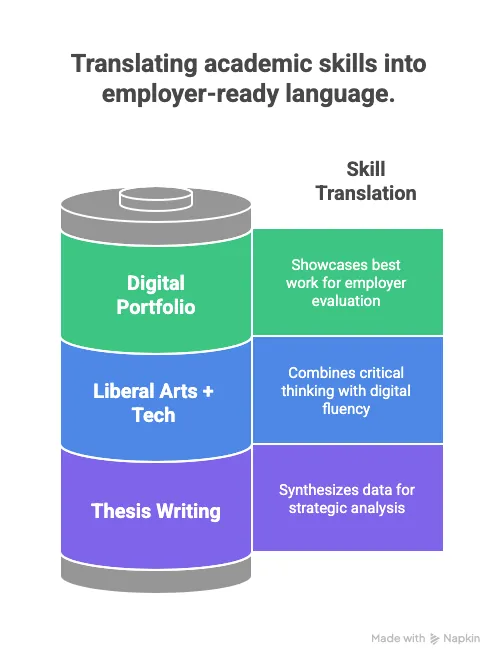
You can help them by replacing academic jargon with "Outcome-Based" descriptors on their resumes and LinkedIn profiles. Instead of "wrote a thesis," guide them to say "Synthesized 50+ data sources to deliver a strategic analysis," which directly maps to the Critical Thinking competency highly valued by recruiters.
Liberal arts students often have the skills but lack the vocabulary. You must coach them to be "multilingual" - able to speak both the language of their discipline and the language of the market.
- Competency Mapping: Use NACE’s Career Readiness Competencies as a rubric.
- Actionable Advice: Have students build a "Digital Portfolio" of their best work. According to AAC&U research, 83% of employers find portfolios more useful than a transcript alone in evaluating a candidate’s potential.
- The College Example: Middlebury College uses industry-specific "Career Communities" to help students translate their liberal arts experience into specialized industry narratives.
| Academic Artifact | Employer-Ready Translation |
|---|---|
| Research Paper | Synthesized information from multiple sources, built a structured argument, and produced evidence-based written analysis. |
| Thesis | Managed a long-term independent research project, organized complex information, and defended findings to an academic audience. |
| Seminar Presentation | Communicated complex ideas clearly to a live audience and adapted messaging for effective knowledge transfer. |
| Group Project | Coordinated tasks, collaborated across a team, managed deadlines, and delivered a shared outcome. |
| Literature Review | Identified patterns, gaps, and themes across large amounts of information to support decision-making and analysis. |
| Community-Based Project | Worked with stakeholders, gathered input, and translated findings into practical recommendations. |
| Debate or Discussion Leadership | Facilitated dialogue, responded to differing viewpoints, clarified positions, and guided productive conversations. |
| Archival or Primary-Source Work | Evaluated evidence, organized information systematically, and created concise interpretive summaries. |
| Fieldwork or Interviews | Collected qualitative data, analyzed participant input, and synthesized insights into actionable findings. |
| Capstone Project | Defined a complex problem, developed a practical solution, managed execution, and presented a final recommendation. |
Also Read: What are the top 5 career services benchmarks every center must track?
The Bottom Line
The long-term ROI of a liberal arts degree is a "slow burn" that eventually outperforms many specialized degrees.
According to Georgetown CEW (2024), the 40-year Net Present Value for many liberal arts colleges exceeds $1.9 million.
Your job is to ensure they survive the first 24 months with a college-level role so they can reach that long-term payoff.
Making this shift - from last-minute placement to early, intentional career design, requires more than good frameworks.
It requires the right support system behind your team.
Hiration is built to make that work more manageable. Its ethical, AI-driven career suite supports students across every stage of growth, from self-assessment and exploration to resumes, interviews, and job matching, so career teams can deliver more personalized guidance at scale without losing the human core of their work.
For institutions rethinking how to engage liberal arts students earlier and more consistently, the right infrastructure can turn these strategies from one-off initiatives into sustainable practice.
Liberal Arts Underemployment — FAQ
Why does liberal arts underemployment happen so early after graduation?
Underemployment often begins with the first post-grad job. Students accept roles that do not require a degree because career targeting and skill translation were delayed, narrowing options by the time graduation arrives.
What is the “undermatch” problem for liberal arts graduates?
Undermatch occurs when graduates take roles that do not align with their education level or long-term potential. These early mismatches can lock in lower trajectories and slow wage growth for years.
When should career teams intervene to prevent underemployment?
Intervention should begin by junior year, when students can still shape internships, skill development, and first-job targets instead of reacting late in senior year.
What does “skill-stacking” mean for liberal arts students?
Skill-stacking pairs liberal arts strengths with one market-aligned technical or digital skill, such as data analysis, research tools, or AI literacy, to increase employability without abandoning the major.
How can students translate academic work into employer language?
Students should replace academic phrasing with outcome-based descriptors that highlight analysis, synthesis, communication, and impact, making classroom work legible to recruiters.
Why are internships critical for liberal arts career outcomes?
Paid internships reduce the risk of underemployment by providing professional signals, applied experience, and clearer first-job pathways that align with college-level roles.
What role should career centers play in first-job planning?
Career centers should help students define a clear “first job target,” align skills and experiences to that role, and ensure graduates leave with a coherent narrative and market-ready materials.