Which career fair format works best for career centers: general or industry-specific?
Use a hybrid model. General fairs maximize reach and exploration, while industry-specific events deliver targeted, deeper conversations; together they align campus-wide access with high-relevance matches for students and employers.
If you're deciding how to structure your career fair calendar, the question is not simply whether general or industry-specific career fairs are better. Each format serves a different purpose.
A broad, all-majors fair can help career centers maximize student reach, support exploration, and bring a diverse employer mix to campus. An industry-specific fair can create stronger alignment between students and employers when interests, majors, or recruiting demand are more concentrated.
The challenge is deciding which format fits which objective, student population, and employer market.
This guide compares general and industry-specific career fairs, explains where each works best, and shows career centers how to choose the right format, build a balanced event mix, and measure whether each fair is delivering the outcomes it was designed to create.
| Factor | General Career Fair | Industry-Specific Career Fair |
|---|---|---|
| Best suited for | Broad access and career exploration | Focused recruiting and defined career interests |
| Student audience | Multiple majors, class years, and career interests | Students interested in a specific industry, function, or discipline |
| Employer mix | Broad range of industries and organization types | Employers concentrated around a particular field |
| Typical experience | Larger number of shorter interactions | Smaller number of more targeted interactions |
| Main advantage | Reach, exposure, and discovery | Relevance, depth, and stronger alignment |
| Main limitation | Some employers may be irrelevant to individual students | Smaller addressable student audience |
| Useful success measures | Student reach, participation breadth, employer diversity | Relevant interactions, interviews, employer return, downstream outcomes |
Are Traditional Career Fairs Still Effective for Students?
Yes, absolutely. Despite the rise of digital recruiting, the in-person career fair remains a powerful engine for connecting students with real-world opportunities.
The data confirms their value: more than half of college students attended a career fair in the past year according to a report by NACE.
Among those attendees, nearly half received interview offers, and about one-quarter secured job offers as a direct result.
This demonstrates that the classic campus fair is still a proven method for converting networking into tangible career outcomes.
Attendance numbers are also bouncing back to pre-pandemic levels.
For example, the median number of students at in-person fairs climbed to approximately 700 in the 2023-24 academic year, a significant increase from 419 just two years prior.
Clearly, the traditional fair continues to play a vital role in early-career hiring.
However, today’s students have evolving expectations.
In an era of personalization, some find the large, impersonal nature of a gymnasium-style fair less appealing.
One career services director described it as a “legacy event” that doesn’t always resonate with Gen Z students, who often prefer more tailored and intimate interactions.
Furthermore, students from underrepresented or first-generation backgrounds may feel anxious about navigating a crowded, high-pressure environment without guidance.
These challenges have prompted career centers to explore alternative formats that can exist alongside, or in place of the traditional expo.
Also Read: How can you make the best out of career fairs?
What is the Difference Between General & Industry-Focused Career Fairs?
The primary distinction lies in scope and focus. A general career fair is a large-scale, "big tent" event that invites employers from all industries to meet students of all majors.
Career fair and job fair are often used interchangeably when referring to employer-student recruiting events. However, the comparison is between a broad event open across majors and industries and a more targeted fair built around a particular sector, discipline, or career field.
Under one roof, a computer science major might encounter recruiters from tech, finance, healthcare, and nonprofit sectors.
These events cast a wide net, offering a broad spectrum of opportunities.
In contrast, an industry-focused career fair, often called a boutique fair, concentrates on a single sector or field.
Examples include an Engineering Expo, an Accounting Career Night, or a Creative Industries Fair.
Only employers directly relevant to that discipline attend, creating a highly targeted networking environment.
Because of their narrower scope, these fairs are typically smaller, featuring perhaps 15-50 employers instead of over 100.
| Aspect | General Career Fair | Industry-Focused Career Fair |
|---|---|---|
| Scope | Open to all majors and industries | Concentrates on one sector or discipline |
| Size | Large; often 100+ employers | Smaller; typically 15–50 specialized employers |
| Networking Style | Quick introductions, broad exposure | In-depth conversations, higher relevance |
| Student Audience | Best for exploration and early-stage search | Best for targeted, major-aligned seekers |
| Employer Mix | Fortune 500s to nonprofits; wide variety | Specialized/niche employers and alumni |
| Outcomes | High volume of leads/interviews | Fewer but stronger, more relevant matches |
Also Read: Why Students Skip Career Fairs, and How to Bring Them Back?
What are the Benefits of General Career Fairs?
General career fairs offer unparalleled breadth and convenience, making them a cornerstone of campus recruiting for good reason.
Their primary advantages lie in exposure and efficiency.
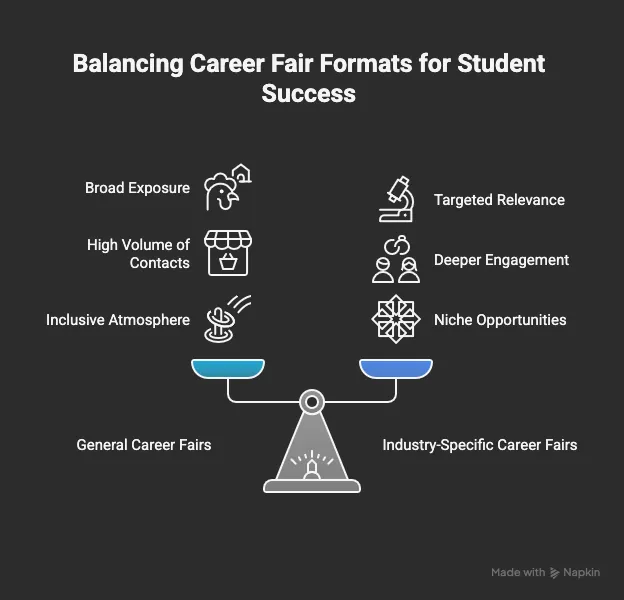
- Career Exploration: For students who are undecided about their career path, these fairs are invaluable. The open format allows them to wander between booths, learn about industries outside their academic focus, and make serendipitous discoveries that can shape their future.
- One-Stop Networking: In a single afternoon, a student can meet with recruiters from dozens of sectors, from government agencies to tech startups. For busy students, this efficiency is a major draw, allowing them to "cover all bases" at once.
- High Volume of Opportunities: The sheer scale of a general fair, with dozens or even hundreds of companies present, increases the odds that a student will make a promising connection. With nearly 45% of attendees receiving interview invitations, the high volume of interactions can directly translate into more opportunities.
- Inclusive Atmosphere: By welcoming all majors and class years, campus-wide fairs foster a sense that every student can participate. First-year students can attend simply to practice their professional communication skills, even if they aren't actively seeking an internship.
Of course, the large scale can also be a drawback. Crowded halls, long lines, and brief conversations can feel overwhelming.
Yet, despite these challenges, general fairs remain highly productive events that lay a foundational layer of career exposure and experience.
| Benefit Type | General Career Fairs | Industry-Specific Career Fairs |
|---|---|---|
| Career Exploration | Broad exposure to multiple sectors and employers | Deeper understanding within a single field or discipline |
| Networking Efficiency | Meet dozens of recruiters across industries in one event | Build stronger relationships with relevant recruiters |
| Preparation Level | Requires minimal specialization or research | Encourages tailored resumes and focused preparation |
| Student Confidence | Ideal for first-year or exploratory students | Best suited for advanced or major-specific students |
| Outcome Quality | Generates a higher volume of interviews and leads | Produces fewer but more relevant job offers |
Also Read: How can career centers build employer partnerships that drive better student outcomes?
What are the Benefits of Industry-specific Career Fairs?
Industry-specific fairs provide focused, high-impact networking opportunities where quality often trumps quantity.
By catering to a single sector, these events allow students to engage in more meaningful conversations from the start.
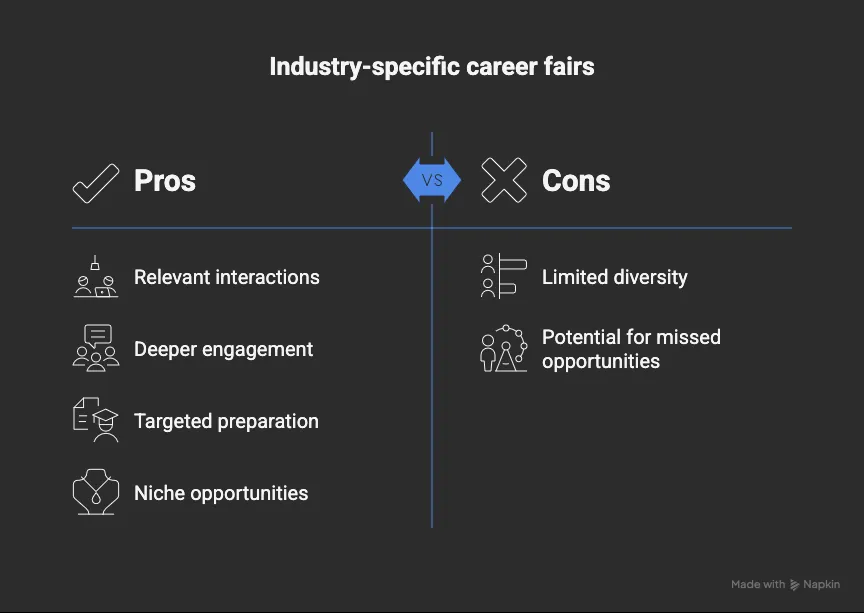
- Relevance: Students spend their time meeting only with employers who align with their major and career interests. This saves time and energy, leading to higher-quality interactions where both parties are already on the same page.
- Deeper Engagement: A smaller, more intimate setting encourages longer and more substantive discussions. Employers often bring technical representatives or alumni who can "talk shop" with students on a deeper level. As one career center director noted, this format provides “a more intimate setting for meaningful interactions.”
- Targeted Preparation: Knowing the fair's theme allows students to tailor their resumes and elevator pitches precisely for that industry. They arrive better prepared and more confident, knowing that every employer they meet is looking for their specific background.
- Niche Opportunities: Specialized or smaller companies that might be overshadowed at a massive expo often prefer niche fairs. This gives students access to unique or local opportunities they might have otherwise missed.
The rise of these fairs is a direct response to student and employer feedback.
Villanova University, for example, noticed that at its general fair, dozens of civil engineering firms would attend, but there weren't enough civil engineering students to meet with all of them.
To solve this, they spun off a dedicated civil engineering event, which proved highly successful in providing a tailored, low-pressure networking space.
Also Read: How to build employer partnerships for career treks?
Also Read: How can career centers align their annual program calendar with hiring cycles to improve student outcomes?
Which Type of Career Fair Yields Better Outcomes?
Both formats lead to successful outcomes, but they deliver value in different ways.
It’s less about which is "better" and more about understanding what each is designed to achieve.
General fairs excel at generating a high volume of initial contacts. An active student can easily leave a large fair with multiple interview invitations across a variety of industries.
The breadth of employers increases the statistical probability of making a connection.
Industry-focused fairs, on the other hand, tend to produce higher-quality matches within a specific domain.
The important distinction for career centers is that the two formats should not necessarily be judged using the same definition of success.
For a general career fair, stronger performance may mean:
- reaching students across a wide range of majors and class years
- attracting a diverse employer mix
- bringing first-time or exploratory students into career services
- increasing the number of employer-student connections
- exposing students to industries they had not previously considered
For an industry-specific fair, stronger performance may instead mean:
- attracting a high percentage of the intended student population
- increasing the relevance of student-employer interactions
- generating interviews or follow-up conversations
- attracting repeat participation from priority employers
- creating stronger internship or job pipelines within that field
A smaller industry fair can therefore outperform a larger general fair against its intended objective even if total attendance is lower. Likewise, a broad fair designed primarily for exploration should not be judged only by immediate job or internship conversions.
An accounting major attending a finance fair might have fewer conversations, but the likelihood that those conversations lead to a relevant internship or job offer is often higher.
Ultimately, research shows that simply attending any career fair boosts a student's chances of success by motivating wider job search activity and building professional confidence.
The "best" outcome is a student who feels empowered and lands an opportunity that advances their goals, a result that both types of fairs can deliver.
Also Read: How Can Career Centers Show ROI Through Retention, Readiness & Outcomes?
When Should Career Centers Choose a General vs. Industry-Specific Career Fair?
Career centers should choose the format based on the problem the event is intended to solve. General career fairs work best when the goal is broad exposure, access, and exploration, while industry-specific fairs are more useful when student interests and employer demand are concentrated enough to support a targeted event.
Use this decision framework:
| If Your Career Center Is Trying To... | Stronger Starting Format |
|---|---|
| Give students exposure to many career paths | General career fair |
| Engage students who are still exploring | General career fair |
| Create one high-visibility campus recruiting event | General career fair |
| Serve employers hiring across multiple majors | General career fair |
| Improve alignment between students and participating employers | Industry-specific fair |
| Serve a major or program with a strong employer ecosystem | Industry-specific fair |
| Respond to concentrated employer demand in one sector | Industry-specific fair |
| Create more focused recruiter-student conversations | Industry-specific fair |
| Serve both exploratory and highly career-focused populations | Combination of both |
Before creating another event, career centers should also examine whether there is enough student and employer demand to support it.
Splitting one large fair into several niche fairs can improve relevance, but only if each event can attract enough students and employers to create useful interaction on both sides.
The better question is therefore not, "Which format is better?" It is, "What outcome are we trying to create, and which format gives us the strongest chance of creating it?"
Should Career Fair Formats Differ by Student Population?
Yes. Career centers can improve fair relevance by considering how students' level of career clarity, academic program, and recruiting needs differ rather than designing every event for the same audience.
For example:
- First-year and exploratory students may benefit more from broad fairs where they can learn about multiple industries and practice speaking with employers without needing a narrowly defined career target.
- Upper-level students with defined career goals may get more value from targeted fairs where most participating employers are actively recruiting for relevant functions or fields.
- Graduate and professional students may need smaller, more specialized events aligned with their prior experience, advanced qualifications, or industry-specific recruiting markets.
- Students in programs such as engineering, accounting, healthcare, or technology may benefit from dedicated events when employer demand is concentrated enough to support them.
- Students changing industries or exploring outside their majors may still need access to broader events rather than being routed only toward fairs associated with their academic department.
Career centers do not need a separate fair for every population. The goal is to identify where differences in student intent and employer demand are large enough to justify a different event format.
This allows us to cover the visible graduate-student and engineering-related query signals without turning the page into a student-facing career fair guide.
Should Career Centers Offer Both General & Industry-specific Fairs?
For most colleges and universities, a hybrid approach is the most effective strategy.
Combining large, all-majors fairs with a series of targeted niche events allows a career center to serve the entire student body effectively.
The general fair acts as a gateway for campus-wide engagement and exploration, while boutique fairs cater to distinct student populations and key industry pipelines.
A practical career fair portfolio might therefore include one or two broad anchor events during the academic year, supplemented by smaller targeted fairs where employer demand and student interest justify them.
Career centers can decide where targeted events belong by reviewing:
- student attendance at previous fairs
- employer demand by industry or function
- majors and programs with concentrated recruiting activity
- employer feedback about student relevance
- student feedback about employer relevance
- internship and full-time hiring cycles
- staff capacity to recruit employers and operate additional events
- outcomes from previous general and targeted fairs
The number of fairs matters less than whether each event has a distinct purpose. If two fairs serve largely the same employers, students, and recruiting objectives, splitting them may simply create more operational work.
If one student or employer segment is consistently underserved at a broad fair, however, a targeted event may solve a genuine gap.
Many institutions have successfully adopted this model.
Pepperdine University, for example, shifted from two large annual fairs to six industry-focused fairs to "personalize the experience for students."
The University of Arkansas regularly offers a robust mix, hosting up to nine targeted fairs each semester alongside its broader recruiting events.
This comprehensive strategy ensures that students who are exploring can broaden their horizons, while those with defined goals can zero in on the right connections.
Also Read: What do recruiters really want in 2026, and how should career centers coach students differently?
How Should Career Centers Measure Career Fair Performance?
Career centers should measure career fair performance against the specific objective of each event rather than assuming that the fair with the highest attendance was the most successful.
At minimum, track:
| Metric | What It Helps You Understand |
|---|---|
| Registrations | Initial student demand |
| Registration-to-attendance rate | How effectively interest converts into participation |
| Unique student participation | Overall student reach |
| Attendance by major and class year | Which student populations the event actually serves |
| First-time attendees | Whether the event is expanding career-services reach |
| Number and mix of employers | Breadth and quality of employer participation |
| Student-to-employer ratio | Whether supply and demand are balanced |
| Employer-student interactions | Actual recruiting activity during the event |
| Interviews or follow-up conversations | Whether interactions progress beyond the fair |
| Internship or job outcomes | Downstream recruiting impact |
| Employer return rate | Whether employers see enough value to participate again |
| Student feedback on employer relevance | Whether students met organizations aligned with their interests |
The same metric can also mean different things depending on the event.
For example, high attendance may be an important success indicator for an all-majors fair designed to maximize exposure. For a small engineering fair, the more important question may be whether participating students met employers recruiting for relevant technical roles and whether those conversations progressed.
Career centers should therefore establish the intended outcome before the event and evaluate the fair against that objective afterward. Over time, comparing performance across semesters can help determine which events should be expanded, redesigned, combined, or discontinued.
Final Thoughts
Choosing between general and industry-specific career fairs is not about identifying one universally better format. It is about matching each event to the student population, employer market, and outcome your career center is trying to create.
Broad fairs can maximize access, exploration, and employer exposure. Targeted fairs can increase relevance and create deeper recruiting conversations for students with more defined goals.
For many institutions, the strongest approach will be a deliberate mix of both, with each event given its own purpose and success measures.
But the impact of any fair depends heavily on how prepared students are when they walk in, and how they follow up afterward.
Students need to show up with strong resumes, clear narratives, and the confidence to engage meaningfully. They also need support to translate those conversations into interviews, applications, and offers.
Without that layer, even well-run events can fall short of their potential.
This is where the right infrastructure can extend the value of every interaction.
Hiration is designed to support this end-to-end journey. From career assessments to AI-powered resume optimization and interview simulation, along with a dedicated counselor module for managing cohorts, workflows, and analytics, the focus is on helping career centers prepare students at scale.
All of this operates within a secure, FERPA and SOC 2-compliant environment built for higher education.
For career centers, the opportunity is not just to host better events, but to ensure those events consistently translate into stronger outcomes.
Industry vs. General Career Fairs — FAQ
Are traditional in-person career fairs still effective?
Yes. More than half of college students attended a fair in the past year, nearly half received interview offers, and about one-quarter secured job offers, showing strong conversion from networking to outcomes.
What’s the core difference between general and industry-specific fairs?
General fairs are broad, all-majors events with many sectors under one roof; industry fairs are focused “boutique” events for a single field, typically featuring ~15–50 directly relevant employers for deeper, targeted conversations.
When is a general career fair the better choice?
Choose general fairs for exploration, one-stop networking, and high volume of opportunities. They help undecided students sample multiple industries and practice professional conversations in a single session.
When do industry-specific fairs work best?
Use industry fairs for relevance and depth. Students meet only aligned employers, prepare targeted materials, and often engage in longer, technical or alumni-led discussions that improve match quality within a field.
Which format yields better outcomes?
Both deliver results in different ways: general fairs generate many initial contacts and interviews across sectors, while industry fairs tend to produce higher-quality matches within a specific domain.
How are attendance trends shaping up post-pandemic?
Attendance is rebounding. Median turnout at in-person fairs climbed to approximately 700 in 2023–24, up from 419 two years prior, underscoring renewed student engagement on campus.
What are common challenges with large general fairs?
Crowded spaces, brief conversations, and a less personal feel can deter some students, especially those who prefer tailored, lower-pressure interactions or need clearer guidance to navigate the room confidently.
How can career centers support first-gen and underrepresented students?
Offer guidance to reduce anxiety: clarify expectations, provide coaching on how to approach employers, and consider smaller or themed events that create more intimate, confidence-building interactions.
What real-world adjustments have universities made?
Centers spin off niche fairs when supply–demand is uneven, such as creating a dedicated civil engineering event to ensure relevant, low-pressure conversations and better alignment between students and employers.
What’s the recommended strategy for most campuses?
Adopt a hybrid portfolio: keep a campus-wide general fair for reach and exploration, and add targeted industry events to personalize experiences and strengthen pipelines for specific majors and employers.