How can career centers match mentorship models to different student needs effectively?
Career centers can build stronger mentorship ecosystems by aligning mentoring formats, mentor types, and operational ownership with specific student development stages. Effective systems use peer, faculty, alumni, and employer mentoring differently across exploration, readiness, networking, and transition phases while combining scalable structures, centralized infrastructure, and model-specific metrics to improve equity, engagement, and career outcomes.
College mentorship programs often struggle when every student is pushed into the same model, regardless of where they are in their academic or career journey.
A first-year student exploring majors, a junior building industry connections, and a senior preparing for full-time recruiting do not need the same kind of mentor, structure, or support.
That matters because poorly matched mentorship programs can waste staff time, frustrate mentors, and leave students with unequal access to career-building relationships.
For career centers, the challenge is not just launching a mentorship program; it is building the right mix of models for different student needs.
This guide breaks down how peer, alumni, faculty, employer, and professional mentorship models work, when to use each format, who should own them on campus, and which metrics career centers should track to prove impact.
Why shouldn't colleges use a single mentorship model for every student?
Colleges shouldn’t use a single mentorship model because students face wildly diverse psychological and professional hurdles across their academic life cycles. A one-size-fits-all approach fails marginalized cohorts and ignores distinct developmental stages. Customizing models ensures institutions address specific barriers, boosting post-graduation employment rates and enhancing overall alumni satisfaction.
If your institution still relies on a monolithic "alumni directory platform" as its sole mentoring solution, you are dropping the ball on student equity.
The professional needs of a first-generation freshman seeking campus belonging look nothing like those of a senior prepping for a technical software engineering interview.
Leaving mentorship to chance or basic opt-in directories skews outcomes toward privileged students who already possess the social capital to self-advocate.
According to the Strada-Gallup Alumni Survey, first-generation college students are significantly less likely to organically find a professor or mentor compared to their non-first-generation peers.
Furthermore, data shows that unguided, unstructured online networks simply collect digital dust.
According to a milestone report by Gallup, only 9% of college graduates report that their university’s online alumni network was actually helpful in the job market.
When you try to serve every student milestone with a single program format, you end up serving no one effectively.
How do peer, alumni, faculty, and employer mentors serve different career needs?
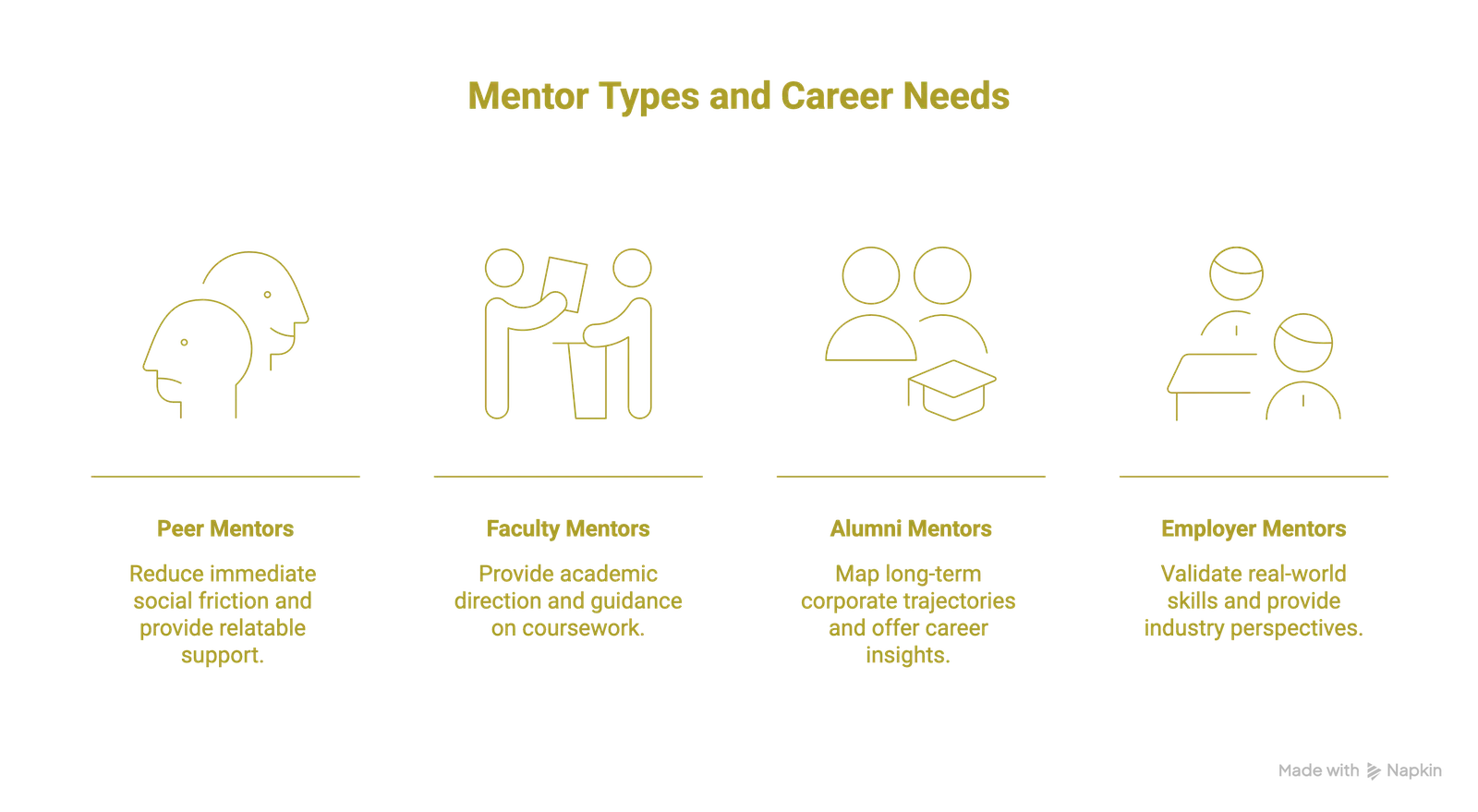
Different mentor types unlock distinct programmatic outcomes based on their unique proximity to student struggles. Peers reduce immediate social friction; faculty provide academic direction; alumni map long-term corporate trajectories; and employers validate real-world skills. Deploying them strategically ensures colleges provide targeted intervention without confusing the core mission of each advocate group.
To optimize your campus ecosystem, you must treat your mentor network as a specialized task force. Each stakeholder category brings a distinct flavor of social capital.
| Mentor Category | Primary Career Need Met | Psychological Barrier Eliminated | Core Strategic Metric Influenced |
|---|---|---|---|
| Peer Mentors | Institutional navigation, transition support, and campus resource routing | Imposter syndrome, social isolation, uncertainty about belonging, and onboarding friction | First-to-second-year retention, engagement consistency, and early student persistence |
| Faculty Mentors | Academic integration, discipline validation, and research pathway development | Curricular confusion, academic self-doubt, and uncertainty about long-term direction | Major persistence, academic engagement, and graduate school pipeline strength |
| Alumni Mentors | Industry exploration, professional identity formation, and long-term career mapping | Networking anxiety, lack of professional confidence, and uncertainty about career pathways | Alumni affinity, long-term engagement, and institutional giving potential |
| Employer Mentors | Industry skill validation, recruiting insight, and workplace expectation alignment | Lack of exposure to professional norms, hiring expectations, and industry-specific culture | Job placement velocity, employer conversion, internship readiness, and starting salary outcomes |
According to the Strada-Gallup Alumni Survey, professors remain the predominant source of undergraduate mentorship, with 64% of mentored graduates identifying a faculty member as their primary guide.
However, expecting faculty to also act as corporate recruiters or peer navigators overburdens them and degrades the quality of the advice given.
Which mentorship model fits each student stage from exploration to transition?
Match models directly to student milestones: exploration, readiness, networking, and transition. Early-stage students need peer or faculty matching to build identity. Career-ready students require industry mentors to develop skills. Networkers benefit from wide alumni contact, while transitioning seniors need employer champions. This prevents engagement decay across four years.
1. Exploration (Freshmen / Sophomores)
Students at this stage grapple with identity and choice of major. They need low-stakes, high-empathy matching. Group mentoring led by older peers or faculty cohorts works best to normalize early academic struggles.
2. Readiness (Sophomores / Juniors)
Once a student clarifies their direction, they enter the readiness phase. They require structured, project-based mentoring or technical skill-gap analysis. According to NACE, programmatic shifts that focus on explicit career development, such as the model deployed at Dominican University - successfully build institutional equity by transforming casual networking into structured career preparation.
3. Networking (Juniors / Seniors)
Here, the goal expands from deep development to wide exploration. Students need access to highly active digital marketplaces to practice informational interviewing. For example, according to the Wellesley College Center for Career Education, their dedicated digital platform, The Wellesley Hive, engages over 7,000 active student and alumni members by facilitating open-ended, customized organic networking tailored to student affinity groups.
4. Transition (Seniors / Career Changers)
Seniors need high-touch, hyper-focused 1:1 corporate matches to survive the recruiting meat grinder. This phase requires tight timelines, resume critiques, mock interviews, and warm corporate introductions.
Also Read: How can career centers turn faculty and alumni into a scalable career readiness network?
When should I use one-to-one, flash, cohort, or embedded-course mentoring?
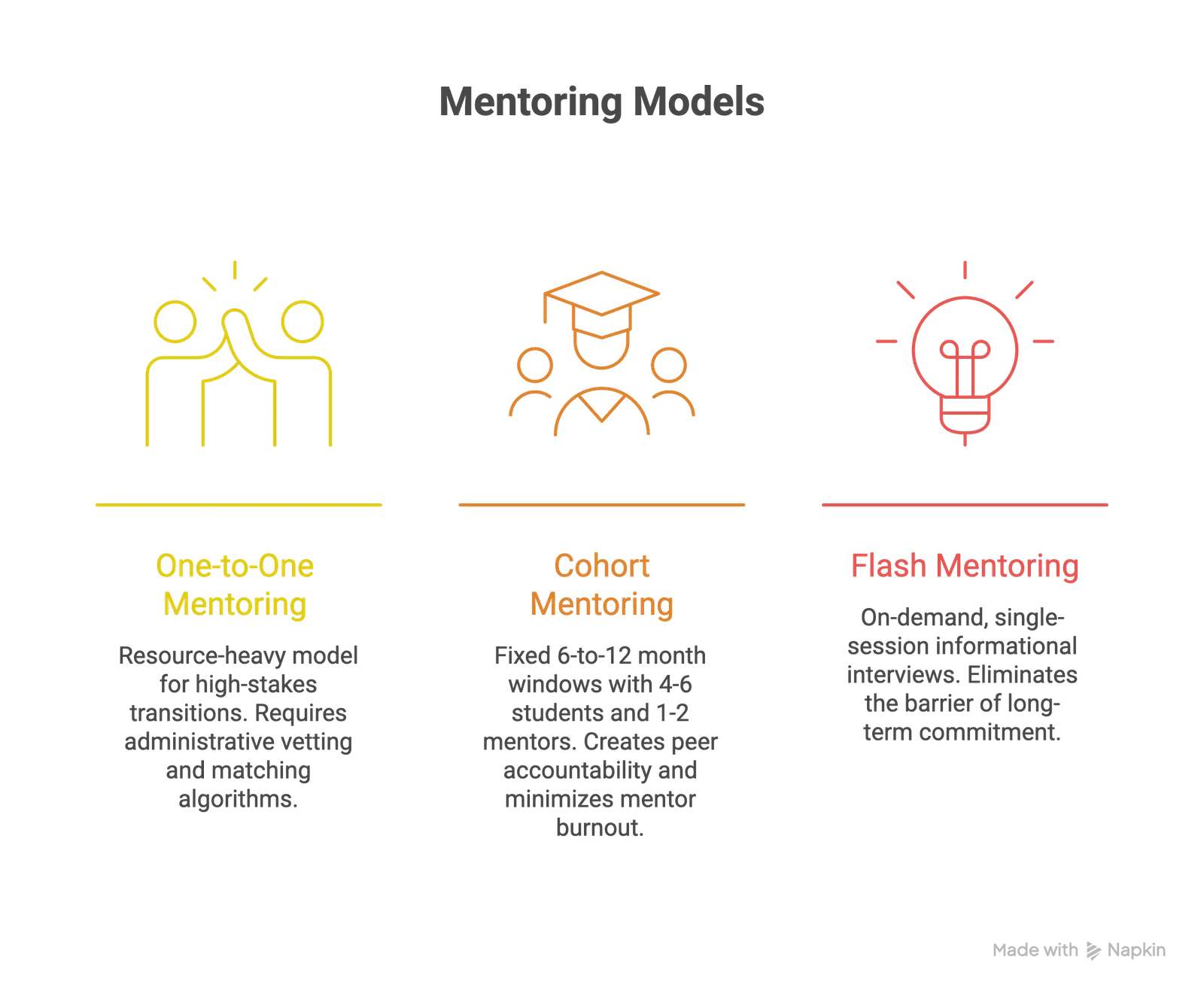
Deploy structural formats based on scale, timeframe, and student psychological barriers. Choose high-touch one-to-one matching for intense career transitions, group or cohort setups for scalable equity, flash mentoring for low-stakes information interviews, and embedded-course mentoring to capture disengaged or busy students who cannot attend extracurricular events.
- One-to-One Mentoring: Reserve this resource-heavy model for high-stakes, time-sensitive transitions. It requires considerable administrative vetting and matching algorithms, making it perfect for senior-year honors programs or target diversity initiatives.
- Cohort Mentoring: Run this format over fixed 6-to-12 month windows. Grouping 4-6 students with 1-2 mentors creates built-in peer accountability and minimizes mentor burnout. According to the Together Platform Guide, successful cohort models thrive on pre-built milestone timelines and structured discussion guides rather than open-ended conversations.
- Flash Mentoring: Eliminate the barrier of long-term commitment. Use flash mentoring for on-demand, single-session informational interviews. According to Stanford University IT Mentoring, flash sessions require no lengthy upfront applications; instead, mentees immediately book a single 30-to-60 minute calendar slot with an expert to address an immediate, tactical professional query.
Pro Tip: Use Embedded-Course Mentoring to solve your equity gaps. Working-class, commuter, or low-income students rarely have the luxury to attend a Tuesday night voluntary networking mixer. By writing mandatory mentoring checkpoints directly into the syllabi of required senior capstone or freshman seminar courses, you bring social capital directly to the students who need it most.
How do I assign departmental ownership for college mentoring programs?
Assign model ownership by matching operational mandates to the primary stakeholder group. Career services should govern alumni and employer programs, academic affairs must guide faculty mentorships, and student life should manage peer initiatives. Misaligning ownership creates systemic operational inefficiencies, limits programmatic scaling, and quickly exhausts volunteer pools across campus.
The biggest operational pitfall in higher education is territorial turf wars. When multiple divisions launch siloed mentoring programs independently, they cannibalize funding and exhaust their volunteer pools.
- Alumni flash mentoring programs
- Corporate pipeline 1:1 mentor matching
- Faculty-to-student research mentoring
- Senior capstone mentoring support
To avoid administrative friction, align ownership directly with departmental key performance indicators (KPIs):
- Central Career Services Office: Owns all external corporate pipelines, structural employer matching, and wide-net alumni engagement systems. Their metric is employment velocity.
- Academic Affairs / Academic Departments: Owns faculty-to-student research mentoring and discipline-specific capstone matching. Their metric is major retention and graduate school placement.
- Division of Student Life / Student Affairs: Owns peer-to-peer onboarding, identity-based affinity groups, and residential life mentoring. Their metric is immediate persistence and sense of belonging.
What should career centers centralize vs let departments run locally?
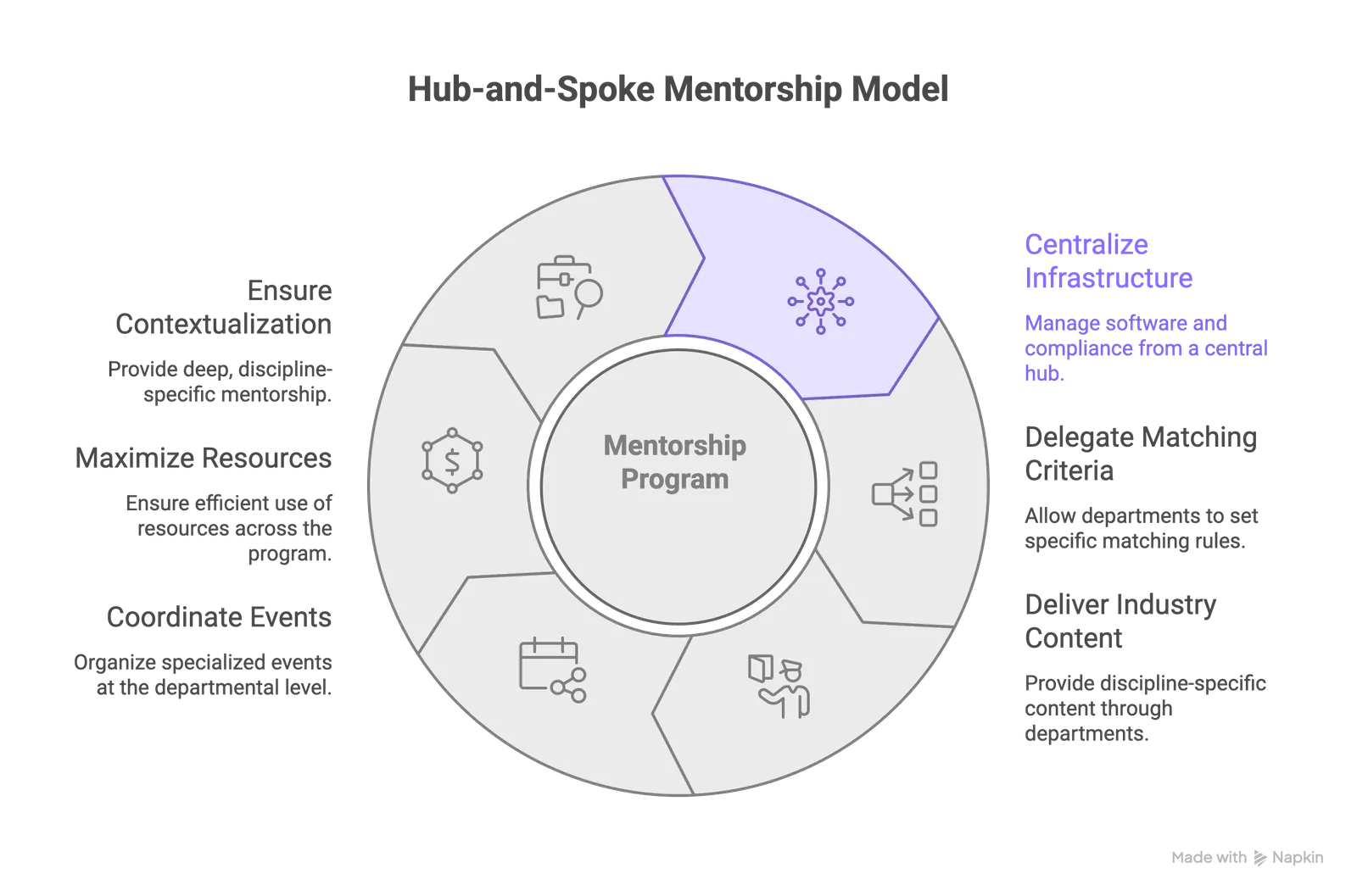
Centralize infrastructure, technological licensing, onboarding compliance, and external corporate matching to ensure structural brand alignment and legal safety. Delegate specific matching criteria, industry-focused content delivery, and student-mentor event coordination to localized academic departments. This hybrid operational strategy maximizes resource utilization while ensuring deep, discipline-specific mentorship contextualization.
To run a friction-free ecosystem, implement a Hub-and-Spoke Operational Model. Career Services acts as the central hub, providing the overarching technological framework and baseline compliance guardrails.
What to Centralize (The Hub)
- Software Stack Management: Centralize procurement for platforms like PeopleGrove, Chronus, or Qooper. Allowing individual departments to buy separate licenses results in fragmented data and wasted budget.
- Risk and Compliance Governance: Manage background checks, Title IX compliance documentation, and mandatory mentor onboarding rules from a single legal center.
- The Master Corporate Database: Maintain a unified register of corporate partners to ensure the business school doesn’t spam the exact same employer partner that the engineering department is trying to pitch.
What to Decentralize (The Spokes)
- Discipline Niche Customization: Allow the Nursing department to dictate their own specific clinical pairing rules, and let the Fine Arts department construct their unique portfolio-review mentorship guidelines.
- Event Execution: Localize the planning of specialized networking mixers, specialized panels, and department-specific match reveal events.
How do I build a university mentorship portfolio without duplicating services?
Build a comprehensive portfolio by mapping every single program format to exclusive learning outcomes and specific target demographics. Use a centralized software platform to funnel students into the ideal track based on diagnostic intake data. This intentional matrix eliminates internal competition for funding and prevents mentor fatigue.
To stop duplicating services across campus, deploy an Intake Diagnostic Workflow. When a student or alum enters your mentoring ecosystem, do not simply drop them into a broad user pool. Force them through a strategic 3-question routing engine.
- Map Out Your Matrix: Create an internal grid where the X-axis represents the student's career maturity stage and the Y-axis represents the mentor format. Ensure that no two campus initiatives occupy the same coordinate.
- Unify the Registration Engine: Build a single campus wide landing page for potential mentors. An alumnus should sign up once to the university's master registry, ticking boxes to state whether they are open to flash mentoring, structured 6-month cohorts, or giving localized resume feedback.
- Deploy Algorithmic Guardrails: Cap mentor outreach limits centrally. Restrict students to a maximum of two active flash outreach requests per week to protect high-profile corporate mentors from inbox exhaustion.
Which mentorship metrics should I track by model to prove career center ROI?
Ditch generic sign-up volume data. Track behavioral, relational, and longitudinal metrics differentiated by each model format. Measure message response times for flash mentoring, program completion rates for cohorts, skill acquisition gains for corporate models, and retention rates for peer programs. Finally, link these explicitly to job placement velocity and salary data.
Reporting "total registered users" to your board of trustees is a vanity metric that masks program failure.
If 40% of your matched pairs fail to communicate past their initial introduction message, your program is bleeding engagement.
Customize your scorecard to reflect the structural realities of each specific model format:
1. Flash Mentoring Metrics
- Mentor Latency Speed: The average hours a mentor takes to reply to an organic student request.
- Booking Conversion Rate: The percentage of initiated student threads that successfully translate into a scheduled calendar meeting.
2. Cohort & Long-Term 1:1 Metrics
- Program Milestone Completion Rate: The percentage of matched pairs that complete all structured discussion modules across the designated 6-month timeline.
- Net Promoter Score (NPS) Asymmetry: The difference between how valuable the student found the relationship versus the mentor's satisfaction score.
3. Institutional ROI Metrics (The Bottom Line)
- First-Destination Placement Velocity: The average number of days post-graduation it takes a highly active mentee to secure a full-time role versus a non-participating peer control group.
- Alumni Giving Correlation: The financial donation delta of alumni who serve as active mentors compared to those who are completely disengaged from the platform.
Also Read: How Career Centers Can Show ROI Through Retention, Readiness & Outcomes
Wrapping Up
Mentorship works best when students are routed to the right kind of support at the right stage, not when every student is pushed into the same program format.
For career centers, that means designing mentorship as part of a broader career readiness ecosystem: one that connects exploration, preparation, skill-building, interview readiness, and post-graduation transition.
Hiration supports that broader journey through Career Assessments, AI-powered Resume Optimization, Interview Simulation, and a dedicated Counselor Module for managing cohorts, workflows, and analytics.
Built on a secure, FERPA and SOC 2-compliant platform, it gives career teams a way to scale structured career support while keeping advisors at the center of the student experience.
A strong mentorship model does not replace career services; it helps career centers make every relationship more intentional, measurable, and useful for students.
Mentorship Program Models — FAQs
Why shouldn’t colleges use one mentorship model for every student?
Students face different developmental, academic, and career challenges across their college journey, making a single mentoring structure ineffective for many populations.
What role do peer mentors serve?
Peer mentors reduce social friction, normalize challenges, and help early-stage students build belonging, confidence, and campus navigation skills.
How are alumni mentors different from faculty mentors?
Alumni mentors provide industry insight and professional trajectory guidance, while faculty mentors primarily support academic development and discipline-specific growth.
Which mentorship models work best for freshmen and sophomores?
Early-stage students benefit most from peer, faculty, and cohort-based mentoring that focuses on exploration, identity development, and campus belonging.
When should colleges use one-to-one mentoring?
One-to-one mentoring works best during high-stakes career transitions such as senior-year recruiting, career changes, or targeted diversity initiatives.
What is flash mentoring?
Flash mentoring provides short, low-commitment informational conversations that help students quickly access tactical career insights without long-term matching requirements.
Why is embedded-course mentoring effective?
Embedded mentoring reaches students who may not participate in extracurricular networking, improving equity and access through required academic structures.
How should mentorship ownership be divided across campus?
Career services should manage employer and alumni mentoring, academic departments should oversee faculty mentoring, and student affairs should coordinate peer mentoring systems.
What should career centers centralize versus decentralize?
Centers should centralize technology, compliance, and employer infrastructure while allowing departments to customize matching criteria, events, and discipline-specific content.
What is the biggest strategic mentorship shift colleges need?
Institutions must move from generic opt-in mentoring programs toward structured mentorship portfolios intentionally aligned with student stage, equity goals, and career outcomes.