How can career centers help students build job-winning portfolios?
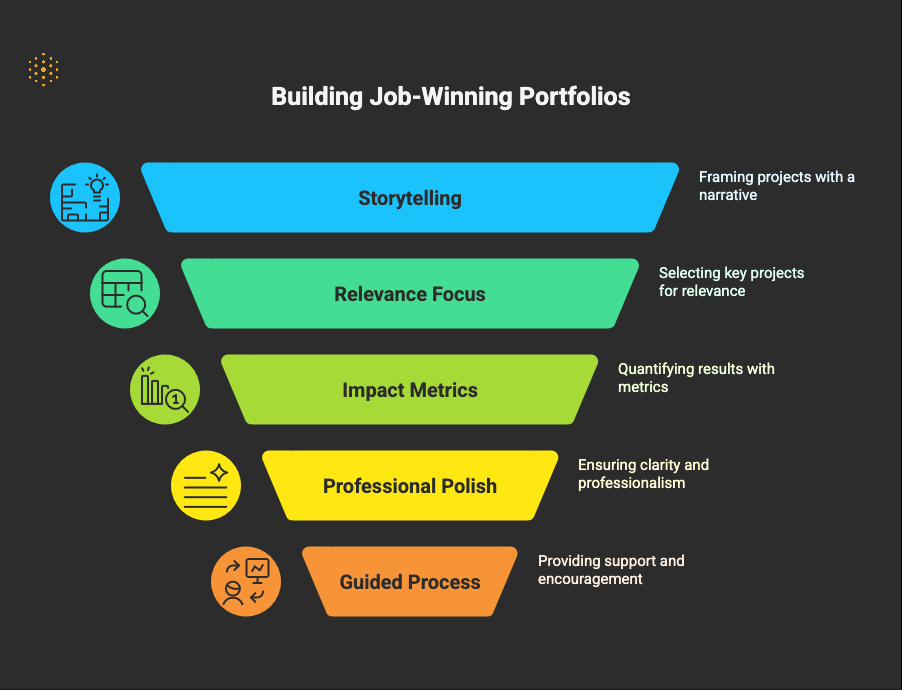
Career centers can guide students to build effective portfolios by focusing on storytelling, selecting relevant work, highlighting measurable impact, maintaining professional presentation, and structuring the process into manageable steps. This helps students clearly demonstrate skills and stand out to employers across industries.
If you’re a career advisor helping students build a portfolio for internships or jobs, the challenge is rarely just getting them to upload a few work samples.
Students need to know what belongs in a career portfolio, how to turn coursework and experiences into credible evidence, and how to present that evidence in a way employers can quickly understand.
A strong student career portfolio can bring together class projects, research, internships, campus roles, volunteer work, and independent projects to show what the student can actually do.
This guide gives career services teams a practical framework for helping students choose stronger portfolio content, tell better project stories, demonstrate impact, understand what employers look for, and prepare their portfolios for applications, interviews, and networking.
How Should Career Advisors Diagnose a Student’s Portfolio Needs?
Students can struggle with portfolio building for very different reasons, from having too many projects to believing they have nothing worth showing. Career advisors can use the situations below to identify the immediate problem and determine what portfolio-ready output the student should work toward next.
| Student Situation | Portfolio Problem | Advisor Intervention | Student Output |
|---|---|---|---|
| Has many class projects | Too much volume and weak relevance for the target role | Help the student select 3–5 role-aligned artifacts that show the strongest evidence | Targeted portfolio project list |
| Has limited experience | Believes they have “nothing to show” | Translate coursework, campus jobs, research, volunteering, and leadership into portfolio-ready evidence | Evidence inventory |
| Applying across roles | Uses the same portfolio order and framing for every opportunity | Create role-specific project versions, sequencing, or labels based on target roles | Marketing, data, or business portfolio version |
| Has strong work but weak explanation | Artifacts lack context, decision-making, or outcome framing | Add challenge-action-result narratives to explain the work clearly | Project case study |
| Has portfolio link but low polish | Broken links, cluttered navigation, unclear hierarchy, or poor mobile experience | Run a link, skim, mobile, accessibility, and employer-readiness review | Employer-ready final version |
What Should a Student Career Portfolio Include?
A student career portfolio should give an employer enough context to understand the work, the student’s contribution, and the skills demonstrated. It does not need to contain every project the student has completed. Career advisors can instead help students choose a smaller set of relevant examples and make the evidence behind each one easy to understand.
A useful portfolio entry typically includes:
| Portfolio element | What the student should show |
|---|---|
| Project or work sample | The actual artifact, deliverable, link, screenshot, presentation, analysis, design, or other evidence |
| Context | What the project was, who it was for, and what problem or goal was involved |
| Student contribution | What the student personally did, especially for team projects |
| Skills and tools | Relevant technical, analytical, communication, research, creative, or professional skills |
| Process | How the student approached the problem or completed the work |
| Result or evidence | Metrics, feedback, findings, improvements, recommendations, or another indication of impact |
| Career relevance | Why this project demonstrates readiness for the roles the student is pursuing |
Advisors can use this structure as a starting point rather than prescribing one portfolio format across every major. A design student, business student, researcher, and computer science student may need very different artifacts, but employers should still be able to understand the work, contribution, skills, and evidence behind each example.
How Should Career Advisors Help Students Tell Stronger Portfolio Stories?
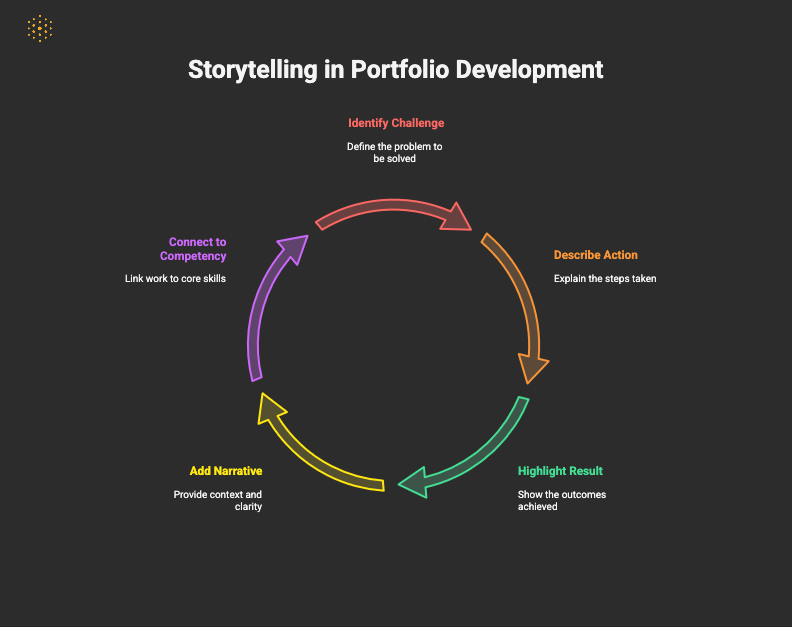
Portfolios shouldn’t be a collection of disconnected artifacts. Help students frame each project around a clear story:
- Challenge: What problem were they solving?
- Action: What did they do?
- Result: What changed or improved?
This structure helps employers understand how a student thinks, not just what they made. Encourage students to add 2-3 lines of narrative per project to provide context and clarity.
At San José State University’s iSchool, students are trained to frame their work through reflective narratives as part of their e-portfolio capstone.
Each entry includes a written explanation that connects the work to a core competency, adding both depth and clarity.
A portfolio entry like “Redesigned a student website to improve event signups - traffic increased by 25% in two weeks” is far more effective than “Website project.”
For students who struggle to explain their work, advisors can use a simple project case study prompt:
| Portfolio Prompt | What the Student Should Answer |
|---|---|
| What was the goal? | The problem, assignment, client need, research question, user challenge, or project objective |
| What was your role? | What the student personally owned, created, analyzed, coordinated, researched, designed, or presented |
| What tools or methods did you use? | Software, research methods, frameworks, data sources, design tools, project processes, or communication formats |
| What changed because of the work? | Result, feedback, adoption, grade, audience response, recommendation, decision supported, or next step created |
| What skill does this prove? | Communication, problem-solving, research, teamwork, technical skill, leadership, professionalism, or role-specific competency |
This helps students move from “I completed a project” to “Here is the problem I solved, how I approached it, and why it matters.”
Also Read: How Can Career Advisors Make Students More Visible on LinkedIn?
How Should Advisors Help Students Choose What to Include in a Career Portfolio?
More isn’t better. Help students select 3-5 of their strongest, most relevant projects, rather than filling the portfolio with every class assignment. Ask them:
- What kinds of roles are you applying to?
- Which projects best show those skills?
A marketing student might highlight a social media campaign, while a data student might showcase a dashboard or analysis project. It’s about aligning their content to the job they want, just like with resumes.
This approach is echoed at Wesleyan University’s Gordon Career Center, where students are guided to tailor their portfolio content with the same intent as a targeted resume - cutting out filler and emphasizing the experiences that match the employer’s needs.
The key is to help students understand what counts as portfolio evidence. Many students assume they need a polished client project, internship, or creative sample.
In reality, advisors can help them translate coursework, research, campus employment, volunteer work, and independent projects into employer-facing proof.
Advisors can make this easier by showing how ordinary academic and experiential work can become portfolio evidence. The examples below can help advisors identify what a student might include and how that evidence can be framed for the roles they are pursuing.
| Student Background | Portfolio-Worthy Evidence | How to Frame It |
|---|---|---|
| Business Student | Case competition, pitch deck, market research, or business analysis | Business problem, recommendation, and decision supported |
| Data Student | Dashboard, Excel model, SQL project, or research dataset | Question, method, insight, and business relevance |
| Marketing Student | Campaign calendar, content samples, or analytics report | Audience, strategy, execution, and performance |
| Journalism Student | Articles, interviews, or multimedia stories | Beat, reporting method, source work, and editorial judgment |
| Tech Student | GitHub project, app prototype, or documentation | Problem, stack, user need, and iteration |
| Liberal Arts Student | Research paper, policy memo, thesis, or presentation | Argument, evidence, analysis, and communication skill |
| Student Worker | Training guide, event plan, or process improvement | Responsibility, stakeholder, and measurable contribution |
The important distinction is that the portfolio should not merely show the final artifact. Advisors should encourage students to explain enough of the project for an employer to understand what they did, why they did it, and what the work demonstrates about them.
Also Read: How does a 4-week job search plan help advisors coach students more effectively in 2026?
What Do Employers Look for in a Student Career Portfolio?
Employers reviewing a student portfolio need to be able to quickly understand whether the work is relevant, credible, and representative of what the student can contribute. Advisors can therefore coach students to think about the portfolio from the reviewer’s perspective rather than treating it as an archive of completed work.
For each major portfolio item, an employer should ideally be able to answer:
- What was the student trying to accomplish?
- What did the student personally contribute?
- Which skills did the work require?
- How did the student approach the problem?
- What was produced or learned?
- What evidence shows the quality or impact of the work?
- How is this relevant to the role the student is pursuing?
This becomes particularly important for internships and entry-level roles because students may not yet have extensive professional experience.
A portfolio can give employers additional evidence through coursework, research, student organizations, independent projects, campus employment, and other experiences that may only receive one or two lines on a resume.
Advisors can therefore review portfolios for clarity, relevance, evidence, and credibility, not simply visual polish.
How Can Advisors Help Students Show Impact in a Career Portfolio?
Employers want to see results - not just effort. That means students should quantify their impact wherever possible:
- “Boosted engagement by 2,000% in six weeks”
- “Reduced response time by 30% with automated workflow”
- “Presented analysis that led to new marketing strategy”
San José State students are encouraged to pair every project with evidence of results, from adoption rates to faculty feedback.
A student who developed a prototype later used by three real-world clients didn’t just showcase the product - she highlighted its downstream value, which left a lasting impression.
But not every student will have hard metrics, and that should not stop them from showing impact.
If they do not have revenue or conversion data, they can use audience size, number of users, event attendance, or participant count.
If there is no employer outcome, they can include faculty feedback, peer review, client comments, or supervisor response.
If the work was never published, they can show a before-and-after comparison or a revised draft. If they do not have a formal internship, they can still highlight project scope, tools used, deadlines, and stakeholders.
If the project was not implemented, they can show the prototype, recommendation, testing insight, or research finding.
For example, “Built a dashboard for a class project” becomes stronger when framed as:
“Built an Excel dashboard analyzing 500+ rows of student engagement data to identify which event formats drove the highest participation.”
Or, “Wrote a research paper” becomes:
“Analyzed 12 peer-reviewed sources to compare policy responses to housing insecurity and presented findings through a 10-page research brief.”
The goal is not to inflate the work. The goal is to help students show evidence clearly.
Also Read: How can career services teams identify and close student skill gaps?
How Can Advisors Help Make Student Portfolios Employer-Ready?
A strong portfolio should be:
- Concise: Easy to skim, no fluff
- Polished: No typos, consistent formatting, functioning links
- Current: Updated every few months, especially when actively job-seeking
Advise your students to test their portfolio across devices to ensure mobile responsiveness and avoid broken visuals or links.
At Nebraska Wesleyan University, digital portfolios are embedded into the curriculum. Students are required to review their portfolios across devices for formatting issues, test for mobile responsiveness, and proofread meticulously.
This attention to professionalism reinforces the idea that the portfolio isn’t just creative expression, it’s a living extension of a candidate’s brand.
It also makes the portfolio easier for employers to review. Even when employers value e-portfolios, they may not have time to click through a messy site or decode unclear navigation.
Career centers can coach students to make the portfolio skimmable in under 90 seconds. Students should:
- Put the strongest project first
- Add a 2-3 line summary above every artifact
- Use clear project titles instead of vague labels like “Final Project”
- Keep navigation simple
- Test every link before sharing
- Avoid password-protected work unless necessary
- Add resume, LinkedIn, and contact details
- Make the site mobile-friendly
- Keep the homepage focused on target roles and strongest proof
A portfolio does not need to be visually elaborate. It needs to be easy to understand, easy to navigate, and easy to connect to the student’s career goal.
Also Read: What guardrails do career centers need for AI use in student job preparation?
How Is a Career Portfolio Different From a Resume or LinkedIn Profile?
A resume, LinkedIn profile, and career portfolio can reinforce one another, but they serve different purposes. Career advisors can help students understand the distinction so they are not simply repeating the same information across all three.
| Career asset | Primary purpose |
|---|---|
| Resume | Summarizes the student’s experience, skills, education, and accomplishments for a specific opportunity |
| Makes the student’s professional identity, experience, connections, and selected work discoverable online | |
| Career portfolio | Provides deeper evidence of what the student has actually created, analyzed, researched, designed, written, built, or accomplished |
A resume might say that a student created a marketing campaign. The portfolio can show the campaign, explain the student's role, document the decisions behind it, and provide evidence of the result.
Students can then connect these assets by adding a portfolio link to their resume, using LinkedIn’s Featured section for selected projects, or sharing relevant work samples directly during an application or interview process.
How Can Advisors Guide Students Through Portfolio Building?
Portfolio building can feel overwhelming, especially for students who think they don’t have “real” experience. Counselors can make the process less intimidating by:
- Breaking it into phases: bio this week, project uploads next
- Framing feedback with “Glow and Grow”: praise first, then guide
- Sharing examples of peer success to inspire confidence
- Using reflection prompts like “What are you most proud of?” to help students uncover value in their academic journey
Wesleyan University’s CSPL 405 course offers a great model: students build their portfolio over a series of weekly prompts and milestones, supported by faculty and peers.
It’s not just a technical process, it’s one of identity formation. When students feel supported, they’re more likely to take ownership, experiment, and refine their work.
To make that support consistent across advisors, career centers can use a simple portfolio review rubric.
| Review Area | Strong Portfolio Signal | Red Flag | Advisor Prompt |
|---|---|---|---|
| Relevance | Projects clearly match the student’s target role, industry, or skill requirements. | Random class-project dump with no role alignment. | “Which three projects best prove the skills in your target job?” |
| Context | Each project explains the problem, audience, assignment, and student’s specific role. | Artifact appears without explanation or ownership. | “What was the problem, and what did you personally do?” |
| Evidence | Uses metrics, feedback, scope, outcomes, examples, or decisions supported. | Says “worked on” without proof of contribution. | “What changed because of this work?” |
| Navigation | Employer can find the student’s strongest and most relevant work quickly. | Too many pages, unclear labels, or buried best work. | “Can someone understand your value in 90 seconds?” |
| Professional Polish | Clean design, working links, readable formatting, and mobile-ready presentation. | Broken links, typos, clutter, inconsistent formatting, or poor mobile view. | “Did you test this as if you were the recruiter?” |
| Career Connection | Portfolio aligns with the resume, LinkedIn profile, target role, and application story. | No clear audience, direction, or connection to the student’s job search. | “What role does this portfolio support?” |
This gives advisors a repeatable way to review portfolios without turning every appointment into a full website critique.
What should students check before publishing and sharing their portfolio?
Before students share their portfolios publicly, career centers should help them review privacy, accessibility, AI use, and distribution. A portfolio is not just a project gallery. It is a public-facing career asset, so students need to know what can be shared, what should be redacted, and where the link should appear in the job search.
Start with privacy. Students should remove private client, employer, patient, student, or research participant information.
If internship or employer work is proprietary, they can use screenshots, summaries, redacted samples, or process descriptions instead of publishing confidential material.
They should also review basic accessibility and readability. That includes clear headings, readable fonts, descriptive links, alt text for images, strong color contrast, and a layout that works well on mobile devices.
If students used AI to brainstorm, rewrite, or organize portfolio content, advisors can encourage them to review every claim carefully. The portfolio should not present AI-generated language, invented outcomes, or exaggerated responsibilities as original experience.
Once the portfolio is ready, students should know where to use it. They can add the link to their:
- Resume header
- LinkedIn Featured section
- Handshake profile
- Email signature
- Cover letter when referencing a specific project
- Interview follow-up email
- Networking outreach
- Grad school applications, when relevant
A portfolio only helps when the right people can find it. Advisors can treat distribution as part of the portfolio-building process, not as an afterthought.
Also Read: What do recruiters really want in 2026, and how should career centers coach students differently?
Final Thoughts
Strong portfolios help students move beyond “telling” to actually showing their capabilities. For career advisors, the goal is to help students turn the experiences they already have into clear, relevant, employer-facing evidence they can use throughout the job search.
But building that level of clarity and consistency across hundreds or thousands of students is where most career centers feel the strain.
That’s where structured systems can support the work you’re already doing.
Hiration offers a full-stack career readiness suite that spans the entire journey - from career assessments to AI-powered resume optimization, interview simulation, and more.
Alongside this, a dedicated counselor module helps teams manage cohorts, workflows, and analytics within a secure, FERPA and SOC 2-compliant environment.
The result is simple: students can build, refine, and present their work more effectively between sessions, giving advisors more time to focus on deeper coaching and long-term career direction.
Student Portfolio Guide — FAQs for Career Centers
Why are portfolios becoming important for students?
Portfolios allow students to demonstrate real work and skills, which helps employers evaluate capabilities beyond resumes, especially in skills-based hiring environments.
How many projects should a student include in a portfolio?
Students should include 3–5 highly relevant projects that align with their target roles, rather than showcasing every assignment.
What makes a portfolio project effective?
Strong projects clearly explain the problem, the student’s actions, and measurable results, helping employers understand both thinking and impact.
How can advisors help students who feel they lack experience?
Advisors can help students reframe academic projects, internships, and personal work as evidence of skills, using reflection prompts and structured guidance.
What role do metrics play in portfolios?
Metrics provide proof of impact, helping students move from describing tasks to demonstrating outcomes that matter to employers.
How should portfolios be maintained over time?
Portfolios should be updated regularly, kept concise, and tested for usability across devices to ensure a professional presentation.
How can career centers scale portfolio support?
By structuring the process into phases, using templates, and integrating portfolio-building into coursework or advising workflows, centers can support more students effectively.