How can career centers help students build strong professional references before senior year?
Career centers can improve student readiness by treating references as long-term professional assets rather than last-minute application tasks. Effective systems teach students how to build relationships early, maintain reference pipelines over time, choose recommenders strategically, support non-traditional students with alternative validators, and use structured templates that strengthen recommendation quality and hiring credibility.
If you’re a career advisor helping students prepare for jobs, internships, or graduate school, reference questions often surface only when an application asks for names, contact details, or recommendation letters.
Students may not know how many references they should have prepared, whether references belong on a resume, whether they should write “references available upon request,” or when they need to ask someone’s permission.
Waiting until the application stage to resolve these questions can leave students scrambling for people who can credibly speak to their work.
Career centers can address this much earlier by treating reference readiness as part of career preparation rather than a final application task.
This guide explains what students should know about choosing, preparing, maintaining, and presenting professional references, and how career services teams can build that guidance into advising at scale.
What Should Career Advisors Tell Students About Professional References?
| Student question | Guidance career advisors can provide |
|---|---|
| How many references should you have prepared? | For employment, students should generally be ready with three to five references, while graduate and professional programs may specify their own number and type of recommenders. USC Career Center notes that employers may request three to five references, while graduate-school requirements vary by program. |
| Should students put references on a resume? | Usually no. References should generally be kept on a separate document and provided when an employer requests them. Penn Career Services explicitly advises students not to include references on the resume. |
| Should a resume say “references available upon request”? | Usually no. The phrase takes up resume space without adding useful information because employers can request references when needed. Penn Career Services specifically notes that there is no need to state “references available upon request.” |
| Should students ask permission before listing a reference? | Yes. Students should confirm that the person is willing to serve as a reference before providing their name to an employer or program. USC Career Center and the University of Michigan both recommend obtaining permission first. |
| How should students present their references? | Use a separate, professionally formatted reference sheet with each person’s name, title, organization, relationship to the student, phone number, and professional email address. |
Why do students need a reference strategy in their first year?
Waiting until senior year to secure references can leave students trying to build important professional relationships just as employers or graduate programs begin asking for them. Employers heavily rely on these validations to make final hiring decisions, meaning students must proactively build professional relationships from day one. Career centers need to shift student mindsets away from transactional, last-minute requests toward long-term relationship cultivation.
Many students mistakenly assume that references are a mere formality performed after a hiring decision is already made. The data reveals a far more volatile reality.
According to a pre-employment screening survey by the SHRM, 87% of employers conduct reference checks as a mandatory part of their hiring process.
When your center integrates a "Reference Strategy" into first-year orientation or foundational workshops, you protect students from hitting a brick wall at the finish line of their job hunt.
How Many References Should Students Have Prepared?
For employment, career advisors can generally encourage students to maintain three to five strong references who are prepared to speak about their skills, work, and professional behavior. USC Career Center notes that employers may request a list of three to five references.
Graduate and professional school requirements can differ, so students should always follow the number and type of recommendation letters specified by each program.
When students ask “how many references should you have prepared?”, the more useful advising conversation is therefore not simply about reaching a number. Students should have enough credible people in their network to select references according to the opportunity.
For example, a student might maintain:
- two faculty members who can discuss academic performance or subject expertise;
- one internship or employment supervisor who can validate workplace performance;
- one campus, research, volunteer, or student-organization supervisor;
- an additional backup reference in case someone becomes unavailable.
Career centers should also distinguish between having references prepared and submitting every reference available. Students should follow the employer or program’s instructions and provide only the number requested.
For graduate applications specifically, Berkeley Career Engagement recommends submitting the requested number rather than adding unnecessary letters.
What Should Students Include When Asking for a Reference or Recommendation Letter?
A powerful request goes beyond asking for a generic favor; it equips the recommender with context, evidence, and clear alignment with NACE competencies. Students must provide specific project examples, recent resumes, and explicit permission. This shifts the reference letter from a bland character statement into a high-impact validation of professional skill sets.
Too often, students send desperate, vague emails to professors saying, "Can you write me a quick recommendation letter?"
This lack of structure leads to bland, unpersuasive letters that rely heavily on subjective opinions rather than objective evidence.
According to official reference guidelines from NACE, shared via Lewis & Clark College, a truly effective reference must be purely factual, avoid subjective editorializing, and relate directly to the specific job duties the applicant will perform.
To help faculty and supervisors do this successfully, teach students to build a "Reference Toolkit" containing:
- A Competency Map: A quick bulleted list matching the student's actual classroom or work accomplishments directly to the target role's required skills.
- The "Why" Context: The exact job or program description so the writer knows the precise target audience.
- A Work Sample Recall: A copy of the specific research paper, team project, or operational goal the student completed under that individual's supervision to jog their memory.

Should Students Put References on a Resume or Write “References Available Upon Request”?
Students generally should not put their references directly on a resume unless an employer specifically asks them to do so. Penn Career Services advises students to save references until they are requested, typically later in the hiring process.
Career advisors should also discourage students from adding “references available upon request” at the bottom of a resume. Employers already understand that they can request references if they need them, so the phrase uses space that could instead communicate the student’s skills, experience, or accomplishments.
Instead, teach students to maintain a separate reference sheet that is ready to send when requested. The document should visually align with the student’s resume and contain the information an employer needs to contact each reference.
This distinction is especially useful when advising first-time applicants:
- Resume: qualifications, skills, education, and relevant experience.
- Reference sheet: people who can verify those qualifications.
- Recommendation letter: a written evaluation submitted when an employer, graduate program, scholarship, or other opportunity specifically requires one.
Career centers can make this guidance consistent by including a reference-sheet template alongside their standard resume and cover-letter resources.
How should students choose between faculty, supervisors, or mentors for their references?
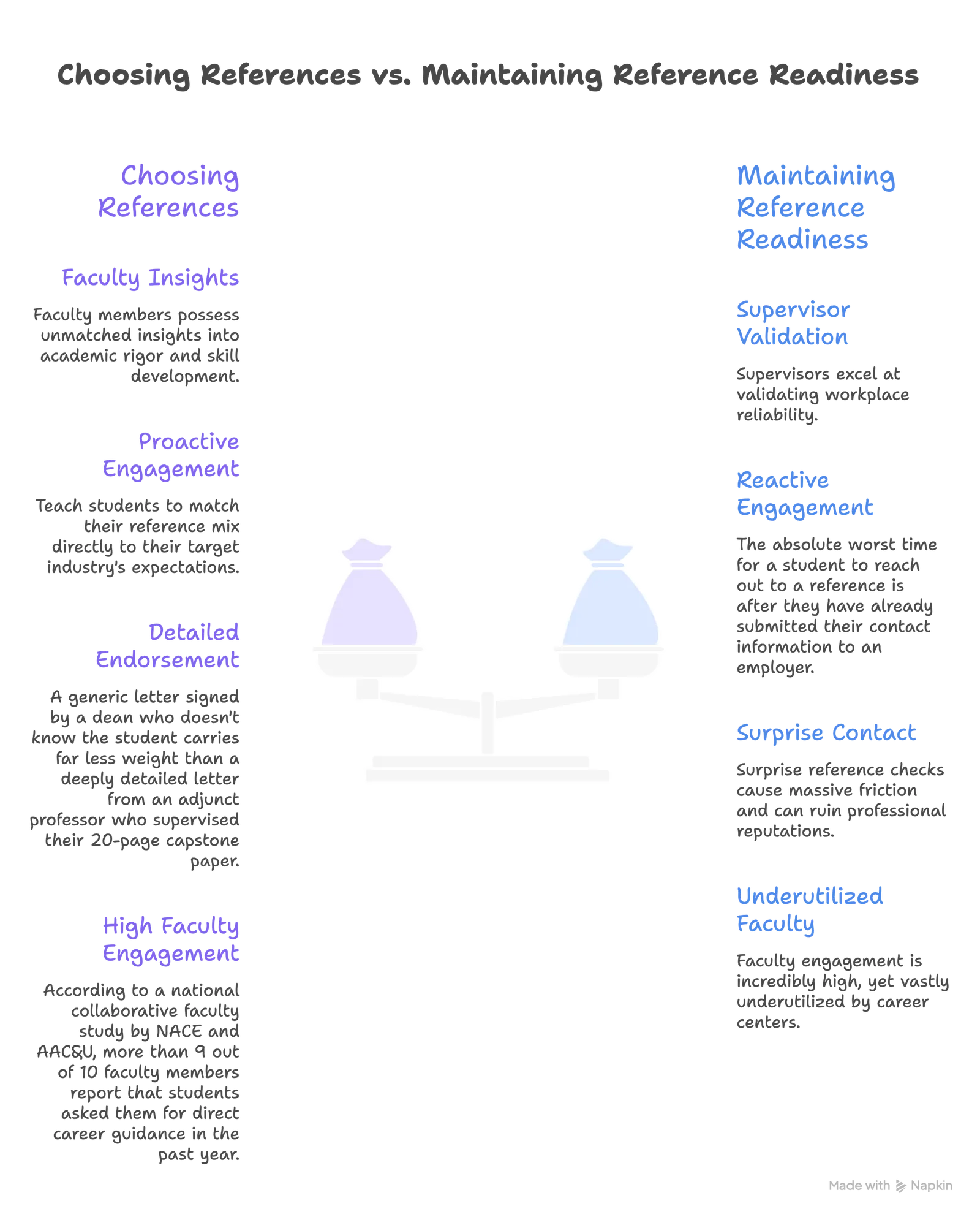
Guide students to select references based on the specific evaluator's ability to verify performance rather than their prestigious job title. While supervisors excel at validating workplace reliability, faculty members possess unmatched insights into academic rigor and skill development. Career centers must train students to match their reference mix directly to their target industry's expectations.
A detailed reference from a professor who directly supervised a student’s work can often provide more useful evidence than a generic letter from a senior university leader who barely knows the student.
Faculty engagement is incredibly high, yet vastly underutilized by career centers.
According to a national collaborative faculty study by NACE and AAC&U, more than 9 out of 10 faculty members report that students asked them for direct career guidance in the past year.
Furthermore, NACE student data indicates that 57% of graduating seniors actively use faculty members as a primary job-search resource.
Teach students to categorize their references into specific pillars:
| Reference Type | Best For Validating... | Industry Target |
|---|---|---|
| Academic Faculty | Critical thinking, research capability, technical expertise, intellectual curiosity, and academic rigor | Graduate schools, research institutions, technical roles, and academically rigorous opportunities |
| Workplace Supervisors | Punctuality, teamwork, operational execution, communication, professionalism, and workplace reliability | Corporate roles, startups, nonprofits, and general professional employment pathways |
| Program Mentors | Leadership potential, emotional intelligence, long-term character, adaptability, and developmental trajectory | Leadership programs, fellowships, selective development opportunities, and mission-driven organizations |
How do we teach students to maintain professional reference readiness over time?
Reference readiness requires consistent, long-term professional relationship maintenance, not just occasional check-ins. Career centers should teach students to treat networking as an ongoing cycle of giving updates, sharing achievements, and seeking feedback. By keeping their network informed before an application cycle, students ensure their references are never caught completely off guard.
So should students ask permission before listing someone as a reference?
Definitely yes. They should ask permission before listing someone's name or contact information as a reference.
The absolute worst time for a student to reach out to a reference is after they have already submitted their contact information to an employer.
Surprise reference checks cause massive friction and can ruin professional reputations.
According to data compiled by College Recruiter, 15% of college workers admit to listing an individual as an official reference without telling them beforehand.
Worse yet, the same study highlights that 16% of employers actively call reference lists before they even invite a candidate in for a formal interview.
To prevent these awkward, high-stakes missteps, teach your students the Reference Pipeline Routine:
- The Bi-Annual Pulse Check: Train students to email their core professional contacts twice a year with genuine updates (e.g., "I just wrapped up my junior year and landed an internship at X Company. Thank you again for your guidance in class last fall!").
- The Skill-Mapping Sync: Encourage students to use structured self-tracking frameworks, similar to the University of North Carolina Wilmington’s "Skill Seeker" framework noted by Kansas State University, to document their evolving competencies and share those ongoing reflections with their mentors.
- The Pre-Flight Warning: The second an application is submitted, the student must notify their references via email with an updated resume and an explicit warning: "You may receive a call or email from X Company regarding a Y role."
How can career centers support non-traditional students who lack strong references?
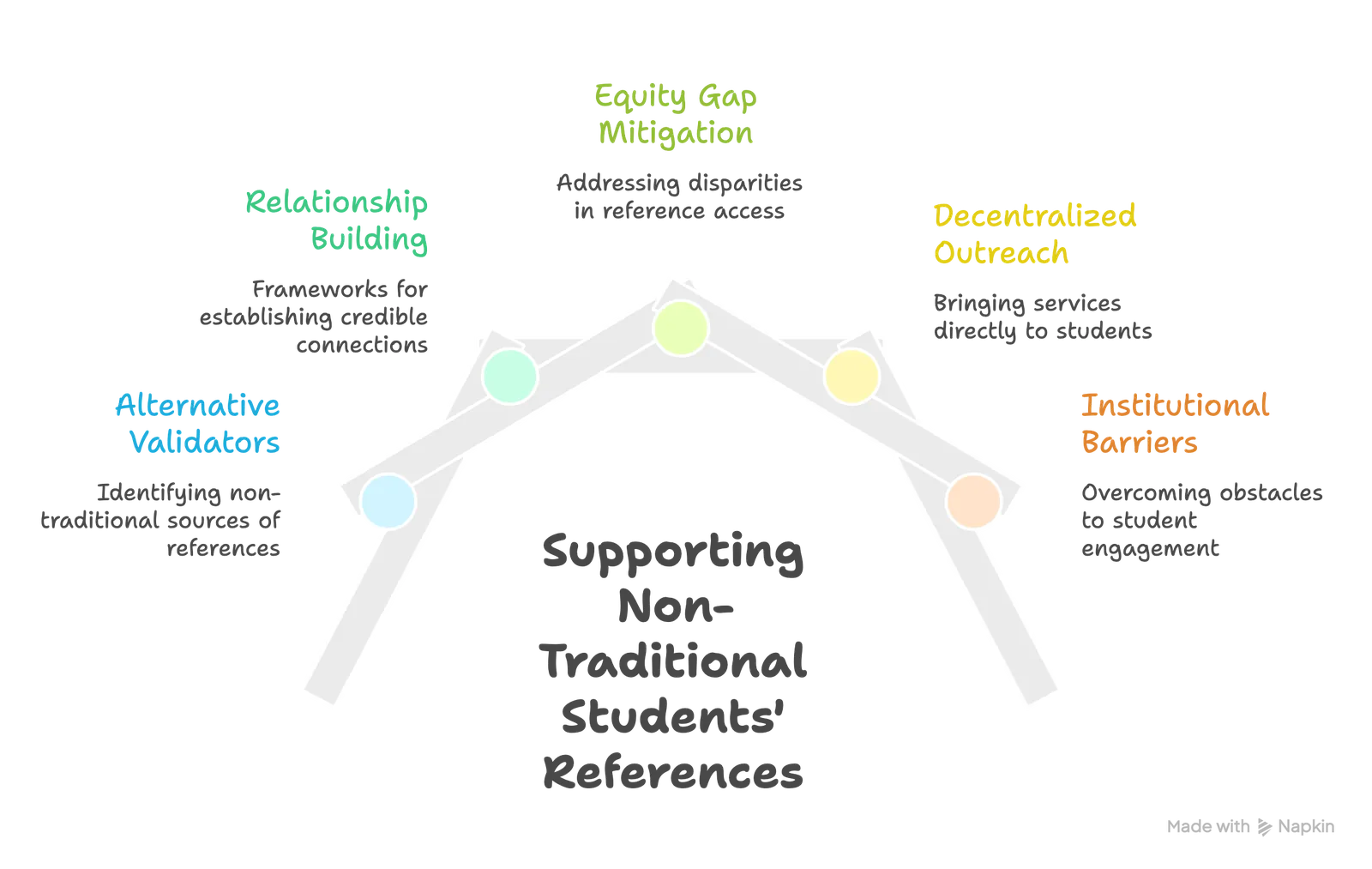
When students lack traditional professional connections, career services must help them map out alternative validators. This includes volunteer coordinators, student club advisors, or cross-functional peers who can vouch for their core skills. You should proactively guide these students through strategic relationship-building frameworks to quickly construct a highly credible reference pipeline.
First-generation, low-income, working, and transfer students often lack the social capital or free time required to secure traditional corporate or academic references.
If a student spent their weekends working an off-campus retail job or commuting immediately after class, they likely won't have deep, personal relationships with tenured department chairs.
Do not let these students panic. Teach them that references do not need to come from Fortune 500 executives to be highly effective.
According to hiring resource data from Diamond Peak Recruiting, volunteer coordinators, student organization advisors, and community leaders are highly credible references who can effectively validate an applicant's punctuality, collaborative capacity, and work ethic.
To proactively mitigate this equity gap, career services teams should actively decentralize their outreach.
As suggested by career readiness models at Kansas State University, career centers should run workshops directly inside first-year residence halls, transfer student lounges, and multicultural student centers rather than waiting for students to walk through the career center doors.
Breaking down these initial institutional barriers helps non-traditional students start building their network immediately.
What Reference Templates and Guidelines Should Career Centers Provide?
Students should generally prepare their professional references on a separate reference sheet rather than placing them on the resume itself. The document can follow the same visual system as the resume, including the student's name, contact header, typography, and overall formatting, while giving employers a simple way to contact each recommender when references are requested.
Career centers must provide highly structured templates that simplify the process for both students and evaluators. This includes reference list formatting sheets matching the resume's aesthetics, formal request email scripts, and faculty "brag sheets." Equipping students with these professional blueprints ensures clean execution and protects the university's legal boundaries.
To turn this advice into an operational reality, your career center should host a downloadable "Reference Mastery Suite" on your student portal.
Do not let students improvise these documents.
According to standard professional templates outlined by the University of Southern California (USC) Career Center, students must format their official reference list using the exact same professional header block, typography, and styling as their resume and cover letter.
This creates a cohesive, highly polished application package.
On the institutional side, your center must provide explicit legal guardrails for faculty members who write letters or answer employer phone calls.
According to standard legal frameworks provided by NACE, any official faculty reference letter must protect student privacy by strictly focusing on documented academic metrics, projects, and observable behaviors.
Faculty must completely omit any personal assumptions, hearsay, or protected demographic traits such as race, age, religion, or marital status.
Essential Templates for Your Center to Build:
The Recommender "Brag Sheet" Blueprint: A simple fillable form where students list:
- The exact courses taken or projects completed under the writer.
- The top three NACE competencies (e.g., Leadership, Technology) they demonstrated.
- Specific, quantifiable examples of their work (e.g., "Managed a $500 budget for the club event").
The Reference List Layout Template: A clean layout featuring:
- Reference Full Name & Current Corporate Title.Organization/Institution Name.
- Professional Relationship (e.g., "Academic Advisor & Capstone Professor").
- Direct, verified phone number and professional email address.
Also Read: 4-Week Job Search Plan for Students: Career Advisor Playbook
Wrapping Up
Building strong reference pipelines should not be left to chance, scattered workshops, or last-minute advisor intervention.
Career centers that operationalize reference readiness early can strengthen student outcomes, improve application competitiveness, and create more scalable career development systems.
Hiration supports this broader mission by combining career assessments, AI-powered resume and interview tools, and counselor workflow management into one FERPA- and SOC 2-compliant ecosystem - helping institutions deliver more structured, personalized, and future-ready student support at scale.
Book a walkthrough to see how Hiration can help your career team deliver more structured, scalable career preparation across the student journey.
Student References & Recommendation Readiness — FAQs
Why should students start building references early?
Strong references depend on long-term relationship development, making early engagement essential for future job and graduate school applications.
Why are references more important than students realize?
Employers and graduate programs often use references as a final validation step to confirm readiness, reliability, and professional credibility.
What makes a recommendation request effective?
Strong requests provide context, target role information, resumes, work samples, competency mapping, and specific examples that help recommenders write detailed evaluations.
Should students choose references based on title or relationship quality?
Relationship quality matters more because detailed, evidence-based recommendations are usually more persuasive than generic letters from prestigious individuals.
What types of references should students build?
Students should develop a mix of faculty, supervisors, mentors, volunteer leaders, and professional contacts who can validate different aspects of readiness.
Why should students maintain references continuously?
Ongoing relationship maintenance prevents surprise requests and helps recommenders provide more current, personalized, and credible endorsements.
What is a reference pipeline routine?
A reference pipeline routine includes periodic updates, skill-sharing check-ins, and early notification before applications or reference checks occur.
How can non-traditional students build credible references?
Volunteer coordinators, campus supervisors, student organization advisors, community leaders, and part-time work managers can all provide strong professional validation.
What templates should career centers provide?
Centers should offer recommendation request scripts, brag sheets, reference list layouts, competency mapping tools, and legal guidance for faculty and staff.
What is the biggest strategic shift career centers need?
Career centers must move from reactive recommendation support toward structured reference-readiness systems embedded throughout the student lifecycle.