How can advisors use labor market data without narrowing student ambition?
Advisors can use labor market data to expand options, test assumptions, and help students make better-informed career decisions. Effective LMI advising connects student interests with job functions, education requirements, wages, demand, geography, employers, and in-demand skills, then turns those signals into practical next steps such as role research, skill-building, informational interviews, and targeted experience planning.
Students often walk into advising with a broad identity statement, not a career target.
“I want to work in health.” “I like policy.” “I want something creative, but stable.” The hard part isn't getting them interested in careers.
It's helping them turn that interest into a credible path without reducing the conversation to wage tables.
Career centers need a repeatable way to turn LMI into advising decisions.
Below is a practical approach to using labor market data in career exploration so students see more options, understand trade-offs earlier, and make decisions that are both informed and personally workable.
How Can Career Centers Use LMI Without Narrowing Student Ambition?
Career centers should use labor market information to expand options, test assumptions, and reduce avoidable risk, not to rank students into “good” and “bad” career choices.
The most effective approach pairs market data with self-assessment so exploration stays student-centered while becoming more concrete.
The fear is understandable.
Once advisors put wage, growth, and demand on the screen, some students hear a verdict. Others assume the institution is steering them away from purpose-driven, creative, or emerging work.
That's usually not a data problem. It's an advising design problem.
What broadening the conversation looks like
A student says they want “sports.” A weak response is to jump straight to the few obvious titles they already know.
A better response is to unpack the interest into functions and environments.
Do they like analytics, event operations, community engagement, sales, coaching, partnerships, media, or facility management?
Once that's clear, labor market data helps surface adjacent roles the student may never have considered.
Advisors can use LMI to show where a student's values and strengths overlap with viable roles across industries, including non-traditional career paths.
Practical rule: Start with identity and motivation. Use data second. If you reverse that order, students often feel sorted rather than supported.
What doesn't work in practice
Several common habits make LMI feel more prescriptive than it needs to be:
- Leading with rankings: Opening with “fastest-growing” or “highest-paying” lists before discussing fit.
- Treating occupation titles as final answers: Students usually need function-level clarity first.
- Ignoring local context: A role may look attractive nationally but unrealistic in the student's intended geography.
- Presenting one pathway: Students need a portfolio of plausible options, not a single recommendation.
A more useful advising stance
The aim isn't to prove a student wrong.
It's to help them make a better-informed version of their own decision.
For example, when a student is committed to a narrow field with volatile hiring, advisors can use LMI to identify adjacent entry points, likely credential expectations, and bridge experiences that preserve the student's long-term direction.
That keeps ambition intact while giving it structure.
Used this way, labor market data doesn't shrink aspiration. It makes aspiration more navigable.
What Specific Labor Market Data Points Should Students Review Before Choosing a Path?
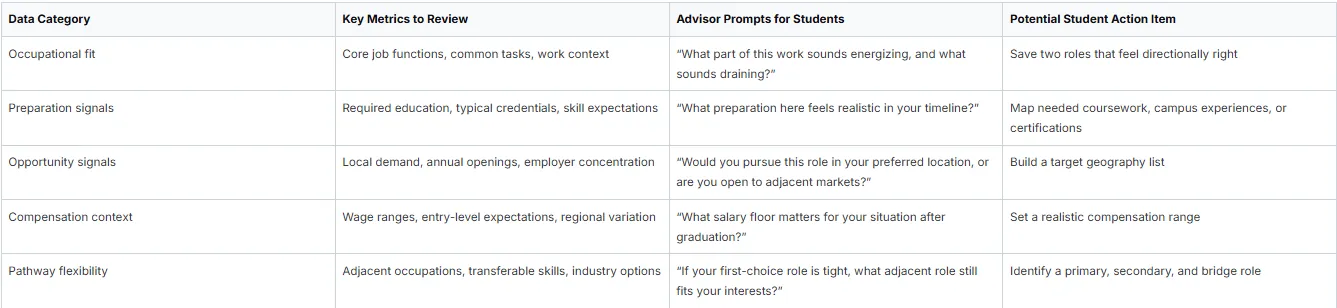
Students should review job functions, education requirements, wage ranges, demand, annual openings, growth, geography, employers, and in-demand skills before choosing a path.
The point isn't to collect more data.
It's to compare options using the same fields so students can see fit, risk, and preparation needs clearly.

Which fields matter most in an exploration conversation
UCF's Labor Market Insights experience is a useful institutional example because it lets users search by occupation, industry, or location and then review demand trends, salary ranges, top employers, education levels, and in-demand skills in one place.
That's the right model for career centers because it mirrors how advisors coach.
Use this checklist in student meetings:
- Role definition: What does the occupation involve day to day?
- Education signal: What level of education is commonly required?
- Wage range: What does compensation look like in the student's target market?
- Openings and demand: Are there enough opportunities to justify the path?
- Growth pattern: Is the role expanding, stable, or tighter than students assume?
- Top employers: Who hires this talent in the target geography?
- Skills language: What capabilities show up repeatedly across postings?
How to make each data point actionable
Students don't need every field in every meeting. They need the right field at the right decision point.

A student exploring analytics, for example, may need more than generic “data” guidance.
For a student exploring analytics, advisors can compare general analyst roles, public-sector data roles, healthcare analytics, and employer-facing operations roles to show how the same skill set changes by sector, geography, and entry expectations.
For teams trying to standardize compensation conversations, this related guide on salary data in career advising is a useful adjacent resource.
Students usually don't need more occupations on a list. They need cleaner criteria for comparing the occupations they're already considering.
How Can Advisors Translate Complex LMI into Actionable Guidance for Students?
Advisors can translate complex labor market information by using a simple coaching sequence: Signal, Story, Strategy.
First identify the relevant market signal, then connect it to the student's goals and context, then convert it into a next-step plan the student can act on this term.

Signal
Start with one insight that matters now. Not five.
If a student is considering user experience, the signal might be that employers consistently ask for portfolio evidence, specific tools, and certain adjacent skills.
If the student is considering public health roles in one metro area, the signal might be that employer concentration is stronger in healthcare systems than in nonprofits.
The advisor's job here is interpretation, not performance. Don't read the dashboard aloud. Pick the signal that changes the student's next decision.
Story
Now tie the signal to the student's narrative.
A student doesn't need to hear, “The market says X.” They need to hear, “Given what you've said you enjoy, this pattern suggests two pathways.
One fits your current preparation. The other may require more intentional experience-building.”
That reframes LMI as context rather than command. It also reduces the chance that students dismiss the data as irrelevant or overly abstract.
Strategy
Close with a plan that is specific enough to track.
Good strategy often includes:
- Experience choice: internship, project, research, campus role, or volunteer work
- Skill evidence: what to add to a portfolio, resume, or LinkedIn profile
- Market test: informational interviews, employer list building, or location comparison
- Preparation decision: whether a credential or graduate study is needed
Here is the framework in meeting language:
“The signal is that this role is asking for a mix of communication and data work in your preferred city. Your story is that you enjoy research but don't want a heavily technical role. So the strategy is to target analyst-adjacent positions, build one data visualization project this semester, and test fit with alumni in two settings.”
That kind of conversation is much more useful than handing a student a report.
Where institutions can operationalize this
Georgia Tech's “design your life” style of career thinking is helpful here because it treats career choice as prototyping, not one perfect answer.
Advisors can adopt the same logic with LMI. Use data to prototype pathways, not to declare a winner.
For teams that want more structure in these early conversations, this framework for career exploration activities for advisors pairs well with LMI-informed coaching.
How Can Career Centers Help Students Balance Market Data with Personal Interests and Constraints?
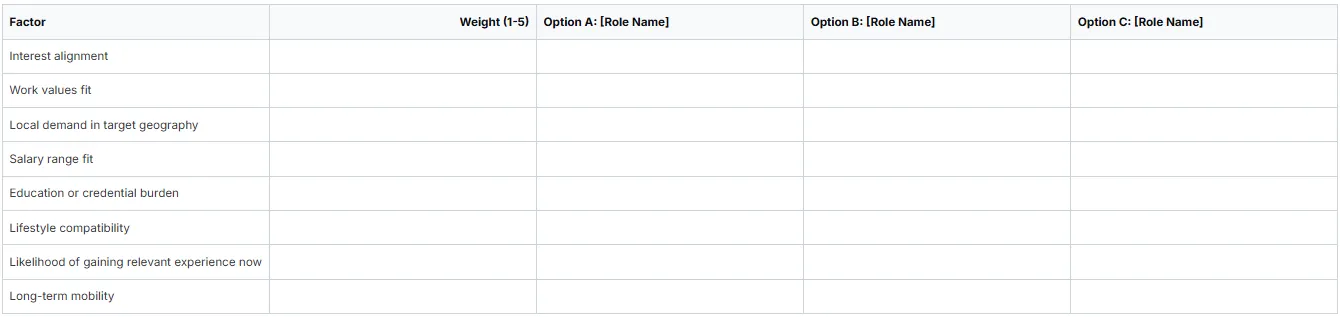
Career centers can help students balance market data with personal constraints by using a decision matrix that places labor signals beside interests, values, geography, finances, and lifestyle considerations.
Students can compare options without pretending that salary alone, or passion alone, is enough.
A common challenge for many advising models arises here. The student says, “I know this other role pays more, but I don't want that life.” Or, “I love this path, but I can't relocate.”
Those are not side issues. They are career decision factors.
A matrix works because it externalizes the trade-offs
When students hold all considerations in their head, the loudest factor usually wins.
A parent's opinion. One internship title. A salary number without context. Writing the criteria down changes the quality of the conversation.
How advisors should facilitate it
Have the student assign the weights first. That reveals what is driving the decision.
A first-generation student supporting family may give salary floor and location stability a high weight.
A student considering mission-driven work may heavily weight values fit and day-to-day task alignment. Neither is wrong. The matrix makes the trade-offs visible.
Don't ask students to choose between “realistic” and “meaningful.” Help them identify the version of meaningful work they can realistically pursue first.
A useful university example
Georgia Tech is often associated with design-oriented career thinking because it encourages students to prototype multiple lives instead of hunting for one fixed answer.
Career centers can adapt that mindset by having students compare two aspirational paths and one bridge path. The bridge path is often the most practical move because it preserves direction while lowering immediate risk.
Questions like these help:
- Which option fits your values best?
- Which option is most workable in your preferred city?
- Which option gives you the strongest first-step experience opportunity?
- Which trade-off feels acceptable, and which one doesn't?
This question set works well alongside these career exploration questions advisors can ask students.
What Are the Signs That Students Are Making More Data-Informed Career Decisions?
Students are making more data-informed career decisions when they move from vague aspiration to specific, evidence-backed plans, compare multiple pathways, ask sharper questions, and adjust their strategy as they learn more.
The shift is visible in language, decision quality, and follow-through.

What advisors should look for in student behavior
The strongest signs are usually qualitative before they become outcomes data:
- More precise language: “I'm targeting program coordinator and community partnership roles in this region” is stronger than “I want to help people.”
- Pathway comparison: The student can explain why they are choosing among multiple roles.
- Preparation awareness: The student knows which skills, experiences, or credentials matter.
- Location realism: The student understands how geography affects options.
- Adaptive planning: The student keeps a preferred path but builds backups and adjacent options.
It's that students make better decisions when institutions help them connect exploration, preparation, and outcomes as one system.
What leaders should measure beyond placement
Career centers should also watch for evidence that students are making decisions that hold up after graduation, not just decisions that sound good in an appointment.
A simple internal scorecard might track:
- role specificity in advising notes
- evidence of occupation and geography research
- internship targeting quality
- alignment between chosen path and documented constraints
- follow-up progression from exploration to application behavior
For teams building stronger reporting, this guide on career center metrics is a practical next step.
How Can Career Centers Implement a Data-Driven Exploration Model?
Career centers can implement a data-driven exploration model by building four things in sequence: shared tools, advisor fluency, workflow integration, and outcome review.
Don't start with dashboards alone. Start with one advising model that the whole team can use consistently, then layer technology and measurement onto it.
A lot of implementations fail because centers buy access to LMI but don't redesign advising.
The data sits in a platform, a few power users adopt it, and students get uneven guidance depending on who they meet with.
What an operational rollout should include
Start small enough to standardize.

Where to set the measurement bar
According to Clear Impact's guidance on timely labor market data for career development, workforce experts recommend tracking employment sustainability, meaning whether the student is still employed in the occupation about a year later.
That's a useful benchmark for career centers because it shifts the question from “Did they land somewhere?” to “Did the pathway hold?”
That standard also pushes teams to build employer feedback loops and pay attention to local hiring shifts, not just annual reports.
What to do if advisor buy-in is mixed
Some staff may worry that data-heavy advising will make conversations feel less human. Address that through examples, peer observation, and shared case reviews.
Compare two notes for the same student:
“Interested in communications.”
vs.
“Exploring internal communications, employer branding, and social media coordination in two target cities. Needs portfolio samples and internship targeting.”
The second note shows the point clearly: LMI does not replace coaching. It makes coaching sharper.
Wrapping Up
Labor market data is most useful when it helps students make clearer, better-supported choices without narrowing their ambition too early.
For career centers, the real work is turning data into repeatable advising conversations, practical next steps, and visible student progress.
Hiration supports that broader workflow with a full-stack career readiness suite spanning Career Assessments, AI-powered Resume Optimization, Interview Simulation, LinkedIn optimization, and more. Its dedicated Counselor Module also helps teams manage cohorts, workflows, and analytics within a secure, FERPA and SOC 2-compliant platform.
A stronger LMI workflow gives advisors a cleaner way to connect student interests, market realities, and action plans.
Labor Market Data in Career Exploration — FAQs
How should advisors use labor market data in career exploration?
Advisors should use labor market data to expand options, test assumptions, compare pathways, and help students connect interests with realistic preparation steps.
Why should LMI not be used as a ranking tool?
Ranking careers by salary or growth alone can make students feel sorted into paths instead of supported in making informed, personally workable decisions.
What labor market data points should students review?
Students should review job functions, education requirements, wage ranges, demand, annual openings, growth trends, geography, top employers, and in-demand skills.
How can advisors make LMI easier for students to understand?
Advisors can use a Signal, Story, Strategy sequence: identify one relevant market signal, connect it to the student’s context, and turn it into a next-step plan.
How should advisors balance market data with student interests?
Advisors should place labor signals beside values, skills, geography, finances, lifestyle needs, and constraints so students can compare trade-offs clearly.
What is a bridge path?
A bridge path is a practical first-step option that preserves a student’s longer-term direction while lowering immediate risk around pay, location, experience, or entry barriers.
What are signs of data-informed career decision-making?
Students use more precise role language, compare multiple pathways, understand preparation needs, factor in geography, and adjust plans based on new evidence.
How should career centers implement LMI advising workflows?
Centers should standardize tools, train advisors on interpretation, integrate LMI into advising workflows, and review whether decisions hold up through outcomes data.
What should career centers measure beyond placement?
Centers should track role specificity, occupation research, geography awareness, internship targeting quality, constraint alignment, and movement from exploration to application.
What is the biggest strategic shift for LMI advising?
Career centers should move from showing students labor market dashboards toward translating labor signals into clearer advising decisions, action plans, and measurable progress.