How can institutions build stronger advisor training systems that improve advising quality?
Institutions can improve advising consistency by building structured advisor development systems that define competencies, standardize observation and feedback, strengthen coaching behaviors, and connect advisor growth to measurable student outcomes. Effective frameworks combine relational coaching, data-informed decision-making, documentation quality, and continuous improvement practices to create scalable, high-quality advising support.
If you’re leading an advising or career services team, advisor training and development cannot stop after onboarding.
Advisors are expected to diagnose student needs, interpret data, support academic and career decisions, document progress, manage follow-up, and create a clear next step for students. Without shared standards for how those skills are developed and evaluated, advising quality can vary significantly across a team.
The challenge is deciding what advisors should be trained on, what good advising should look like in practice, and how leaders can coach improvement without turning development into a compliance exercise.
This guide gives higher-ed leaders a practical advisor training and development framework. It covers industry standards, academic advising best practices, core competencies, training curricula, observation checklists, feedback strategies, professional development pathways, coaching cadence, and metrics for measuring advisor growth.
What Should an Advisor Training Framework Include?
An advisor training framework should define the skills advisors must demonstrate, how leaders will observe those skills, how feedback will be delivered, and how improvement will be measured. The goal is not to script every student conversation. It is to create a shared standard for advising quality, documentation, follow-up, and student progress.
A strong framework usually includes five parts:
- core advisor competencies
- observation and coaching tools
- structured feedback practices
- role-based development pathways
- performance and progress metrics
Without those pieces, advisor development becomes too informal. One advisor may be excellent at building rapport but weak at documentation. Another may understand policy but struggle to help students make decisions. A third may give strong advice but fail to create follow-up accountability.
A framework helps leaders coach those differences consistently.
Advisor Development Framework at a Glance
Use this table as the foundation for advisor training, observation, and performance coaching.
| Framework area | What it defines | How leaders can use it |
|---|---|---|
| Core competencies | The knowledge, behaviors, and judgment advisors should demonstrate | Set shared expectations |
| Training curriculum | What advisors need to learn and practice | Structure onboarding and ongoing development |
| Observation | What good advising looks like in an actual session | Identify specific coaching needs |
| Feedback | How leaders respond to observed behavior | Turn observation into improvement |
| Development pathway | How expectations change with advisor experience | Differentiate professional development |
| Measurement | How advisor and student progress will be assessed | Track whether development is working |
| Continuous improvement | How the team reviews patterns and adjusts practice | Improve advising at the system level |
Are There Industry Standards for Advisor Training and Development?
There is no single advisor training checklist that every college or university must follow. However, professional competency frameworks and institutional advising standards provide a strong foundation for defining what advisors should know, how they should practice, and how their development should continue over time.
NACADA: The Global Community for Academic Advising organizes academic advising competencies into three areas: Conceptual, Informational, and Relational. The model is intended to guide advisor professional development and help advising professionals apply those competencies across different institutional contexts.
Institutional frameworks extend that foundation into day-to-day training. UC Berkeley, for example, treats advisor development as an ongoing process supported through mentoring, coaching, reflective supervision, scenario-based learning, case analysis, and practical assignments rather than relying only on formal instruction.
Indiana University’s Advising & Career Framework similarly establishes professional expectations for advisors and career services professionals, calls for coaching-based training, proactive student support, regular professional development, and institutional measurement of advising and student outcomes.
For advising leaders, the practical implication is that an advisor training framework should cover four levels:
- Professional foundations: advising principles, ethics, role expectations, and institutional context.
- Applied advising competencies: diagnosis, communication, decision support, referrals, documentation, and follow-up.
- Observed practice: whether advisors demonstrate those competencies consistently with students.
- Continuous development: coaching, feedback, professional learning, and reassessment over time.
The institution can then adapt those standards to its advising model, student population, staffing structure, and strategic priorities.
What Are the Best Practices for Academic Advising in 2026?
Academic advising best practices in 2026 increasingly emphasize consistent competencies, coaching-based conversations, proactive support, career-connected guidance, data-informed outreach, ongoing professional development, and measurement of student progress rather than appointment volume alone.
For advising teams, six practices are especially useful:
1. Define shared advisor competencies
Advisors should know what strong practice looks like across diagnosis, communication, institutional knowledge, decision support, documentation, referrals, and follow-up.
2. Treat training as continuous development
Advisor development should continue beyond initial onboarding. Observation, case review, coaching, peer learning, and targeted skill development should reinforce practice throughout an advisor’s career.
3. Use coaching-based advising
Students should leave advising interactions with greater clarity and ownership rather than simply receiving instructions. Advisors need skills in questioning, listening, reflection, option comparison, and action planning.
4. Make support more proactive
Advisors should know how to interpret student context and available signals so they can identify needs before every student has to ask for help.
5. Connect academic decisions to longer-term goals
Course choices, majors, internships, projects, graduate study, and career planning increasingly overlap. Advisors should be able to help students understand those connections while staying within appropriate role boundaries.
6. Measure whether advising creates movement
Teams should examine documentation quality, follow-through, referrals, milestone completion, student clarity, and other indicators of progress rather than treating appointment counts as the primary measure of advising effectiveness.
Indiana University’s current framework, for example, connects coaching-based practice, proactive outreach, academic and career integration, professional development, and institutional measurement within one advising and career-development model.
Also Read: How to Train New Advisors at Scale and Standardize Support?
What Should an Academic Advisor Training Program Cover?
An academic advisor training program should combine institutional knowledge with applied advising practice. Advisors need to know policies and systems, but they also need opportunities to practice diagnosis, coaching, documentation, referrals, data use, career-connected conversations, and student follow-up.
A practical training curriculum can include:
| Training area | Advisors should learn | Practice method |
|---|---|---|
| Advising foundations | advising philosophy, ethics, role boundaries, professional expectations | guided discussion + cases |
| Institutional knowledge | policies, curriculum, student resources, referral pathways | scenario exercises |
| Student context diagnosis | how to review context and identify the underlying need | case review |
| Relational coaching | listening, questioning, validation, summarizing, decision support | role-play |
| Career-connected advising | how academic choices connect to skills and career goals | student scenarios |
| Data literacy | interpreting student signals, milestones, and dashboards | guided data exercises |
| Documentation | case notes, decisions, action items, and referrals | note audits |
| Technology | advising systems and student-support tools | hands-on practice |
| Follow-up | action planning, accountability, outreach, and escalation | workflow simulation |
| Difficult situations | boundaries, uncertainty, complex cases, and referral decisions | scenario-based practice |
The curriculum should not be delivered as information transfer alone. Advisors need opportunities to apply what they learn, receive feedback, and demonstrate the skill in realistic situations.
UC Berkeley specifically identifies scenario-based learning, case study analysis, project-based assignments, mentoring, coaching, and reflective supervision as useful approaches for advisor development.
What Skills Should Advisors Master in 2026?
Advisors should master four skill areas: student context diagnosis, relational coaching, data-informed outreach, and career-connected decision support. These skills help advisors move beyond answering immediate questions and toward guiding students through decisions that affect persistence, confidence, academic momentum, and long-term career direction.
The role of the advisor is becoming more complex because student needs are rarely isolated.
A course choice may connect to financial pressure. A missed milestone may reflect confidence, family obligations, unclear career goals, or limited understanding of the institution’s systems.
According to NACADA: The Global Community for Academic Advising, effective advising is built on a tripartite model of Conceptual, Informational, and Relational competencies.
Those competencies provide the professional foundation. Within that broader framework, advising teams can train for specific capabilities required in their own operating environment, including student context diagnosis, relational coaching, data-informed outreach, and career-connected decision support.
Advisor training should therefore focus on both technical knowledge and coaching judgment.
1. Student context diagnosis
Advisors need to review available context before the session and identify what may be driving the student’s need.
This includes:
- academic standing
- degree progress
- prior advising notes
- missed milestones
- engagement history
- declared interests
- career goals
- previous action items
- support referrals
A strong advisor does not enter every session with a blank slate. They use available context to ask better questions faster.
2. Relational coaching
Students are more likely to act on guidance when they feel heard and respected. Relational advising is not just being friendly. It includes validation, active listening, trust-building, and the ability to create psychological safety while still moving the conversation toward action.
Advisor training should include practice in:
- reflective listening
- validating language
- asking open-ended questions
- summarizing student concerns
- noticing uncertainty or hesitation
- balancing empathy with clarity
3. Data-informed outreach
Advisors should know how to interpret basic student signals. That does not mean every advisor needs to become a data analyst. It means advisors should understand how to use available information to prioritize outreach and support.
Useful signals may include:
- drop in platform activity
- missed advising appointment
- incomplete career milestone
- repeated course withdrawal
- no follow-up after advisor recommendation
- resume reviewed but not revised
- mock interview started but not completed
- senior with no job-search activity
Training should help advisors decide which signals need a nudge, which need a direct appointment, and which need escalation.
4. Career-connected decision support
Academic advising and career advising often overlap. Students may choose courses, majors, internships, projects, or graduate school paths without fully understanding how those choices connect to future goals.
Advisors should be trained to ask career-connected questions without turning every academic session into a job-search appointment.
Examples:
- “How does this course connect to the skills you want to build?”
- “Which option gives you stronger evidence for your next internship?”
- “What kind of work are you trying to test through this choice?”
- “Would this decision keep more paths open or narrow your options too early?”
These questions help students understand the career implications of academic decisions.
How Should Directors Observe Advisor Performance?
Directors should observe advisor performance through specific behaviors, not vague impressions. A useful observation process reviews preparation, interaction quality, decision coaching, documentation, and follow-up. The goal is to identify what the advisor did, how the student responded, and what should be strengthened in the next session.
Observation should not feel like surveillance. It should function as professional coaching. A strong observation process includes:
- a clear rubric
- shared expectations before observation
- one or two focus areas per session
- specific evidence from the interaction
- advisor self-reflection
- a short feedback conversation
- one practice target for the next cycle
Leaders should avoid trying to evaluate everything at once.
For example, one observation may focus only on opening and goal-setting. Another may focus on action planning. Another may review documentation quality after the appointment.
What Should Be Included in an Advisor Coaching Observation Checklist?
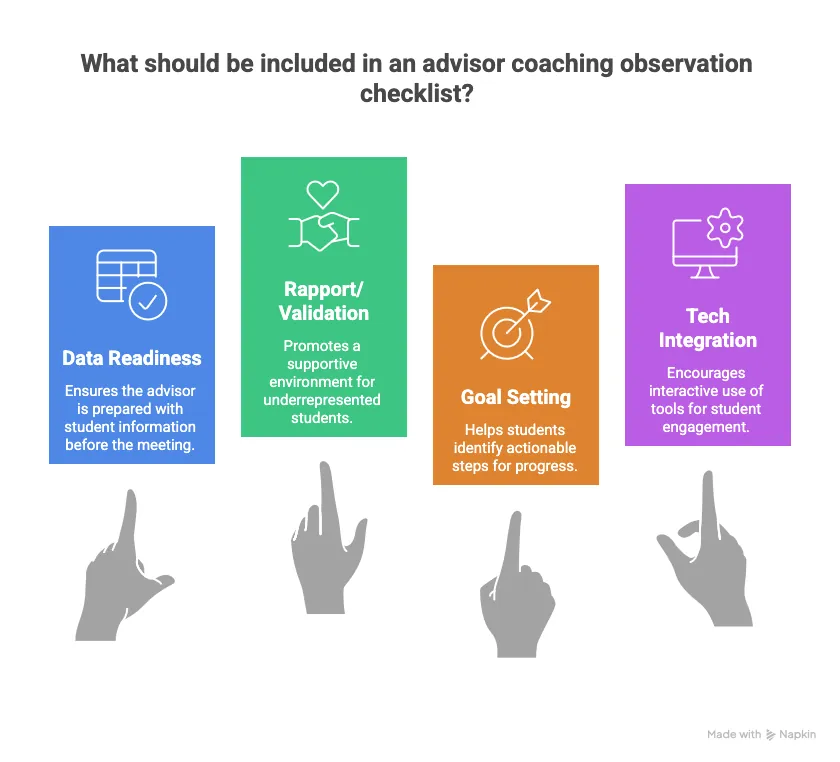
An advisor coaching observation checklist should include preparation, rapport, diagnosis, decision support, action planning, documentation, and follow-up. It should not only assess whether the advisor was helpful. It should show whether the session created clarity, student ownership, and a measurable next step.
The strongest checklists focus on observable behaviors. According to a 2024 study in the NACADA Journal, academically and interpersonally validating experiences are key to the persistence of underrepresented students.
Avoid rating only broad traits such as:
- friendly
- knowledgeable
- professional
- supportive
- helpful
Those qualities matter, but they are too vague for coaching. Instead, observe whether the advisor:
- reviewed student context before the session
- clarified the student’s goal
- asked diagnostic questions
- summarized the issue accurately
- connected guidance to academic or career goals
- helped the student compare options
- documented action items
- created follow-up accountability
That level of specificity makes feedback easier to give and easier to act on.
Advisor Coaching Observation Checklist
Use this checklist during live observations, recorded session reviews, peer observations, or case note audits.
| Area | Observable behavior | Review question |
|---|---|---|
| Preparation | Reviews available student context before the interaction | Did the advisor enter with enough context to ask focused questions? |
| Opening | Clarifies the student’s purpose and desired outcome | Was the goal of the session clear? |
| Diagnosis | Uses questions to uncover the underlying issue | Did the advisor solve the right problem? |
| Listening | Summarizes and validates relevant student concerns | Did the student appear understood? |
| Decision support | Helps the student compare realistic options | Did the advisor support decision-making rather than simply prescribe? |
| Career connection | Connects decisions to skills, experiences, or future goals where appropriate | Did the student understand the longer-term implications? |
| Action planning | Defines clear next steps | Did the student leave knowing what to do? |
| Documentation | Records relevant context, decisions, and action items | Could another advisor understand what happened? |
| Follow-up | Establishes accountability or escalation when needed | Is the next touchpoint clear? |
Also Read: 7 Career Coaching Case Note Templates for Structured Advising
How Can Leaders Give Better Feedback to Advisors?
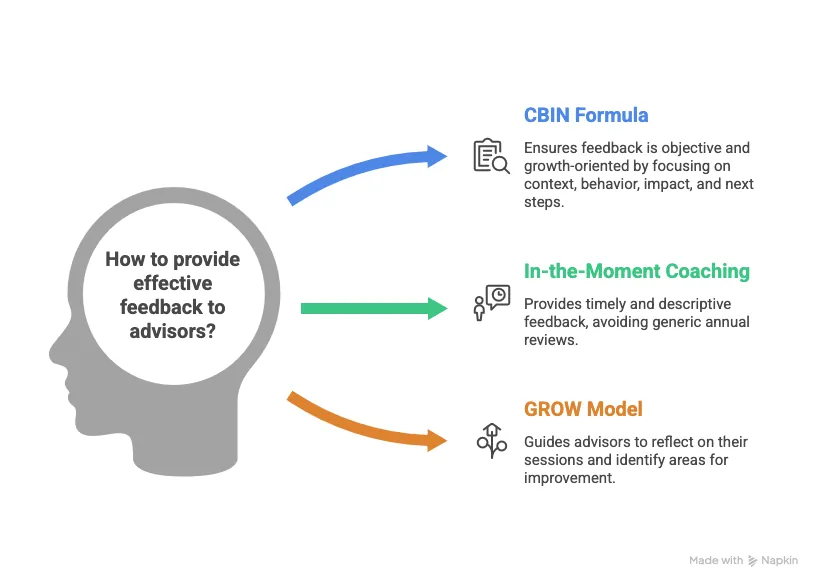
Leaders can give better feedback by describing the context, naming the observed behavior, explaining the student impact, and agreeing on a next practice target. Feedback should be specific enough that the advisor knows what to repeat, stop, or improve in the next session.
Annual reviews are too delayed to improve advising practice on their own. Advising leaders need lighter, more frequent feedback loops that connect observed behaviors to student clarity, follow-through, and momentum.
A useful feedback structure is:
- Context: When and where the behavior occurred
- Behavior: What the advisor did or said
- Impact: How it affected the student or session
- Next Step: What the advisor should practice next
These advisor feedback strategies work best when the discussion stays anchored to observable evidence rather than broad judgments about the advisor.
Advisor Feedback Template
Use this format after an observed session or documentation review.
Advisor:
Date:
Session Type:
Observation Focus:
Context:
What session, student situation, or documentation sample is being discussed?
Observed Behavior:
What did the advisor do or not do? Use specific evidence, not interpretation.
Student Impact:
How did the behavior affect student clarity, confidence, decision-making, or follow-through?
Coaching Question:
What question will help the advisor reflect?
Next Practice Target:
What should the advisor try in the next session?
Follow-Up Date:
When will the leader review progress?
Example
Context: Sophomore academic planning session on March 12
Observed Behavior: The advisor helped the student choose courses but did not connect the options to the student’s stated interest in healthcare administration.
Student Impact: The student left with a schedule, but not a clearer understanding of how the courses supported career direction.
Coaching Question: “What career-connection question could you have asked before recommending the final schedule?”
Next Practice Target: In the next academic planning session, ask one question that connects course choice to skills, internships, or career goals.
Follow-Up Date: Review one session note next week.
How Should Directors Structure Advisor Coaching Conversations?
Advisor coaching conversations should help the advisor reflect on the session, identify what worked, examine what could improve, and commit to one specific behavior to practice. The conversation should feel developmental, not punitive, and should connect directly to observed advising behaviors.
A simple coaching model can follow four prompts:
- What worked? What did the advisor think went well in the session?
- What did you notice? What happened when the student responded, hesitated, changed direction, or committed to an action?
- What would you change? Which moment could have been handled differently?
- What will you practice next? What single behavior should the advisor intentionally test in the next relevant interaction?
This structure keeps feedback from becoming a lecture. It also helps advisors build self-awareness, which is essential for long-term growth.
What Professional Development Pathway Should Advisors Follow?
Advisor development should follow a pathway that changes as advisors gain experience. New advisors need structure and policy fluency. Developing advisors need coaching skill and documentation consistency. Senior advisors need specialization and data use. Lead advisors need supervision, training, and system improvement skills.
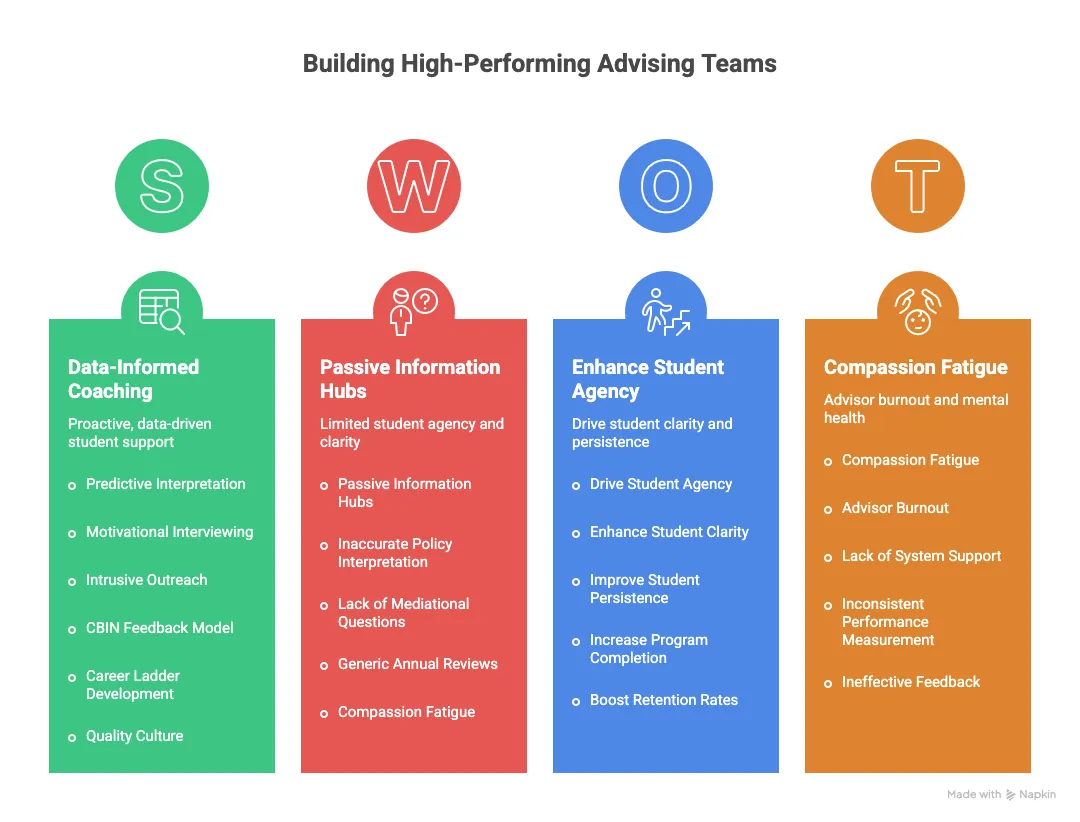
Continuous growth prevents the "compassion fatigue" often cited in recent NACADA Journal (2024) research on advisor mental health.
A flat training model does not work well because advisors do not all need the same development at the same time. A role-based pathway can look like this:
| Development stage | Primary focus | Evidence of readiness for the next stage |
|---|---|---|
| New advisor | policies, systems, referral pathways, role boundaries, documentation | gives accurate guidance and documents consistently |
| Developing advisor | diagnosis, relational coaching, action planning, follow-up | demonstrates consistent session quality across common cases |
| Experienced advisor | complex cases, specialization, data use, proactive intervention | handles higher-complexity work independently |
| Senior/lead advisor | coaching others, calibration, training, process improvement | improves practice beyond their own caseload |
The pathway gives leaders a way to differentiate development without creating entirely separate training systems for every advisor.
Also Read: Workshop Scripts Advisors Can Use to Create Verifiable Student Outcomes
How Often Should Advisor Training and Coaching Happen?
Advisor training should happen often enough to reinforce practice, but there is no universal cadence that every institution needs to follow. The right schedule depends on advisor experience, team size, advising volume, institutional complexity, and the behaviors the team is trying to improve.
A practical cadence might include:
| Timing | Development activity | Primary purpose |
|---|---|---|
| Onboarding | intensive foundational training | establish policies, systems, standards, and role expectations |
| First 90 days | observation and frequent coaching | reinforce practice while habits are forming |
| Monthly | case review, calibration, or peer learning | address recurring issues and maintain consistency |
| Quarterly | focused skill development | deepen one competency or respond to an emerging need |
| Each semester | observation or competency review | assess progress against shared expectations |
| Annually | development planning | identify next-stage goals and broader professional growth |
This should be treated as an adaptable operating model rather than an industry requirement.
The important principle is continuity. UC Berkeley describes advisor development as ongoing and highlights mentoring, coaching, reflective supervision, case-based learning, and other continuing learning opportunities as ways to support growth beyond initial training.
How Can Teams Build a Culture of Continuous Improvement?
Teams build a culture of continuous improvement by reviewing advising practice regularly, using data without blame, and turning patterns into process changes. The goal is not to police advisors. It is to help the team learn which practices improve student clarity, follow-through, and momentum.
Continuous improvement works best when teams review both qualitative and quantitative evidence.
Use:
- case note reviews
- student feedback
- peer observations
- appointment outcomes
- follow-up completion
- cohort progression
- referral patterns
- advising bottlenecks
- missed milestones
The key is psychological safety. Advisors must be able to discuss what did not work without fear that every challenge will become a performance issue.
A useful improvement cycle is:
- Plan: Choose one advising behavior or workflow to improve.
- Do: Test the change for a short period.
- Check: Review student and advisor signals.
- Act: Keep, revise, or stop the practice.
Example:
If students often leave appointments without completing follow-up tasks, the team might test a new student action-plan template for four weeks. After that period, leaders review whether follow-up completion improved.
Also Read: How can advisors use a self-assessment toolkit to become strategic, AI-ready career center professionals?
How Should Advising Leaders Measure Advisor Development?
Advising leaders should measure advisor development through student follow-through, documentation quality, session consistency, referral accuracy, coaching behavior, and advisor growth over time. Appointment volume alone is not enough because it does not show whether students left with clarity or completed meaningful next steps.
Useful metrics include:
Advisor capability
- observation or coaching rubric scores
- documentation quality
- competency development over time
- training completion
- accuracy of referrals
- consistency of action planning
Student movement
- follow-up completion
- action-plan completion
- milestone progress
- referral follow-through
- student clarity or confidence after advising
- completion of agreed next steps
Operational consistency
- case-note completion
- follow-up consistency across advisors
- escalation accuracy
- variation in observed advising behaviors
- recurring coaching needs across the team
- patterns by advisor, student group, or service area
The best measurement systems combine numbers and context. A high appointment count with poor documentation may still create operational risk.
Strong student satisfaction with low follow-through may show that students like the experience but are not taking action. Good advising measurement should reveal both service quality and student movement.
Institutional measurement can also help leaders determine whether the development system itself is working. Indiana University’s framework, for example, calls for monitoring student outcomes and professional expectations alongside regular training and professional development.
Advisor Training Implementation Plan
Advising leaders can build the framework in phases instead of trying to redesign everything at once.
| Timeline | Focus | Leader Action | Output |
|---|---|---|---|
| Weeks 1–2 | Define standards | Select 5–7 advising behaviors and competencies that should be observed consistently across the team | Advisor competency rubric |
| Weeks 3–4 | Standardize documentation | Create required note fields, documentation expectations, and a consistent action-plan structure | Case note template |
| Weeks 5–6 | Pilot observation | Observe 3–5 advising sessions or review a sample set of case notes to identify patterns and gaps | Coaching notes and common advising themes |
| Weeks 7–8 | Train feedback process | Use a structured feedback template and assign one practical growth target per advisor | Advisor development goals |
| Weeks 9–10 | Review metrics | Track action-plan completion, follow-up rates, documentation quality, and advising consistency | Baseline performance and quality view |
| Weeks 11–12 | Adjust and scale | Refine rubrics, templates, workflows, and training processes based on advisor and student feedback | Team-wide advisor development system |
This implementation plan gives teams a realistic starting point. The goal is not perfection in the first term. The goal is to move from informal development to consistent, observable, and coachable advising practice.
Wrapping Up
High-performing advising teams are built through systems, not individual effort alone. Advisors need clear expectations, practical training, useful observation, timely feedback, and development pathways that match their experience level.
When advisor skills are defined, observed, and coached consistently, advising becomes easier to improve.
Leaders can see where students are getting clarity, where follow-up is breaking down, where documentation needs work, and where advisors need additional support.
Hiration supports this kind of structured advising environment across the career readiness journey. Our platform brings together career assessments, AI-powered resume optimization, interview simulation, student workflows, and counselor-facing analytics within a secure, FERPA- and SOC 2-compliant environment.
When advising is treated as a discipline to be developed at the system level, teams can create more consistent student experiences, stronger follow-through, and clearer evidence of progress.
Advisor Training Framework — FAQs
What should an advisor training framework include?
A strong framework includes advisor competencies, coaching observation tools, structured feedback practices, role-based development pathways, and measurable performance metrics.
Why is informal advisor development a problem?
Informal development creates inconsistent advising quality, uneven documentation standards, and limited visibility into whether students are progressing effectively.
What are the most important advisor skills in 2026?
Advisors increasingly need student context diagnosis, relational coaching, data-informed outreach, and career-connected decision support skills.
Why is relational coaching important in advising?
Relational coaching helps students feel heard, improves trust, increases follow-through, and creates stronger student engagement during decision-making conversations.
How should directors observe advisor performance?
Observation should focus on specific advising behaviors such as preparation, questioning, action planning, documentation, and follow-up rather than vague impressions.
What makes an effective coaching observation checklist?
Strong checklists evaluate observable advising actions including context review, goal clarification, diagnostic questioning, option comparison, and accountability planning.
How should leaders give feedback to advisors?
Effective feedback explains the observed behavior, its impact on the student experience, and one specific practice target for improvement.
Why should advisor development pathways differ by experience level?
New advisors need policy and workflow structure, while experienced advisors require specialization, coaching leadership, and systems-level improvement skills.
How can teams build a culture of continuous improvement?
Teams improve by reviewing advising patterns regularly, using feedback safely, analyzing student follow-through data, and testing workflow improvements iteratively.
What is the biggest strategic shift advising leaders need to make?
Institutions must move from personality-driven advising toward structured, observable, and coachable advising systems that improve service quality consistently.