If your career center regularly works with students who have never created a resume, the first challenge is often helping them recognize what they have to include.
A student without internships or formal employment may assume they have nothing worth documenting, even when they have completed substantial coursework, group projects, volunteer activities, or other responsibilities.
This creates a recurring challenge for career services teams: students need help identifying and organizing their experiences before they can benefit from professional resume feedback.
This guide explains how to establish a structured first-draft process that can address this gap, where AI can provide support, and what students should complete before requesting advisor feedback.
Why Do Students Struggle to Create Their First Resume?
Students often struggle with their first resume because they interpret experience too narrowly. They may associate resume content exclusively with internships, paid employment, or formal leadership positions. Career centers can address this by helping students recognize relevant skills and responsibilities across academic, extracurricular, community, and personal experiences.
The problem is not necessarily a lack of experience. It is often a lack of awareness about which experiences can demonstrate useful capabilities.
For example, a student who has never held a job may have:
- Completed a semester-long research project involving data collection and analysis.
- Coordinated activities for a student organization.
- Managed scheduling and other responsibilities while caring for a family member.
- Participated in a community volunteering initiative.
These activities are not automatically appropriate for every resume, but they provide starting points for identifying relevant experience.
This broader perspective is supported by NACE, which recognizes that career-readiness competencies can develop across curricular and extracurricular activities.
Similarly, MIT Career Advising & Professional Development encourages first-year students to draw from projects, coursework, independently developed skills, and earlier experiences.
What career centers should do: Begin first-resume workshops with an experience-discovery activity, rather than immediately asking students to open a resume template.
The initial objective should be to establish what students have done, not how professionally they can describe it.
What Information Should Students Gather Before Building a Resume?
Before creating a resume, students should complete a basic experience inventory. This worksheet should capture activities, responsibilities, skills, and outcomes without requiring students to translate them into resume language immediately. Separating information gathering from document creation helps career centers identify usable material before students begin drafting.
A simple worksheet can organize this process across six experience categories.
First-resume experience inventory worksheet
| Experience category | Questions students should answer |
|---|---|
| Coursework and academic assignments | Which courses involved presentations, research, analysis, or substantial assignments? What did you complete? |
| Class and personal projects | What did you create or investigate? What was your specific contribution? |
| Volunteering and community activities | Where did you contribute? What responsibilities did you take on? |
| Student organizations and campus activities | What activities did you organize, support, or participate in? |
| Part-time work and informal employment | What tasks did you perform? What tools, processes, or people did you work with? |
| Caregiving and family responsibilities | Did you coordinate schedules, manage resources, or undertake responsibilities that demonstrate relevant capabilities? What are you comfortable disclosing? |
For each experience, students should record five details:
- Activity: What was the experience?
- Role: What did you personally do?
- Context: Where and when did it happen?
- Skills used: What knowledge or capabilities did it require?
- Evidence: What did you produce, complete, support, or accomplish?
These responses become the raw material for the first draft.
For students with limited employment histories, career centers can also point to the University of California, Berkeley's first-year resume examples, which recognize coursework, extracurricular activities, volunteering, and part-time employment as potential resume content.
Implementation tip: Distribute the worksheet before first-resume appointments, incorporate it into introductory career courses, or offer it as a self-service activity.
Students should be able to complete it without knowing how to write a resume.
How Can Career Centers Guide Students From Raw Experience to a First Draft?
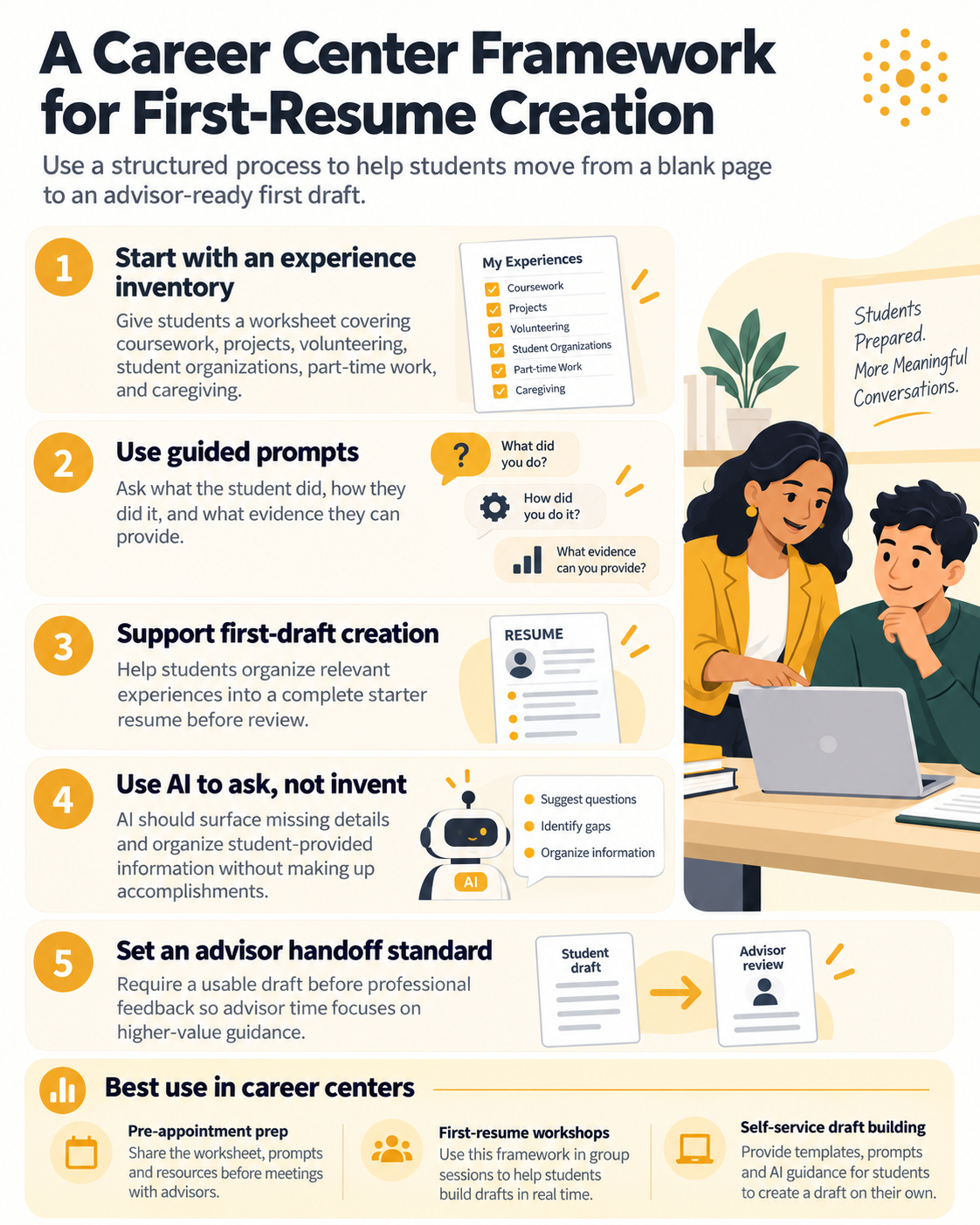
Career centers can use a repeatable five-stage workflow to move students from an experience inventory to an initial resume. Each stage should produce a concrete output, allowing students to progress independently where possible and enabling staff to identify exactly where additional guidance is needed.
Stage 1: Complete the experience inventory
Have students document their education, activities, projects, employment, and other potentially relevant experiences.
Output: A preliminary collection of experiences and skills.
Stage 2: Explore missing information
Ask students to revisit experiences that contain insufficient detail.
For example, a student might write "participated in a marketing project."
Instead of immediately drafting that experience, ask:
- What was the project trying to achieve?
- What was your individual responsibility?
- What did your group produce?
- Which tools or methods did you use?
Output: A more complete record of the student's actual contributions.
Stage 3: Select relevant experiences
Ask students to identify the purpose of their first resume, such as securing an on-campus job, applying for an internship, or pursuing a research opportunity.
Then have them select experiences that demonstrate potentially relevant knowledge, responsibilities, or skills.
Students who have not identified a specific opportunity can start with a general first resume and refine its focus later.
This approach is consistent with MIT's resume guidance, which recommends selecting relevant experiences from a broader record that may include academic projects, personal projects, and other activities.
Output: A shortlist of experiences to include.
Stage 4: Assemble the initial document
Students can now transfer the selected information into a resume builder or institution-provided starter document.
At this stage, the focus should remain on content completion. Students should establish their educational background, relevant experiences, skills, and any additional applicable information.
They should not need to perfect each description before proceeding.
Output: A complete, editable first draft.
Stage 5: Confirm missing details
Before submitting the document, students should identify incomplete entries, uncertain dates, missing project details, or information they still need to verify.
Unresolved information should be clearly marked rather than replaced with assumptions.
Output: A first draft that accurately represents the student's experiences and is ready for a subsequent review.
Career centers can deliver this workflow as a self-guided online activity, introductory workshop, peer-led session, or preparation requirement for selected advising appointments.
Where Should AI Assist Students During First-Draft Creation?
AI is most useful during first-draft creation when it helps students recall, explain, and organize their existing experiences. Rather than generating accomplishments from limited information, AI should ask contextual questions, identify missing details, and help students assemble their responses into an initial document they can verify.
There are three useful intervention points.
1. Experience discovery
When a student says they have no experience, AI can ask about coursework, assignments, volunteer responsibilities, student activities, and independent projects.
Questions should uncover experiences the student has actually completed.
2. Contextual information gathering
If a student mentions a project without explaining their role, AI can ask follow-up questions about responsibilities, contributions, and completed work.
This reduces the need for students to anticipate every detail a resume might require.
3. First-draft organization
Once sufficient information has been collected, AI can help place experiences into appropriate categories and organize student-provided information into an editable document.
Career centers can use the following instruction as a starting point for an AI-supported workflow:
Help me create my first resume using only experiences I provide. Ask me one question at a time about my coursework, projects, activities, and responsibilities. Help me identify what information is relevant and organize it into a first draft. Do not invent responsibilities, skills, achievements, dates, or results. If information is missing, ask me rather than assuming an answer.
Importantly, students should remain responsible for confirming every detail before using the document.
MIT's guidance on AI-assisted resume creation similarly warns against invented experiences and emphasizes maintaining student ownership of the final content. It also recommends considering data privacy when sharing personal information with AI tools.
For career centers, this suggests a clear implementation principle: AI should support information discovery and draft assembly within institution-approved privacy practices, while students retain control over what their resumes claim.
What Should Students Complete Before Requesting Advisor Feedback?
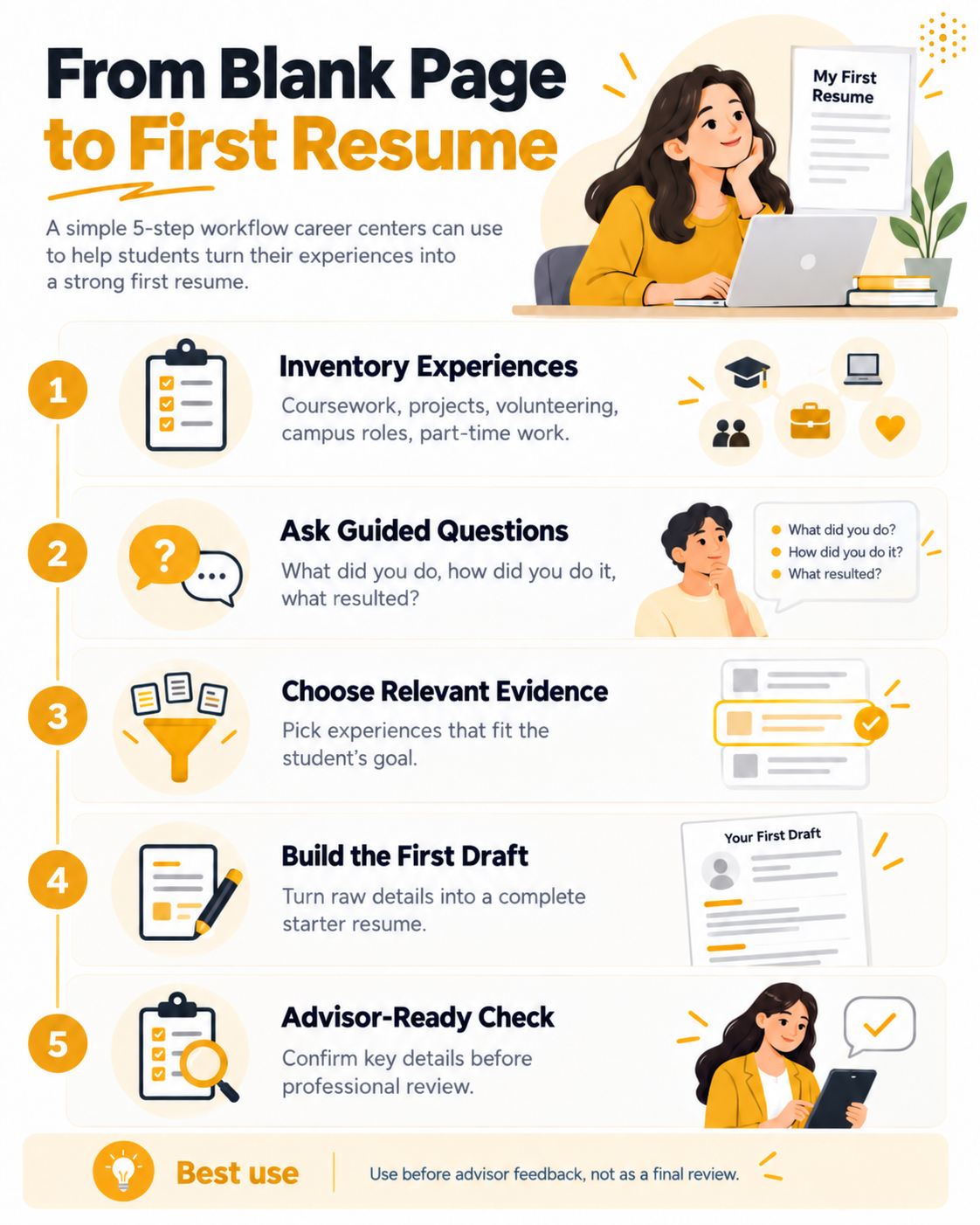
Students should arrive at a resume review with a usable first draft, not an empty document or an unorganized collection of experiences. Career centers can establish basic completion requirements that confirm students have gathered relevant information, assembled an initial document, and identified questions requiring professional guidance.
A first-draft completion checklist can help students determine whether they are ready for the next stage.
First-resume completion checklist
- I have recorded my educational background and relevant academic information.
- I have considered coursework, projects, activities, employment, and other experiences that might demonstrate useful skills.
- I have selected experiences relevant to my immediate career objective or general application needs.
- I have included enough information to explain my personal responsibilities and contributions.
- I have assembled these details into an editable resume document.
- I have checked that the information is accurate and identified any remaining questions.
The checklist is a draft-completion requirement, not a resume-quality assessment. A student can meet these expectations even if their document still needs significant improvement.
Career centers should also allow exceptions when students need help completing the inventory, have accessibility-related needs, or face urgent application deadlines. Preparation requirements should guide the process rather than prevent students from receiving assistance.
The University of Pennsylvania Career Services provides a useful example of separating resume creation from subsequent support, directing students who have created a resume toward peer advisors, appointments, and document review services.
Career centers can make a similar distinction between two service stages:
| Service stage | Primary objective |
|---|---|
| First-resume creation | Help students identify experiences and produce an accurate, usable draft |
| Professional resume review | Help students improve an existing document for their intended opportunities |
This gives students a clearer next step and allows advisor appointments to focus on decisions that benefit from professional judgment.
To Sum Up
Helping students create their first resume starts with making their existing experiences visible.
Career centers can make the process more accessible by establishing a common experience inventory, using guided questions to uncover missing information, and setting clear expectations for first-draft completion.
AI can support these steps without taking ownership of the student's experiences or replacing professional guidance.
Hiration supports this process with a guided AI Resume Builder and Reviewer that helps students organize their experiences and develop stronger resumes.
Rather than simply rewriting vague descriptions, its AI can ask contextual questions about what students did, how they did it, and what they accomplished, using their responses to suggest improvements without inventing achievements.
Career centers can also use Hiration's Counselor Module to review resumes, track student activity, and identify where additional guidance may be needed.
Book a Hiration walkthrough to see how your career center can help students turn their experiences into their first resume while keeping advisors involved where their expertise is most valuable.