If your career center has employers willing to engage with students beyond career fairs and information sessions, an Employer-in-Residence program can turn that interest into recurring, one-on-one career support.
But offering employer office hours is only the starting point. Who gets an appointment? What should employers actually do during those sessions? And how do you keep career guidance separate from recruiting?
Without clear answers, sessions can become informal networking events with inconsistent attendance and limited value for students.
This guide covers how career services teams can select employer participants, structure office hours, manage student access, prepare both sides, and measure whether the program is delivering useful career guidance.
What Is an Employer-in-Residence Program?
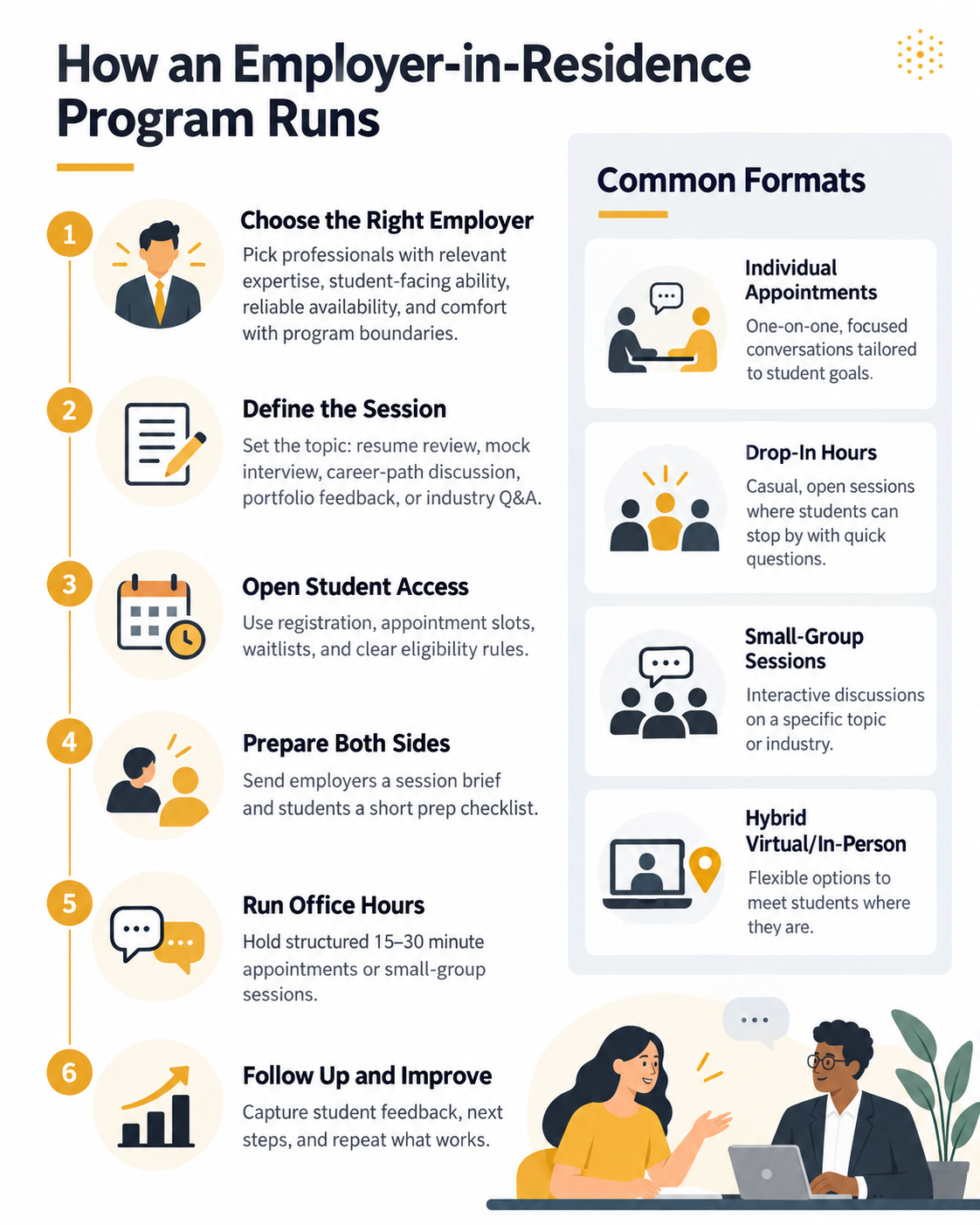
An Employer-in-Residence program is a career services initiative that brings industry professionals into scheduled, student-facing sessions for career guidance, industry insights, and professional development. Sessions may involve individual appointments, small-group conversations, or drop-in office hours. Rather than one-off employer presentations, the career center operates a recurring schedule of these opportunities.
The format should follow the type of support students need.
| Program format | Best suited for | Student access |
|---|---|---|
| Individual office hours | Resume feedback, mock interviews, personalized industry questions | Pre-booked 15–30-minute appointments |
| Drop-in hours | Quick career questions, industry exploration, informal guidance | First-come, first-served |
| Small-group sessions | Shared industry questions, career paths, professional expectations | Registration with a participant cap |
| Hybrid office hours | Students and professionals unable to attend campus sessions | Virtual appointments alongside in-person sessions |
For example, North Carolina Central University offers Employer-in-Residence office hours through half-day or full-day schedules, with appointments available in 15- or 30-minute intervals.
The important distinction is that students receive direct time with a professional, not simply another opportunity to hear an employer presentation.
If your team is still identifying which existing relationships to prioritize, use a structured employer partnership framework before inviting representatives into the program.
Which Employers Should Participate in the Program?
Career centers should select Employer-in-Residence participants based on their ability to provide relevant career guidance, not simply their willingness to recruit on campus. The professional representing an organization matters as much as the employer itself. Someone who can explain industry expectations and provide constructive feedback is generally better suited to office hours.
Before confirming participation, assess four factors:
- Relevant expertise: Can the representative discuss roles, skills, hiring expectations, or career paths that interest students?
- Student-facing ability: Can they provide actionable feedback rather than deliver a company presentation?
- Reliable availability: Can they commit to the assigned session and notify staff promptly about changes?
- Appropriate scope: Are they comfortable following the career center's guidance, privacy, and recruiting boundaries?
For specialized sessions, match the professional's expertise to the advertised topic.
A software engineer may be suitable for technical resume discussions, while a human resources professional may be better positioned to explain behavioral interviews or recruitment processes.
Career Services should confirm the representative's name, role, session topic, and availability before advertising appointments.
What Should Employers Actually Do During Office Hours?
Employer office hours should give students something they cannot easily obtain from a general company presentation: specific feedback, direct answers, or a clearer understanding of professional expectations. Career Services should assign each session a defined purpose so students know what to prepare and employers know what they are expected to deliver.
Ohio State University's Recruiter in Residence program offers one-on-one opportunities for resume reviews, interview preparation, and general career advice.
| Office-hour activity | What the employer does | Student takeaway |
|---|---|---|
| Resume review | Reviews experience descriptions, relevance, and industry terminology | Specific resume revisions |
| Mock interview | Asks role-relevant questions and gives feedback | Clear interview improvement points |
| Career-path discussion | Explains roles, progression, and entry requirements | Better understanding of career options |
| Portfolio or project feedback | Evaluates how students present their work | Improvements to project explanations |
| Industry Q&A | Discusses workplace expectations and emerging skill requirements | Questions answered and next steps identified |
| Networking practice | Helps students practice introductions and professional conversations | Feedback on communication and follow-up |
Career centers can make sessions more useful by asking employers to follow a simple appointment structure:
- First 3 minutes: Understand the student's goal or question.
- Next 12-20 minutes: Provide focused guidance, feedback, or practice.
- Final 2-5 minutes: Identify one or two practical actions the student can take afterward.
These timings are suggested templates, not universal standards.
Avoid trying to cover resumes, interviews, networking, and career exploration in one short appointment. Students should leave with meaningful guidance on the topic they booked.
How Should Career Centers Schedule and Match Students?
Career centers should establish a predictable schedule, a clear appointment process, and eligibility rules that reflect the session's purpose. General career conversations can remain open to most students, while specialized appointments may require relevant interests or preparation. Matching should prioritize learning needs rather than employer preferences for potential candidates.
Choose a manageable frequency
Start with a four-week pilot featuring one employer session per week. Rotate employers or professional specialties depending on student needs.
A sample operating calendar could look like this:
| Week | Employer expertise | Session focus | Format |
|---|---|---|---|
| Week 1 | Finance professional | Resume feedback for finance roles | Six 20-minute appointments |
| Week 2 | Technology professional | Project and portfolio feedback | Six 20-minute appointments |
| Week 3 | Healthcare administrator | Career pathways and industry expectations | Four 30-minute appointments |
| Week 4 | HR or talent professional | Behavioral mock interviews | Four 30-minute appointments |
This proposed calendar uses two-hour blocks and can be adjusted to staff capacity and student demand.
UMass Dartmouth offers a useful operational example: weekday employer office hours with 20-minute prescheduled appointments, available in person or virtually.
Set student admission and matching rules
Use the career center's existing appointment system, such as Handshake or another scheduling platform, to manage registrations.
A practical approach is to:
- Let students select appointments by industry, role, or activity.
- Limit initial bookings to one appointment per student per cycle when demand exceeds capacity.
- Use first-come, first-served registration for general sessions.
- Introduce brief interest questions for specialized appointments, without turning them into hiring screens.
- Maintain a waitlist and release cancellations promptly.
- Provide an accessible alternative for students unable to attend the scheduled format.
For example, students booking portfolio reviews can be asked to identify the type of work they want discussed. They should not have to demonstrate that they are already strong candidates.
Keep registration confirmation separate from attendance. A student who expresses interest should know whether an actual appointment is secured.
Where Should Mentoring End and Recruiting Begin?
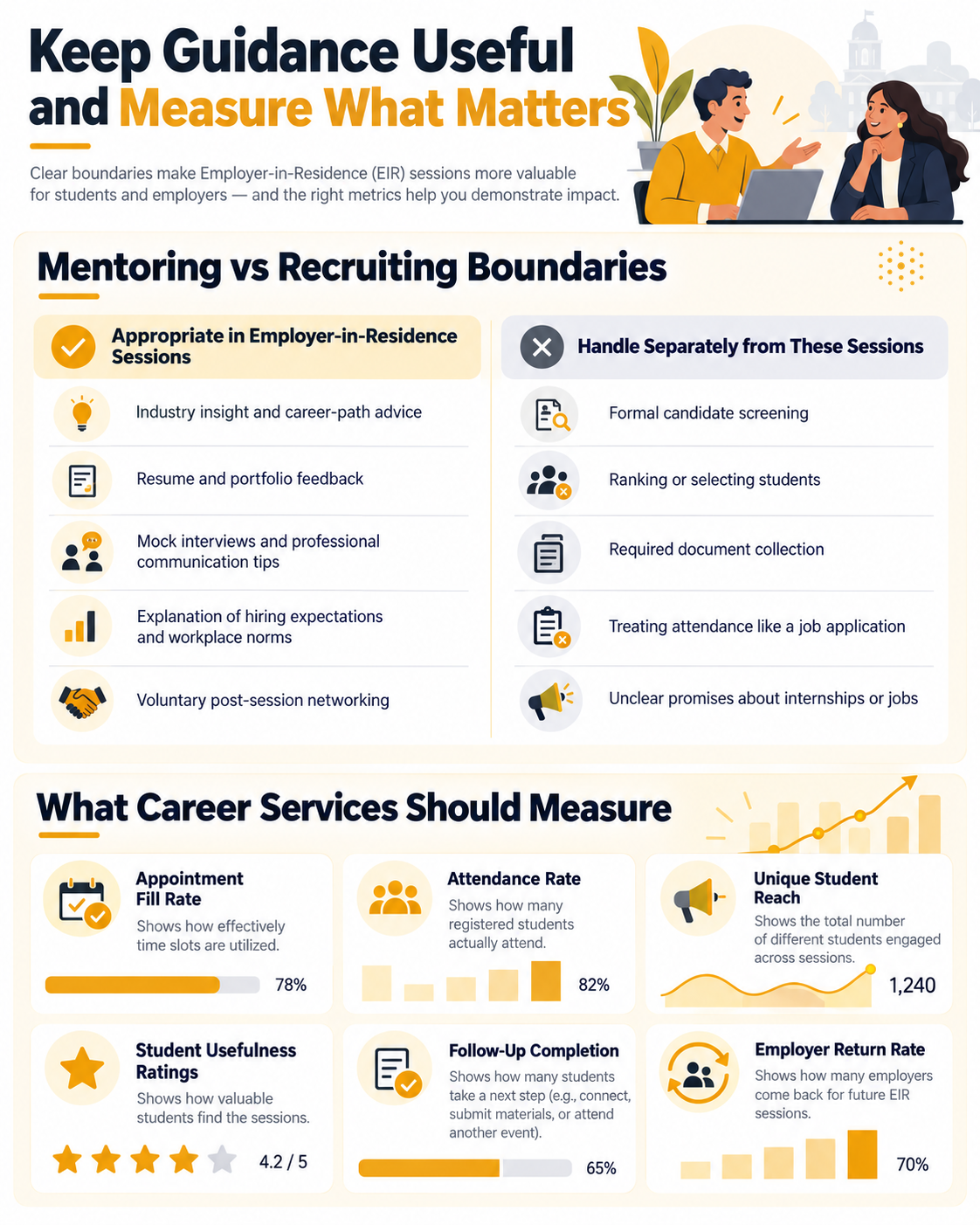
Employer-in-Residence programs can create professional connections, but career centers should clearly define whether a session is educational, recruitment-focused, or a combination of the two. Without that distinction, students may mistake informal guidance for an interview, while employers may treat mentoring appointments as opportunities to evaluate prospective candidates.
Ohio State makes the distinction explicit: its Recruiter in Residence program supports professional development but is not intended as a recruiting event.
Career Services should establish boundaries before participation:
- Career guidance: Employers may discuss industries, skills, resumes, interviews, and professional experiences.
- Recruitment conversations: Employers may explain application processes or available opportunities when the session rules permit it.
- Candidate evaluation: Formal screening, ranking, or selection should take place through a separately designated recruiting process.
- Student information: Employers should not collect or retain student documents or personal information beyond what students knowingly agree to share under institutional policies.
- Follow-up: Students may choose to connect with representatives afterward, without being required to enter a recruiting process.
For a non-recruiting session, tell both parties explicitly that attendance does not constitute a job application or interview.
If an employer wishes to conduct formal candidate interviews, Career Services should arrange a separate activity with clearly communicated eligibility and participation rules.
The goal is to preserve a useful learning environment without creating confusion about what access to an employer actually means.
How Should Career Centers Prepare Employers and Students?
Career centers should give both participants clear instructions before each session. Employers need to understand the intended activity, student audience, appointment length, and institutional expectations. Students should arrive with a specific question or document so limited meeting time is spent on guidance rather than explaining the purpose of the appointment.
Prepare the employer
Send a short briefing that includes:
- Session date, location or virtual link, and arrival instructions.
- Student audience and appointment schedule.
- Expected activity, duration, and suggested discussion format.
- Guidelines for feedback, confidentiality, and recruitment.
- Staff contact for technical issues, absences, or inappropriate requests.
Confirm arrangements a few days before the session and identify a backup plan if the representative cancels.
Prepare students
Send students a short preparation checklist when they book:
- Review the representative's role and industry.
- Identify one main question or objective.
- Bring a relevant resume, portfolio, or project if required.
- Prepare a brief introduction.
- Understand whether the appointment is advisory or recruitment-related.
- Know how to cancel or reschedule.
For resume sessions, career advisors can encourage students to complete an initial review before meeting the employer. This reserves employer time for industry-specific feedback instead of basic formatting corrections.
Close the appointment
After the session, ask students to record one action they intend to take and provide a quick usefulness rating.
Career Services can then direct them toward an advisor appointment, additional practice, or another relevant resource without requiring the employer to provide ongoing mentoring.
How Should Career Centers Measure Employer-in-Residence Success?
Career centers should measure whether students are accessing appointments, receiving useful guidance, and acting on it. Employer participation alone does not establish program effectiveness. A small number of well-used sessions with clear student outcomes may be more valuable than a large schedule with low attendance and limited follow-through.
| Metric | What to track | What it tells Career Services |
|---|---|---|
| Appointment fill rate | Booked appointments ÷ available slots | Whether the session attracts demand |
| Attendance rate | Attended appointments ÷ booked appointments | Whether registrations convert into participation |
| Unique student reach | Number of individual students served | How broadly access is distributed |
| Student usefulness | Short post-session rating and feedback | Whether sessions address student needs |
| Follow-up completion | Students reporting completion of an agreed next step | Whether guidance translates into action |
| Employer return rate | Employers participating again in a later cycle | Whether participation is sustainable |
| Staff effort | Hours spent scheduling, preparing, and supporting sessions | Whether the program is manageable |
Review results after the pilot
After four weeks, compare results across industries, appointment types, and scheduling windows.
Look for specific patterns:
- Are certain sessions consistently fully booked?
- Which topics receive the strongest usefulness ratings?
- Are students cancelling because of inconvenient times?
- Do participants leave knowing what to do next?
- Which formats require disproportionate staff effort?
Use these findings to modify the next cycle. Expand sessions with sustained demand, revise underused topics, and adjust appointment lengths when students regularly need more or less time.
Do not rely on internship or job offers as the primary measure of a mentoring-focused program. Those outcomes may be worth recording when voluntarily reported, but the immediate purpose is useful student access to professional expertise.
Wrapping Up
An effective Employer-in-Residence program does not require a complex structure. It requires suitable professionals, clearly defined appointments, fair student access, and consistent follow-through.
The career center's role is to make each interaction purposeful while keeping employers focused on their expertise and students prepared to benefit from it.
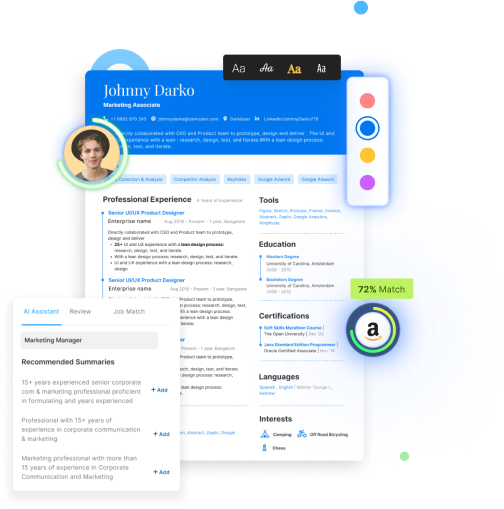
Hiration can support the student preparation surrounding these appointments through AI-powered resume reviews, interview practice, and other career readiness tools. Its Counselor Module also gives advisors visibility into student preparation and progress, helping them identify where additional guidance may be useful.
Book a walkthrough to see how Hiration can help students prepare before employer sessions and continue improving afterward.