If your career center works with students involved in undergraduate research, you've likely encountered students who can explain their projects in detail but struggle to show employers why that experience is relevant.
A student may have spent months testing hypotheses, resolving unexpected results, or analyzing complex data without recognizing the professional value of those decisions.
And because much of this work happens under faculty supervision, Career Services may have limited visibility into what students actually contributed.
Career centers can close this gap by working more closely with undergraduate-research offices and helping students identify credible evidence from their research.
This guide covers how to establish those partnerships, uncover career-relevant contributions, connect research experience to industries outside academia, develop interview stories, and determine which research materials students can safely share with employers.
How Can Career Services Partner With Undergraduate Research Offices?
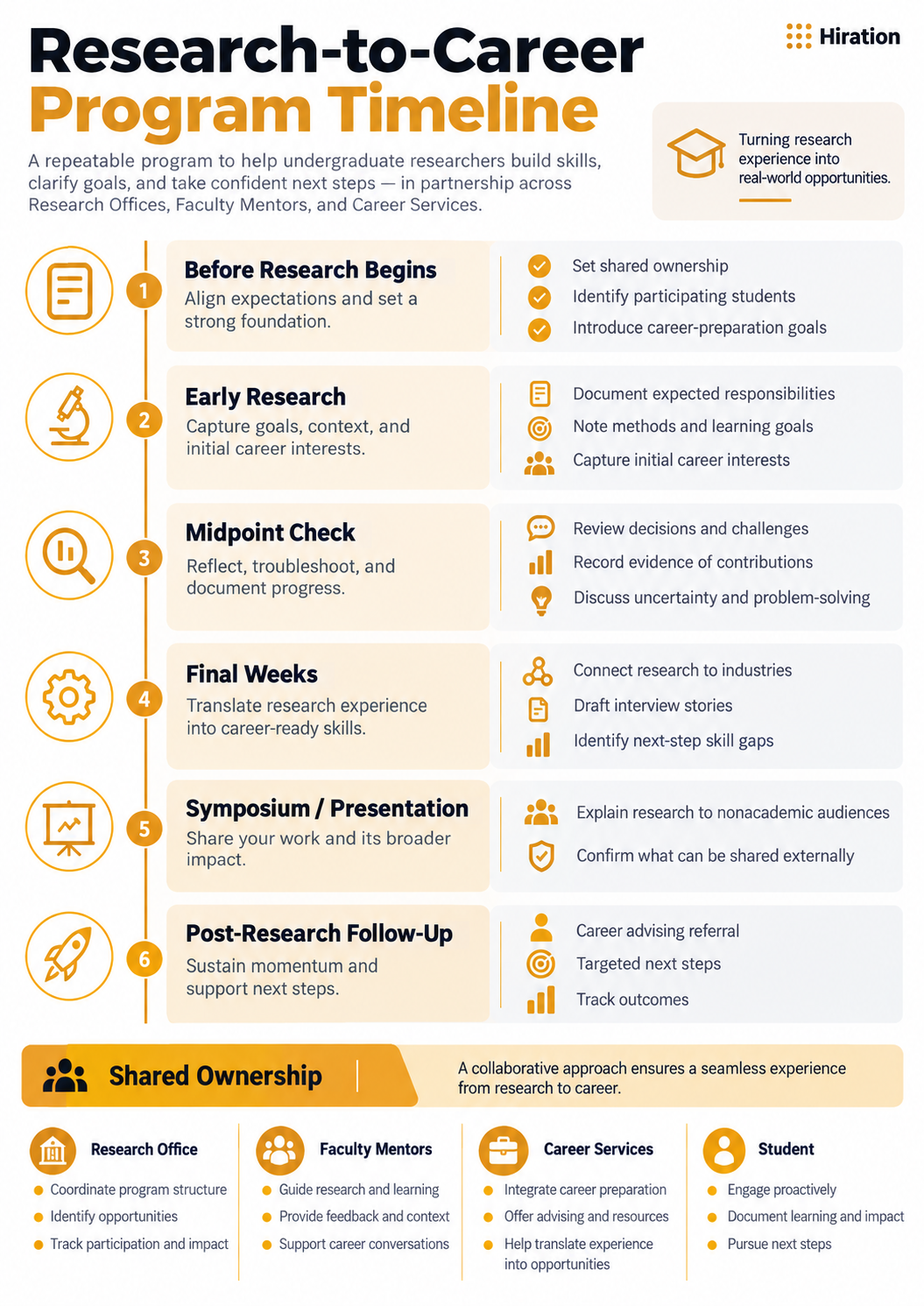
Career Services can partner with undergraduate-research offices by establishing referral points within existing research programs, dividing responsibilities between research staff and career advisors, and introducing career preparation at defined milestones. Research grants, faculty assistantships, summer research programs, and undergraduate symposia all provide opportunities to reach students without creating a separate program.
The first step is identifying where undergraduate researchers already interact with the institution.
Research offices typically manage or coordinate opportunities that Career Services may not directly oversee. These can include funding applications, faculty mentoring arrangements, undergraduate research placements, and presentation events.
Rather than asking researchers to discover career support independently, career centers can establish a referral process around those existing activities.
| Research touchpoint | Career Services involvement | Responsibility |
|---|---|---|
| Research grant applications | Introduce professional development goals alongside research objectives | Research office identifies applicants; Career Services provides reflection prompts |
| Faculty research assistantships | Refer students for a research-experience review | Faculty mentors identify participants; advisors conduct reviews |
| Summer research programs | Offer preparation before research begins and reflection near completion | Research office schedules sessions; Career Services delivers support |
| Undergraduate research symposia | Help students explain findings to employers and nonacademic audiences | Research office manages presentations; Career Services coordinates career-focused practice |
| Research completion | Connect research outcomes to potential industries and roles | Faculty validates contributions; Career Services supports career exploration |
Existing university practices offer useful starting points.
At UC Davis, the Undergraduate Research Center and Career Center jointly offered a February 2026 workshop on using Handshake to post research opportunities. Although focused on research recruitment rather than career translation, it demonstrates how the two offices can coordinate around a shared student activity.
The University of Rochester provides another model through its Schwartz Discover Grant Professional Development Series.
Its 2026 programming included research integrity, collaboration, communication with nonacademic audiences, and conference preparation, giving career centers several points where employer-facing preparation could be incorporated.
A practical starting point is one summer research cohort, with an assigned contact in each office, agreed referral dates, and clear responsibilities for student preparation.
How Can Advisors Identify Career Evidence Within Undergraduate Research?
Advisors can identify career readiness evidence by examining the decisions students made during research, not simply the techniques they learned or the findings they produced. Research responsibilities, methodological choices, unsuccessful experiments, ethical judgments, documentation practices, and independent contributions can reveal specific behaviors relevant to professional work.
A student's description of research often begins with the project topic or technical methods. An advisor needs to understand what happened during the work and what the student personally contributed.
For example, a biology student might describe performing laboratory assays over eight weeks. That explains the activity, but it does not establish whether the student followed established instructions, diagnosed unexpected results, modified procedures, or made independent decisions.
Advisors can investigate six areas:
- Research responsibilities: Which stages did the student own? Were they collecting data, maintaining equipment, designing instruments, recruiting participants, or coordinating with other researchers?
- Methodological decisions: Why did the student select a particular method? What alternatives did they consider, and what trade-offs influenced their choice?
- Uncertainty and unsuccessful experiments: What happened when results contradicted expectations? How did the student investigate possible errors or limitations?
- Research ethics: How did the student handle participant consent, confidentiality, data integrity, attribution, or other relevant ethical requirements?
- Documentation and reproducibility: What records did the student maintain? Could another researcher understand or reproduce the work from those records?
- Independent contributions: Which findings, decisions, improvements, or deliverables can reasonably be attributed to the student rather than the wider research team?
Consider a student working on a water-quality research project.
If the student independently noticed inconsistencies between sampling locations, checked collection procedures, identified a possible source of contamination, and recommended repeating selected samples, the evidence is not merely that they conducted environmental research.
Their actions demonstrate an identifiable process of detecting a problem, investigating its cause, and recommending a response.
The advisor should confirm these details rather than assuming them from the project description.
This distinction is consistent with NACE's Career Readiness Competencies, which describe observable behaviors associated with critical thinking, communication, professionalism, teamwork, and other competencies.
Career centers can standardize this assessment through a short research-evidence record containing:
- Research responsibility and level of independence
- Specific decision or challenge encountered
- Action taken and reasoning behind it
- Evidence supporting the student's contribution
- Faculty mentor verification, where appropriate
The record should distinguish completed work from proposed work and verified results from preliminary observations.
Students who assisted on a project without designing its methods may still have valuable evidence.
Accurate documentation, adherence to protocols, careful observation, and responsible escalation of problems can demonstrate professional readiness without overstating their role.
How Can Students Connect Research Experience to Industries Outside Academia?
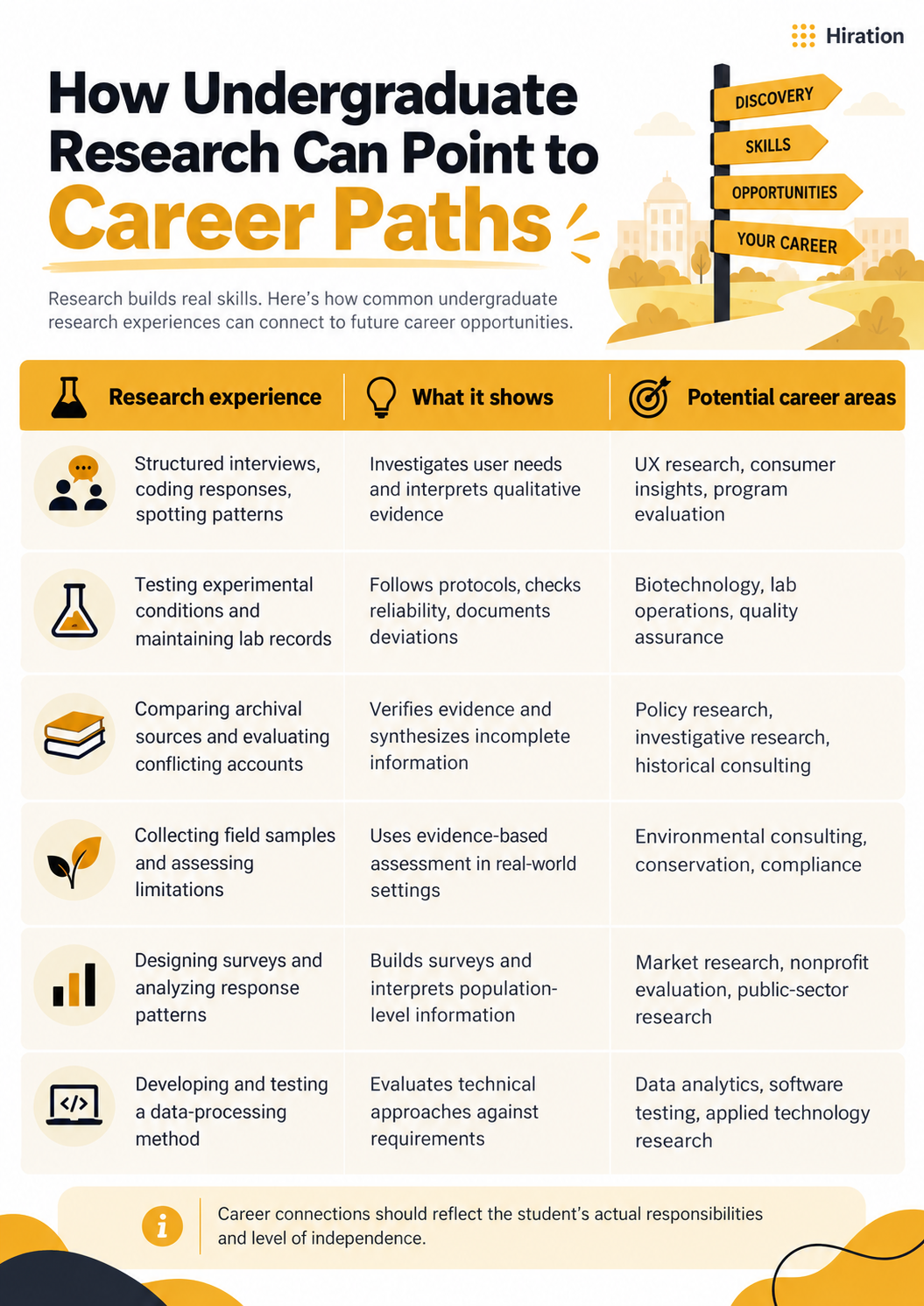
Career advisors can connect undergraduate research to industries outside academia by comparing the actual methods and decisions involved in a student's project with the work performed in different occupations. The strongest connections come from specific research activities, such as survey design, experimental validation, archival analysis, or field observation, rather than broad claims about transferable skills.
A researcher's academic discipline does not have to determine their professional direction.
For example, a psychology student who recruited participants, developed interview questions, and analyzed qualitative responses may want to explore user research or program evaluation.
A history student who compared conflicting archival sources may find relevant work in policy research or investigative analysis.
These connections become clearer when advisors start with what the student actually did.
| Undergraduate research experience | Connection to professional work | Potential industries or occupational areas |
|---|---|---|
| Psychology student conducts structured interviews, codes responses, and identifies recurring behavior patterns | Investigating user needs and interpreting qualitative evidence | UX research, consumer insights, program evaluation |
| Biology student tests experimental conditions, maintains laboratory records, and investigates inconsistent results | Following testing protocols, assessing reliability, and documenting deviations | Biotechnology, laboratory operations, quality assurance |
| History student compares archival records, evaluates conflicting accounts, and establishes source reliability | Evidence verification and synthesis from incomplete information | Public policy research, historical consulting, investigative research |
| Environmental science student collects field samples, compares measurements across locations, and evaluates limitations | Environmental monitoring and evidence-based assessment | Environmental consulting, conservation, environmental compliance |
| Sociology student designs surveys, evaluates response patterns, and identifies limitations in collected data | Survey development and interpretation of population-level information | Market research, nonprofit evaluation, public-sector research |
| Computer science student develops a data-processing method, tests its accuracy, and documents performance limitations | Evaluating technical approaches against defined requirements | Data analytics, software testing, applied technology research |
These are possible career connections, not automatic qualifications for particular positions.
Advisors should validate them against occupational requirements, employer expectations, and the student's actual technical proficiency.
The U.S. Department of Labor's O*NET OnLine can support this comparison.
For instance, O*NET identifies survey collection, data analysis, interpretation, and reporting among the activities associated with survey research occupations. An advisor working with a sociology researcher can compare those responsibilities with the student's documented experience.
A useful advising conversation follows three questions:
- Which research activities did the student perform independently or substantially contribute to?
- Which occupations use comparable methods or address similar types of problems?
- What additional knowledge, tools, experience, or credentials would the student need to enter those occupations?
The third question is essential. Research experience may establish relevant preparation without satisfying every requirement of a professional role.
Career centers can also invite employers working in research-intensive occupations to review anonymized descriptions of undergraduate projects.
Their feedback can help advisors distinguish genuinely relevant experience from connections that sound convincing but do not reflect the work performed in those roles.
How Can Research Experiences Become Strong Interview Stories?
Career advisors can help undergraduate researchers develop interview stories by focusing on moments when research required judgment, adaptation, collaboration, or communication under uncertainty. Unexpected findings, unsuccessful experiments, revised hypotheses, disagreements about methods, and decisions made with incomplete evidence provide specific situations students can explain to employers.
Research interviews often differ from academic presentations.
An academic audience may expect detailed methods, disciplinary terminology, and theoretical context. An employer may instead want to understand how the student approached a problem, responded to an unexpected outcome, or worked with others.
Advisors can help students identify one meaningful incident from their research and reconstruct the decisions involved.
Example: An unsuccessful experiment becomes a problem-solving story
Consider a hypothetical chemistry student whose experiment repeatedly produces inconsistent results.
An advisor might ask:
- What result were you expecting, and what actually happened?
- How did you decide whether the problem was procedural, environmental, or related to the original hypothesis?
- What did you investigate before changing your approach?
- Which decisions were yours, and where did your supervisor provide direction?
- What did the revised experiment establish, even if it did not produce the expected outcome?
The student's story could explain how they reviewed laboratory records, compared conditions across trials, discovered an uncontrolled variable, and worked with their supervisor to revise the procedure.
The evidence lies in the investigation and decisions, not in claiming that the experiment eventually succeeded.
Example: A research-team disagreement becomes a collaboration story
A student working on an interdisciplinary project may disagree with another researcher about how to categorize observations.
The advisor can explore how the student explained their reasoning, considered the other researcher's interpretation, consulted the project supervisor, and contributed to an agreed approach.
This gives employers a concrete example of collaboration grounded in a real disagreement rather than an unsupported claim about teamwork.
For interview preparation, advisors should ask students to explain the research situation, their specific judgment or contribution, the evidence available, and what they learned.
Where outcomes remain uncertain, the student should acknowledge that uncertainty. A credible account of revising a hypothesis or recognizing insufficient evidence may be more relevant than presenting every research experience as a success.
Which Research Artifacts Can Students Share With Employers?
Students may be able to share approved research posters, published papers, abstracts, presentations, and other research outputs with employers. However, career advisors should check whether materials contain unpublished findings, confidential data, intellectual property, or information governed by research agreements. Faculty approval and institutional research policies should determine what can be disclosed.
Research differs from ordinary coursework because students may contribute to projects they do not independently own or have permission to publish.
A student may have created a graph, contributed to a manuscript, or helped develop an experimental procedure without having authority to distribute the underlying information.
Career centers should therefore establish a research-specific disclosure check before recommending any artifact for employer review.
| Research material | Potential restriction | Recommended advisor action |
|---|---|---|
| Unpublished findings or manuscripts | Early disclosure may conflict with publication plans or research agreements | Ask the student to obtain permission from the research supervisor before sharing |
| Experimental designs, prototypes, or technical specifications | Material may involve intellectual property or pending patent activity | Refer the student to the supervisor and relevant institutional office before disclosure |
| Participant interviews, recordings, or individual-level datasets | Consent, confidentiality, and approved research protocols may restrict disclosure | Confirm permitted uses; do not assume removing names makes material shareable |
| Collaborative research posters or presentations | A student may not have authority to distribute work created by the research group | Confirm approval and appropriate attribution |
| Published or publicly released research outputs | Public availability may not resolve reuse, authorship, licensing, or third-party restrictions | Check the permitted use and clarify the student's individual contribution |
The distinction between presenting research at a university event and distributing it externally deserves particular attention.
At Washington University in St. Louis, the Undergraduate Research Symposium FAQ requires faculty mentor involvement and addresses intellectual property concerns. It explains that students may use alternative public-facing materials when sensitive research cannot be disclosed.
Similarly, the University of Minnesota's Undergraduate Research Symposium instructs students to confirm with their faculty mentors that their work can be presented publicly.
Career centers can use these examples to establish a simple approval process:
- Ask whether the material has already been publicly released with appropriate authorization.
- Identify any unpublished findings, confidential information, or research agreements that may affect disclosure.
- Direct the student to their faculty mentor or institutional research office when approval is required.
- Where necessary, help the student explain their permitted responsibilities and methods without revealing restricted material.
For research that cannot be shared, a student may still be able to discuss approved, nonconfidential aspects of their work. The boundaries should be established by the responsible research personnel rather than assumed by the advisor.
The immediate priority for undergraduate research is determining what students have permission to disclose.
Wrapping Up
Undergraduate research gives students opportunities to develop skills that extend well beyond academic settings.
The challenge for Career Services is making those experiences visible, helping students explain their individual contributions, and connecting what they have learned to opportunities outside academia.
By partnering with undergraduate-research offices and faculty mentors, career centers can make this preparation part of the research experience rather than something students address only when they begin applying for jobs.
Hiration supports this preparation through a full-stack career readiness suite, from career assessments and exploration to AI-powered resume optimization, LinkedIn profile optimization, and mock interviews.
Its separate Counselor Module helps career teams manage student cohorts, assign activities, and track progress through analytics, all within a FERPA- and SOC 2-compliant platform.
Book a walkthrough to see how Hiration can help your career center support students from academic exploration to career preparation, while giving advisors greater visibility into their progress.