If your career center supports students applying for federal government jobs, standard resume and interview guidance may not be enough.
Students can meet the academic requirements for a position and still be screened out because they overlooked eligibility restrictions, failed to demonstrate specialized experience, or missed required documentation.
Federal hiring follows a different process, involving USAJOBS announcements, hiring paths, qualification standards, assessment questionnaires, and often longer recruitment timelines.
Career advisors don't need to become federal hiring specialists, but they should know how to help students interpret these requirements, prepare complete applications, and recognize when agency-specific guidance is necessary.
This guide breaks down the federal hiring procedures career services teams should understand and how to incorporate them into student advising.
How Can Advisors Help Students Navigate USAJOBS?
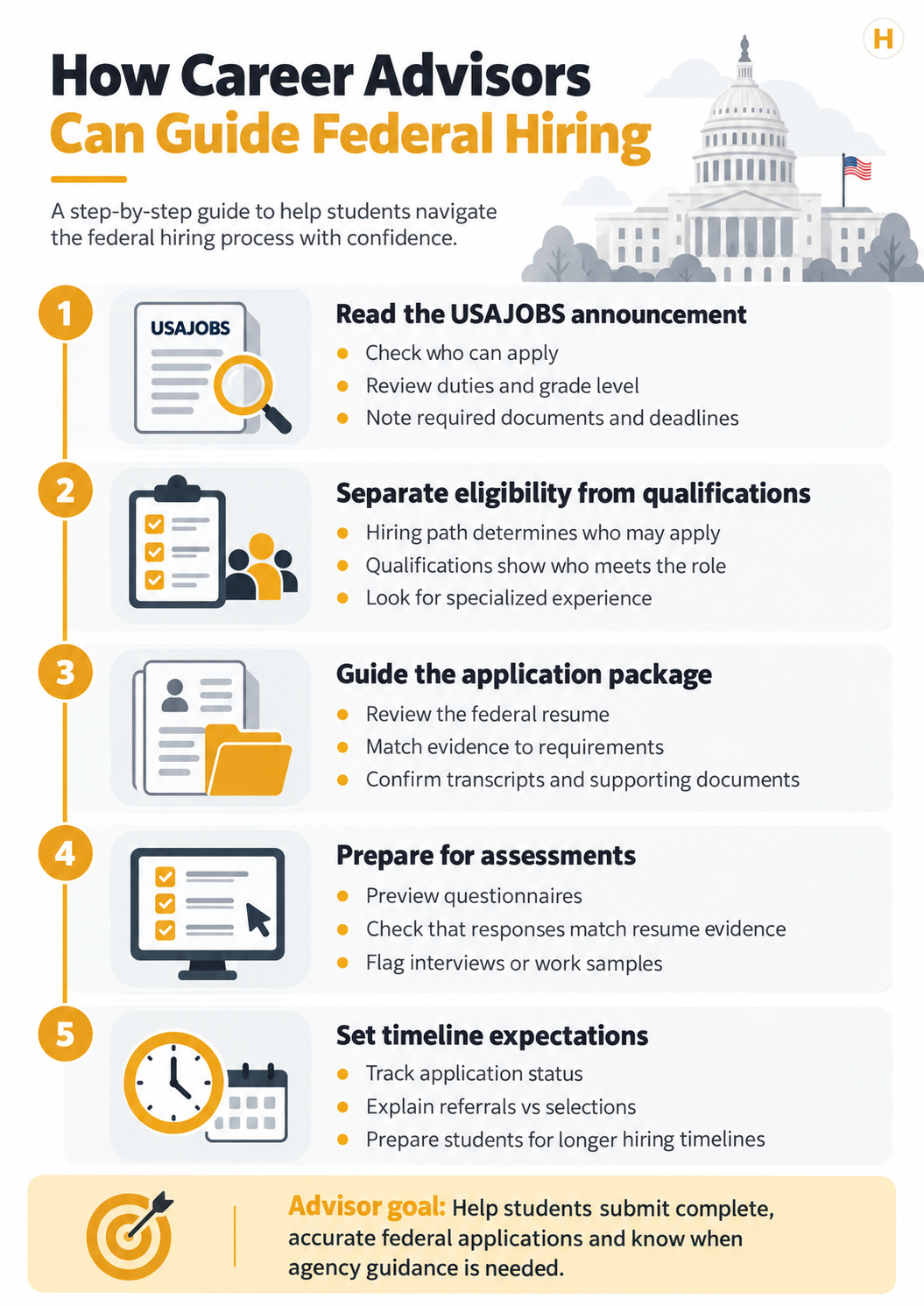
Career advisors can make USAJOBS easier to navigate by teaching students to read job announcements in the right order. Before discussing whether a position fits a student's interests, advisors should establish whether the student can apply, meets the stated qualifications, and understands the application requirements. These are separate questions in federal hiring.
Unlike many private-sector listings, federal announcements distinguish between applicants who are eligible to apply and those who are qualified for the position.
A student may meet every technical requirement but still be ineligible under the advertised hiring path.
What advisors should check in a USAJOBS announcement
| Announcement section | What the advisor should establish |
|---|---|
| This job is open to | Whether the student belongs to an eligible hiring group |
| Duties | Whether the responsibilities align with the student's experience and interests |
| Qualifications | Whether the student meets the education, experience, and specialized requirements |
| Pay scale and grade | Whether the student is applying at an appropriate experience level |
| How you will be evaluated | Whether assessments, questionnaires, or work samples are required |
| Required documents and How to apply | What the student must submit, where, and by which deadline |
Start with eligibility, not the job description. Some positions are open to the public, while others are restricted to federal employees, veterans, recent graduates, or applicants meeting other hiring criteria.
Next, help students interpret qualification requirements.
For example, an announcement may allow applicants to qualify through education, specialized experience, or a combination of both. Another may require specific coursework or experience equivalent to a particular federal grade.
Advisors should also explain common terminology:
- Occupational series: The numerical classification assigned to a type of federal occupation.
- GS grade: A position's level within the General Schedule pay system.
- Specialized experience: Work that demonstrates the specific capabilities required for the position.
- Hiring path: The applicant category under which someone may be eligible to apply.
GS grades should not be treated as interchangeable with degree levels. Although some entry-level positions accept educational qualifications, the applicable standard depends on the occupation and announcement.
A useful exercise is to have students select two federal announcements and compare eligibility, qualifications, required documents, and assessments before choosing where to apply.
How Can Career Advisors Guide Federal Resume and Application Preparation?
Federal resume advising should begin with the job announcement rather than a standard resume template. Advisors need to help students identify the experience and qualifications an agency expects to see, then check whether the application documents provide sufficient evidence. The objective is to demonstrate relevant qualifications accurately while meeting the announcement's instructions.
Review the resume against federal requirements
Under the federal Merit Hiring Plan, USAJOBS limits resumes to two pages, a requirement introduced in September 2025.
However, the shorter format does not remove the need for detailed qualification evidence. Federal applicants still need to describe their relevant work clearly enough for the hiring agency to evaluate their experience.
Advisors should check that students:
- Include relevant employment dates, hours worked per week, and specific responsibilities.
- Demonstrate experience that corresponds to the announcement's qualification requirements.
- Explain technical or academic work in language a federal reviewer can understand.
- Use examples of responsibility, methods, and outcomes rather than unsupported skill claims.
- Follow the agency's instructions for resume content, formatting, and submission.
For instance, if an announcement requires experience analyzing data and preparing reports, an advisor should help the student identify relevant research, internships, or employment and describe the actual work performed.
A statement such as "Supported research activities" provides little evidence. A more useful description would identify the data analyzed, methods used, reports produced, and the student's individual contribution.
The experience must be genuine, and the advisor should not assume that an academic project satisfies a particular federal qualification.
Check supporting documents before submission
A complete resume does not necessarily mean a complete federal application. Depending on the position and hiring path, students may need:
- Academic transcripts demonstrating completed courses, degrees, or academic standing.
- Enrollment verification or proof of expected graduation.
- Documentation supporting a specific hiring eligibility or preference.
- Writing samples, certifications, or other occupation-specific evidence.
Advisors should review the Required Documents section with students rather than rely on a universal checklist. Some agencies accept unofficial transcripts initially, while others specify different documentation requirements.
Students should also confirm that each document has been successfully attached or submitted through the required application system.
USAJOBS warns that missing documentation can affect an applicant's consideration. Its required documents guidance is a useful reference for advisor appointments.
How Can Career Centers Help Students Access Pathways Opportunities?
Career centers should make federal Pathways opportunities part of their internship and graduate employment advising. These programs provide structured routes into federal employment, but students must understand the relevant eligibility windows, appointment conditions, and application requirements. Advisors should also distinguish a Pathways appointment from a guaranteed permanent federal position.
Explain the two current Pathways programs
| Program | Who it serves | Advisor priority |
|---|---|---|
| Pathways Internship Program | Eligible students enrolled in qualifying educational programs | Verify enrollment requirements, appointment conditions, and possible conversion opportunities |
| Pathways Recent Graduates Program | Individuals who generally completed a qualifying degree or certificate within the previous two years | Check graduation dates, program eligibility, and application deadlines |
The Recent Graduates Program also provides extended eligibility in certain circumstances for veterans whose military service obligations prevented them from applying within the usual two-year window.
Build Pathways guidance into existing advising activities
Career centers do not necessarily need a separate federal careers program. They can incorporate Pathways guidance into established activities.
- During internship advising: Introduce the Pathways Internship Program alongside other internship options. Show students how to use the Students hiring-path filter on USAJOBS and review eligibility before applying.
- During final-year appointments: Identify students approaching graduation who may qualify for Recent Graduates positions. Discuss opportunities before graduation so students can prepare their documents and searches.
- During graduate follow-ups: Include Pathways opportunities in communications with eligible recent alumni, particularly those still exploring public-service employment.
Advisors should also explain that completing a Pathways program does not automatically result in permanent employment. Conversion depends on program requirements, qualifications, agency decisions, and applicable rules.
The OPM Students and Recent Graduates guidance should remain the primary reference for program details.
Because recruitment periods and agency participation can change, career centers should direct students to current announcements instead of relying on previous years' application calendars.
How Should Advisors Prepare Students for Federal Assessments and Hiring Timelines?
Federal hiring preparation should cover what happens after the resume is submitted. Depending on the announcement, students may face occupational questionnaires, additional assessments, eligibility reviews, and multiple stages of selection. Advisors can help them prepare accurate responses, monitor their application status, and plan around timelines that may extend well beyond private-sector recruiting cycles.
Prepare students for occupational questionnaires
Some federal applications require applicants to assess their experience against specific tasks or competencies.
For example, a questionnaire may ask whether an applicant has independently analyzed datasets, prepared technical reports, or presented recommendations.
Advisors should teach students to connect each response to verifiable experience. A practical preparation exercise is to:
- Open the questionnaire preview, when available, before starting the application.
- Identify the competencies being assessed.
- Ask the student for a specific example supporting each claimed level of experience.
- Check whether the resume provides consistent evidence.
- Review any additional assessment instructions and deadlines.
The goal is not to select the highest possible response. Students should represent their experience accurately and ensure their application supports those claims.
Agencies may use other assessments, including structured interviews, writing exercises, or job-related tests. Advisors should use the announcement's How You Will Be Evaluated section to identify what preparation is appropriate.
Explain what federal application statuses mean
Students accustomed to relatively quick employer responses may misinterpret federal hiring updates.
Advisors should explain the typical progression:
Application received → Application reviewed → Referred or not referred → Selected or not selected
Additional interviews, assessments, and checks may occur during the process. Three distinctions are particularly important:
- Received confirms that an application has reached the agency, not that the applicant qualifies.
- Referred means the application has been forwarded for hiring consideration, not that an interview is scheduled.
- Selected does not necessarily mean the student can immediately begin employment.
After a tentative offer, background investigations, suitability reviews, or security clearance procedures may delay the final offer and start date.
USAJOBS states that federal hiring timelines vary by agency, position, and applicant volume. Some pre-employment checks can take weeks or months.
Career advisors should therefore avoid promising specific response or onboarding dates.
Establish a follow-up plan
During appointments, ask students to maintain a record of:
- The vacancy announcement number and closing date.
- Application submission confirmation.
- Assessment deadlines and completion status.
- Changes in application status.
- Agency communications and requested actions.
Students can review application updates through the USAJOBS Track this application feature, which may direct them to the hiring agency's system.
For career planning, advisors should encourage students to continue exploring other opportunities while federal applications remain under review, rather than treating a referral or tentative offer as a confirmed start date.
When Should Career Centers Refer Students for Specialized Federal Hiring Guidance?
Career centers can support students with federal job searches, application preparation, qualification comparisons, and interview readiness. However, advisors should not make authoritative determinations about hiring eligibility, veterans' preference, security clearance, or other agency-specific requirements. Their responsibility is to recognize when specialized clarification is needed and connect students with the appropriate official resource.
Identify questions that require agency guidance
A student may have a straightforward resume question but a complicated eligibility situation.
Examples include:
- Whether citizenship or employment authorization satisfies a position's restrictions.
- Whether particular coursework or professional experience meets a specialized qualification.
- Whether a student qualifies for veterans' preference or a disability-related hiring authority.
- Whether an applicant's circumstances satisfy background investigation or clearance requirements.
- Whether missing documents can be submitted after an application deadline.
These questions should not be resolved through assumptions based on previous applications.
Advisors can refer students to the agency contact listed in the USAJOBS announcement, relevant OPM guidance, or an appropriate institutional specialist.
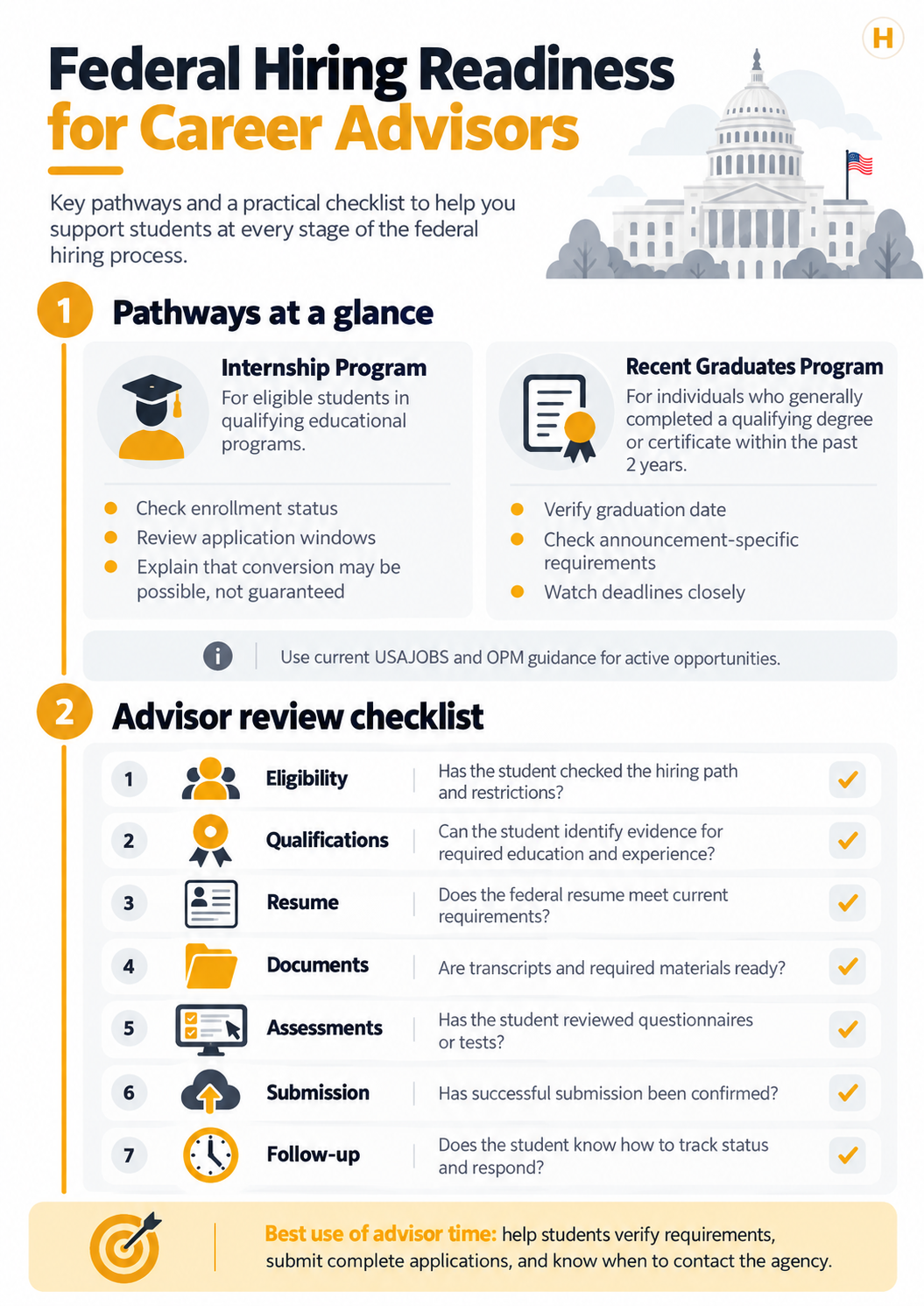
Use a federal application readiness checklist
A short checklist can help advisors maintain consistent guidance without turning every appointment into a lengthy review.
| Checkpoint | Advisor review question |
|---|---|
| Eligibility | Has the student checked the hiring path and eligibility restrictions? |
| Qualifications | Can the student identify evidence for the required education and experience? |
| Resume | Does the federal resume meet the current length, content, and announcement requirements? |
| Documentation | Are all applicable supporting documents prepared and submitted correctly? |
| Assessments | Has the student reviewed and completed the required questionnaires or assessments? |
| Submission | Has the student confirmed successful submission before the deadline? |
| Follow-up | Does the student understand how to track the application and respond to agency requests? |
This checklist can be used in a dedicated federal application appointment or incorporated into a standard job-search advising session.
Career centers can also maintain a small, regularly reviewed resource collection containing the USAJOBS announcement guide, current OPM Pathways information, federal resume instructions, and agency contact procedures.
Assigning one staff member responsibility for periodically checking these resources can help keep guidance aligned with policy changes without requiring every advisor to become a federal hiring specialist.
The same principle applies when advising students on unfamiliar industries: advisors should know which questions they can address confidently and which require specialist expertise.
Wrapping Up
Federal hiring preparation works best when advisors teach students to interpret the application requirements rather than simply complete the forms for them.
The more independently students can assess eligibility, prepare evidence, and track their applications, the more effectively career centers can use advising time for complex decisions.
Hiration supports this preparation through AI-assisted resume building, resume feedback, interview practice, and career planning. Its Counselor Module also gives career services teams visibility into student progress and opportunities for targeted feedback.
Book a walkthrough to see how Hiration can support students throughout career preparation while helping advisors monitor progress and focus their time where individual guidance is needed.