Graduation season creates a hard visibility problem for career centers: some seniors are still applying, some are interviewing without offers, and others have no clear target role at all.
Treating them as one “unplaced” group leads to broad reminders and workshops when many students need fast, barrier-specific intervention.
That matters because late-cycle support affects more than individual job outcomes. When seniors leave without a plan or accept misaligned roles under pressure, career centers face weaker first-destination results, higher underemployment risk, and less evidence of institutional career readiness.
This guide explains how career centers can identify unplaced seniors earlier, segment them by barrier, prioritize the highest-risk cases, activate just-in-time employer and alumni pathways, and measure meaningful movement before graduation.
How Can Career Centers Support Seniors Without Jobs Before Graduation?
Career centers can support unplaced seniors by shifting from broad job-search advice to targeted late-cycle triage.
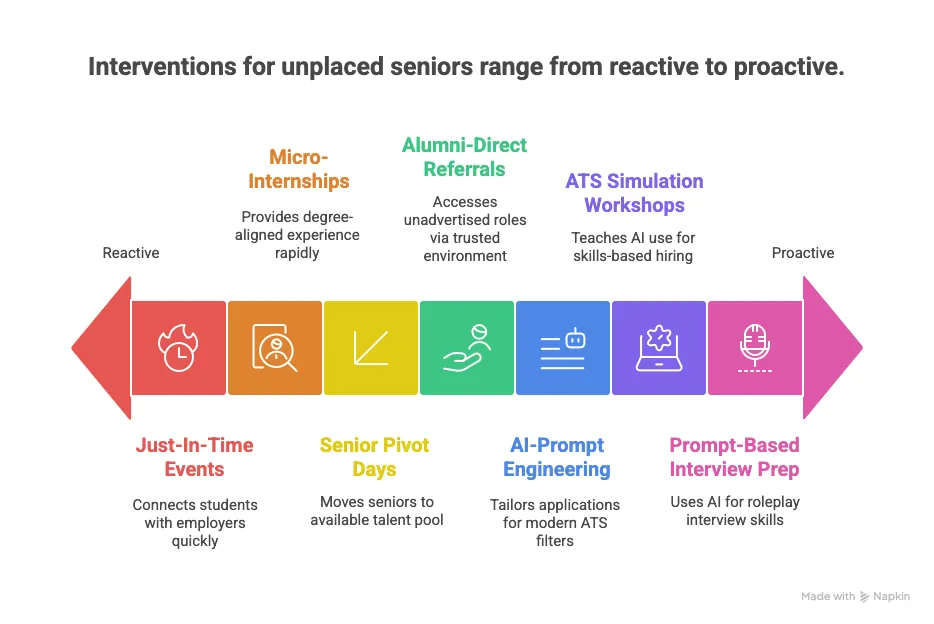
That means identifying who is still unplaced, segmenting students by barrier, and matching each group with the right intervention: role narrowing, resume repair, interview preparation, alumni referral, employer introduction, micro-internship, or follow-up accountability.
A senior who has applied to 80 jobs with no interviews does not need the same support as a senior who gets interviews but no offers.
A senior with no target role does not need the same intervention as a senior who has a strong target but no warm employer leads.
Late-cycle advising works best when career centers stop treating “unplaced” as one category.
The better question is:
Why is this student still unplaced, and what is the fastest meaningful intervention?
Also Read: 5 StrengthsFinder Activities Career Centers Need for Student Success
Why Late-Cycle Seniors Need Triage, Not Generic Job Search Advice
Generic job-search programming is often too slow for seniors who are weeks away from graduation.
A workshop on “how to start your job search” may be useful in September. In April, it may be too broad.
Late-cycle seniors need faster answers:
- Which roles are still realistic?
- Which employers are still hiring?
- What is weak in the student’s materials?
- Is the student applying too broadly?
- Is the student getting interviews but not converting?
- Does the student have a referral path?
- Is the student considering underemployment out of panic?
- What can be fixed this week?
A triage model helps advisors spend limited time where it matters most.
Instead of sending every unplaced senior the same message, the career center can group students by barrier and deploy focused support.
That is the difference between activity and intervention.
Which Unplaced Seniors Should Career Centers Prioritize First?
Career centers should start by identifying seniors with the highest risk of leaving without a clear plan or entering roles that do not support long-term career mobility.
Useful signals can come from advising records, first-destination survey outreach, faculty referrals, career platform activity, event attendance, resume review history, and direct senior surveys.
Prioritize students who show signs such as:
- No post-graduation plan
- No advising appointment in the last 60 days
- No resume update in the current semester
- Many applications but no interviews
- Interviews but no offers
- No target role family
- No employer contacts or alumni conversations
- No internship, project, or work sample evidence
- Low engagement with career services
- High anxiety or disengagement after repeated rejection
- Considering a misaligned role only because graduation is close
The goal is not to label students as problems. It is to decide where limited advisor capacity can create the fastest movement.
A short senior pulse survey can help:
What best describes your current situation?
- I have accepted an offer.
- I am interviewing.
- I am applying but not hearing back.
- I am still figuring out what roles to target.
- I have paused my search.
- I am considering an option but unsure if it is a good fit.
- I need help urgently.
That one question can help career teams separate students who need light-touch support from students who need direct intervention.
How Should Career Centers Segment Unplaced Seniors by Barrier?
Once the unplaced group is identified, advisors should segment by the reason students are stuck.
This prevents a common late-cycle mistake: telling every senior to “apply more.”
| Senior Segment | What Is Happening | Career Center Intervention |
|---|---|---|
| No Clear Target | Student is applying broadly, delaying decisions, or avoiding the job search altogether | 1:1 triage appointment focused on role-family narrowing and target-role selection |
| Weak Materials | Student is applying consistently but receiving few or no interview responses | Rapid resume and LinkedIn review tied directly to three target job postings |
| Weak Interview Conversion | Student secures recruiter screens or interviews but struggles to progress to offers | Role-specific mock interview practice and STAR-story refinement |
| No Warm Leads | Student relies exclusively on job boards and has little professional-network activity | Alumni referral sprint, networking outreach plan, and targeted employer-contact list |
| Skill Evidence Gap | Student lacks projects, experiences, or work samples that demonstrate readiness for target roles | Micro-internship, short project, certification, portfolio artifact, or experiential-learning plan |
| Low Momentum | Student appears discouraged, overwhelmed, or disengaged from the search process | Small weekly action plan paired with advisor accountability checkpoints |
| Underemployment Risk | Student is close to accepting a role that is misaligned with long-term goals due to urgency or pressure | Degree-relevance conversation, alternative-role mapping, and decision-support coaching |
The intervention should match the barrier. A student with weak targeting does not need 20 more job boards.
A student with weak interview answers does not need another resume workshop.
A student with no warm leads needs connection-building support, not another reminder to apply online.
Also Read: How can career centers help students build strong professional references before senior year?
What Should Career Centers Do in the Final 30 Days Before Graduation?
A 30-day plan gives career centers a practical structure for late-cycle support.
The goal is not to solve every student’s career path in one month. It is to create movement before momentum is lost.
| Timeline | Career Center Priority | Actions to Take |
|---|---|---|
| Week 1 | Identify and segment unplaced seniors | Pull senior status data, distribute a pulse survey, gather faculty referrals, review advising records, and segment students by primary barrier (target clarity, materials, interviews, networking, or motivation) |
| Week 2 | Repair application materials | Run rapid resume, LinkedIn, and cover letter clinics tied to specific target roles and active job postings |
| Week 3 | Activate direct connections | Launch alumni referral hours, create a still-hiring employer list, engage local and regional employers, and promote warm introductions where possible |
| Week 4 | Convert momentum into next steps | Run role-specific interview preparation, track employer follow-ups, schedule advising checkpoints, monitor student progress, and document movement toward interviews, offers, or alternative pathways |
Week 1: Identify and segment
Start with visibility.
Career centers should not wait for seniors to self-identify. Many students who need the most support may be the least likely to ask for help.
Use multiple inputs: surveys, advising data, career platform usage, faculty referrals, event attendance, employer engagement, and first-destination outreach.
Group students by barrier, not just by major.
Week 2: Repair materials
Ask students to bring three target postings, not just a resume.
That allows advisors to check whether the resume is aligned with actual roles. The goal is to fix weak evidence, missing keywords, vague bullets, and unclear positioning quickly.
A useful rule:
Every senior should leave with one target role family, three relevant postings, and a revised resume section tied to those roles.
Week 3: Activate connections
Late-cycle opportunities often move through faster, more direct channels.
Career centers can build a “still hiring” employer list, ask alumni for quick conversations, contact regional employers, and organize small employer sessions by role family.
Smaller events can be more useful than broad fairs at this stage.
The goal is not attendance volume. The goal is employer access for available seniors.
Week 4: Convert momentum
The final week should focus on interviews, referrals, applications, and follow-up.
Track whether students have taken concrete actions: applications submitted, interviews scheduled, alumni contacted, employer conversations completed, or micro-internships started.
A student who moves from “no plan” to “targeted plan with three applications and one employer conversation” has made real progress, even if the final offer comes later.
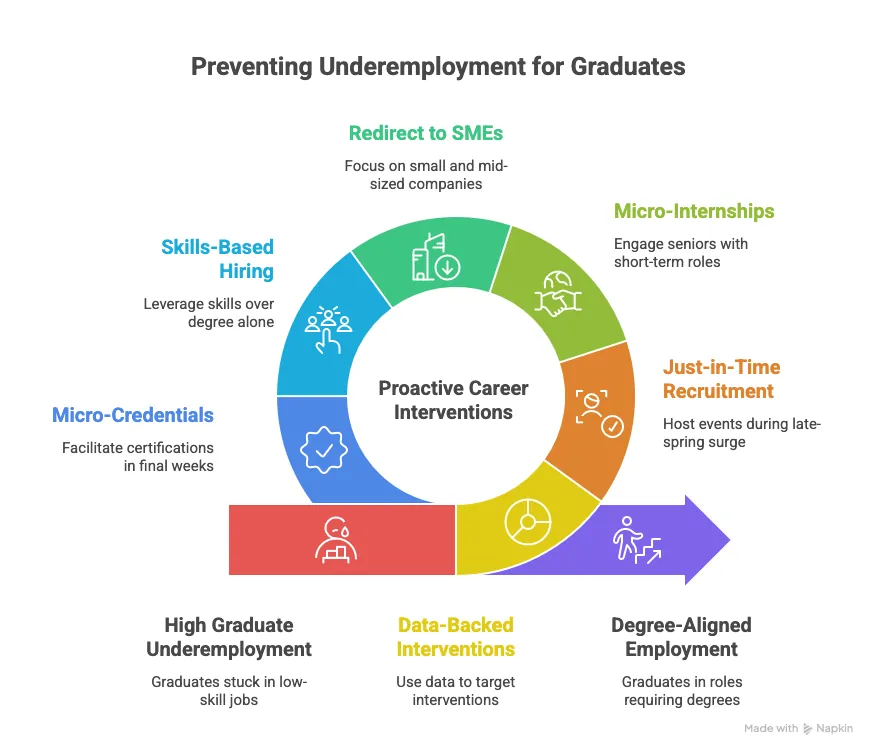
How Can Advisors Reduce Underemployment Risk?
Underemployment risk rises when students feel they are running out of time.
A senior may accept the first available role, even if it does not use their degree, build relevant skills, or create a path to the next opportunity.
Advisors should not shame students for considering immediate work. Many students have financial pressure, family expectations, immigration timelines, relocation constraints, or debt concerns.
The conversation should be practical, not judgmental.
A useful advisor script:
“The goal is not to judge any job. The question is whether this role helps you build toward the career path you want. Let’s compare three things: the skills you will use, the experience you will gain, and whether this role creates a path to the next opportunity.”
Advisors can ask:
- What skills will this role help you build?
- Is the role connected to your target field?
- Will the experience make your next application stronger?
- Is there a promotion or internal mobility path?
- Are you accepting this because it fits your goals or because the timeline feels stressful?
- What alternative roles could still meet your financial and career needs?
The goal is not to block a student from taking a job. The goal is to help them understand the trade-off.
Sometimes the right answer is an immediate role plus a 90-day plan to keep moving toward a degree-aligned path.
Which Late-Cycle Employer Strategies Work Best?
Late-cycle employer strategy should be more targeted than a general career fair.
By April and May, many large employers may have completed their planned campus recruiting. Smaller employers, local organizations, nonprofits, public sector offices, healthcare organizations, education employers, regional companies, and business services firms may still have shorter hiring windows or urgent needs.
Career centers can support seniors by building faster employer pathways.
Useful late-cycle strategies include:
- Create a “still hiring” employer list by role family
- Ask employer partners which roles are open for immediate or summer starts
- Contact alumni who can host quick referral or information sessions
- Package available seniors by interest area, such as marketing, analytics, operations, healthcare, education, or nonprofit work
- Run small just-in-time hiring events instead of broad fairs
- Invite local and regional employers who hire closer to start dates
- Follow up with employers within 48 hours after student introductions
- Give students employer-specific application deadlines and next steps
The best late-cycle employer outreach is specific.
Instead of saying:
“Do you have opportunities for our seniors?”
Ask:
“Do you have entry-level roles, project-based work, internships, trainee roles, or immediate openings for students in business, communications, data, healthcare, or operations?”
That gives employers a clearer way to respond.
What Should Career Centers Avoid When Supporting Unplaced Seniors?
Late-cycle pressure can lead to well-intended but weak interventions. Avoid these mistakes:
- Sending every unplaced senior the same generic workshop invite
- Telling students to “apply more” without reviewing targeting
- Measuring success only by application volume
- Waiting until graduation week to identify at-risk seniors
- Treating any job as a successful outcome
- Overloading discouraged students with too many tasks
- Running late-cycle events without employer follow-up
- Ignoring students who are silently disengaged
- Offering resume feedback without looking at target roles
- Encouraging AI use without quality control
- Treating underemployment as a student failure instead of a preventable risk
The best late-cycle support is focused, sequenced, and realistic. Students need enough structure to move, not so much advice that they freeze.
Also Read: How should career centers respond when students lose job offers unexpectedly?
How Should Career Centers Measure Late-Cycle Intervention Success?
Career centers should track more than whether a senior attended an appointment.
Late-cycle intervention success should show movement. Useful metrics include:
| Measurement Area | What to Track |
|---|---|
| Identification | Number of unplaced seniors identified through institutional data, surveys, advisor outreach, faculty referrals, or self-reporting |
| Segmentation | Percentage of seniors grouped by barrier type, readiness level, engagement status, or employment risk category |
| Readiness Actions | Resume revisions completed, LinkedIn updates made, mock interviews completed, target-role lists created, and advising appointments attended |
| Employer Movement | Alumni referrals generated, employer conversations initiated, networking contacts made, and applications submitted to still-hiring organizations |
| Skill Evidence | Micro-internships started, portfolio artifacts created, short projects completed, certifications begun, or work samples developed |
| Conversion | Interviews scheduled, final-round interviews reached, offers received, and degree-aligned roles accepted |
| Momentum | Students moving from “no plan” to “active plan,” completing agreed next steps, or progressing to a new readiness stage |
| Follow-Up | Advising check-ins completed, action plans reviewed, next steps documented, and student responses to outreach efforts |
The most useful metric may be movement by barrier. For example:
- 40 students identified as unplaced
- 28 completed triage
- 16 revised resumes for target roles
- 12 completed mock interviews
- 18 connected with alumni or employers
- 9 interviews generated
- 6 offers or short-term projects secured
- 10 students moved from “no plan” to active search plan
That kind of reporting helps career centers show that late-cycle intervention created measurable progress, even before every first-destination outcome is finalized.
Also Read: How can career centers prepare students for AI-driven interviews?
Wrapping Up
Late-cycle senior support works best when career centers can see who needs help, what barrier is slowing them down, and which intervention should come next.
A resume review, mock interview, employer referral, or alumni connection becomes more useful when it is part of a connected readiness workflow rather than a one-off service.
That is where the right infrastructure matters. Hiration supports the full career readiness journey with Career Assessments, AI-powered Resume Optimization, Interview Simulation, LinkedIn Optimization, and more.
Its separate Counselor Module also helps career teams manage cohorts, monitor engagement, track workflows, and review analytics within a secure, FERPA and SOC 2-compliant platform.
For career centers supporting unplaced seniors before graduation, that kind of system can make late-cycle intervention easier to organize, easier to scale, and easier to measure.