How can career centers build structured student skills gap systems that improve readiness?
Career centers can improve student outcomes by shifting from generic resume reviews to repeatable skills gap analysis systems. Effective frameworks diagnose whether students face missing skills, weak evidence, poor positioning, unclear role alignment, or confidence gaps, then convert those findings into targeted 30-60-90 day readiness plans that improve employability in measurable ways.
If you’re a career advisor conducting a skills gap analysis for a student, one of the hardest parts is figuring out what the gap actually is.
A student may genuinely be missing a skill required for their target role. But they may also already have the skill and simply lack strong evidence of it on their resume, LinkedIn profile, or in an interview.
That distinction matters because each problem requires a different intervention. Without it, skills gap analysis can quickly turn into generic advice to “gain more experience” or complete another course.
This guide shows career teams how to conduct a student skills gap analysis systematically, identify and prioritize the right gaps, separate missing skills from weak evidence, and turn the findings into practical 30-60-90 day development plans.
What is a Student Skills Gap Analysis?
A student skills gap analysis is a structured review of the difference between the skills a target role requires and the skills a student can currently prove.
The word prove matters. A student may list “communication” or “leadership” on a resume, but if they cannot show where they used that skill, what they did, and what changed because of it, the employer may not treat the claim as credible.
A strong skills gap analysis helps advisors answer five questions:
- What role or industry is the student targeting?
- Which skills appear repeatedly in job descriptions for that role?
- Which of those skills can the student already prove?
- Which skills are missing, weak, or poorly translated?
- What should the student do in the next 30, 60, or 90 days to close the highest-priority gap?
This turns advising from general encouragement into a concrete coaching process.
A student skills gap analysis is narrower than a broader career readiness gap analysis.
Career readiness may include engagement, professional behaviors, career decision-making, application readiness, and confidence.
A skills gap analysis focuses specifically on what a target role requires, what the student can demonstrate, and what evidence or capability still needs to be built.
How Do Career Advisors Conduct a Skills Gap Analysis for a Student?
Career advisors can conduct a skills gap analysis by starting with a defined target role, identifying recurring requirements across several job descriptions, mapping the student’s existing evidence against those requirements, classifying the gaps, prioritizing the most important ones, and turning them into specific development actions.
A practical process looks like this:
| Stage | Advisor action | Output |
|---|---|---|
| 1. Define the target | Identify a realistic role family or industry | Clear career target |
| 2. Identify required skills | Compare 3-5 relevant job descriptions | Recurring skills and requirements |
| 3. Map existing evidence | Review coursework, projects, jobs, leadership, resume, LinkedIn, and interview stories | Skills the student can already prove |
| 4. Diagnose the gap | Separate missing skills from weak or hidden evidence | True gap vs. translation gap |
| 5. Prioritize | Rank gaps by role importance and evidence strength | Highest-priority gaps |
| 6. Build evidence | Choose learning, project, experience, or positioning actions | Concrete development plan |
| 7. Reassess | Review updated evidence after 30, 60, or 90 days | Measurable progress |
The important distinction is that the analysis should not automatically end with “take a course.” Sometimes the student needs a new capability. Sometimes they already have the capability and need stronger evidence.
Use this table during advising sessions to identify where the gap actually sits.
| Area | What to check | Possible gap |
|---|---|---|
| Target role | Is the student pursuing a defined role family? | Targeting gap |
| Required skills | Which capabilities repeat across relevant job descriptions? | Market-alignment gap |
| Resume | Can the student demonstrate those skills through specific examples? | Evidence or translation gap |
| Does the profile reinforce the same skills and direction? | Positioning gap | |
| Interview | Can the student explain where and how they used each priority skill? | Articulation gap |
| Academic/campus experience | Are relevant skills being overlooked because the experience is described academically? | Translation gap |
| Technical or role-specific requirements | Is a required capability genuinely absent? | Skill gap |
| Follow-through | Is there a defined action and timeline for closing the gap? | Development gap |
How Can Advisors Compare a Student’s Profile Against Target Roles?
The first step is not reviewing the resume. It is clarifying the target.
A resume can only be evaluated properly when the advisor knows what role, industry, or function the student is trying to pursue. Otherwise, feedback becomes generic: improve formatting, add metrics, strengthen bullets. Useful, but not enough.
Ask students to bring 3-5 job descriptions for roles they would realistically consider. Then look for repeated patterns.
Track:
- recurring technical skills
- recurring soft skills
- tools and platforms
- certifications or credentials
- preferred experience
- repeated verbs, such as analyze, coordinate, present, troubleshoot, research, manage, or design
- education or major requirements
- industry-specific language
The goal is not to tell the student they must match every requirement. It is to identify which skills matter most across similar roles.
Advisor prompt
“Let’s not look at one job description in isolation. Let’s compare a few similar roles and see what keeps repeating. Those repeated skills are the strongest signals for what this market expects.”
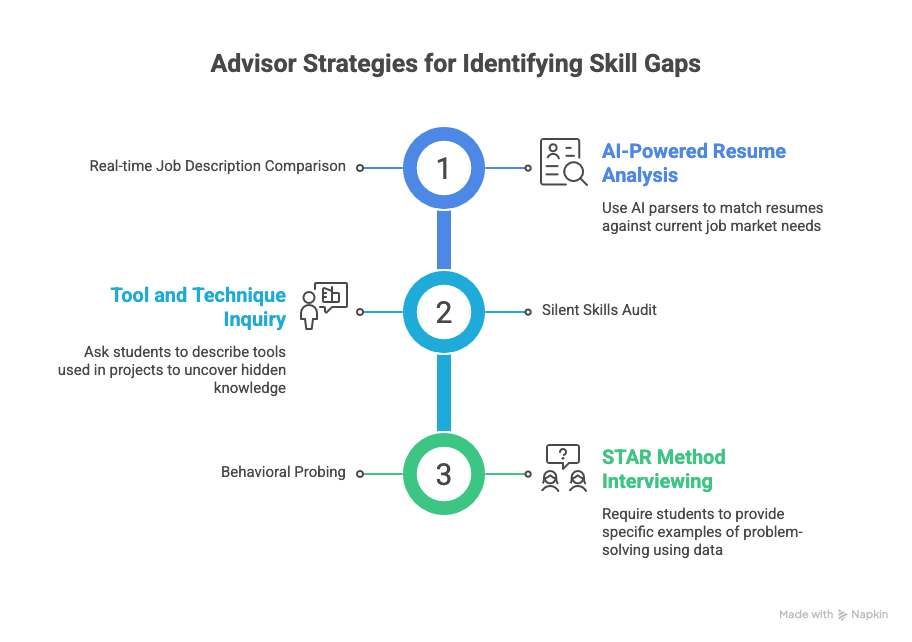
How Do You Tell a Real Skill Gap From an Evidence Gap?
Not every gap is a missing skill.
Many students already have relevant experience, but the evidence is buried. A student who worked as a resident assistant may have conflict resolution, event planning, crisis response, and peer leadership experience.
A student who worked in dining services may have customer service, workflow management, training, and time-pressure communication experience.
A student who completed a research paper may have source evaluation, synthesis, writing, and analytical thinking experience.
The advisor’s job is to separate a real skill gap from a translation gap.
Is It a Real Skill Gap or a Translation Gap?
This distinction matters because the wrong diagnosis creates the wrong solution. If the issue is translation, the student may not need a new course.
They may need better language. If the issue is missing evidence, they may need a project, internship, campus role, or credential.
A useful way to classify the finding is:
| Gap type | What it means | Typical intervention |
|---|---|---|
| Missing skill | The student cannot yet perform an important required skill | Course, training, project, credential, experience |
| Missing evidence | The student may understand the skill but has nothing concrete to demonstrate it | Project, internship, campus role, portfolio artifact |
| Translation gap | The student has relevant experience but describes it in language employers may not recognize | Resume, LinkedIn, and interview reframing |
| Articulation gap | The evidence exists, but the student cannot explain it clearly | Interview practice, STAR stories, reflection |
| Targeting gap | The student’s materials do not align with a defined role | Role clarification and job-description analysis |
How Can Advisors Audit a Student’s Resume, LinkedIn, and Interview Evidence?
A skills gap analysis should not happen in one document only. A student’s resume, LinkedIn profile, and interview answers should all tell the same skill story.
If the resume says the student has project management skills, the LinkedIn profile should support that direction, and the student should be able to explain a project management example in an interview.
Use this three-part audit.
Resume Audit
Ask:
- Does the resume match the target role family?
- Are the most important skills visible in the top half?
- Do bullets show action, context, and result?
- Are tools, methods, and outcomes included where relevant?
- Does the student use the employer’s language naturally?
- Are skills supported by real examples?
Weak bullet:
“Worked on social media for student club.”
Stronger bullet:
“Created a 4-week Instagram content calendar for a student club campaign, increasing event registrations from 45 to 78.”
LinkedIn Audit
Ask:
- Does the headline show direction?
- Does the About section explain interests and strengths?
- Are skills aligned with target roles?
- Are projects or experiences described with evidence?
- Does the profile reinforce the resume?
- Is the student findable for relevant keywords?
Weak headline:
“Student at ABC University”
Stronger headline:
“Finance Student | Interested in Investment Research, Data Analysis & Market Strategy”
Interview Story Audit
Ask:
- Can the student describe a real example for each priority skill?
- Does the answer explain their individual role?
- Does the story include a result or learning?
- Can the student connect the example to the target role?
- Does the student avoid vague claims like “I am hardworking” or “I am a team player”?
A strong interview answer should show:
- what the situation was
- what the student was responsible for
- what action they took
- what changed
- what they learned
- how it applies to the role
How Can Advisors Map Academic Experiences to Market Skills?
Students often underestimate academic work because they do not know how employers interpret it.
A project, paper, lab, presentation, studio critique, case competition, clinical rotation, or capstone can all contain marketable skills. The problem is that students usually describe them in academic language.
Career advisors can help students convert academic language into employer-facing language.
Academic-to-Market Skills Mapping
| Academic Experience | Student Language | Employer-Facing Skill Language | Where to Use It |
|---|---|---|---|
| Research Paper | “Wrote a paper for class” | Research, source evaluation, synthesis, structured writing, and analytical communication | Resume projects section, writing sample, graduate applications, or interview stories |
| Group Project | “Worked with classmates” | Team coordination, project planning, collaboration, communication, and conflict resolution | Resume bullets, teamwork-focused interview answers, or LinkedIn project descriptions |
| Lab Assignment | “Completed lab work” | Data collection, technical execution, compliance, process accuracy, and documentation | Technical resume projects, STEM roles, or technical skills sections |
| Presentation | “Presented in class” | Public speaking, audience adaptation, visual communication, and message delivery | Interview responses, LinkedIn projects, or communication-focused resumes |
| Case Study | “Analyzed a company” | Business analysis, strategic thinking, problem framing, and recommendation development | Consulting resumes, business applications, or interview examples |
| Capstone Project | “Completed final project” | Project management, applied problem-solving, stakeholder communication, and execution | Portfolio projects, advanced resume bullets, or interview narratives |
| Student Employment | “Worked on campus” | Customer service, scheduling, operations, reliability, training, and workplace accountability | Resume experience section, transferable skills framing, or behavioral interviews |
The goal is not to exaggerate academic work. The goal is to name it in a way employers can recognize.
Also Read: How to Prevent Liberal Arts Underemployment in the First Post-Grad Job
How Should Career Centers Prioritize Student Skills Gaps?
A student may have several gaps. Advisors need to help prioritize which ones matter first. Use job descriptions to rank gaps by importance.
Ask:
- Does the skill appear in many roles or just one?
- Is it required or preferred?
- Can the student learn it quickly?
- Can the student prove it through a project?
- Is it a technical tool, a behavior, or a credential?
- Will closing this gap improve resume quality, interview readiness, or both?
Skill Gap Priority Matrix
| Gap Type | Priority Level | Example | Best Intervention |
|---|---|---|---|
| Required skill missing across many target roles | High | SQL for data analyst roles | Course, project, and resume update |
| Skill exists but is not visible | High | Leadership from campus job not shown on resume | Resume rewrite and interview story development |
| Preferred skill missing | Medium | Tableau listed as preferred | Short tutorial and dashboard project |
| Skill listed but not provable | Medium | “Communication” with no example | STAR story and bullet rewrite |
| Nice-to-have skill in one posting | Low | Industry-specific tool appearing once | Monitor, but do not prioritize yet |
This prevents students from chasing every credential or skill they see. The goal is focused progress.
A Simple Student Skill Gap Scoring Method
Career centers can make prioritization more consistent by scoring each potential gap across three dimensions.
| Score | Role importance | Evidence gap | Closure feasibility |
|---|---|---|---|
| 0 | Not relevant to target roles | Strong evidence already exists | No intervention needed |
| 1 | Appears occasionally | Evidence exists but could be clearer | Requires substantial time or experience |
| 2 | Appears frequently or is preferred | Limited evidence | Can be improved during the current semester |
| 3 | Repeatedly required across target roles | No credible evidence | A realistic action can create evidence quickly |
Add the three scores to create a 0-9 priority score.
- 7-9: Address first
- 4-6: Build into the student’s development plan
- 0-3: Monitor or deprioritize unless the target changes
The score should be used as a triage tool rather than a rigid assessment. An advisor may still prioritize a difficult-to-close skill when it is fundamental to the student’s target field.
For example, if SQL appears repeatedly as a required skill, the student has no SQL evidence, and a project can be completed during the semester, it becomes a strong candidate for immediate intervention. If a certification appears in only one job description and is merely preferred, it may not deserve the same attention.
How Can Students Close a Skills Gap With a 30-60-90 Day Plan?
Once the highest-priority gap is clear, advisors should turn the finding into a short upskilling plan.
A strong plan should include:
- one target role family
- one priority gap
- one learning action
- one evidence-building action
- one resume/profile update
- one market test
30-60-90 Day Upskilling Plan
| Timeline | Student Focus | Advisor Role | Output |
|---|---|---|---|
| 30 Days | Clarify the target role and close one visible evidence gap | Review job descriptions, current materials, and missing proof points | Updated resume, LinkedIn headline, and skill evidence |
| 60 Days | Build or document one project that proves the target skill | Recommend a project, course, campus role, credential, or work sample path | Portfolio entry, project bullet, or work sample |
| 90 Days | Test the skill in the market through applications and interviews | Review applications, employer responses, and interview feedback | Revised job search strategy based on employer response |
Example 30-60-90 Plan
- Student goal: Apply for entry-level data analyst roles
- Priority gap: SQL appears in most target job descriptions, but student has no evidence of SQL experience
- 30 days: Complete beginner SQL module and update skills section
- 60 days: Build a small project analyzing public data with SQL and Excel
- 90 days: Add project to resume and apply to 10 targeted roles requiring SQL basics
This plan turns “learn SQL” into a measurable advising pathway.
Example: Marketing Student With a Technical Skills Gap
A marketing student may already have strong content creation and campus leadership experience but find that analytics and reporting tools appear repeatedly across marketing coordinator roles.
Instead of telling the student to “build more marketing skills,” the advisor can isolate the specific gap.
- Target role: Marketing coordinator
- Existing evidence: Social media management, content creation, event promotion
- Priority gap: Limited evidence of campaign analytics and reporting
- Action: Complete a basic analytics module and analyze the performance of an existing student-organization campaign
- Evidence: Create a short report showing reach, engagement, conversion, findings, and recommendations
- Market test: Add the project to the resume and use it as an interview example
Example: Liberal Arts Student With a Translation Gap
A liberal arts student targeting research or policy roles may appear to lack analytical experience because their resume lists papers, coursework, and academic projects without describing the underlying skills.
The analysis may show that the capability already exists.
- Target role: Research or policy analyst
- Existing evidence: Research papers, source evaluation, qualitative analysis, presentations
- Apparent gap: Analytical skills
- Actual diagnosis: Translation gap
- Action: Rewrite academic experiences to show research methods, synthesis, findings, and outcomes
- Market test: Use the revised examples in applications and interview practice
In this case, recommending another credential would address the wrong problem.
Also Read: Designing Micro-Internships: A 5-Step Guide for Career Centers
When Should Advisors Recommend Micro-Credentials to Close Skills Gaps?
Micro-credentials can help students close specific gaps, but they should not be treated as generic resume decorations.
A credential is useful when it meets three conditions:
- It maps to a repeated requirement in target job descriptions.
- It comes from a credible provider or recognizable industry source.
- The student can apply the skill in a project, portfolio, internship, or work example.
A certificate alone is rarely enough. Employers still need evidence that the student can use the skill.
Micro-Credential Decision Checklist
Before recommending a micro-credential, ask:
- Does this skill appear in at least 3-5 target job descriptions?
- Is the credential recognized in the student’s target industry?
- Is the skill missing, or is it only poorly translated?
- Can the student complete it within a realistic timeline?
- Will the student create a project or artifact using the skill?
- Will the credential strengthen the student’s resume, LinkedIn, or interview story?
If the answer is no, the student may need a better project, stronger resume language, or more targeted experience instead.
How Can Career Centers Track Student Skills Gaps Over Time?
A tracker helps advisors and students monitor progress over time.
Student Skills Gap Tracker
This tracker is especially useful for career centers managing cohorts, career courses, internship programs, or senior job search groups.
| Student / cohort | Target role | Priority skill | Current evidence | Gap type | Intervention | Review date | Status |
|---|---|---|---|---|---|---|---|
| Student A | Data analyst | SQL | None | Missing skill/evidence | Course + project | 30 days | In progress |
| Student B | Policy analyst | Research | Academic papers not translated | Translation gap | Resume + interview reframing | 14 days | In progress |
| Student C | Marketing coordinator | Analytics | Limited reporting evidence | Evidence gap | Campaign analysis project | 30 days | Not started |
Leading universities are proactively bridging the skills gap by embedding high-stakes sectoral competencies directly into their student pathways. According to Georgia State University, their "College to Career" explorer uses real-time data to map diverse degree backgrounds to specific industry roles, while Allegheny College has successfully launched 28 stackable micro-credentials in AI Strategy and Digital Content specifically for Liberal Arts majors. Additionally, Arizona State University has integrated Green Tech and Sustainability certifications into its core business and engineering curricula to meet the 105% growth in renewable energy roles.
How Career Centers Can Scale Skill Gap Analysis?
One-on-one advising is valuable, but skill gap analysis should not depend entirely on individual appointments.
Career centers can scale this process by creating shared systems.
1. Use role-family templates
Create templates for common role families:
- data analyst
- marketing coordinator
- software engineer
- HR assistant
- financial analyst
- research assistant
- healthcare administrator
- policy analyst
- teacher
- sales development representative
Each template should include common skills, sample job descriptions, resume examples, project ideas, and interview prompts.
2. Embed skill audits into career courses
A required career readiness course or major-specific career module can include a skills gap assignment.
Students can:
- choose one target role
- analyze 3 job descriptions
- identify 5 priority skills
- map current evidence
- choose one gap to close
- submit a 30-60-90 day plan
3. Use group advising for common gaps
If many students have the same gap, do not solve it one appointment at a time.
Run skill-building sprints such as:
- Resume Evidence Sprint
- LinkedIn Skills Alignment Sprint
- STAR Story Sprint
- Portfolio Project Sprint
- Job Description Analysis Sprint
- AI Literacy for Job Search Sprint
4. Partner with faculty
Faculty can help students recognize skills already being built in coursework. Career centers can provide language, rubrics, and assignments that help students translate academic work into career evidence.
5. Use technology for first-pass analysis
Technology can help identify patterns across resumes, job descriptions, interview practice, and student profiles. But it should support advisor judgment, not replace it.
The best use of technology is to surface likely gaps quickly so advisors can focus on diagnosis, prioritization, and coaching.
6. Separate Individual Skill Gaps From Cohort-Level Gaps
The same analysis becomes more useful when career centers aggregate patterns across students.
An individual gap requires an individual intervention. A repeated gap across a large student group may point to a program-level opportunity.
For example:
- Two students targeting analytics roles have no SQL evidence: address through individual advising.
- A large share of students targeting analytics roles have no SQL evidence: consider a workshop, course partnership, project sprint, or faculty collaboration.
- Students across several majors have relevant teamwork experience but consistently fail to demonstrate it on resumes: the issue may be articulation rather than capability.
- Students complete credentials but cannot explain how they applied the skills: the intervention may need to focus on evidence-building and reflection rather than adding more credentials.
Career centers can review patterns by:
- major
- class year
- target role family
- industry
- competency
- resume or interview performance
- gap type
- intervention completed
A simple cohort view can help teams decide where high-touch advising is necessary and where one shared intervention can address a recurring problem.
What Questions Should Advisors Ask During a Student Skills Gap Analysis?
Use these prompts during advising sessions.
Target role questions
- What role family are you targeting?
- Which three job descriptions best represent your goal?
- What skills repeat across those descriptions?
- Which requirements feel most difficult to prove?
Evidence questions
- Where have you used this skill before?
- What project, job, course, or leadership role shows this?
- What was your specific contribution?
- What changed because of your work?
- Can you explain this example in an interview?
Gap diagnosis questions
- Is the skill missing, or is the evidence unclear?
- Is this a required skill or a preferred skill?
- Would a recruiter see this skill in your resume within 10 seconds?
- Does your LinkedIn profile support the same skill story?
- What is the smallest project or action that would create evidence?
Upskilling questions
- What can you complete in 30 days?
- What project can prove the skill in 60 days?
- How will we test this in applications within 90 days?
- What support do you need to stay accountable?
How Should Career Centers Measure Whether Skill Gap Support is Working?
Career centers should measure whether skill gap analysis leads to real progress.
Track:
- number of students completing a skills gap audit
- resume revisions completed after audit
- LinkedIn/profile updates completed
- projects or credentials completed
- mock interview score improvement
- student confidence before and after the audit
- applications submitted to better-fit roles
- employer response rate
- interview invitations
- internship or job outcomes
- progress by student group, major, or cohort
The goal is not just to identify gaps. The goal is to close them and see whether student outcomes improve.
The World Economic Forum has projected that 39% of workers’ core skills will change by 2030, which makes ongoing skill diagnosis more important for students entering a fast-changing labor market.
Newer labor-market research also suggests that AI is reshaping which skills are exposed to automation and which remain valuable.
A 2026 paper mapping AI skill shifts found that many observed AI interactions are still augmentation rather than full automation, which reinforces the need to teach students how to combine technical fluency with judgment, communication, and problem-solving.
Wrapping Up
Student skills gaps are not always about ability. Often, they are about evidence.
A student may already have strong communication, leadership, research, analysis, or problem-solving experience, but if those skills are not visible in the resume, LinkedIn profile, interview story, or project evidence, employers may not recognize them.
Career centers can close this gap by using a repeatable process: compare target roles, identify priority skills, separate missing skills from weak evidence, map academic and campus experiences to market language, and build a 30-60-90 day upskilling plan.
Hiration supports this work by helping career teams turn skill-gap advising into a more structured, measurable process. Our platform supports career assessments, AI-powered resume optimization, interview simulation, job-description-based skill analysis, student workflows, and counselor-facing analytics within a secure, FERPA- and SOC 2-compliant environment.
When advisors can identify the real gap, students stop guessing what they lack and start building the proof employers need to see.
Student Skills Gap Analysis — FAQs
What is a student skills gap analysis?
A skills gap analysis compares target job requirements against the skills a student can currently prove through evidence, positioning, and role alignment.
Why is proving skills more important than listing them?
Employers prioritize demonstrated evidence over claimed competencies, making proof through projects, work, or outcomes essential for credibility.
What are the five main readiness gaps advisors should diagnose?
The primary gaps are missing skills, weak evidence, poor translation, unclear positioning, and confidence or targeting issues.
Why should advisors start with target job descriptions?
Job descriptions reveal repeated market requirements, helping advisors prioritize the skills that matter most for real hiring outcomes.
What is the difference between a real skill gap and a translation gap?
A real skill gap means the student lacks the capability, while a translation gap means relevant experience exists but is poorly framed for employers.
Why should resume, LinkedIn, and interview stories be audited together?
Students need a consistent, role-aligned skill narrative across all major hiring touchpoints to improve credibility and conversion.
How can academic work be converted into marketable skills?
Advisors help students translate coursework, projects, research, and campus work into employer-recognized language focused on outcomes and workplace relevance.
When should micro-credentials be recommended?
Micro-credentials are most useful when they directly match recurring job requirements and are paired with practical evidence such as projects or portfolios.
What makes a strong 30-60-90 day upskilling plan?
Strong plans include one priority skill gap, one learning action, one evidence-building step, resume/profile updates, and real application testing.
What is the biggest strategic shift for career centers?
Career centers must move from broad career advice toward structured readiness systems that diagnose, prioritize, and systematically close employability gaps.