How does a 4-week job search plan help advisors coach students more effectively in 2026?
A structured 4-week job search plan gives advisors visibility into student activity, replaces vague effort with measurable signals, and enables timely intervention across resumes, applications, networking, and interviews without increasing advisor workload.
If you’re advising a student who is already applying for jobs, the challenge is often not getting them to do more.
It is figuring out what is actually blocking progress: unclear role targeting, weak application materials, too much cold applying, inconsistent follow-up, or poor interview conversion.
Without a structured way to review activity and outcomes, those problems can look the same from one advising appointment to the next.
This guide gives career advisors a 4-week job search framework for students who are actively searching. Each week has a specific objective, student actions, advisor checkpoints, and evidence to review so you can identify where the search is stalling and decide what should change next.
4-Week Job Search Plan at a Glance
Use this table as the core advising framework.
| Week | Student Focus | Advisor Goal | Daily Micro-Goal | What to Track | Red Flag |
|---|---|---|---|---|---|
| Week 1 | Resume targeting and role list | Build a focused search direction before applications begin | Identify five target skills from one job description | Roles identified, roles approved, and resume versions created | Student has no clear role focus or uses one resume for every role |
| Week 2 | Application quality | Replace mass applying with fewer, stronger applications | Submit one high-quality tailored application per day | Applications submitted, resume version used, and follow-up plan | Student submits many applications with little or no tailoring |
| Week 3 | Warm outreach and networking | Add referrals, alumni conversations, and employer intelligence | Send two personalized outreach messages per day | Outreach sent, replies, informational interviews, and referrals | Student only cold applies and avoids relationship-building |
| Week 4 | Interview prep and pipeline audit | Diagnose where the search is stalling and reset the strategy | Practice three STAR stories for target roles | Screens, interviews, rejections, offers, and pipeline stall points | Student gets no responses after three weeks or repeats the same strategy |
Treat the four weeks as a decision cycle, not just a sequence of assignments. Each week should give the advisor enough evidence to decide whether the student is ready to move forward, needs to correct the current strategy, or requires a different intervention.
4-Week Job Search Tracker for Students
Use this tracker throughout the plan so advisors can review patterns, not just individual applications.
| Date | Role | Employer | Source | Resume Version Used | Follow-Up Completed? | Networking Contact? | Status | Advisor Note |
|---|---|---|---|---|---|---|---|---|
| Jan 10 | Marketing Intern | ABC Company | Marketing v2 | Yes | Alumni contacted | Applied | Strong fit, monitor response | |
| Jan 11 | Data Analyst Intern | XYZ Corp | Employer site | Data v1 | No | None | Drafting | Needs stronger project bullet |
| Jan 12 | Program Assistant | Nonprofit Org | Handshake | General v1 | Yes | Staff member contacted | Screen | Prepare interview stories |
This tracker helps advisors spot patterns quickly. For example, if a student is applying to many roles but not tailoring resumes, Week 2 needs more quality control.
If a student gets interviews but no offers, Week 4 should focus on interview performance. If the student never receives employer responses, the issue may be role fit, resume quality, or lack of warm outreach.
Why Students Need a Structured Job Search Plan?
Many students treat the job search as a volume game. They assume more applications will lead to better odds, even when the applications are poorly targeted or weakly tailored.
That approach can backfire. According to NACE’s 2025 Student Survey Report Executive Summary, Class of 2025 graduating seniors submitted a median of 10 job applications, up from 6 for the Class of 2024, while receiving fewer offers on average.
The job market is not universally closed, but it is uneven.
According to NACE’s Job Outlook 2026 Spring Update, employers expect to hire 5.6% more new college graduates from the Class of 2026, but hiring growth varies across industries and employer types.
That means students need to apply with more precision. They need to understand where they are a strong fit, how to tailor materials, how to build warm signals, and how to adjust when the pipeline stalls.
A structured job search plan helps advisors answer four questions quickly:
- Is the student applying to the right roles?
- Are their materials strong enough for those roles?
- Are they relying only on cold applications?
- Where are they stalling in the hiring funnel?
How Should Advisors Run a Weekly Job Search Check-In?
A weekly job search check-in should review both what the student did and what happened as a result. The goal is not to audit task completion for its own sake. It is to use the student’s activity to identify what is working, where movement is stopping, and what should change next.
A short advisor review can follow the same five-step structure each week:
| Check-In Step | Advisor Question | Output |
|---|---|---|
| Review actions | What did you complete since the last check-in? | Actual job search activity |
| Review signals | What happened after those actions? | Responses, conversations, interviews, or other movement |
| Find the pattern | Where does progress appear to be stopping? | Current bottleneck |
| Choose one correction | What needs to change this week? | Specific intervention |
| Set the next checkpoint | What evidence will we review next time? | Clear accountability |
Keep the correction narrow. If targeting is the problem, changing interview preparation will not help. If the student is reaching interviews but not progressing, increasing application volume may not address the issue either.
Each check-in should end with one clear priority for the following week and a defined piece of evidence the advisor will review next time.
Week 1: How Should Advisors Help Students Target Roles and Resumes?
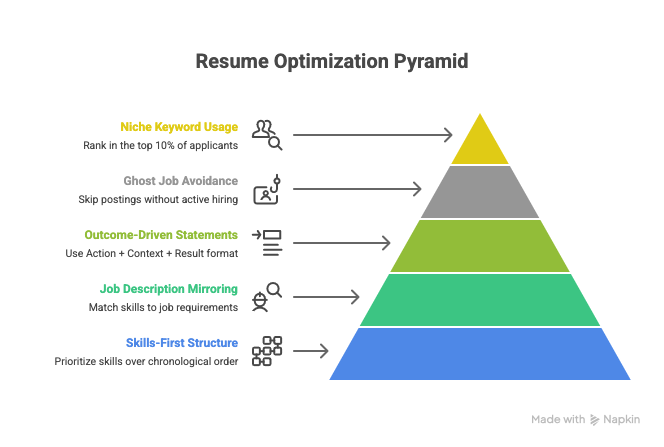
Week 1 should focus on direction before volume. Students should not start by applying to every role that looks vaguely relevant. They should first identify target role families, skill patterns, and resume positioning.
This matters because hiring is increasingly skills-based. According to NACE, 70% of employers use skills-based hiring, but fewer than 40% of graduating seniors are familiar with the term.
That creates a major coaching gap for career centers.
The advisor’s job in Week 1 is to help students translate their experience into evidence that matches the kinds of roles they want.
Week 1 Advisor Priorities
Focus on:
- identifying 2-3 target role families
- reviewing job descriptions for recurring skills
- creating one base resume for each role family
- replacing generic bullets with evidence-based bullets
- helping students avoid low-fit roles
- teaching students how to verify priority postings on employer career pages when possible
Students should learn that a job description is not just a posting. It is a map of what the employer values.
Student Assignment
Ask students to choose three job descriptions from one target role family and identify:
- repeated technical skills
- repeated soft skills
- required tools
- preferred experience
- keywords used across multiple postings
- examples from their own experience that prove those skills
Then ask them to build a resume version around that role family.
Daily Micro-Goal
Identify 5 target skills from one job description and match each skill to one real experience.
Week 1 Resume Targeting Template
| Target Role Family | Repeated Skills | Student Evidence | Resume Section to Update | Advisor Note |
|---|---|---|---|---|
| Marketing Coordinator | Campaign execution, analytics, writing, and social media strategy | Campus campaign work, newsletter creation, and internship experience | Experience + Skills | Add measurable metrics and stronger outcomes to campaign-related bullets |
| Data Analyst | SQL, Excel, dashboards, and analytical problem-solving | Academic projects and research assistant responsibilities | Projects + Skills | Strengthen tools used, technical specificity, and quantifiable outcomes |
| HR Assistant | Communication, scheduling, employee support, and coordination | Student organization leadership and campus employment | Experience | Highlight coordination ability, operational reliability, and follow-through |
Also, help students protect their time by avoiding "Ghost Jobs" (postings that remain open without active hiring).
Instruct students to cross-reference every LinkedIn listing with the company’s official career portal; if it isn't listed there, it's a ghost job and should be skipped.
Advisor Script: When a Student Has No Clear Role Focus
“You do not need to choose your entire career today. But for this week, we need a role family to aim at. Let’s pick one direction to test, gather three job descriptions, and see what skills keep repeating. That will give us a stronger starting point than applying broadly.”
Week 1 Advisor Checkpoint
Before moving into application volume, confirm that the student has a defined target, can identify recurring requirements across relevant job descriptions, and has at least one resume version positioned around that role family.
If the student is still applying across unrelated roles or cannot explain why their experience fits the target, keep the focus on targeting. Increasing application volume at this stage only creates more activity around an unresolved positioning problem.
Also Read: 7 Student Outreach Templates That Actually Get Responses
Week 2: How Should Advisors Set Job Application Targets for Students?
Week 2 should shift from role targeting to application quality. There is no single weekly application number that fits every student, industry, recruiting cycle, or job market.
Set a target that creates enough activity to generate useful feedback without pushing the student toward low-fit or minimally tailored applications. The number should reflect role availability, deadlines, application complexity, and the student’s capacity.
The advisor’s job is not to maximize volume. It is to make sure the student is submitting enough high-quality applications to reveal whether the current targeting and positioning strategy is working.
Week 2 Advisor Priorities
Focus on:
- tailored resumes
- role-fit checks
- application tracking
- follow-up planning
- avoiding low-quality mass applying
- identifying whether a cover letter is worth the effort
- helping students prioritize high-fit roles
Daily Micro-Goal
Complete 1 deep-dive application per day.
A deep-dive application includes:
- job description review
- tailored resume
- role-fit check
- employer research
- follow-up plan
- LinkedIn or alumni check where relevant
Application Quality Control Template
Use this before students submit applications.
| Quality Check | Yes / No | Advisor Note |
|---|---|---|
| Resume matches the role family | ||
| At least 5 relevant skills from the job description appear naturally | ||
| Resume includes at least one quantified or specific outcome | ||
| Student meets most core requirements | ||
| Student has researched the employer | ||
| Follow-up plan exists | ||
| Application is worth submitting | Approve / Revise / Skip |
Advisor Decision Options
After review, mark the application as:
- Approve: Strong fit and ready to submit
- Request revision: Role is relevant, but materials need improvement
- Skip: Role is too low-fit, outdated, unclear, or not worth the time investment
How Should Advisors Diagnose the Application Strategy?
Use patterns across several applications rather than treating each submission as an isolated event.
| What the Advisor Sees | What to Investigate | Next Action |
|---|---|---|
| Applications spread across unrelated role families | Targeting may still be too broad | Return to role targeting and narrow the search |
| Relevant roles but weak tailoring | Materials may not show enough role-specific evidence | Review resume positioning and application quality |
| Many relevant applications but little employer response | Role fit, resume positioning, employer mix, or application strategy | Audit a sample of recent applications before adding more volume |
| Strong materials but inconsistent application activity | Execution barriers, search habits, or application friction | Identify what is preventing consistent follow-through |
| Employer response is stronger for one type of role | The market may be giving the student a useful targeting signal | Prioritize similar roles and examine what those applications have in common |
The purpose of this review is not to assign a universal conversion benchmark. It is to help the advisor compare the student’s activity against their own emerging pattern and decide what should be tested next.
Advisor Script: When a Student Is Mass Applying
“I understand why sending more applications feels productive. But if the resume is not aligned and there is no follow-up plan, the extra volume may not improve your odds. Let’s slow down for a moment and make sure each application is strong enough to teach us something.”
Week 2 Advisor Checkpoint
By the end of Week 2, the advisor should be able to review a meaningful sample of applications and determine whether the student is consistently applying to relevant roles with sufficiently tailored materials.
Do not increase volume automatically when responses are limited. First determine whether the problem is execution, targeting, positioning, or simply that more time and evidence are needed before drawing a conclusion.
Also Read: How to prevent underemployment for liberal arts students?
Week 3: How Should Advisors Help Students Build a Networking Strategy?
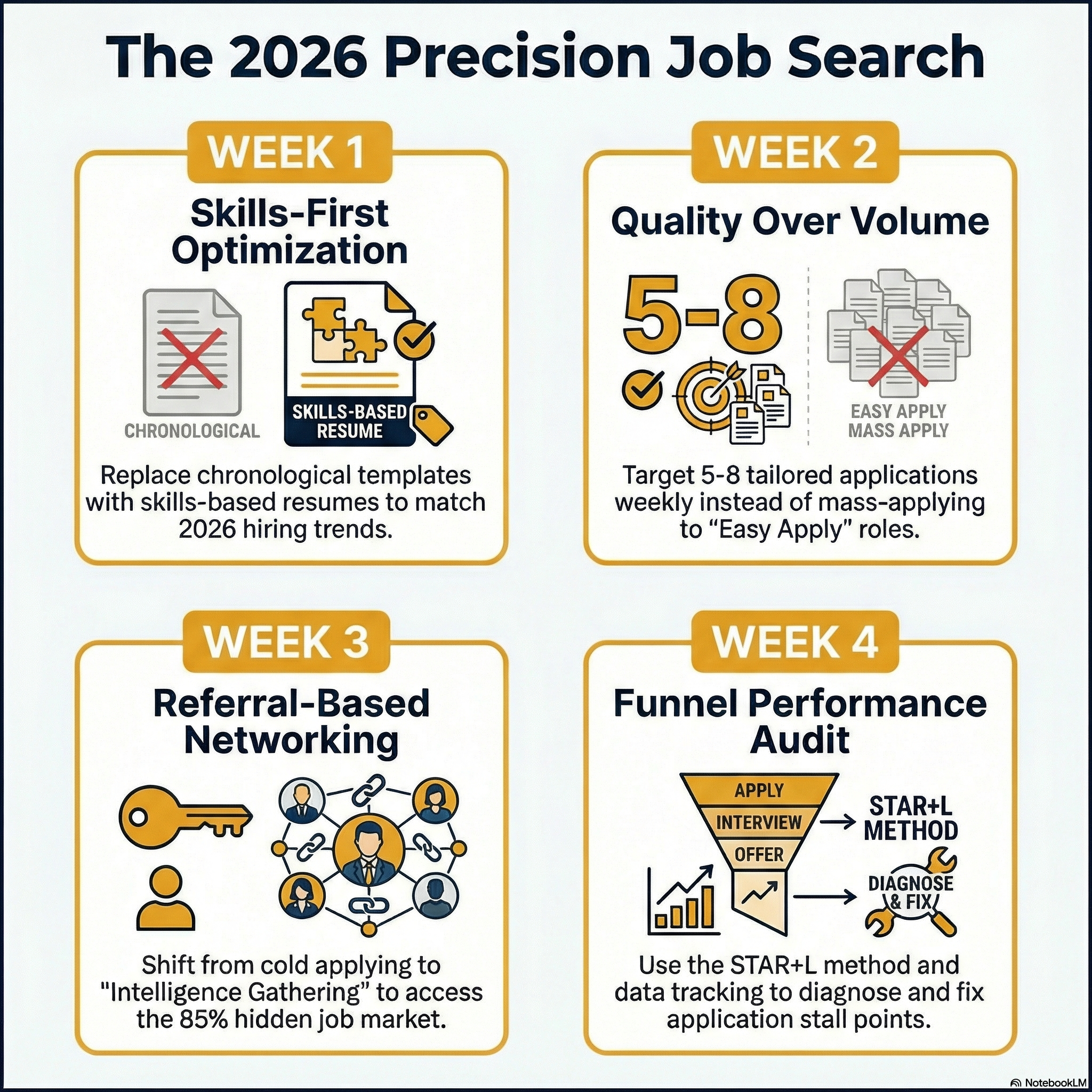
Week 3 should test whether the student is relying too heavily on cold applications. The goal is not to turn networking into another volume target or teach students to ask strangers for jobs. It is to add relevant human context around the roles and employers they are already targeting.
Coach students to identify alumni, professionals, recruiters, faculty, or other relevant contacts connected to their target roles. Then review whether those conversations are improving employer insight, role selection, referrals, or follow-up opportunities.
Networking should support the application strategy, not sit beside it as an unrelated activity.
Week 3 Advisor Priorities
Focus on:
- alumni outreach
- informational interviews
- recruiter follow-up
- LinkedIn profile alignment
- employer research
- referral pathways
- message quality
- follow-through
Students should learn that outreach is not the same as asking for a job. It is a way to gather information, understand roles, and build credibility.
Daily Micro-Goal
Set a small outreach target, such as 1-2 personalized messages on networking days, and adjust it based on the relevance of available contacts, the student’s target roles, and their capacity to follow up thoughtfully.
Outreach Message Template
Hi [Name],
I’m a [Year] at [University] exploring [Role/Industry]. I saw your experience in [Company/Field] and would appreciate learning how you got started. Would you be open to a 15-minute conversation sometime next week?
Thank you,
[Student Name]
Networking Conversion Template
Use this to track whether students are moving from cold applying to signal-building.
| Networking Action | Number Completed | Quality Notes | Next Step |
|---|---|---|---|
| Alumni identified | |||
| Outreach messages sent | |||
| Replies received | |||
| Informational interviews scheduled | |||
| Informational interviews completed | |||
| Referrals or warm leads created | |||
| Applications connected to outreach |
Advisor Assessment
Review:
- message personalization
- relevance of contacts
- follow-up quality
- confidence in conversation
- whether outreach is connected to target roles
- whether student is asking for insight, not favors
Advisor Script: When a Student Is Nervous About Networking
“You do not have to ask anyone for a job. Your goal is to learn. A good outreach message simply asks for 15 minutes of insight from someone whose path is relevant. That is a much lower-pressure starting point.”
Week 3 Advisor Checkpoint
By the end of Week 3, determine whether the student’s search now includes relevant human signals beyond cold applications.
Review who they contacted, why those people were relevant, which messages received replies, what the student learned, and whether any conversations created useful follow-up opportunities.
If outreach activity is high but the contacts are poorly matched or the messages are generic, fix contact selection and message quality before increasing outreach volume.
Also Read: How should career centers design intake questionnaires to improve advising outcomes?
Week 4: How Should Advisors Audit Job Search Progress?
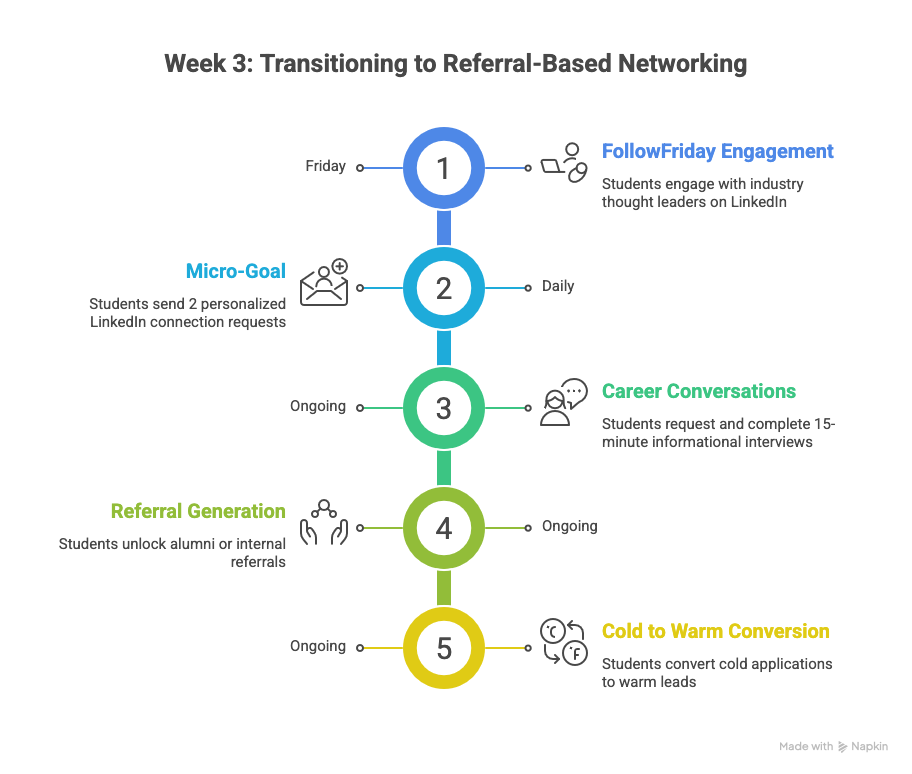
Week 4 is the diagnosis week. By this point, the advisor should have evidence across role targeting, applications, outreach, employer responses, and interviews. Use that record to identify where movement is stopping rather than telling the student to simply apply more.
A targeting problem should not be treated like a resume problem. A response problem should not be treated like an interview-performance problem.
Review the student’s tracker, recent applications, outreach activity, and interview history, then identify the stage that requires intervention next.
A student can stall at several points:
- identifying roles
- submitting quality applications
- getting employer responses
- converting screens to interviews
- converting interviews to offers
- maintaining motivation
Each stall point requires a different intervention.
Week 4 Advisor Priorities
Focus on:
- pipeline review
- application-to-response rate
- networking activity
- interview readiness
- role fit
- burnout signals
- strategy reset if needed
Daily Micro-Goal
Practice 3 STAR stories aloud for specific target roles.
Each story should include:
- situation
- task
- action
- result
- learning or reflection
- connection to target role
Pattern Diagnosis Template
| Funnel Stage | What to Check | Likely Issue | Advisor Response |
|---|---|---|---|
| No roles identified | Student lacks clear target direction | Career clarity or exploration gap | Return to structured role exploration, strengths mapping, and career option narrowing |
| Roles identified but few applications | Student feels overwhelmed or uncertain | Execution, accountability, or workflow issue | Break search into smaller daily goals and create a structured application system |
| Many applications, no responses | Resume quality, targeting, or role fit | Application strategy or materials problem | Revise resume, tighten role targeting, and strengthen application alignment |
| Responses but no interviews | Application evidence or screening fit | Weak positioning, insufficient proof, or poor alignment | Improve resume bullets, cover letter precision, and evidence quality |
| Interviews but no offers | Interview performance and candidate presentation | Storytelling, preparation, or confidence gap | Conduct mock interviews, strengthen STAR stories, and refine interview strategy |
| Student disengaged | Burnout, discouragement, or reduced momentum | Emotional fatigue or psychological overload | Implement a reset week, reduce pressure, and rebuild momentum with smaller wins |
Advisor Script: When a Student Has No Responses
“No responses after a few weeks does not mean you are not employable. It means the current strategy is not producing a signal. Let’s look at where the process is breaking: the roles, the resume, the application quality, the outreach, or the timing.”
Week 4 Advisor Checkpoint
At the end of Week 4, do not ask only whether the student completed enough activity. Ask what the last four weeks have taught you about the search.
Record the dominant stall point, the intervention you are changing, and the evidence you will review during the next cycle. The next month should begin with a specific hypothesis about what needs to improve rather than returning automatically to higher application volume.
Advisor Notes: Modifying for Student Personas
The same 4-week structure can work for different student groups, but advisors should adjust the emphasis. Keep the weekly sequence consistent while changing the type and intensity of support based on the student’s barriers, context, and level of independence.
First-generation students
Focus on making the hidden curriculum explicit. Add more support around networking, employer communication, job search language, and what “professional follow-up” looks like.
International students
Spend more time on employer eligibility, sponsorship language, interview expectations, and role targeting. Make sure students know how to identify employers open to hiring international candidates.
Liberal arts students
Prioritize skills translation. Help students connect writing, research, analysis, communication, and project work to employer needs.
Students with low confidence
Use smaller micro-goals and more frequent check-ins. Avoid overwhelming them with large weekly targets.
Students applying to competitive industries
Add more emphasis on warm outreach, alumni conversations, portfolio evidence, and interview practice.
What if the 4-Week Job Search Produces No Meaningful Movement?
Use a short reset when the student has completed the process but the activity is not producing useful signals, or when the same weak pattern continues despite repeated effort.
The reset is not another full job search program. It is a brief intervention designed to correct the next cycle.
For five days, reduce application volume and focus on:
- reviewing target role families and current postings
- auditing recent applications and resume versions
- completing a small number of market-learning or informational conversations
- identifying a better-fit group of roles or employers
- practicing interview responses if interview conversion is the primary problem
- deciding what will be tested differently in the next application cycle
If the student is close to graduation and remains unplaced, move into a dedicated late-stage intervention rather than extending the same four-week framework indefinitely.
Advisor Script: When a Student Is Burned Out
“You have been putting in effort, but the process is not giving you useful feedback right now. This week, we are not going to push more volume. We are going to pause, study the pattern, and rebuild the strategy so your next applications are more intentional.”
Also Read: How Career Centers Can Support Seniors Without Jobs Before Graduation?
How Career Centers Can Use This Plan at Scale
A 4-week job search plan can be standardized across an advising caseload without turning it into a full cohort curriculum.
Keep the same weekly assignments, tracker fields, advisor checkpoints, and escalation rules, then let advisors intervene where the student’s evidence shows a stall.
For higher-volume use, career centers can assign weekly activities through their existing systems, require students to maintain one shared tracker, and reserve advisor time for students whose targeting, application quality, outreach, or interview conversion needs closer support.
If the goal is to turn the framework into a facilitated cohort program with common milestones, assignments, workshops, and program-level assessment, use a dedicated job search bootcamp framework rather than expanding the individual advising process here.
Final 4-Week Student Checklist
By the end of the 4-week plan, each student should have:
- defined target role families
- at least one resume version aligned with each primary role family
- a consistent record of high-fit, tailored applications
- an updated job search tracker
- documented outreach activity and employer responses
- relevant informational conversations requested or completed
- role-specific STAR stories prepared for interviews
- a clear understanding of where the current search is stalling
- one specific strategy change to test during the next job search cycle
This gives the student a visible record of progress and gives the advisor a better foundation for coaching.
Wrapping Up
A structured job search does not reduce student agency. It restores it.
When advisors replace vague encouragement with clear systems, students stop guessing and start making better decisions at every stage of the search. They learn how to target roles, tailor materials, build warmer signals, practice interviews, and diagnose where the process is breaking.
The 4-week plan outlined here is designed to fit real advising constraints: limited time, growing caseloads, and the need for consistency across students and advisors. The goal is not to make students apply faster. It is to help them apply with intent.
Hiration supports this kind of advisor-led job search structure by bringing resume optimization, interview preparation, job search workflows, and counselor visibility into one platform. Career teams can manage cohorts, track progress, and guide students more effectively without increasing manual workload.
When students have a clear plan and advisors have visibility into the pipeline, the job search becomes more measurable, more coachable, and more likely to produce meaningful progress.
4-Week Job Search Plan — FAQs
Who is this 4-week job search plan designed for?
This plan is designed for Career Service Professionals coaching students in structured, skills-based hiring environments common in 2026.
Does this plan prioritize application volume or application quality?
The plan prioritizes application quality, focusing on targeted roles, tailored materials, and clear follow-up strategies rather than mass applying.
How does this framework help advisors diagnose job search problems?
Weekly tracking templates surface patterns across resumes, applications, networking, and interviews, allowing advisors to identify bottlenecks early.
Can this plan be used with large student caseloads?
Yes. The structure is designed to scale by focusing advisor time on review patterns rather than individual applications.
What happens if a student sees no progress by Week 4?
The plan includes a Reset Week approach, shifting focus from applications to self-assessment and informational interviews to prevent burnout.
Is this plan meant to replace existing career tools?
No. The plan is designed to improve how advisors coach within existing systems by adding structure, sequencing, and visibility.