Building a modern career center requires completely dismantling the outdated, transactional "drop-in and review my resume" model.
If you are a Career Services Professional (CSP) or Director at a US college, you already know that waiting for students to walk through your doors leaves the most vulnerable populations behind.
To secure budget, drive equity, and prove institutional value, you need a strategic course of action.
This guide provides an actionable career center strategic plan template backed by latest data to help you lead your institution’s career ecosystem.
What goals should career centers include in their strategic plans?
Modern career center goals must prioritize "Career Everywhere" ecosystems, AI-literacy, and closing the "unpaid intern offer gap." Goals should shift from measuring appointments to measuring the density of a student's professional network and their ability to articulate skills in an AI-vetted job market.
To set these goals, you need to look at the reality of the 2024-2026 job market.
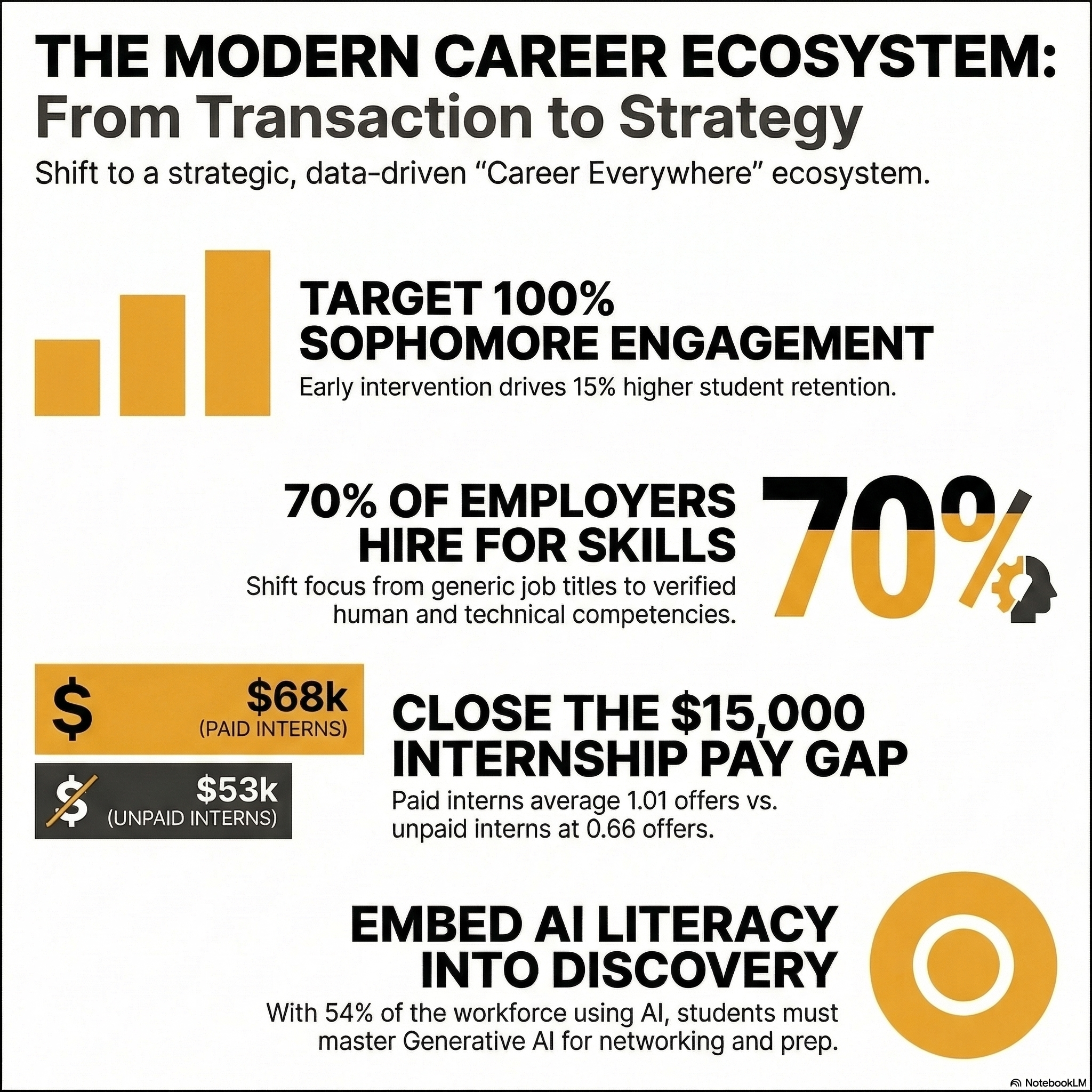
According to the NACE 2024 Student Survey Report, the landscape has shifted: paid interns now average 1.01 job offers, while unpaid interns actually trail behind with only 0.66 offers - even lower than students with no internship experience at all (0.74 offers).
This anomaly often occurs because unpaid internships are concentrated in lower-paying public service sectors.
Your strategic goal must be to aggressively convert unpaid roles into paid ones or provide "gap funding" to ensure students in every major have equitable access to high-offer pathways.
Furthermore, with hiring for the Class of 2026 projected to be relatively flat, increasing only 1.6% compared to 2025 according to NACE’s Job Outlook 2026, your goals should focus on "early and often" engagement.
A goal of 100% engagement by the end of the sophomore year is the new standard for driving retention.
Also Read: Which benchmarks should college career centers track to measure and improve impact?
What are some sample strategic priorities for a modern career center?
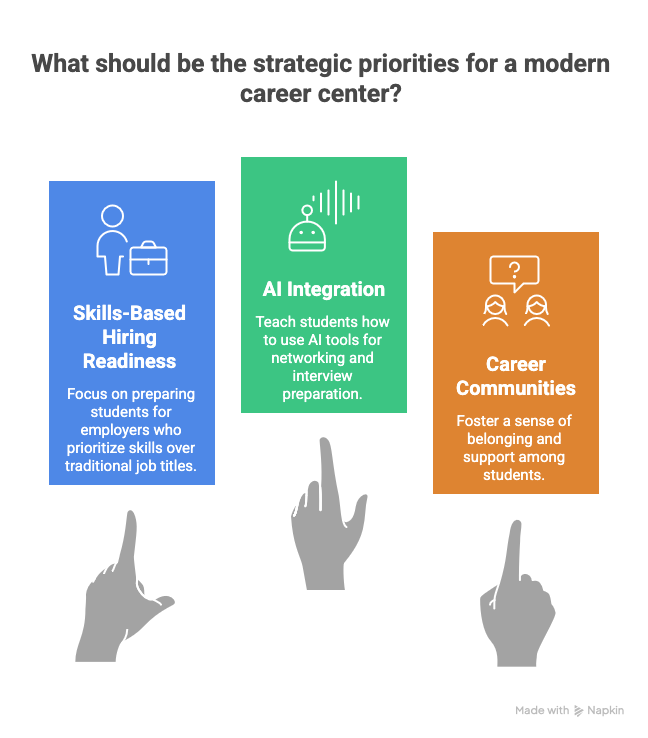
Strategic priorities should include scaling "Skills-Based Hiring" readiness, embedding AI tools into the career discovery process, and fostering "Career Communities." These priorities ensure that the center is not a siloed office but a ubiquitous campus presence that prepares students for a tech-heavy, skills-first workforce.
According to NACE’s Job Outlook 2026 survey, 70% of employers now use skills-based hiring practices, up from 65% just a year ago.
Your top priority should be a "Skills Audit" for every student, moving away from generic job titles and toward verified competencies.
This is exactly what the University of Central Florida (UCF) is doing with their "Skill-Based Career Paths" initiative, ensuring students can articulate the "human skills" (like resilience and agility) that The World Economic Forum’s Future of Jobs Report 2025 identifies as the most critical for the next five years.
Another priority is AI integration.
Since 54% of workers across all industries used AI in 2025 according to the PwC Global Workforce Hopes and Fears Survey 2025, your plan must include teaching students how to use Generative AI for networking and interview prep without losing their "authentic voice."
How do career services align their strategies with university-wide outcomes?
Career services must align with the "Value of Degree" and "Economic Mobility" metrics that Boards of Trustees now prioritize. By linking career readiness directly to student retention and long-term alumni wealth, you move the career center from a "cost center" to a "revenue and reputation driver."
The pressure on ROI is higher than ever. According to SHRM’s 2025 College Graduate Report, 80% of graduates are deeply concerned about job security.
If your strategic plan can prove that students who engage with your office are 15% more likely to be retained into their junior year, you align with the university's primary financial goal: tuition retention.
Look at Marquette University, which uses its Graduate First Destination Survey to report a 93% career outcomes rate.
By sharing this data with the admissions office, they turn career success into a recruitment tool, proving that the university isn't just a place to learn, but a launchpad for economic mobility.
How can career centers measure the success of their strategic plans?
Success should be measured by the "Knowledge Rate" of first destinations, internship-to-full-time conversion rates, and salary parity across demographics. Instead of just counting attendees, measure the "Career Mobility Index" of your graduates five years out to see if your interventions led to sustainable wealth.
Don't settle for "placement" as your only KPI. According to NACE’s 2025 Internship & Co-op Report, the average intern-to-full-time conversion rate fell to 62% in 2025, the lowest in five years.
If your conversion rates are higher than this national average, you have a massive strategic win to report.
You could use tools like the Lightcast "Embark" First Destination Survey to track median starting salaries.
For example, the NACE 2024 Student Survey shows a massive salary gap: paid interns had a median starting salary of $68,041, while unpaid interns sat at $53,125.
Measuring and closing this $15,000 "pay equity gap" through your strategic interventions is the ultimate proof of a career center’s value in 2026.
Wrapping Up
A strategic plan only works if career centers have the infrastructure to execute it at scale.
Supporting early engagement, skills-based hiring readiness, and outcome tracking requires tools that extend career guidance beyond one-on-one appointments.
Hiration helps make this possible by providing a full-stack career readiness suite - including career assessments, AI-powered resume optimization, interview simulation, and a dedicated counselor module to manage cohorts, workflows, and analytics, all within a secure, FERPA and SOC 2-compliant environment.
Combining strong strategy with the right infrastructure is what ultimately turns career readiness goals into measurable student outcomes.