How can career centers optimize budgets while improving outcomes?
Career centers can optimize budgets by focusing on data-driven targeting, improving conversion efficiency, leveraging external funding, auditing expenses, using predictive analytics, and deploying scalable technology. These strategies help maximize impact, reduce waste, and extend support without increasing overall spending.
If your career center is working with a limited budget, the solution might not be spending less.
It is deciding where staff time and funding create the most value, which services should stay high-touch, which can be delivered more efficiently, and which programs or tools are no longer earning their cost.
That matters even more when personnel already takes up most of the budget, leaving relatively little room for technology, programming, employer engagement, outreach, and new initiatives.
The goal of budget optimization is therefore not across-the-board cuts. It is making more deliberate choices about what to protect, what to scale, what to consolidate, and where additional funding could expand capacity.
This guide explains 7 practical ways your career center can make limited budgets go further without losing sight of student support and outcomes.
1. Audit Where Your Budget and Staff Time Are Going
Career centers should start budget optimization by looking at both direct spending and the staff time required to deliver each service. A program with a small budget may still be costly if it consumes significant advisor time, while a larger investment may be worthwhile if it reaches more students or reduces repetitive work.
Before deciding what to cut or expand, review where your resources are currently going.
| What to review | What to look for |
|---|---|
| Programs and events | Cost, attendance, repeat participation, and staff hours required |
| Career technology | Active users, repeat usage, cost per active student, and overlapping functionality |
| Advising services | Appointment demand, wait times, and staff time required |
| Outreach | Which efforts actually lead students to use career services |
| Workshops and resources | Attendance, completion, and whether similar support already exists elsewhere |
| Manual processes | Tasks that repeatedly consume advisor or administrative time |
| Employer programs | Participation, recurring employer engagement, and student reach |
Rather than reducing every expense, identify where the center is committing money or staff capacity without seeing enough student use, strategic value, or operational benefit in return.
For example, a workshop may cost very little to run but require hours of staff preparation for consistently low attendance. On the other hand, a technology platform may have a higher upfront cost but support thousands of students and reduce the amount of repetitive work handled manually.
Looking at both money and staff time gives career centers a better basis for deciding what should stay, what needs to change, and where resources could be redirected.
Also Read: How Can Career Centers Demonstrate Institutional ROI?
2. Reduce Costs Without Reducing Student Support
Career centers can reduce costs by changing how some services are delivered rather than simply cutting programs. The key is to protect staff time for work that requires individual judgment while finding more scalable ways to deliver repeatable support.
Because staff time represents a major part of a career center's available resources, even services with low direct costs can become expensive when they require significant advisor hours.
Start by looking at which services genuinely require one-to-one support and which could be delivered through group sessions, self-service resources, peer support, technology, or a hybrid model.
| Career service | Best-fit delivery model | Budget consideration |
|---|---|---|
| Complex career decision-making | High-touch advising | Protect advisor time for cases requiring judgment |
| Career-change or job-search strategy | High-touch or hybrid | Individual support may still be necessary |
| First-pass resume feedback | Scalable or hybrid | Reduce repetitive review time |
| Basic interview practice | Scalable or hybrid | Allow repeated practice without repeated appointments |
| General career information | Self-service or group | Avoid using appointments for routine information |
| Workshops | Group or on-demand | Extend one resource across more students |
| Employer relationship management | High-touch | Relationship-building is difficult to scale |
| Routine reminders and follow-up | Automated | Reduce administrative staff time |
For example, a career center may not need to reduce resume support to lower the staff cost associated with it. Students could complete an initial review independently and use advisor appointments for more complex questions, tailoring, or career strategy.
The same principle can apply to interview preparation, general career education, routine follow-up, and other repeatable activities.
The goal is not to replace high-touch career services. It is to avoid paying the staff-time cost of delivering every service at the highest-touch level when a lower-cost delivery model can still provide useful support.
Also Read: How Should Universities Structure Staffing Models for Modern Career Centers?
3. Look Beyond Your Core Budget for Additional Funding
Optimizing a limited budget does not always mean reducing spending. Career centers can also look for funding outside their core institutional allocation when a service supports broader workforce, student-success, or academic priorities.
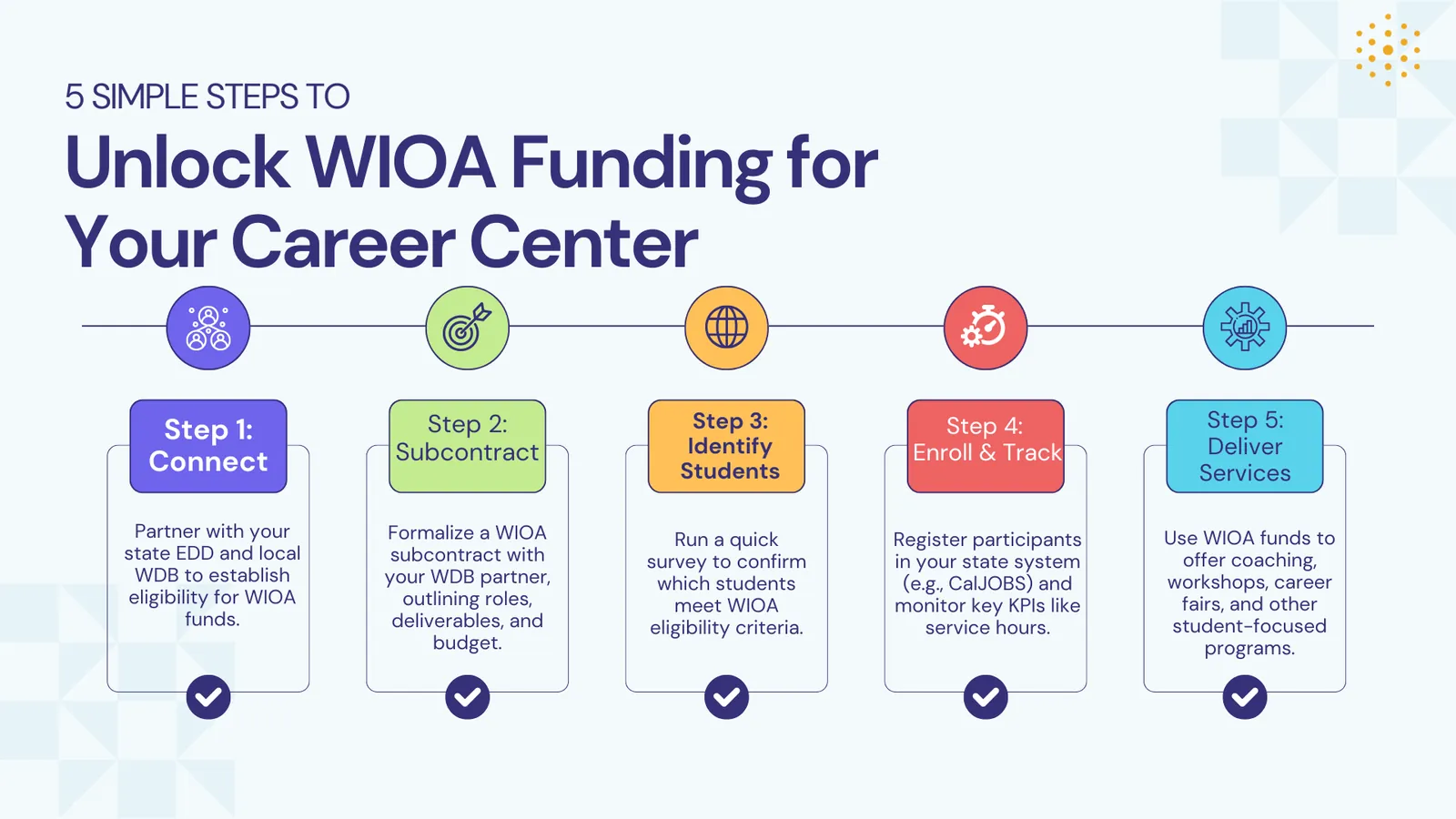
Workforce-development partnerships are one potential source. Programs funded through initiatives such as the Workforce Innovation and Opportunity Act (WIOA) can support areas including job-search assistance, workforce preparation, career development, and work-based learning.
Career centers can also explore funding or cost-sharing opportunities through:
- workforce-development partners;
- academic schools and departments;
- student-success initiatives;
- employer partnerships;
- institutional grants;
- state or federal programs;
- alumni or advancement initiatives.
Before pursuing outside funding, clarify what the funding can be used for, which students are eligible, what reporting is required, how long the funding lasts, and how much administrative work the partnership will create.
External funding is most useful when it extends a service the career center already considers strategically important. Creating a new program simply because funding is temporarily available can introduce additional costs once the funding period ends.
Also Read: Federal Funding for Career Centers: Grant Guide and Action Checklist
4. Stop, Consolidate, or Redesign Low-Value Spending
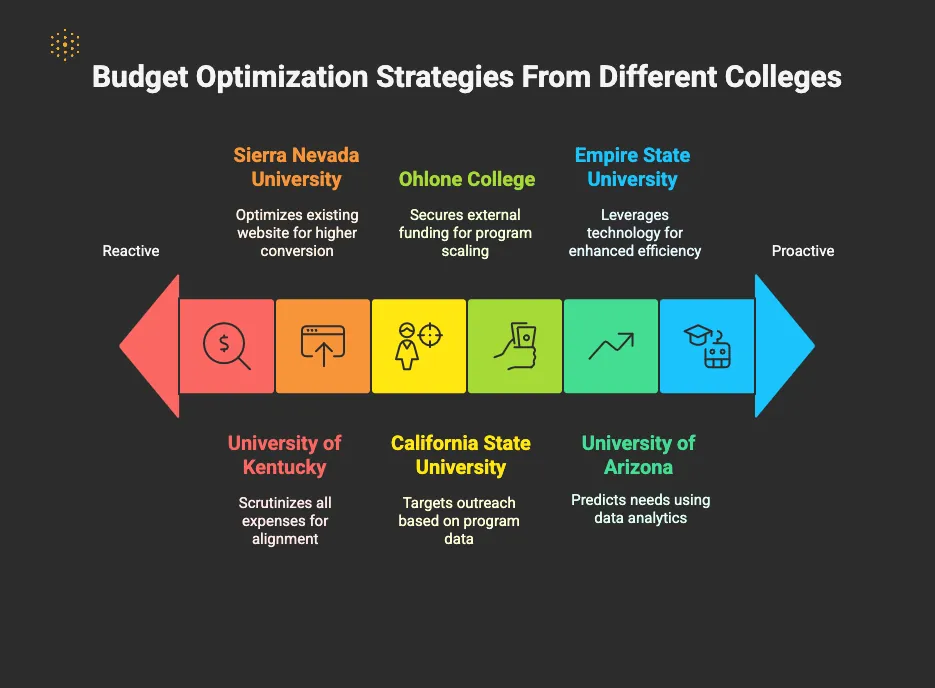
The University of Kentucky implemented a zero-based budgeting approach as a key strategy for optimizing resource allocation across the institution, including its career services.
Unlike incremental budgeting, where the previous year's budget serves as a starting point, zero-based budgeting requires every department to justify each and every expense from the ground up annually.
This rigorous process compels a thorough review of all spending, ensuring that resources are strategically directed towards programs and activities that most closely align with the institution's overarching priorities, such as enhancing student success and research outcomes.
Look for four signals when reviewing existing expenses:
| Signal | Question to ask |
|---|---|
| Low utilization | Are enough students or employers using this to justify the resources required? |
| Duplication | Are multiple tools, programs, or teams solving substantially the same problem? |
| High staff burden | Does delivery require more staff time than the value it creates? |
| Poor strategic fit | Does this still support the career center's current priorities? |
A low-attendance workshop, for example, does not necessarily need to disappear. It may work better as an on-demand resource, a targeted session for a specific student population, or part of a larger program.
The same applies to technology. Low usage does not automatically mean a platform should be cancelled. The problem could be weak onboarding, limited promotion, poor integration with advising, or overlapping functionality.
The important distinction is between low-value spending and valuable spending that is being poorly implemented.
The first may need to be removed or consolidated. The second may need to be redesigned before additional budget is committed to it.
Also Read: How should universities structure staffing models for modern career centers?
5. Use Data to Prioritize Where to Invest the Next Dollar
Once a career center identifies spending that can be reduced, consolidated, or redesigned, the next question is where those resources should go. Instead of comparing new investments only by price, evaluate them across four dimensions:
| Dimension | Question to ask |
|---|---|
| Student impact | Could this improve access, readiness, engagement, or outcomes? |
| Reach | How many students could realistically benefit? |
| Staff capacity | Could it reduce repetitive work or free staff for higher-value support? |
| Strategic importance | Does it support priorities the career center or institution is already accountable for? |
A higher-cost initiative may still represent better value if it supports a large proportion of students or meaningfully increases staff capacity.
At the same time, a program serving a smaller group may still deserve investment when that population requires more intensive support or the program addresses an important institutional priority.
The goal is not to create a universal score for every investment. It is to give the career center a consistent way to compare competing uses of limited resources.
This is also where budget optimization differs from budget planning. Budget planning determines how funding is structured and justified. Budget optimization asks whether the resources already available are being directed toward the highest-value uses.
For example, the University of Arizona effectively utilized predictive analytics as a powerful tool for both budget optimization and deficit reduction.
By leveraging data to identify patterns in areas such as faculty workload, student course demand, and facility utilization, the university gained valuable insights into potential areas of inefficiency in resource allocation.
Based on these data-driven insights, they implemented targeted cost-control measures like hiring and compensation freezes, that helped shrink their FY 2024 budget deficit from over $162 million to just $63 million!
Also Read: Career Center Budget Planning Template for Institutional Impact
6. Get More Value From Your Existing Career Technology
Technology only improves budget efficiency when students and staff actually use it and it contributes to better service delivery, greater access, or reduced manual work.
Before adding another platform, review how effectively your current technology stack is being used.
| Question | What it helps you assess |
|---|---|
| How many eligible students actively use it? | Adoption |
| How many students return after their first use? | Repeat value |
| Which features are actually being used? | Utilization |
| Does another platform perform the same function? | Tool overlap |
| What staff work does it reduce? | Capacity value |
| Is it integrated into advising and student communication? | Operational fit |
| Can staff see usage across different student groups? | Visibility |
| What is the cost per active user? | Financial efficiency |
A platform with extensive functionality may still provide limited value if very few students use it or if it sits outside the way advisors actually work.
Conversely, technology can justify its cost when it helps students complete repeatable preparation independently, provides support between appointments, gives career teams visibility into progress, or reduces routine work for advisors.
The first priority should therefore be better utilization before additional procurement.
Before purchasing another tool, determine whether the current technology stack contains unused capabilities, overlapping functionality, or adoption problems that should be addressed first.
Institutions like Empire State University have improved student engagement by 25%, and Long Beach City College achieved a 10x ROI and recovered lost tuition - maximizing ROI on existing tools while justifying continued investment.
Also Read: Where does AI add real value in career services and where does it fall short?
7. Measure Whether Your Budget Changes Are Working
In Simple Terms
Reducing spending alone does not show that a budget change was successful. Career centers also need to determine whether the change improved student access, staff capacity, service utilization, or another intended outcome.
The right metrics depend on what the investment or change was designed to achieve.
| Metric | What it can help measure |
|---|---|
| Cost per engaged student | Efficiency of spending |
| Students reached per staff member | Service capacity |
| Advisor hours spent on repeatable tasks | Staff efficiency |
| Technology adoption | Whether existing investments are being used |
| Repeat engagement | Whether students continue using services |
| Program cost per participant | Program efficiency |
| Appointment wait times | Whether capacity has improved |
| Career-readiness activity completion | Student progress |
| Employer participation | Value of employer-facing investments |
Not every initiative needs to improve every metric.
Instead, decide before making a budget change what result would justify the investment.
If a technology investment is intended to reduce repetitive resume reviews, track advisor time. If a program is intended to expand access, measure student participation. If outreach is intended to engage students who rarely use career services, track whether participation among those students increases.
This creates a feedback loop where future budget decisions are informed by evidence from previous investments rather than assumptions.
Also Read: Career Center Metrics: What Should Career Services Track?
Wrapping Up
Optimizing a career center budget does not mean cutting every expense. It means understanding where money and staff time are going, protecting high-value services, scaling repeatable support, consolidating low-value spending, and measuring whether investments are actually improving capacity or student access.
Technology can support that model when it reduces repetitive work and gives students useful support outside advisor appointments rather than simply adding another platform to the stack.
Hiration provides students with on-demand support across resumes, interviews, LinkedIn, cover letters, and career preparation, while giving career teams visibility into student activity and progress through the Counselor Module.
For career centers reviewing how technology fits within a limited budget, the goal should be simple: invest in tools that extend staff capacity and give students meaningful support when advisors cannot be available.
Book a walkthrough to see how Hiration can fit into your career center's service model.
Career Center Budget Optimization — FAQs
Why is budget optimization important for career centers?
With most budgets heavily allocated to staffing, career centers must maximize the remaining funds to improve student outcomes, engagement, and scalability without additional resources.
How can data improve budget efficiency?
Data helps target outreach, identify underperforming programs, and allocate resources more effectively, reducing wasted spend and improving results.
What is conversion rate optimization in this context?
It involves improving existing channels, such as websites or campaigns, to increase engagement and outcomes without increasing marketing spend.
How can career centers access additional funding?
Centers can leverage external funding sources such as WIOA, Perkins grants, or state programs to support initiatives without relying solely on institutional budgets.
What is zero-based budgeting?
Zero-based budgeting requires justifying every expense from scratch each year, ensuring resources are directed toward high-impact programs and eliminating inefficiencies.
How does predictive analytics help with budgeting?
Predictive analytics identifies patterns in demand and resource usage, enabling career centers to anticipate needs and allocate funds more strategically.
What role does technology play in budget optimization?
Technology enables scalable support through tools like AI resume reviews, LMS-based resources, and chatbots, reducing manual workload and improving efficiency.
What is the key principle behind effective budget optimization?
The focus should be on building systems that scale impact over time, ensuring each investment contributes to measurable outcomes and long-term efficiency.