If your career center asks students to self-report internships, the next question is how much of that information you can actually verify.
A student may report the employer, role, dates, and supervisor, but Career Services still needs a consistent way to decide what evidence is sufficient, when an employer should be contacted, and what to do when details are missing or cannot be confirmed.
Without clear verification standards, staff can end up making case-by-case decisions that are hard to apply consistently or defend later.
This guide explains how career centers can verify self-reported internships using clear evidence standards, verification levels, employer confirmation, exception rules, and defined staff ownership.
| If the record has... | Verification action | Suggested status |
|---|---|---|
| Student report only | Keep record, request evidence if required | Self-reported |
| Employer-issued offer letter with required details | Review document against report | Evidence reviewed |
| Direct employer confirmation | Match confirmation to reported details | Employer confirmed |
| Missing or inconsistent information | Request clarification | Needs information |
| Employer cannot be reached | Review alternative evidence | Verification pending / exception review |
| Insufficient evidence after follow-up | Keep record but exclude from verified counts | Unable to verify |
| Material contradiction from employer | Escalate for staff review | Disputed |
What Should Internship Verification Actually Establish?
Internship verification should confirm the specific facts the institution needs to rely on, not attempt to prove every detail about the experience. At minimum, Career Services should decide whether it needs evidence of the employer, student's connection to the role, role title, internship dates, supervisor, and other fields used in institutional reporting.
Verification starts by separating two questions:
What did the student report?
and
What can the institution independently support?
For example, a student might report:
- Employer: ABC Analytics
- Role: Data Analyst Intern
- Start date: June 1
- End date: August 15
- Paid: Yes
- Supervisor: Jane Smith
The verification process does not need to investigate the student's entire internship. It needs enough evidence to determine whether the fields Career Services intends to treat as verified are supported.
That means institutions should define a minimum verification standard before staff begin reviewing records.
A practical minimum could include:
- employer or host organization
- student's internship role
- start and expected end date
- supervisor or employer contact where required
- internship relationship between the student and organization
Other details can have their own evidence rules.
For instance, an offer letter may confirm compensation. A supervisor confirmation may establish dates. A student saying an internship was remote may not require a second verification step if work modality is not used for high-stakes reporting.
Verification should therefore be field-aware, not simply a single yes/no checkbox attached to the entire record.
It is also important to separate verification from completion. Evidence that a student accepted or began an internship does not prove the student later completed it.
You can view the broader process for capture, completion, outcomes, and institutional reporting in our internship tracking framework.
What Should Count as Evidence for a Self-Reported Internship?
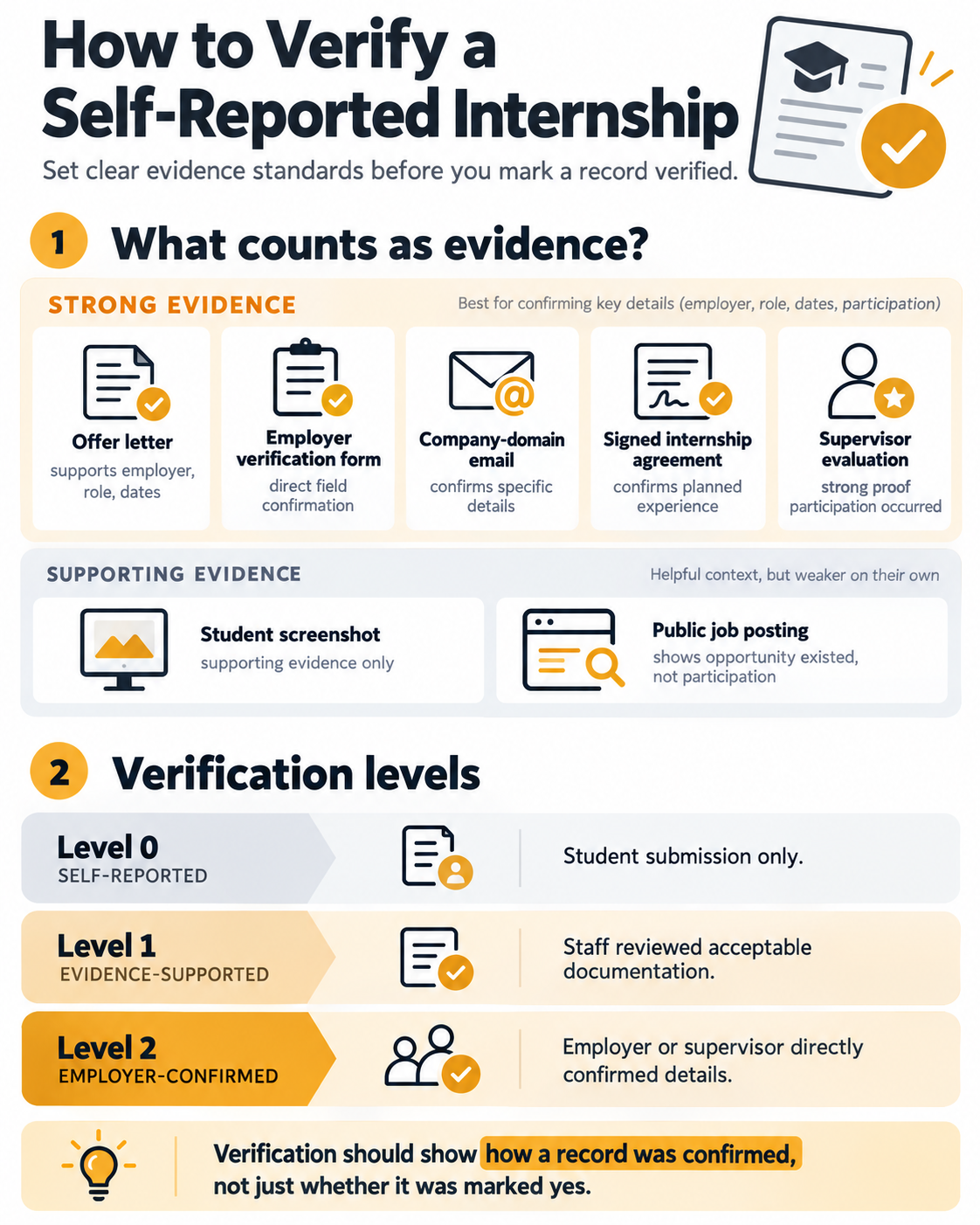
Acceptable evidence should come from a source that can reasonably support the facts being verified. Employer-issued documents and direct employer confirmation generally provide stronger corroboration than student-entered information alone, while screenshots, public job postings, and informal messages may be useful supporting evidence but should not automatically verify participation.
Career centers can create an evidence hierarchy instead of making staff decide from scratch every time.
| Evidence | What it can support | Important limitation |
|---|---|---|
| Employer-issued offer letter | Employer, role, dates, location, supervisor, compensation if listed | Confirms an offer, not necessarily that the student started |
| Employer verification form | Specific fields confirmed directly by employer | Depends on what the form actually asks |
| Company-domain email from supervisor/HR | Employer relationship and specific details in the message | Verify sender and what was explicitly confirmed |
| Internship agreement signed by employer | Planned experience, responsibilities, dates | Does not establish completion |
| Faculty/program confirmation | Useful where faculty directly coordinated the placement | Secondhand knowledge alone may be insufficient |
| Institution-held funding/payroll documentation | Participation or payment where applicable | May not verify role details |
| Supervisor evaluation | Strong evidence that participation occurred | Usually available later in the experience |
| Student screenshot or informal message | Supporting evidence | Easier to alter and may lack context |
| Public internship posting | Confirms the opportunity existed | Does not prove the student held the role |
Use employer-issued documents when possible
An offer letter is useful because several important fields can be verified at once.
For example, the University of Texas at Dallas internship process requires a signed employer offer letter containing information such as the organization, internship title, start and end dates, hours, work location, supervisor contact information, and job description.
Similarly, UT Austin's CPT guidance prefers an employer verification form and, when a letter is used instead, requires details including employer name, work location, dates, title, job description, hours, supervisor information, and signature.
These are program-specific requirements, not universal standards for every self-reported internship. They do, however, show how an institution can define exactly what documentary evidence must establish.
Do not treat every document as equally strong
A screenshot saying "Congratulations, we'd love to have you join us" is not equivalent to an employer letter identifying the organization, role, dates, and supervisor.
Likewise, a LinkedIn update or public job posting can support review, but neither independently proves that the student participated.
The evidence standard should reflect how confidently Career Services intends to use the record later.
When Should Career Centers Contact the Employer Directly?
Direct employer confirmation is most useful when documentary evidence is missing, inconsistent, unusually difficult to validate, or when the institution needs a higher level of confidence in the record. Career centers do not necessarily need to contact every employer if acceptable employer-issued evidence already supports the required fields.
A risk-based approach keeps verification manageable.
Documentary review may be enough when:
- the student submits a complete employer-issued offer letter
- required details match the self-report
- the employer and contact information can be reasonably identified
- no material inconsistencies appear
- the intended use does not require direct employer confirmation
Employer confirmation may be appropriate when:
- no employer-issued documentation exists
- dates, employer, role, or supervisor details conflict
- the evidence appears incomplete or altered
- the organization is difficult to identify
- the internship is being used for an institutional benefit requiring stronger verification
- an exception is being requested
- the institution's policy requires employer confirmation for the relevant program
Career centers should keep the employer request short. The employer usually only needs to confirm fields such as:
- Student name
- Organization
- Internship title
- Start and end dates
- Supervisor
- Any other field required by institutional policy
For example, Carnegie Mellon University's Summer Internship Employer Verification Form asks the employer to identify the organization, supervisor, work address, duties, internship dates, and weekly hours, and includes a supervisor signature.
Wesleyan uses an even stronger source-control step in its credit-bearing internship process: the internship supervisor must send the verification form directly to the Gordon Career Center to confirm required internship hours.
For self-reported non-credit internships, Career Services may not need that level of verification for every record. But direct-from-employer submission can be useful when the verification level requires independent confirmation rather than student-supplied evidence.
What Verification Levels Should Career Centers Use?
Career centers should use several verification levels so a submitted internship is not forced into a misleading verified/unverified binary. The level should show how the record was corroborated, while a separate status identifies records that still need information, are under review, or could not be verified.
A practical framework could look like this:
| Verification level | Meaning | Example evidence |
|---|---|---|
| Level 0: Self-reported | Student has reported the internship; no supporting evidence reviewed | Student submission only |
| Level 1: Evidence-supported | Staff reviewed acceptable independent documentation | Employer offer letter, signed agreement |
| Level 2: Employer-confirmed | Employer or supervisor directly confirmed required details | Verification form or direct company email |
These levels describe strength of verification. Then maintain a separate workflow status:
| Status | Meaning |
|---|---|
| Submitted | Waiting for verification review |
| Needs information | Required fields or evidence are missing |
| Verification pending | Evidence requested or employer contacted |
| Verified | Required verification level reached |
| Unable to verify | Reasonable verification attempts did not produce sufficient evidence |
| Disputed | Evidence materially conflicts with the student's report |
| Exception approved | Alternative evidence was accepted under documented policy |
This distinction prevents a common data problem. Suppose two students have records marked simply "Verified."
Student A uploaded an offer letter.
Student B's supervisor responded directly and confirmed the internship.
Both may meet the institution's standard, but the institution should still be able to tell how each record was verified.
That becomes important when verification rules change or leadership asks what sits behind the reported numbers.
How Should Career Centers Handle Incomplete or Unverifiable Records?
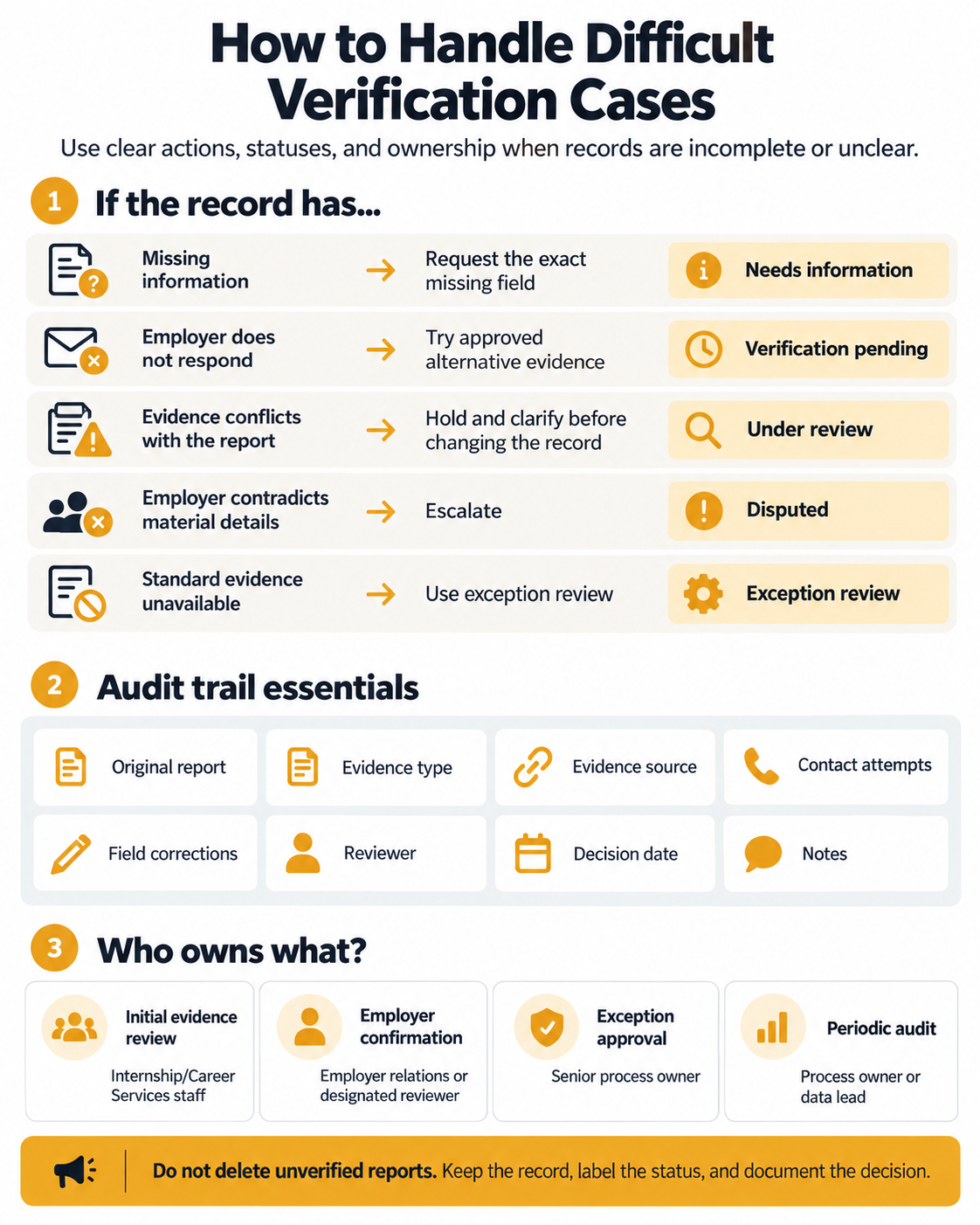
Do not delete an internship simply because it cannot be verified. Keep the student's report, clearly label its verification status, document the attempts made, and exclude it from verified reporting where appropriate. "Unable to verify" should also remain different from "false" unless the institution has evidence that the report itself is inaccurate.
This is where clear status definitions matter.
If information is missing
Move the record to Needs information and identify exactly what is missing.
Do not send:
We need more information about your internship.
Send:
We need your supervisor's name and an employer-issued document showing your internship dates.
Specific requests are easier for students to resolve.
If the evidence conflicts with the report
Do not silently overwrite the student submission.
For example:
Student report: May 15 to August 30
Offer letter: June 1 to August 15
Record:
- original student-reported dates
- evidence dates
- date discrepancy identified
- source used
- corrected value, if confirmed
- staff member making the change
That creates traceability instead of replacing one value with another and losing the history.
If the employer does not respond
No response is not evidence that the internship did not exist.
Move the record through your defined follow-up process, then either:
- accept another approved form of evidence
- send it for exception review
- mark it unable to verify
If the employer denies or contradicts the internship
That is different from simply not receiving a response.
Place the record in Disputed status and escalate it to the designated reviewer rather than asking an individual staff member to make an informal judgment.
| Situation | Recommended handling |
|---|---|
| Missing document | Needs information |
| Missing one required field | Request specific field |
| Employer does not respond | Try approved alternative evidence |
| Organization cannot be identified | Exception review or unable to verify |
| Evidence conflicts with student report | Hold and clarify |
| Employer contradicts material details | Disputed and escalate |
| Evidence remains insufficient | Unable to verify |
| Alternative evidence meets approved exception rule | Exception approved |
The important rule is consistency.
Two students presenting the same evidence problem should not receive different verification decisions simply because different staff members reviewed their records.
How Should Career Centers Handle Verification Exceptions?
Career centers should define common exception types and the alternative evidence allowed for each before unusual cases appear. Exceptions should provide another route to verification, not eliminate the verification standard because the usual document or employer contact is unavailable.
Common situations may include:
- a small employer does not issue formal offer letters
- a supervisor has left the organization
- an internship was arranged through a faculty member
- the student worked in a research lab or less formal organization
- employer confidentiality limits what can be documented
- the internship occurred internationally
- the employer uses a personal rather than company-domain email
- an approved university funding program already holds relevant documentation
The answer should not simply be: "Use staff discretion."
Instead, define acceptable alternatives.
For example:
| Exception | Possible alternative evidence |
|---|---|
| No formal offer letter | Employer confirmation email or signed verification form |
| Supervisor has left | HR confirmation or another authorized employer contact |
| Faculty-arranged placement | Faculty confirmation plus available employer documentation |
| Employer email has no company domain | Signed letter plus separate organization/contact validation |
| Confidential role | Employer confirms limited required fields without disclosing sensitive work |
| Existing university-funded internship | Approved institutional documentation if it contains required verification fields |
An exception should record:
- why the standard evidence was unavailable
- alternative evidence reviewed
- staff reviewer
- approval or rejection
- date
- any reporting limitations attached to the record
The goal is not to make exceptions difficult. It is to make them repeatable and auditable.
If ten students encounter the same "exception," it may no longer be an exception. It may be a signal that the standard verification policy needs to change.
Who Should Own Self-Reported Internship Verification?
One team or role should own the verification standard, while individual review tasks can be distributed. Staff need to know who performs routine reviews, who follows up with students or employers, who approves exceptions, and who resolves disputed records.
The model can stay simple.
| Verification activity | Suggested owner |
|---|---|
| Initial evidence review | Internship/Career Services staff |
| Missing-information follow-up | Assigned reviewer or operations staff |
| Employer confirmation | Internship or employer-relations staff |
| Routine verification decision | Designated reviewer |
| Exception approval | Senior process owner |
| Disputed record review | Process owner plus appropriate institutional partner |
| Verification policy maintenance | Career/Experiential Learning lead |
| Periodic audit | Process owner or data/operations lead |
The exact office names will vary by institution. What matters is avoiding situations where:
- one advisor accepts screenshots while another does not
- employer relations assumes advisors are confirming employers
- exceptions sit in individual inboxes
- no one closes pending records
- staff cannot explain why a record was marked verified
Create one verification guide that specifies:
- required fields
- acceptable evidence
- verification levels
- follow-up rules
- exception types
- escalation path
- audit requirements
- final decision authority
Staff should not have to invent verification policy while reviewing individual student records.
Final Thoughts
Self-reporting tells a career center that an internship may exist. Verification determines how confidently the institution can rely on that record.
A practical verification process does not require treating every internship identically. It defines what evidence is acceptable, distinguishes evidence-reviewed records from employer-confirmed ones, gives unresolved cases clear statuses, documents exceptions, and leaves an audit trail behind every decision.
That gives Career Services something more useful than a spreadsheet full of internships marked "yes."
It gives the team a defensible way to explain which records were verified, how they were verified, and which records should not yet be treated as confirmed.
Hiration can support the career-readiness work around these experiences by helping your team prepare students for resumes, applications, LinkedIn profiles, and interviews while giving counselors greater visibility into student preparation.
Book a walkthrough to see how Hiration can help your team prepare students before, during, and after the internship experience.