Non-credit internships are easy for career centers to miss because students can find, accept, and complete them without entering an institutional process.
There may be no course registration, faculty approval, funding application, or career center appointment that signals the experience exists. Even when students know they can report an internship, they may not see a reason to do it, may overlook the request, or may abandon a form that asks for too much.
Improving self-reporting therefore requires more than publishing an internship form. Career centers need to make reporting relevant, easy, timely, and visible through the people and channels students already use.
This guide explains how career centers can improve non-credit internship self-reporting through better messaging, timing, reminders, campus prompts, lower-friction reporting, and response-rate measurement.
| If you are seeing... | Likely issue | What to examine first |
|---|---|---|
| Few students reach the form | Awareness | Where and when the reporting ask appears |
| Students click but do not submit | Friction | Form length, required fields, mobile experience |
| Students ask why they should report | Relevance | Student-facing value proposition |
| Most reports arrive months later | Timing | When the first ask and reminders are sent |
| Some academic units report far more than others | Campus reinforcement | Faculty and advisor prompts |
| Initial outreach works but later reminders do not | Message fatigue | Whether follow-ups change the reason to respond |
Why Do Students Fail to Report Non-Credit Internships?
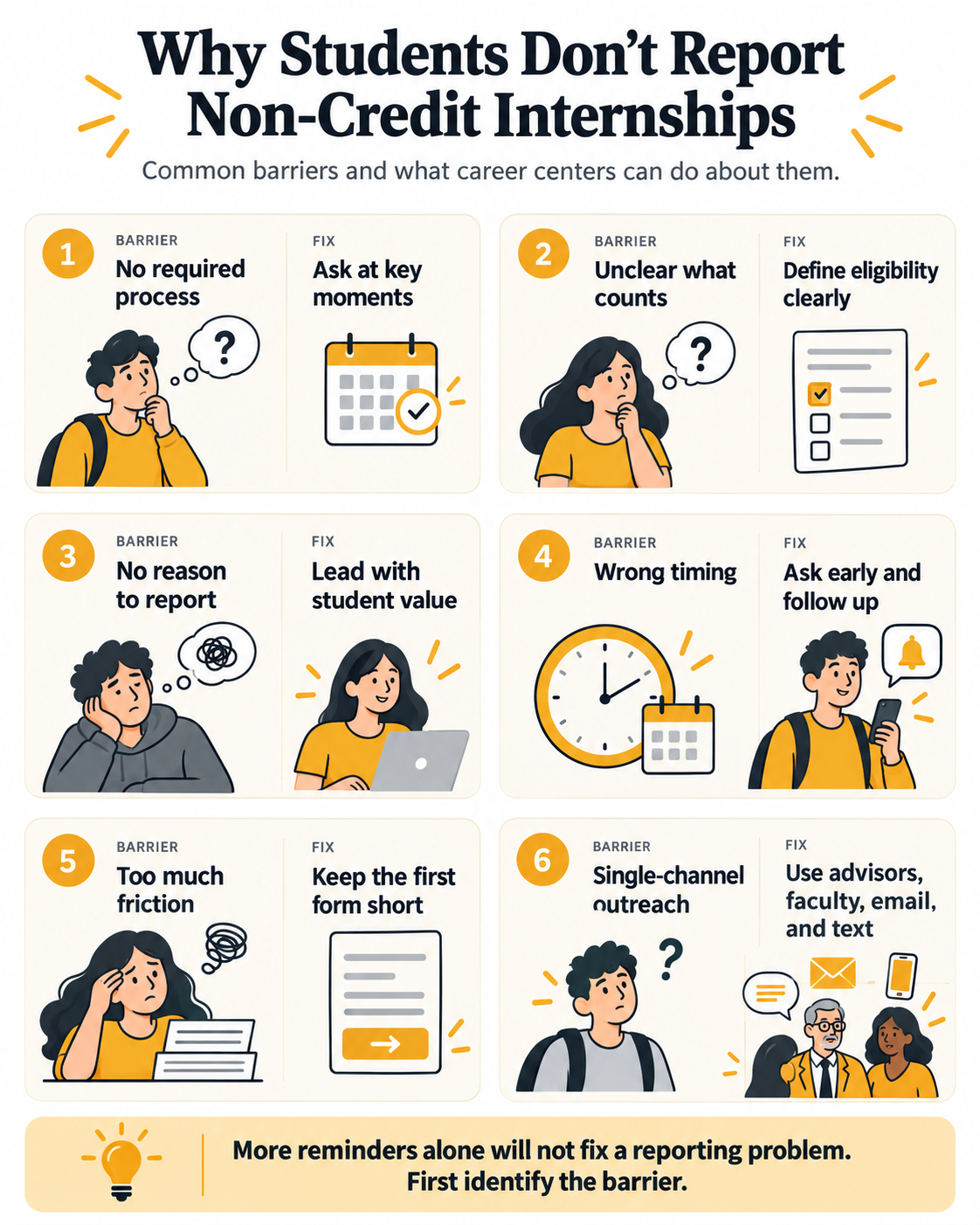
Students may not report because they do not know the university wants the information, do not think their internship qualifies, see little value in reporting, receive the request at the wrong time, or encounter too much friction. Career centers should identify the specific barrier before simply increasing reminder volume.
Credit-bearing internships usually have built-in institutional touchpoints. Non-credit experiences often do not.
A student can secure an internship through an employer website, LinkedIn, a professor, personal networking, or a previous employer and begin working without contacting Career Services.
Some students may also assume that reporting is only necessary when:
- the internship is for academic credit
- Career Services helped them find it
- university approval is required
- the experience is paid
- the internship is still in progress
That ambiguity matters. Indiana Tech's internship guidance explicitly distinguishes non-academic internships from credit-bearing internships and asks students to tell the Career Center about non-academic experiences even though university approval is not required.
Before changing the campaign, determine whether the primary problem is awareness, relevance, trust, timing, access, or effort.
Those barriers require different responses.
How Should Career Centers Frame the Reporting Ask So Students Act?
Students need to understand what counts, why reporting is useful, how much effort it requires, and what they should do next. Lead with the student-facing reason to participate rather than making institutional data collection the main message.
"Please complete our internship reporting form" explains the task. It does not explain why the student should care.
A stronger request answers four questions immediately:
- Does my internship count?
- Why should I report it?
- How long will this take?
- Where do I report it?
Make eligibility explicit
Do not make students interpret phrases such as "experiential learning activity." Say directly that they should report internships that are:
- non-credit
- paid or unpaid
- found independently
- found outside the career platform
- already underway
- completed recently
The wording matters because Career Services is specifically trying to capture experiences that may never have entered a university process.
Give students a reason to participate
Institutional reporting needs may be important internally, but they are rarely the strongest student-facing reason to respond.
Possible value propositions include:
- recognition for the experience
- helping future students understand where peers intern
- access to post-internship career support
- translating the experience into a resume or LinkedIn profile
- institutional recognition where available
- eligibility for an approved incentive or benefit
For example, Shawnee State University tells students that a non-credit internship can be denoted on their transcript if they report it.
The University of Maryland's internship survey has used a different approach, telling students the survey takes less than five minutes while offering incentives such as professional headshots, padfolios, career-advisor appointments, and prize opportunities.
And the University of Houston's Bauer College on the other hand asks students to share internship or full-time offers "in under 2 minutes" and connects participation with recognition, inspiring peers, and building their professional brand.
These approaches are different, but the principle is the same: give students a visible reason to act.
The exact message should reflect what your institution can genuinely offer. Do not promise recognition, transcript notation, incentives, or other benefits unless they are actually available.
When Should Career Centers Ask, Remind, and Follow Up?
Ask when the internship is already relevant to the student rather than relying on one end-of-year survey. A strong sequence creates several timely opportunities to report, with each follow-up changing the context or reason to respond instead of simply repeating the original email.
A student who accepted an offer this week already knows the employer, role, location, and expected dates.
Waiting several months creates unnecessary distance between the experience and the reporting request.
Useful reporting moments include:
Do not send the same reminder four times
There is no universal reminder cadence that every career center should adopt. A useful starting sequence might involve an initial request, a shorter follow-up several days later, reinforcement through another campus contact, and a final catch-up message.
The important variable is not simply frequency. Change something across the sequence:
- sender
- subject line
- channel
- reason to report
- timing
- incentive
- context
Although its guidance is about first-destination data rather than internships, NACE recommends personalized outreach, simplified questions, electronic outreach such as texts or push notifications, repeated in-person touchpoints, and collaboration with faculty to improve student response.
The same collection principle is useful here: students should encounter the reporting request at several relevant moments, not receive an identical mass email repeatedly.
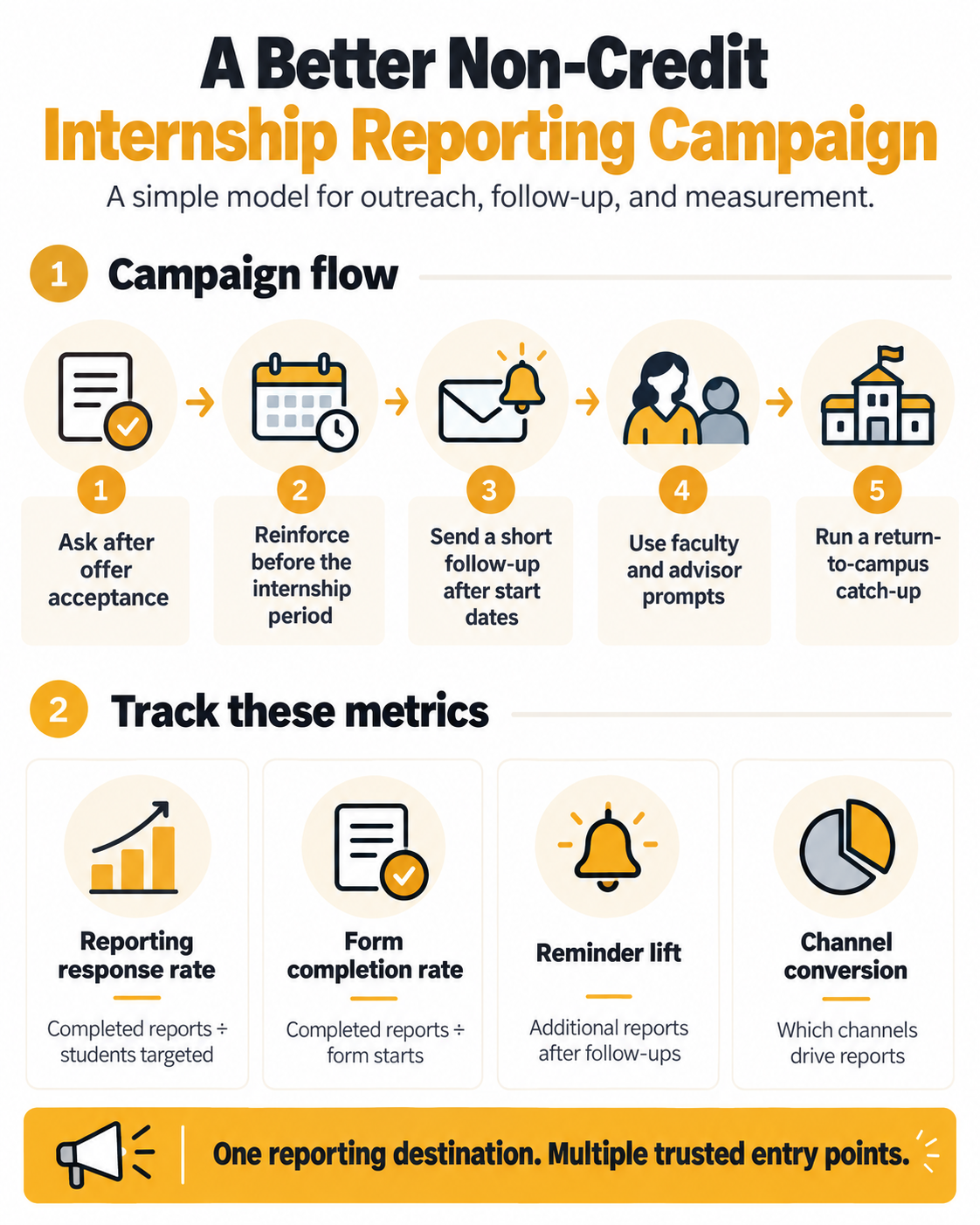
A summer campaign, for example, could begin as students accept offers in spring, receive faculty and advisor reinforcement before summer, add a brief prompt after common internship start dates, and finish with a return-to-campus catch-up.
That creates multiple chances to report without creating multiple reporting processes.
Where Should Students Encounter the Reporting Request?
Use one reporting destination but create multiple trusted ways for students to reach it. Email can be one channel, but faculty conversations, academic advising, texts, student portals, career appointments, QR codes, newsletters, and classroom prompts can surface internships that Career Services would otherwise never see.
The principle is:
One reporting destination, multiple entry points.
That avoids two problems.
First, Career Services does not have to rely on students noticing one email.
Second, faculty and advisors can support reporting without creating their own forms, spreadsheets, or parallel tracking processes.
Use campus partners as prompts, not separate data collectors
Faculty and advisors frequently hear about internships naturally.
A student may mention a summer role during office hours.
An academic advisor may ask about plans for the next semester.
A career advisor may see a new internship added to a resume.
Those are reporting opportunities.
Indiana Tech's faculty guidance explicitly asks faculty and staff who know a student is completing or has completed a non-academic internship to encourage the student to complete the university's reporting form.
Career Services can make this easier by giving campus partners one link and one short prompt.
| Campus partner | Natural moment | Suggested prompt |
|---|---|---|
| Career advisor | Student adds an internship to a resume | "Have you reported this internship yet?" |
| Faculty member | Student discusses summer plans | "If you're interning this summer, including outside a credit course, please report it to Career Services." |
| Academic advisor | Student discusses next-term plans | "Are you completing an internship next term? Make sure Career Services knows about it." |
| Department newsletter | Before summer | "Interning this summer? Report where you're headed." |
| Career course instructor | Internship discussion | Include the reporting link directly in the course material |
Match the channel to the moment
Email works well when there is enough context to explain the request.
A text can work as a short reminder.
A QR code can support classroom announcements, career fairs, workshops, and advising materials.
A student portal or career platform can keep the reporting route visible throughout the semester.
NACE's current outcomes-collection guidance similarly recommends combining digital outreach with existing in-person student touchpoints rather than depending on one communication method.
The goal is not maximum channel volume. It is making reporting easy to encounter when students are already talking or thinking about their internships.
How Can Career Centers Make Reporting Easier to Complete?
The first report should establish that the internship exists, not collect every detail Career Services may eventually want. Reduce required fields, prefill information already held by the institution, use conditional questions, make the process mobile-friendly, and move information that is not immediately necessary to a later stage.
Every extra requirement creates another chance for a student to postpone reporting.
For the initial report, prioritize information students are likely to know without looking anything up.
| Field | Initial report? | Reason |
|---|---|---|
| Employer | Yes | Identifies the experience |
| Role title | Yes | Identifies the experience |
| Start/end dates | Yes | Establishes timing |
| Credit/non-credit | Yes | Identifies the population |
| Paid/unpaid | Usually | Useful classification |
| Location/modality | Usually | Easy to provide |
| Major/class year | Prefill where possible | Institution may already know it |
| Long reflection | Later | Not needed to establish the record |
| Detailed outcome questions | Later | Experience may have just begun |
| Supporting documents | Only when necessary | Adds friction to initial reporting |
If students have to find a supervisor's complete contact information, upload several documents, write a reflection, and answer outcome questions before they can tell Career Services that the internship exists, the intake process is doing too much.
This is also where expected completion time can help.
Do not advertise a two-minute process unless it genuinely takes two minutes. But test the form yourself and tell students what level of effort to expect.
For decisions about verification, internship statuses, the system of record, completion, outcomes, ownership, and institutional reporting, use the broader guide to tracking credit and non-credit internships.
How Should Career Centers Measure Reporting Response Rates?
Measure the reporting funnel rather than looking only at the total number of internships submitted. Track who was reached, who entered the reporting process, who completed it, which reminders generated additional reports, and which channels or academic units produced the strongest response.
This helps distinguish an outreach problem from a form problem.
If few students visit the form, the issue may be awareness, timing, or messaging.
If many students start but do not finish, the problem is more likely friction.
If one college consistently produces more reports than another, Career Services can investigate whether faculty or advisor reinforcement differs.
Useful measures include:
| Metric | What to calculate | What it helps diagnose |
|---|---|---|
| Reporting response rate | Completed reports ÷ students targeted | Overall campaign response |
| Form completion rate | Completed reports ÷ form starts | Form friction |
| Click-to-report conversion | Completed reports ÷ reporting-link clicks | Whether interested students complete |
| Reminder lift | Additional reports after each follow-up | Which reminders work |
| Channel conversion | Reports attributed to each channel | Where students respond |
| Time to report | Time between offer/start date and report | Whether capture is becoming more timely |
| Response by college/program | Compare academic units | Where reinforcement may be weak |
| Response by campaign period | Compare reporting cycles | Whether changes are improving response |
Do not confuse response rate with internship capture rate
Suppose Career Services sends an internship reporting request to 2,000 students and receives 300 reports.
You can calculate the response to that campaign.
You cannot automatically conclude that the institution captured a specific percentage of all non-credit internships unless you independently know how many of those students actually completed one.
That unknown denominator is part of the reason non-credit internship reporting is difficult in the first place.
Start with your own baseline and test changes against it.
For example:
- shorten the initial form
- change the first reporting moment
- rewrite the student value proposition
- introduce an advisor prompt
- test text against email-only outreach
- add a return-to-campus catch-up
- test an institution-approved incentive
Then compare what changed.
The aim is not simply to generate more submissions. It is to determine where students are dropping out of the reporting process and which intervention improves response.
Final Thoughts
Getting students to report non-credit internships is primarily an adoption challenge.
Career centers need to make it obvious which experiences should be reported, give students a clear reason to participate, ask while the internship is relevant, create multiple trusted routes to the same form, and keep the first submission easy to complete.
The initial self-report has one job: help the institution learn that the internship exists. The broader tracking process can handle what happens after that.
Hiration can support the career-readiness work around those experiences by helping students translate internships into stronger resumes and LinkedIn profiles, prepare to discuss their work in interviews, and get more from advisor feedback.
Want to help more students turn their internship experience into stronger career preparation? Book a walkthrough with Hiration.