How should career centers structure staffing models to scale student outcomes effectively?
Career centers can improve staffing effectiveness by shifting from outdated generalist models toward hybrid systems that combine specialized advising, centralized operations, peer-supported service tiers, dedicated employer relations, and technology-enabled workflow efficiency. The strongest staffing models protect advisor time, expand access, and align team design directly with measurable student and institutional outcomes.
Career centers today are expected to drive measurable outcomes - student employment, employer partnerships, and institutional reputation.
Yet many offices still operate with staffing models designed for a much simpler era of resume reviews and career fairs.
The result is a structural mismatch.
Small teams are managing thousands of students, complex career technology stacks, employer pipelines, and outcomes reporting, all while trying to deliver meaningful career guidance.
This guide explains how career centers can structure modern teams, define essential roles, choose between centralized and hub-and-spoke models, use peer advisors, apply technology responsibly, and redesign staffing in a practical 90-day roadmap.
Career Center Staffing Models at a Glance
Use this table to compare common staffing models before redesigning your team.
| Staffing Model | Best For | Core Roles | Strengths | Watch-Outs |
|---|---|---|---|---|
| Centralized Model | Smaller institutions or teams prioritizing consistency and operational simplicity | Generalist advisors, employer relations lead, and operations coordinator | Consistent student experience, unified branding, and streamlined data collection | May offer less specialized support for distinct colleges, disciplines, or industries |
| Decentralized Model | Large universities with college-specific advising and employer demands | Embedded college advisors, department-level employer contacts, and local coordinators | Strong academic integration, faculty relationships, and contextual specialization | Can create fragmented systems, duplicated tools, inconsistent data, and employer confusion |
| Hub-and-Spoke Model | Complex institutions requiring both strategic consistency and specialization | Centralized operational hub plus embedded or specialized advisors | Balances infrastructure efficiency with tailored student and employer support | Requires strong governance, role clarity, and coordination |
| Industry-Cluster Model | Institutions with strong employer ecosystems or industry-aligned pathways | Career coaches aligned to sectors like tech, healthcare, business, or policy | Supports employer relevance, broader student exploration, and industry fluency | Depends heavily on advising coordination and strong labor market intelligence |
| Peer-Advisor-Supported Model | High-volume centers with limited professional staffing capacity | Peer advisors, peer leads, and supervising professional staff | Scales foundational services while reducing advisor burden | Requires robust training, oversight, escalation systems, and quality assurance |
| Tech-Enabled Lean Team | Small teams expanding support reach without immediate staffing growth | Career advisor, workflow or technology lead, and support staff | Improves scalability, self-service access, and foundational 24/7 student support | Technology must be strategically integrated, governed, and actively maintained |
The best model is rarely pure. Most modern career centers need a hybrid structure: centralized operations, specialized advising, peer-supported first-level help, and technology that reduces repetitive work.
A tech-enabled staffing model should also account for platform adoption work, including walkthroughs, student nudges, usage review, workflow alignment, and post-launch support.
What Roles Does a Modern Career Center Need?
Modern career centers require a mix of specialized roles: Industry-aligned Career Coaches, Employer Relations Managers, and Data/Operations Specialists. Instead of generalists, successful offices now hire for specific industry "clusters" and dedicated operations roles to manage the massive influx of career tech and outcomes data required for institutional reporting.
The "one-size-fits-all" counselor is a relic of the past. To drive real results, you need a team that mirrors the professional world.
According to the NACE 2024-25 Career Services Benchmarks Report, the median total office full-time equivalent (FTE) is 7.0, which means every role must be hyper-efficient.
Below are the core roles a modern career center should consider.
1. Career Coach or Career Advisor
What this role owns
Career coaches help students with exploration, career planning, resumes, interviews, job search strategy, graduate school decisions, and professional identity.
They are the human center of career services. Their highest-value work is not formatting resumes. It is helping students make decisions, translate experience, build confidence, and move through uncertainty.
What this role should not own
Career coaches should not spend large amounts of time on repetitive administrative tasks, platform troubleshooting, event logistics, or first-pass resume formatting if those tasks can be handled through peers, templates, technology, or operations staff.
Key metrics
Track:
- appointments completed
- student satisfaction
- action items completed after sessions
- readiness score improvement
- resume/interview improvement
- repeat engagement
- outcomes linked to advised students
When to prioritize this role
Prioritize this role when students need more individualized guidance, when advising demand is high, or when under-engaged students require proactive support.
2. Employer Relations Manager
What this role owns
Employer relations managers build and maintain employer partnerships. They understand hiring needs, create recruiting opportunities, support employer events, and help connect students to relevant pipelines.
This role increasingly resembles an account management function. Employer partners need consistent communication, clear access points, and a strong reason to keep recruiting from the institution.
What this role should not own
Employer relations staff should not be the only source of student prep. Their role is to bring opportunity into the institution. Career coaches and readiness systems should prepare students to meet that opportunity.
Key metrics
Track:
- active employer partners
- repeat employer participation
- jobs and internships posted
- interviews generated
- hires reported
- employer satisfaction
- event ROI
- pipeline growth by industry
When to prioritize this role
Prioritize employer relations when your center needs stronger hiring pipelines, more industry partnerships, better internship access, or more coordinated campus recruiting.
3. Industry Specialist or Career Community Lead
What this role owns
Industry specialists support students by career interest area rather than only by major. For example, one advisor may support students interested in technology, another in healthcare, another in business, and another in public service.
This model is useful because students do not always pursue careers that map neatly to their academic major.
What this role should not own
Industry specialists should not operate in silos. They need shared advising standards, shared data systems, and coordination with employer relations.
Key metrics
Track:
- student engagement by career community
- employer partnerships by industry
- industry-specific internship and job outcomes
- event attendance by career interest
- student movement between interest areas
- outcomes by role family
When to prioritize this role
Prioritize this role when students need industry-specific advice or when your institution wants to help students explore career paths across majors.
4. Career Technology and Operations Manager
What this role owns
This role manages the tools, workflows, platforms, automations, reporting processes, and operational systems that keep the career center running.
As career centers adopt more technology, this role becomes essential. Without a clear owner, tools become fragmented, data gets messy, and advisors spend too much time troubleshooting instead of advising.
What this role should not own
This role should not define student strategy alone. It should partner with advisors, employer relations, and leadership to ensure technology supports the service model.
Key metrics
Track:
- platform adoption
- workflow completion
- tool usage by student group
- advisor time saved
- reporting accuracy
- system integration
- student self-service completion
- reduction in manual tasks
When to prioritize this role
Prioritize this role when your career center has multiple tools, inconsistent usage, manual reporting, low adoption, or staff time lost to operational work.
5. Data and Outcomes Analyst
What this role owns
A data and outcomes analyst helps the career center track engagement, readiness, equity, employer activity, and outcomes. This role turns raw activity into evidence that leadership can use.
Career centers increasingly need to answer questions such as:
- Which students are using services?
- Which student groups are missing?
- Which programs improve readiness?
- Which employer partnerships produce outcomes?
- How does engagement connect to first-destination results?
What this role should not own
This role should not be reduced to annual reporting only. Data should guide ongoing decisions, not just end-of-year summaries.
Key metrics
Track:
- engagement by class year and major
- engagement by demographic group
- readiness progression
- first-destination outcomes
- employer outcomes
- usage-to-outcome correlations
- staff capacity metrics
When to prioritize this role
Prioritize this role when leadership expects stronger reporting, when data is fragmented, or when the career center needs to demonstrate ROI more clearly.
6. Peer Advisor Program Lead
What this role owns
A peer advisor program lead trains and supervises student peer advisors who help with foundational career tasks such as resume basics, LinkedIn profile checks, platform navigation, event preparation, and first-level questions.
Peer advisors can expand capacity without replacing professional staff.
What this role should not own
Peer advisors should not handle complex career decisions, sensitive student concerns, offer negotiation, visa-related strategy, or deeper coaching needs without escalation.
Key metrics
Track:
- peer sessions completed
- student satisfaction
- escalation rate to professional staff
- resume or LinkedIn completion
- wait-time reduction
- peer advisor training completion
- quality review results
When to prioritize this role
Prioritize peer advisors when your staff are overwhelmed by basic questions, resume formatting, event prep, or platform support.
7. Student Engagement or Career Marketing Coordinator
What this role owns
This role drives student awareness, outreach, campaigns, event promotion, nudges, and engagement strategy. Many career centers assume students will find services on their own. They often do not.
A student engagement lead helps career centers move from passive availability to proactive outreach.
What this role should not own
This role should not only “promote events.” It should help design engagement journeys by class year, major, student group, and readiness stage.
Key metrics
Track:
- email and campaign engagement
- event registration and attendance
- first-time users
- repeat engagement
- engagement by student group
- no-show rates
- conversion from outreach to action
When to prioritize this role
Prioritize this role when students use services late, attend events inconsistently, or miss career readiness milestones.
8. Internship or Experiential Learning Coordinator
What this role owns
This role supports internship access, employer coordination, academic credit processes, student preparation, and experiential learning pathways.
It is especially valuable for institutions focused on first-year internships, micro-internships, co-ops, service learning, or career-connected coursework.
What this role should not own
This role should not operate separately from employer relations or career advising. Internship access is both an employer strategy and a student readiness strategy.
Key metrics
Track:
- internship participation
- paid vs. unpaid internships
- internship access by student group
- employer internship partners
- internship-to-offer conversion
- student reflection completion
- supervisor feedback
When to prioritize this role
Prioritize this role when internships are central to outcomes, equity, and academic program value.
If your coaches are spending 20% of their time troubleshooting software or manually entering data, you are misallocating your most expensive resource.
Also Read: Career Center Organizational Structure: How to Choose the Right Model
What Roles Should You Prioritize by Career Center Size?
Not every career center can hire every role. The real question is what to prioritize next based on team size and constraints.
| Team Size | Staffing Priority | What to Centralize | What to Automate or Delegate | What to Add Next |
|---|---|---|---|---|
| 1–3 People | Generalist advising, foundational employer relations, and basic reporting | Employer contacts, reporting systems, and core student resources | First-pass resume reviews, FAQs, appointment reminders, and event logistics | Peer advisors, student workers, or part-time operational support |
| 4–7 People | Dedicated advising, employer engagement, and operations ownership | Employer strategy, technology systems, data collection, and FDS management | Resume basics, mock interview preparation, and platform onboarding | Career technology or operations manager |
| 8–12 People | Specialized advising by college or industry with stronger data infrastructure | Technology stack, employer strategy, communications, and reporting | Student intake, reminders, foundational reviews, and resource distribution | Data/outcomes analyst plus student engagement lead |
| 13+ People | Hub-and-spoke systems with industry clusters, employer teams, analytics, and operations | Employer strategy, data governance, technology procurement, and institutional reporting | High-volume advising tasks, standard workflows, and routine follow-up systems | Specialized staff for equity, internships, faculty partnerships, and career communities |
This framework helps teams avoid the common mistake of hiring only more advisors when the real bottleneck may be operations, technology, data, or engagement.
Should you choose a centralized or decentralized staffing model?
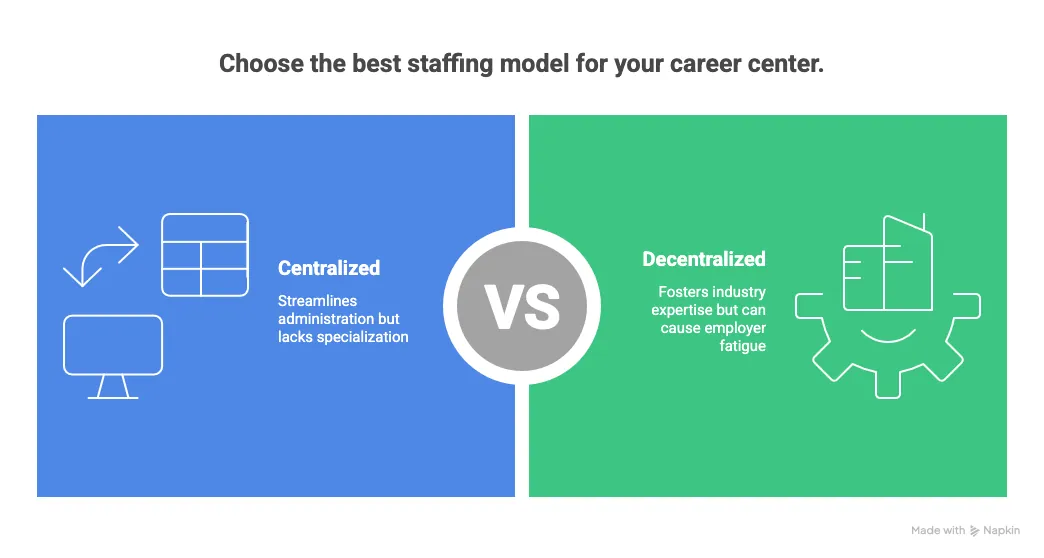
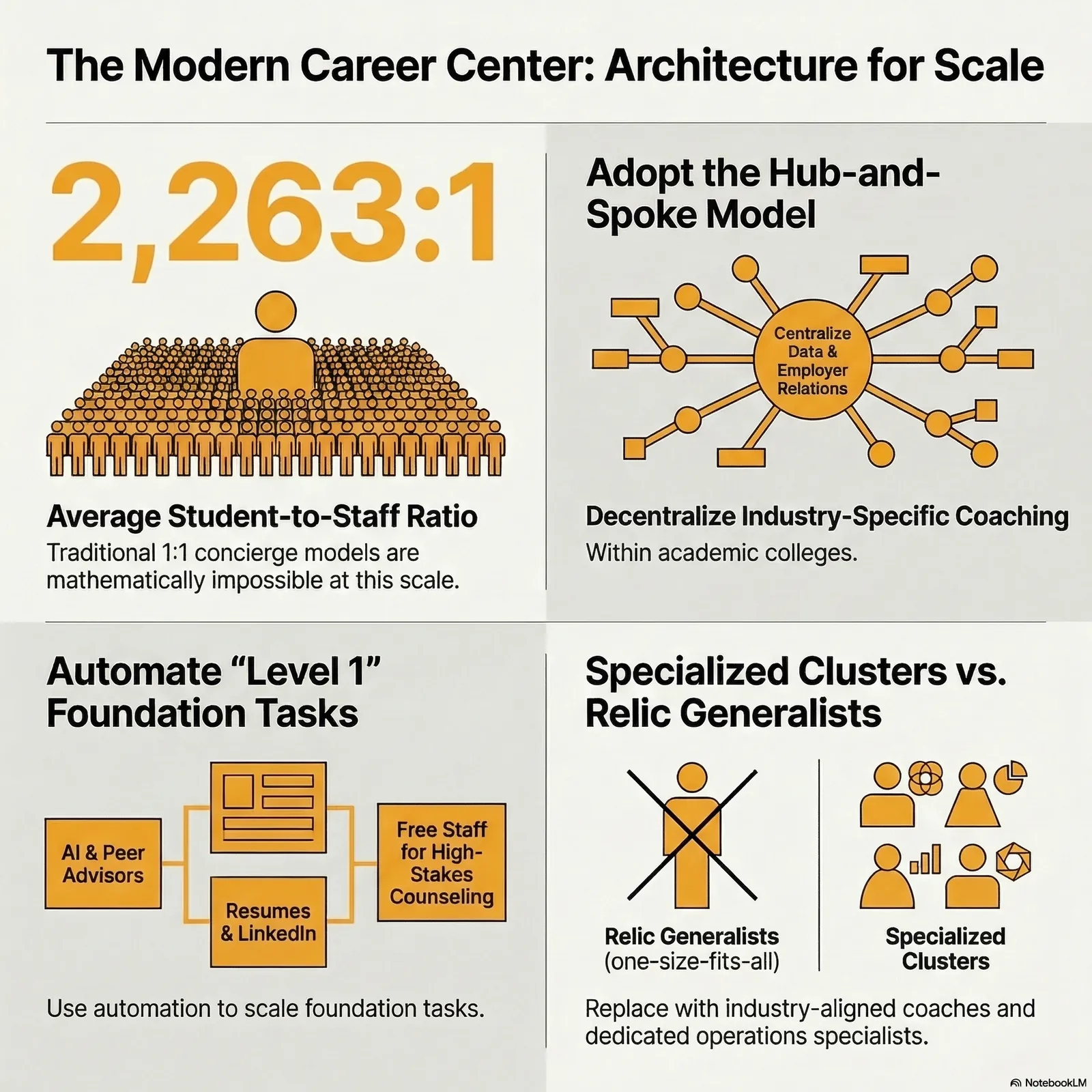
Most high-performing universities are moving toward a "Hub-and-Spoke" model. This approach centralizes administrative functions like employer relations, technology, and data collection in a "hub," while "spokes", specialized career coaches are embedded directly within academic colleges to provide industry-specific expertise and foster closer relationships with faculty and students.
The debate isn't about where people sit, but how they function.
A decentralized model often leads to "employer fatigue," where a single company has to contact five different offices to hire on one campus.
A prime example of this working at scale is Rutgers University. They utilize a "Career Communities" model that aligns staff with specific industry clusters (the spokes) while maintaining a central infrastructure for operations and employer outreach.
This allows for deep industry expertise without sacrificing a unified campus experience.
Also Read: How should career center leaders structure teams, priorities, and data systems for impact?
How Can Peer Advisors Scale Career Services Capacity?
Peer advisors scale your impact by handling "Level 1" inquiries - basic resume formatting, LinkedIn profile setups, and platform navigation. By using a triage system, peer mentors resolve high-volume, foundational tasks, which frees up professional staff to focus on high-stakes career counseling, complex offer negotiations, and strategic employer development.
You cannot hit your engagement goals if your senior staff is stuck explaining how to upload a PDF.
To make peer programs actionable, move away from 1:1 "drop-ins" and toward Group Advising and Sprint Workshops.
These "sprint" models allow one staff member (or peer lead) to assist 10-15 students simultaneously on specific deliverables, drastically increasing throughput compared to traditional appointments.
This moves the needle from "passive support" to "active production."
| Student Need | Peer Advisor Handles? | Professional Advisor Needed? |
|---|---|---|
| Basic resume formatting | Yes | No, unless complexity or strategic repositioning is required |
| First LinkedIn profile setup | Yes | No, unless advanced branding or strategic optimization is needed |
| Career fair preparation | Yes | No, unless the student has specialized concerns or unique barriers |
| Platform navigation | Yes | No |
| Major or career uncertainty | No | Yes |
| Offer negotiation | No | Yes |
| International student job strategy | No | Yes |
| Career anxiety or low confidence | Sometimes, for initial support | Yes, when deeper coaching or intervention is necessary |
| Interview practice basics | Yes | Yes, for advanced, technical, or role-specific strategy |
Peer programs should not be treated as free labor. They need training, supervision, scripts, escalation rules, and quality review.
Also Read: Career Center Capacity Planning: How to Manage Demand & Improve Access
What is a realistic student-to-staff ratio for career centers?
There is no single perfect student-to-staff ratio. A realistic ratio depends on institution size, service model, technology, student needs, and how much career education is embedded into the curriculum.
The current draft cites the common tension clearly: many career centers want more personalized support, but real-world staffing capacity is much tighter.
NACE benchmark data cited in the draft shows a median total office FTE of 7.0, which means many teams must serve large student populations with relatively small staff.
Instead of relying only on a single ratio, career centers should track capacity using multiple measures:
- student-to-staff ratio
- advisor caseload
- appointment wait time
- resume review turnaround time
- number of students served per advisor
- percentage of time spent on direct student support
- percentage of time spent on administrative work
- self-service completion rate
- peer advisor usage
- technology-supported workflow completion
A high ratio is not automatically a failure if the center has strong systems. But a high ratio with long wait times, low engagement, manual workflows, and weak reporting signals a serious capacity issue.
Also Read: How Can Career Centers Cut Student No-Shows and Boost Attendance?
How Can Technology Extend Staff Capacity Without Replacing Advisors?
Technology should not be treated as the staffing model by itself. It should support the staffing model. The right technology can take pressure off professional staff by handling high-volume, repeatable tasks such as:
- first-pass resume feedback
- cover letter structure
- LinkedIn profile review
- mock interview practice
- career assessments
- appointment preparation
- student intake
- reminders and nudges
- cohort workflows
- reporting and dashboards
That allows advisors to spend more time on work that requires human judgment:
- career exploration
- confidence and anxiety
- complex decision-making
- offer strategy
- equity-centered support
- employer relationship strategy
- faculty collaboration
- student motivation and accountability
A good technology layer should answer three questions:
- Does it reduce repetitive staff work?
- Does it help students make progress outside appointments?
- Does it give advisors better visibility into student readiness and outcomes?
If a tool only adds another dashboard without improving access, reducing workload, or strengthening reporting, it may increase operational burden instead of reducing it.
90-Day Roadmap to Redesign Your Career Center Staffing Model
Career centers do not need to redesign everything at once. A 90-day process can help leaders identify capacity gaps, clarify roles, and pilot a better service model.
Days 1-15: Audit Staff Time and Student Demand
Start by understanding where time is going.
Track:
- appointment types
- appointment wait times
- resume review volume
- event support time
- employer relations workload
- reporting workload
- administrative tasks
- technology troubleshooting
- student no-shows
- repeated questions
Ask each staff member to estimate how much time they spend on:
- direct advising
- employer relations
- event planning
- administrative work
- data/reporting
- technology support
- student outreach
- internal meetings
This audit often reveals that highly skilled staff are spending too much time on repeatable work.
Days 16-30: Map Services by Complexity
Group services into three levels.
| Service Level | Student Need | Best Delivery Model |
|---|---|---|
| Level 1 | Basic, repeatable, high-volume foundational career needs | Self-service tools, peer advisors, templates, digital resources, and AI-supported systems |
| Level 2 | Guided skill-building, structured development, and personalized feedback | Group advising, workshops, advisor reviews, cohort models, and structured intervention workflows |
| Level 3 | Complex career decisions, strategic planning, and high-touch individualized coaching | Professional advisors, specialists, or targeted referrals for advanced support |
Examples:
- Resume formatting = Level 1
- Resume strategy for a competitive role = Level 2
- Career uncertainty or offer negotiation = Level 3
This helps determine which work should stay with professional staff and which work can be scaled.
Days 31-45: Decide What to Centralize, Specialize, Automate, or Delegate
Use four decision categories.
| Category | Use When | Examples |
|---|---|---|
| Centralize | Work requires consistency, strong data governance, operational efficiency, or external coordination | Employer relations, career technology, reporting, first-destination surveys, and institutional communications |
| Specialize | Work depends on industry expertise, academic integration, or specific student population context | Career coaching, faculty partnerships, industry advising, internship strategy, and specialized student support |
| Automate | Tasks are repeatable, low-risk, and operationally predictable | Appointment reminders, intake workflows, first-pass resume reviews, FAQs, and standard resource delivery |
| Delegate to Peers | Work is foundational, scalable, and benefits from accessible human support | Resume basics, LinkedIn setup, platform guidance, event preparation, and introductory advising support |
This step turns broad staffing frustration into specific design decisions.
Days 46-60: Redefine Role Ownership
Create a role ownership chart.
| Work Area | Primary Owner | Support Owner | Success Metric |
|---|---|---|---|
| Resume First-Pass Review | Peer advisors or career technology systems | Career advisor | Review turnaround time |
| Advanced Resume Coaching | Career advisor | Industry specialist | Interview response rate |
| Employer Outreach | Employer relations manager | Industry specialist | Employer repeat engagement |
| Student Campaigns | Engagement coordinator | Advisors | Registration-to-attendance rate |
| Technology Workflows | Operations manager | Advisors | Tool adoption and workflow completion |
| Outcomes Reporting | Data analyst | Career center director | Reporting accuracy and stakeholder usage |
| Faculty Partnerships | Embedded advisor | Director or dean liaison | Course integration, referrals, or academic partnership growth |
This prevents invisible work from falling on the same few people.
Days 61-75: Pilot the New Service Model
Choose one high-volume area to pilot.
Good pilot options include:
- resume review triage
- peer advisor drop-ins
- career fair preparation
- mock interview workflow
- first-year career readiness module
- senior job search sprint
- employer event follow-up
Define the pilot clearly:
- who it serves
- what problem it solves
- who owns each step
- what data will be collected
- how success will be measured
Keep the pilot small enough to manage but large enough to generate useful data.
Days 76-90: Review Workload and Scale What Works
At the end of the pilot, review:
- student usage
- advisor workload
- turnaround time
- student satisfaction
- completion rates
- quality of outputs
- staff feedback
- outcome signals
Then decide:
- continue
- expand
- revise
- stop
- automate further
- hire for a missing role
The goal of the 90-day roadmap is not to finalize the perfect org chart. The goal is to move from staffing assumptions to evidence-based capacity planning.
Final Staffing Checklist for Career Center Leaders
Use this checklist before changing roles or requesting headcount.
- Do we know where staff time is currently going?
- Are professional advisors spending too much time on repeatable tasks?
- Do we have a clear Level 1, Level 2, and Level 3 service model?
- Are employer relations, technology, and reporting owned clearly?
- Are peer advisors trained and supervised?
- Do advisors have visibility into student progress?
- Are we centralizing the right functions?
- Are we specializing where students need context?
- Are we measuring workload, not just appointments?
- Can we explain which role we need next and why?
If the answer to most of these questions is no, the staffing issue may not be only a headcount issue. It may be a service design issue.
Also Read: How can universities build professional development systems that improve career services quality?
Wrapping Up
Designing a modern career center staffing model is not just about adding more people. It is about structuring roles, workflows, and systems so the team can support more students without losing quality.
The most effective offices combine specialized staff, centralized operations, peer-supported services, and technology that handles high-volume foundational tasks.
That allows career coaches to focus on the activities that require human judgment: career exploration, industry advising, employer strategy, equity interventions, and helping students translate experience into clear career signals.
Hiration supports this model with a full-stack career readiness suite covering the student journey from career assessments to AI-powered resume optimization and interview simulation. The dedicated Counselor Module helps career teams manage cohorts, workflows, analytics, and student progress within a secure FERPA- and SOC 2-compliant environment.
The goal is to give career teams the infrastructure to operate at scale, protect advisor time, and make every role in the staffing model count.
Career Center Staffing Models — FAQs
Why are traditional career center staffing models becoming outdated?
Traditional generalist models often cannot scale to modern demands involving employer relations, career technology, analytics, and large student populations.
What core roles should modern career centers prioritize?
Core roles include career advisors, employer relations managers, technology and operations leaders, data analysts, peer program leads, and engagement specialists.
Why is specialization increasingly important?
Specialized roles improve efficiency by aligning staff expertise with distinct operational, industry, employer, or student engagement functions.
What is the hub-and-spoke staffing model?
This model centralizes operations and employer systems while embedding specialized advisors closer to academic units or career communities.
How do peer advisors improve staffing efficiency?
Peer advisors handle foundational, high-volume tasks such as resume basics and platform navigation, allowing professional staff to focus on higher-complexity work.
What tasks should technology support?
Technology should automate repeatable workflows such as first-pass resume reviews, scheduling, reminders, mock interviews, and reporting.
What metrics should staffing leaders track?
Important metrics include advisor workload, wait times, student engagement, time spent on administrative work, employer outcomes, and operational efficiency.
How should career centers prioritize new hires?
Hiring priorities should be based on service bottlenecks, whether in advising, operations, technology, employer development, or engagement rather than defaulting to more advisors.
Why is a service-tier model useful?
Tiered models align service complexity with appropriate staffing levels, ensuring high-value staff time is reserved for the most impactful interventions.
What is the biggest strategic staffing shift career centers need?
Career centers must move from headcount-focused staffing toward systems-based workforce design that integrates people, process, and technology for scalable impact.