How can career advisors design workshops that produce verifiable student outcomes instead of passive learning?
Advisors can redesign workshops to generate measurable artifacts by linking resumes to interview narratives, optimizing LinkedIn profiles for recruiter search, and running practice-based interview sessions with rubric scoring. When each session produces outputs like STAR stories, annotated resumes, outreach templates, and peer-evaluated interview responses, career centers can verify skill development and track readiness using tangible evidence instead of attendance.
Most career workshops stop at awareness. Students leave with ideas, but no proof they can perform under pressure.
The gap between a strong resume and a strong interview isn’t a knowledge problem; it’s an articulation problem.
This guide shows how to redesign common career workshops so every session produces a verifiable artifact - mapped resume bullets, structured STAR stories, optimized LinkedIn positioning, and practiced interview responses.
The goal is simple: turn passive learning into tangible evidence of skill that students can use immediately in the hiring process.
How can advisors bridge the gap between a resume and an interview?
Advisors can bridge this gap by treating the resume as an active interview preparation tool, not a passive document. This workshop script reframes each resume bullet point as a prompt for a behavioral interview story. According to research published by the Collegiate Career Services Association of Colorado and Wyoming, this direct linkage is critical for students who struggle to articulate their written qualifications under pressure.
Script & Facilitator Notes
This workshop directly addresses a common student failure point: the inability to substantiate written claims with verbal evidence. The script is divided into two modules: artifact deconstruction and narrative construction.
Part 1: Deconstructing the Resume for Interview Cues (25 mins)
- Facilitator Prompt: "Your resume got you the interview; now it's your script. Let's analyze it like a recruiter. Open the target job description. Using a highlighter, identify the top five required competencies. Now, map each competency to a specific bullet point on your resume."
- Activity: Students work individually or in pairs to map job description keywords to their resume experiences.
- Verification: Advisors can verify this by reviewing the student's annotated resume and job description, ensuring a logical connection between required skills and claimed experience.
Also Read: How to Give Resume Feedback in 5 Minutes?
Part 2: Translating Bullets to Narratives (30 mins)
- Facilitator Prompt: "For each highlighted bullet point, you need a story. We will use the STAR method - Situation, Task, Action, Result - to build one. Your 'Action' should be specific, and your 'Result' must be quantified. Let's draft one together."
- Activity: Students draft one STAR story based on a key resume bullet point. In breakout rooms, they practice telling the story to a peer, who provides feedback using a simple rubric (clarity, impact of result).
- Verification: The tangible artifact is a written STAR story. The University of Richmond's career services provides an excellent rubric for assessing STAR story effectiveness, focusing on specificity and quantifiable outcomes.
Also Read: How to Build and Use a Standard Resume Critique Rubric?
How can LinkedIn workshops produce measurable outcomes beyond profile completion?
Effective LinkedIn workshops focus on optimizing profiles for recruiter search algorithms and creating templates for strategic outreach, producing verifiable increases in profile views and networking activity. The goal is not just a "complete" profile, but a discoverable one. According to a 2024 EDUCAUSE analysis, digital identity is a core student competency, yet most workshops stop at cosmetic updates.

Script & Facilitator Notes
This workshop script moves students from passive profile building to active, strategic engagement.
Part 1: Profile Optimization for Recruiter Search (25 mins)
- Facilitator Prompt: "Your LinkedIn headline and 'About' section are the most heavily weighted fields in recruiter searches. Let's reverse-engineer them. Identify three keywords from a target job description and integrate them into your headline. Your 'About' section should then expand on these, framed as 'I help [Company Type] do [Task] by [Skill].'"
- Activity: Students rewrite their headline and the first two sentences of their 'About' section in real-time.
- Verification: Advisors can see the changes live. A successful outcome is a headline that moves from a generic title (e.g., "Student at XYZ University") to a value-oriented statement (e.g., "Aspiring Data Analyst | Python, SQL, & Tableau | Seeking FinTech Opportunities").
Part 2: The Informational Interview Outreach Engine (30 mins)
- Facilitator Prompt: "A great profile is useless without engagement. We will now draft a template for an informational interview request to an alum. The template must be personalized, concise, and end with a clear, low-friction ask."
- Activity: Students use a provided template to draft a connection request and a follow-up message. They identify one alum from their institution on LinkedIn to target.
- Verification: The artifact is the drafted outreach message. Wake Forest University has demonstrated success by tracking the number of informational interviews conducted by students post-workshop as a key engagement metric.
Also Read: How can career advisors improve student visibility on LinkedIn?
How can interview prep workshops move beyond theory to build demonstrable skill?
Interview prep workshops build demonstrable skill by forcing students to practice articulating their experiences using a structured framework like STAR (Situation, Task, Action, Result) and recording their responses for rubric-based peer and self-assessment. The failure mode of most interview workshops is prioritizing content delivery over live, evaluated practice.

Script & Facilitator Notes
This script is designed entirely around practice and feedback loops.
Part 1: Story Mining & Mapping to Competencies (20 mins)
- Facilitator Prompt: "Behavioral interviews assess competencies. Let's map your best stories to the skills employers want. On your handout, list three key projects or experiences. Next to each, list the top 2-3 competencies you demonstrated, such as 'problem-solving' or 'team collaboration.'"
- Activity: Students complete a "Competency-Story Map" worksheet.
- Verification: The completed map is the artifact. It serves as a bank of stories students can draw from, preventing them from repeatedly using the same example.
Also Read: What are some good icebreakers for career coaching sessions?
Part 2: Live Practice with Peer Evaluation (35 mins)
- Facilitator Prompt: "You will now go into breakout rooms. Person A will answer the question 'Tell me about a time you had to work with a difficult team member.' Person B will time the response, keep it under two minutes and score it using the provided rubric, focusing on the clarity of the 'Result.'"
- Activity: Students engage in timed, paired mock interviews.
- Verification: Students submit their peer-scored rubric. Studies have confirmed that peer feedback in mock interviews significantly boosts student confidence and performance in actual interviews.
Also Read: How can career centers close the equity gap for FGLI students?
How can non-technical advisors effectively run technical interview workshops?
Non-technical advisors can effectively run these workshops by focusing on the communication and problem-solving frameworks that technical recruiters evaluate, rather than the code itself. The key is to teach students how to articulate their thought process. Many technically proficient students fail interviews because they cannot explain their approach clearly, a gap career services is perfectly positioned to fill.

Script & Facilitator Notes
This workshop partners CSPs with student TAs from computer science departments for content expertise.
Part 1: The Problem-Solving Communication Framework (20 mins)
- Facilitator Prompt: "Your interviewer is evaluating your thought process, not just the right answer. We'll use a five-step framework: 1. Clarify the problem. 2. State your assumptions. 3. Propose a high-level approach (pseudocode). 4. Code it. 5. Discuss trade-offs and test cases. Today, we focus only on steps 1, 2, 3, and 5."
- Activity: The advisor walks through a simple logic puzzle (e.g.,"how many golf balls fit in a school bus?"), modeling the communication framework aloud.
Also Read: How can career centers prepare students for AI-driven interviews?
Part 2: Mock Whiteboarding with Peer Feedback (35 mins)
- Facilitator Prompt: "In breakout rooms, one student will be the 'interviewer,' the other the 'candidate.' The interviewer will present a LeetCode-style problem. The candidate will not code but will talk through the five-step framework. The interviewer's only job is to provide feedback on the clarity of the explanation."
- Activity: Paired practice using a shared virtual whiteboard tool.
- Verification: The tangible outcome is the student's ability to articulate a structured problem-solving approach.
Also Read: Career Coaching Session Agenda Template for Scaling Student Support
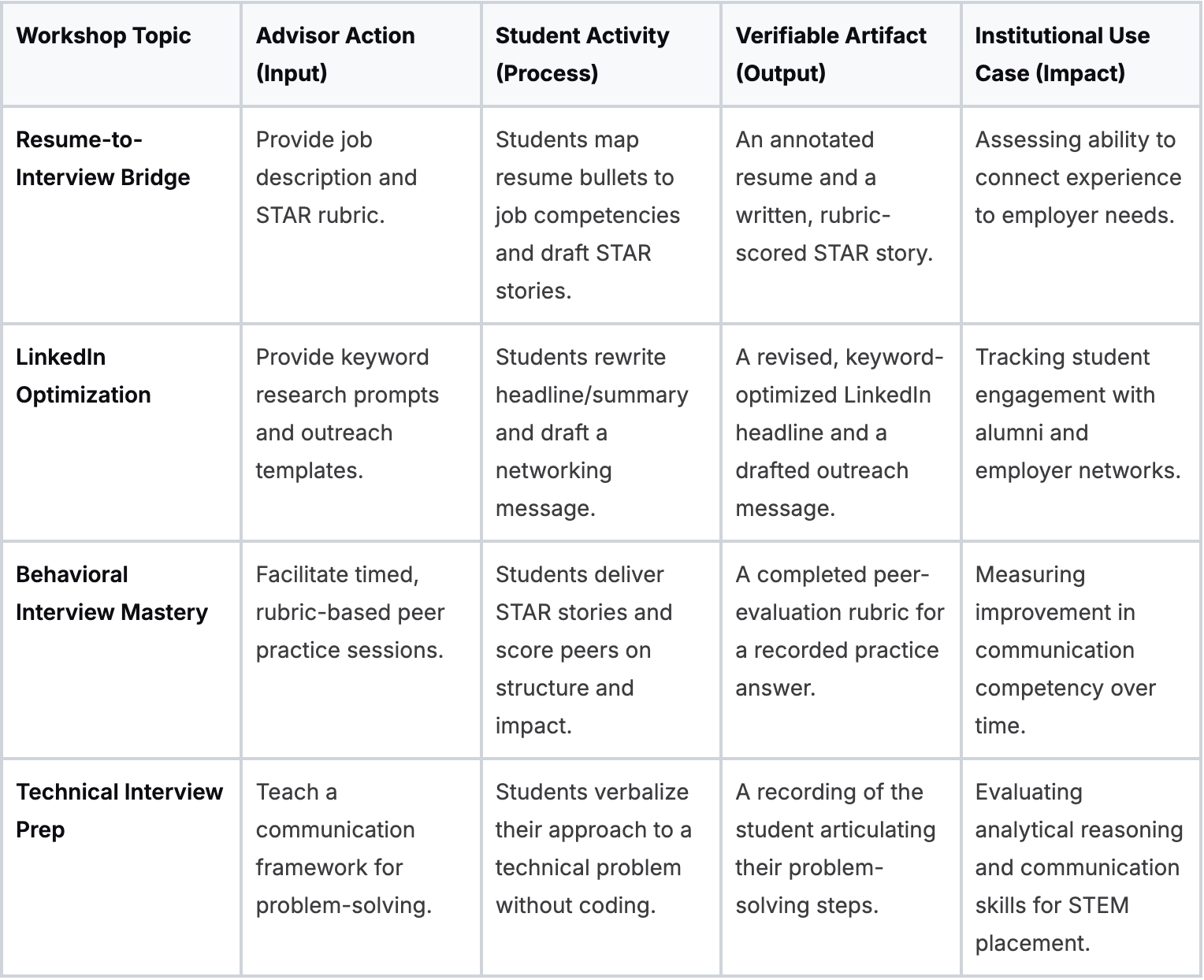
Framework: Mapping Workshop Activity to Verifiable Evidence
Also Read: How career centers can support seniors without jobs before graduation?
Wrapping Up
The shift from awareness to artifact is a structural upgrade to how career readiness is delivered and measured. When every workshop produces a tangible output, advisors gain verifiable evidence of skill development, not just attendance.
For teams managing large caseloads, this model creates leverage by standardizing delivery, reducing one-off advising, and improving outcome consistency across cohorts.
Hiration makes this scalable by providing a full-stack, end-to-end system - from career assessments to AI-powered resume optimization, interview simulation, LinkedIn optimization, and more, along with a dedicated Counselor Module to manage cohorts, workflows, and analytics in one secure, FERPA and SOC 2-compliant platform.
As career services move toward evidence-based practice, the metric that matters shifts from attendance to proof of competence.
Workshop Scripts for Verifiable Career Outcomes — FAQs
What makes a career workshop produce measurable student outcomes?
Workshops must generate tangible artifacts such as STAR stories, optimized LinkedIn sections, annotated resumes, or scored mock interview responses that demonstrate applied skill.
How can advisors connect resumes directly to interview preparation?
Advisors can map resume bullet points to behavioral interview stories and train students to translate each experience into a STAR-based narrative.
How should LinkedIn workshops be structured for measurable impact?
LinkedIn sessions should focus on keyword optimization for recruiter search and structured outreach templates that drive profile visibility and networking activity.
What is the most effective format for interview preparation workshops?
The most effective format uses live practice, timed responses, and peer-scored rubrics to build and evaluate structured answers under real interview conditions.
How can non-technical advisors run technical interview workshops?
Advisors can focus on teaching structured problem-solving communication frameworks that evaluate reasoning, assumptions, and explanation clarity rather than coding accuracy.
How can career centers verify that workshops are improving student readiness?
Verification comes from reviewing artifacts such as annotated resumes, STAR narratives, outreach drafts, and scored interview rubrics that show measurable improvement over time.
Why is an artifact-based workshop model important for scaling career services?
Artifact-based workshops standardize delivery, reduce repetitive advising, and provide data-backed evidence of student skill development across large cohorts.