How can career centers build a messaging playbook using student personas?
Career centers can build an effective messaging playbook by identifying key student personas using institutional data, tailoring tone and content to each group’s psychological barriers, and validating outreach through measurable engagement and student actions.
Career center outreach often fails not because students ignore support, but because the message does not match the student’s actual barrier.
A senior without a plan, an international student navigating sponsorship, and a first-generation student decoding employer expectations should not receive the same generic reminder.
That matters institutionally because irrelevant outreach weakens engagement, hides demand, and makes it harder for career centers to prove which interventions move students toward action.
This guide explains how career centers can build student personas, match messaging tone to student needs, verify personas with behavior and advisor feedback, design short outreach sequences, and start with simple pilots before scaling personalization across the institution.
Student Persona Messaging Matrix for Career Centers
| Student Persona | Core Barrier | Messaging Tone | Best CTA | What to Measure |
|---|---|---|---|---|
| Pragmatic Procrastinator | Overwhelmed by choices and delaying action | Simple, direct, practical, and low-friction | “Take one 10-minute step” | Clicks, appointment bookings, resume uploads, and task completion |
| Ambitious Achiever | Fear of falling behind peers or missing opportunities | Challenging, achievement-oriented, and opportunity-focused | “Sharpen your competitive edge” | Event signups, advanced workshop attendance, mock interviews, and internship applications |
| FGLI Navigator | Unclear on unwritten professional and recruiting norms | Supportive, trust-building, and demystifying | “Here’s what employers expect and how to prepare” | Resource clicks, advising appointments, repeat engagement, and milestone completion |
| International Student | Sponsorship uncertainty, recruiting timelines, and visa-related concerns | Direct, practical, and visa-aware | “Build a sponsor-aware search plan” | Sponsorship-focused workshop attendance, curated employer clicks, and advising utilization |
| Quiet Explorer | Uncertain about career direction but not yet in crisis | Curious, exploratory, and low-pressure | “Compare 3 career paths” | Assessment completions, exploration appointments, and career-path research actions |
| Disengaged Senior | Low visibility, limited momentum, and no clear next step | Urgent but non-judgmental | “Confirm your post-grad plan” | Survey completions, senior advising appointments, job-search activity, and follow-up engagement |
This table should not be treated as a fixed list. Each institution should adapt personas based on its own student population, programs, and career center data.
For example, a community college may need personas tied to working learners, adult students, transfer students, or certificate completers. A business school may need personas tied to competitive recruiting timelines. A large public university may need personas by college, class year, and commuter status.
The persona should match the messaging problem the career center is trying to solve.
What student personas should career centers prioritize?
Prioritize personas based on institutional data and high-stakes needs, not just demographics. Focus on segments whose career navigation is most complex: the Pragmatic Procrastinator (overwhelmed by process), the Ambitious Achiever (fears missing a competitive edge), First-Generation/Low-Income students (face navigational uncertainty), and International Students (grapple with sponsorship anxiety).
These personas move beyond simple segmentation by capturing the core psychological barriers to engagement.
They should be built by cross-referencing Student Information System (SIS) data with engagement metrics from platforms like Handshake.
A 2024 NSSE report indicates that students who perceive support services as relevant are 40% more likely to utilize them.
For example, the University of California, Berkeley's Career Center analyzes first-destination survey data by college to spot trends, which provides a quantitative foundation for developing and validating such personas.
A persona should represent a pattern that affects action. Useful signals include:
- Appointment history
- Event attendance
- Resume uploads
- Career assessment completion
- Class year
- Major or academic college
- International status where appropriate and approved
- First-generation or low-income status where appropriate and approved
- Job-search stage
- Platform activity
- Advisor observations
- Student survey responses
- First-destination or senior outcome signals
The goal is to make outreach more relevant. A practical persona should answer four questions:
- What is the student trying to do?
- What is stopping them?
- What message will feel relevant?
- What action should the message drive?
Start with a small set of personas that map to recurring career center challenges.
Also Read: How to Build Scalable Peer Mentor Programs That Drive Student Outcomes?

How can a career center verify persona accuracy?
Verify personas by testing them against student behavior and advisor observations. Run A/B tests with persona-specific messages and track engagement lifts. For an FGLI persona anxious about finances, an email highlighting paid micro-internships should significantly outperform a generic “internship opportunities” message. A measurable lift in click-through and appointment bookings validates the persona's core motivation.
Another verification method involves sharing draft personas with frontline advisors and asking: “Does this reflect the students you met this week?”
This feedback loop, used by institutions like the University of Richmond, ensures personas mirror on-the-ground realities.
Finally, review student-produced artifacts. Do resumes from your “Ambitious Achiever” persona consistently show leadership roles?
These patterns in student work can confirm or challenge a persona's defined characteristics.
Clemson University's Center for Career and Professional Development uses this integrated data approach to tailor outreach, making their communication more effective.
| Validation Method | What It Tests | What to Look For | Example Signal |
|---|---|---|---|
| A/B Message Test | Whether the persona’s motivation, language, and call to action are accurate | Higher open rates, clicks, appointment bookings, resource use, uploads, or registrations | “Take one 10-minute step” outperforms “Book an appointment today” among low-engagement students |
| Advisor Review | Whether the persona reflects real student behaviors and advising conversations | Advisors recognize the barriers, language patterns, concerns, and next steps | Career coaches consistently identify the same student profile during appointments |
| Platform Behavior | Whether actual student actions match the assumptions behind the persona | Resume uploads, assessment starts, event registrations, mock interview usage, or advising activity | Students classified as Quiet Explorers complete assessments before booking appointments |
| Artifact Review | Whether student work products show the expected readiness gap | Weak resume bullets, unclear role targets, incomplete LinkedIn profiles, or unfocused applications | Pragmatic Procrastinators frequently submit incomplete application materials |
| Follow-Up Survey | Whether the outreach or intervention increased clarity and actionability | Students can name a specific next step, resource, or action they plan to take | Students report a clearer internship-search plan after receiving targeted messaging |
| Cohort Comparison | Whether engagement patterns differ across student populations | Meaningful variation by class year, college, major, first-generation status, or other groups | International students respond more strongly to sponsorship-focused messaging than general job-search campaigns |
| Appointment Notes | Whether outreach themes match issues raised during advising sessions | Students describe the same barrier, concern, or objective referenced in communications | Students responding to networking campaigns later discuss networking uncertainty during advising appointments |
A persona should be revised if the data does not support it.
For example, if the “Pragmatic Procrastinator” message does not increase resume uploads or quick appointments, the problem may not be procrastination. The real issue may be confusion, intimidation, lack of time, or unclear value.
A persona is a hypothesis about what will move a student to action.
Also Read: How can career centers use predictive outreach to identify and support students earlier?
How should messaging tone differ for each persona?
Messaging must be tuned to the specific psychological frequency of each persona. For the ‘Pragmatic Procrastinator,’ the tone must be urgent but simple, providing a clear, low-effort next step. For the ‘Ambitious Achiever,’ the tone should be exclusive and challenging, offering a competitive edge. This is not just about word choice; it’s about aligning the entire message with the student’s internal narrative.
FGLI students often require a supportive and demystifying tone that builds trust and clarifies the unwritten rules of career development.
For international students, the tone must be direct and pragmatic, openly acknowledging their unique hurdles like visa sponsorship.
The University of Texas at Austin's career center, for example, customizes its weekly newsletters by college and major.
This simple segmentation makes their outreach exponentially more relevant because the tone and content align with the specific academic and career context of the recipients.
Here are some examples:
- Pragmatic Procrastinator
- Core barrier: The student knows career tasks matter but keeps delaying them.
- Tone: Simple, short, action-first.
- Subject line: One resume fix before Friday
- Message angle: You do not need to finish your entire resume today. Start with one section.
- Sample message:
Your resume does not need to be perfect before you get feedback. Upload your current draft by Friday and start with one quick fix: turning one responsibility into a stronger achievement bullet. - CTA: Upload your resume for a quick review.
2. Ambitious Achiever
- Core barrier: The student is already engaged but wants an edge.
- Tone: Challenging, selective, outcome-oriented.
- Subject line: Make your strongest experience interview-ready
- Message angle: You already have strong experience. The next step is learning how to present it strategically.
- Sample message:
You have the experience. Now make sure it lands clearly in interviews. Join the advanced interview lab to practice turning leadership, internship, and project examples into concise, evidence-based answers. - CTA: Join the advanced interview lab.
3. FGLI Navigator
- Core barrier: The student may not know the unwritten rules of career development.
- Tone: Supportive, clear, demystifying.
- Subject line: What employers expect but may not explain
- Message angle: Career preparation often includes hidden expectations. The session makes them visible.
- Sample message:
Some parts of the job search are not always explained clearly, from networking emails to resume language to interview follow-up. This session breaks down what employers expect and how to prepare step by step. - CTA: Attend the first-gen career readiness session.
4. International Student
- Core barrier: The student is navigating work authorization, timelines, sponsorship uncertainty, and employer research.
- Tone: Direct, practical, timing-aware.
- Subject line: Build a sponsor-aware job search plan
- Message angle: Your search needs to account for timelines, employer research, and role targeting.
- Sample message:
A strong job search plan for international students needs more than a polished resume. This workshop covers how to research employer petition patterns, understand timing questions, and prepare for sponsorship-related conversations. - CTA: Join the CPT/OPT job-search workshop.
The USCIS H-1B Employer Data Hub can help students research employer petition history, but career centers should frame it carefully. It is a research tool, not a guarantee that an employer will sponsor a role.
5. Quiet Explorer
- Core barrier: The student is unsure what roles fit but is not ready for intensive job-search action.
- Tone: Curious, low-pressure, exploratory.
- Subject line: Not sure what roles fit? Start here
- Message angle: You do not need a final answer. Start by comparing a few directions.
- Sample message:
You do not need to choose a career path today. Start by comparing three possible directions, what each role actually involves, and which next step would help you learn more. - CTA: Complete a career assessment or book an exploration appointment.
6. Disengaged Senior
- Core barrier: The student is near graduation with no clear plan or limited engagement.
- Tone: Urgent but non-judgmental.
- Subject line: Still deciding your next step after graduation?
- Message angle: It is not too late to build a short-term plan.
- Sample message:
If your post-graduation plan is still unclear, start with one step this week. Complete the senior next-step check-in so the career center can help you identify whether you need resume support, job-search targeting, interview prep, or career direction. - CTA: Complete the senior next-step check-in.
Also Read: Career Coaching Session Agenda Template for Scaling Student Support

Persona-Driven Messaging & Verification Framework
The following framework maps distinct messaging approaches to verifiable student actions.
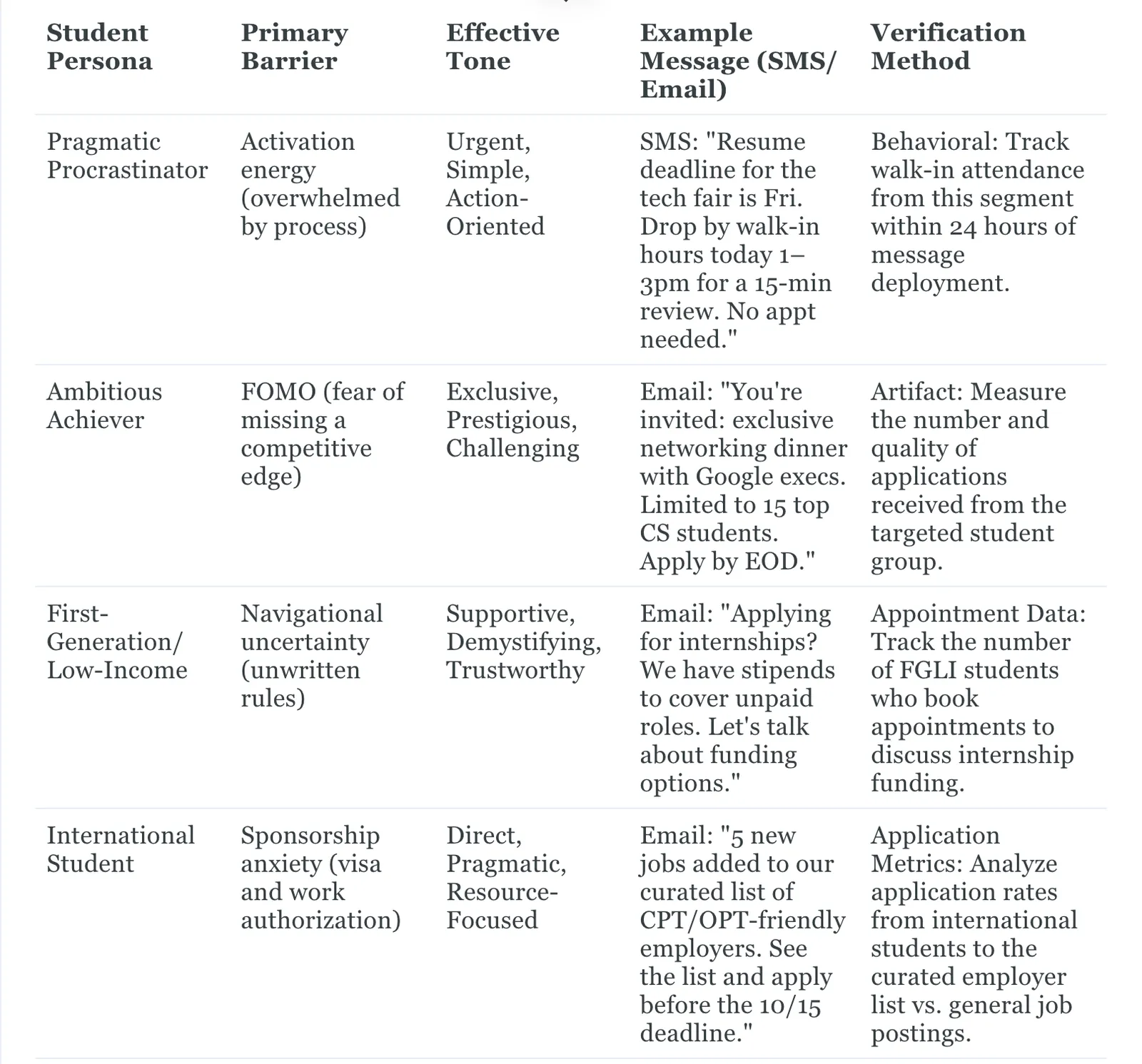
This moves from abstract personas to concrete outreach tactics that can be measured.
Also Read: Workshop Scripts Advisors Can Use to Create Verifiable Student Outcomes
What Does a Persona-Based Outreach Sequence Look Like?
Persona-based messaging works best as a short sequence, not a one-off email. A single message may create awareness. A sequence can move the student from recognition to action.
| Message | Purpose | Example | What Success Looks Like |
|---|---|---|---|
| Message 1 | Name the specific problem | “Not sure where to start with your internship search?” | Students recognize themselves in the message and engage with the content |
| Message 2 | Offer one low-friction action | “Upload one resume draft for review.” | Students complete a simple first step rather than postponing action |
| Message 3 | Add relevance or social proof | “Students in your major often start with these 3 role paths.” | Students see the action as relevant, achievable, and worth exploring |
| Message 4 | Create timing urgency | “Career fair registration opens next week.” | Students act before a deadline, event, or recruiting milestone passes |
| Message 5 | Route to human support | “Book a 20-minute appointment if you want help narrowing your options.” | Students who need deeper support transition from self-service to advising |
The sequence should stay focused.
A student who clicked a resume review message should receive a follow-up about resume completion, not a generic list of every upcoming event.
A senior who completed a post-graduation check-in should receive a next-step message based on their status: applying, interviewing, unsure, still exploring, or not yet started.
A student who attended an international job-search workshop should receive a follow-up tied to employer research, not a general “thanks for attending” message.
Good sequencing reduces noise.
It helps students feel that career services remembers the action they took and knows the next logical step.
Where do scaled personalization efforts typically fail?
Scaled personalization efforts typically fail due to institutional realities: siloed data, fragmented tools, and advisor bandwidth limitations. Career centers often possess rich demographic data in the SIS and separate engagement data in other platforms, but these systems rarely integrate. This data disconnect leads to incomplete personas and irrelevant messaging.
This is a systems problem. For example, a student logging into a resume builder three times a week might be flagged as “disengaged” for not attending workshops, leading to mismatched outreach.
This integration challenge is well-documented; EDUCAUSE has documented that integrating disparate campus technologies remains a top institutional challenge, directly crippling effective student outreach.
The consequences are significant, especially as a recent NAFSA report flagged a 17% decline in new international student enrollment for Fall 2025.
The most sophisticated messaging playbook will fail if the underlying data is fragmented and advisors lack integrated tools to act on insights efficiently, which is why building scalable systems for career services is crucial.
How Can Career Centers Start Without Overbuilding?
Career centers do not need a large personalization system to begin. Start with one high-priority audience and one behavior.
Examples:
- Seniors with no known plan → complete a next-step check-in
- Students with no resume on file → upload a resume draft
- First-year students → complete a career assessment
- International students → attend a sponsor-aware job-search session
- Career fair registrants → prepare an employer introduction
- Students who attended a resume workshop → submit a revised draft
Then build one persona-specific message for that behavior.
Track the result.
Revise.
Scale only after the team knows the message changes action.
A simple pilot can answer:
- Did the persona message outperform the generic message?
- Did students take the intended action?
- Did advisors recognize the persona pattern?
- Did the follow-up workflow support students after the click?
- Did the message create useful data for future outreach?
Start small, but make the measurement clear.
Wrapping Up
Persona-based outreach works when it turns broad student categories into clearer next steps. The goal is not to label students permanently, but to understand what is stopping action and send messages that feel relevant enough to move them forward.
For career centers, the bigger opportunity is building a repeatable system: identify the student segment, match the message to the barrier, track the action, and refine the workflow over time.
Hiration supports that journey with a full-stack career readiness suite spanning Career Assessments, AI-powered Resume Optimization, Interview Simulation, LinkedIn optimization, and more. Its separate Counselor Module helps teams manage cohorts, workflows, and analytics within a secure, FERPA and SOC 2-compliant platform.
With the right message, the right timing, and the right system behind it, personalization can become a practical way to move more students from awareness to action.
Student Persona Messaging — FAQs
Why does generic career services messaging fail to engage students?
Generic messaging fails because it assumes a single student audience, ignoring different motivations, anxieties, and decision-making styles across student groups.
Which student personas should career centers prioritize?
Career centers should prioritize personas such as the Pragmatic Procrastinator, Ambitious Achiever, FGLI students, and International Students, based on institutional data and support needs.
How can career centers verify that their personas are accurate?
Personas can be validated through A/B testing of messaging, advisor feedback, and analyzing student behaviors such as engagement, appointment bookings, and artifact quality.
How should messaging tone vary across student personas?
Messaging tone should align with each persona’s psychological drivers, such as urgency for procrastinators, exclusivity for achievers, clarity for FGLI students, and practical guidance for international students.
How can advisor scripts be personalized for difficult student conversations?
Advisors can personalize scripts by using inquiry-first coaching that validates student concerns and reframes setbacks into actionable next steps based on the student’s persona.
How do career centers measure messaging and script effectiveness?
Effectiveness can be measured through post-appointment actions such as resume updates, follow-up bookings, and workshop attendance rather than satisfaction alone.
How should messaging be adapted for international students?
Messaging for international students should address work authorization, visa timelines, and sponsorship strategies directly with practical, data-driven guidance.
Why do scaled personalization efforts often fail in career services?
Personalization fails due to fragmented systems, siloed data, and limited advisor bandwidth, preventing consistent, data-informed outreach at scale.
How does persona-based messaging improve career readiness outcomes?
Persona-based messaging increases relevance, drives engagement, and connects outreach to measurable skill development and employment outcomes.