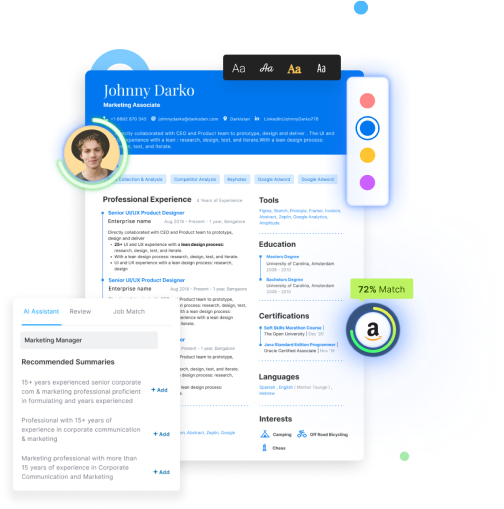
The ground has shifted under every career center. The degree is no longer the signal, attention is scarce, and employers are filtering for proof - not potential.
At the same time, your team is expected to deliver more personalized guidance to more students than ever before, with the same limited staff.
This blog breaks down what actually defines the 2026 job search landscape and what it means for how career services must operate.
From skills-first hiring and self-service advising to data-driven strategy and AI as a co-pilot, these are not abstract trends.
They are the operating model of the next generation of career centers and the playbook for staying relevant, credible, and impactful.
What are the defining trends in the 2026 job search landscape?
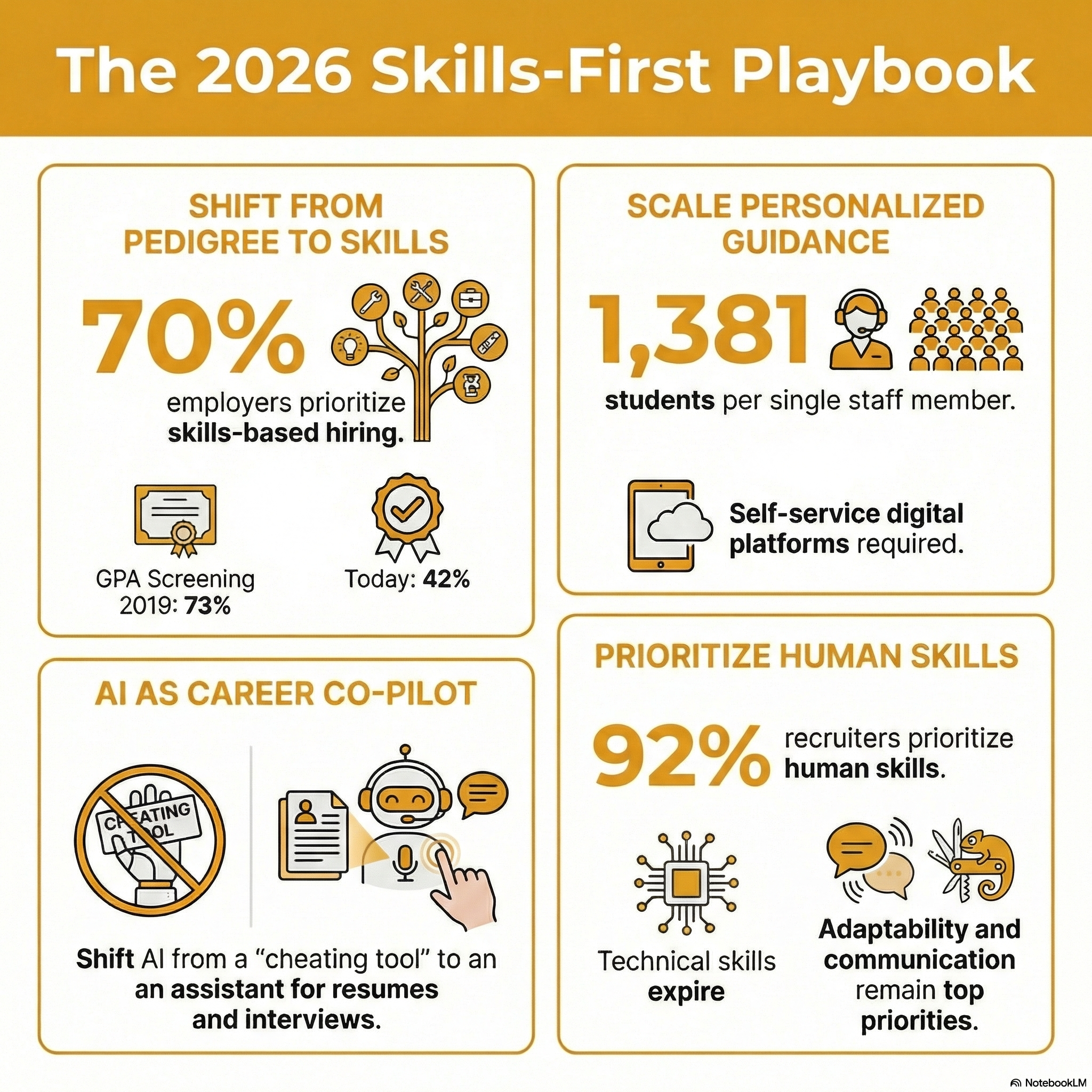
The 2026 job market is dominated by a "skills-first" philosophy where pedigree takes a backseat to proven competency. According to NACE’s Job Outlook 2026 survey, 70% of employers now prioritize skills-based hiring, and GPA screening has plummeted from 73% in 2019 to just 42% this year.
For decades, the college degree was the ultimate signal. That signal has weakened.
According to NACE, hiring for the Class of 2026 is projected to grow by a modest 1.6%, creating a hyper-competitive environment where "generalist" resumes are discarded by automated systems.
Actionable advice for CSPs:
- Audit for AI-Friendliness: Move beyond traditional formatting. Teach students how to optimize for "ATS 2.0," which scans for specific skill clusters rather than just keywords.
- Focus on Durable Skills: While technical skills expire, "human" skills (communication, adaptability) remain the top priority for 92% of hiring professionals, according to LinkedIn’s Global Talent Trends.
Also Read: How to Build Scalable Peer Mentor Programs That Drive Student Outcomes?
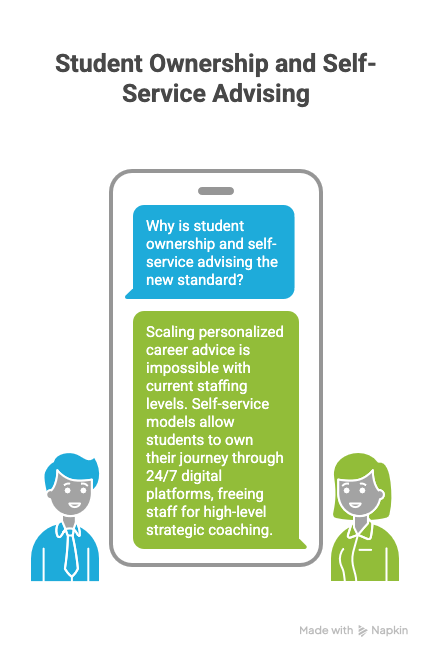
Why is student ownership and self-service advising the new standard?
Scaling personalized career advice is impossible with current staffing levels. The median ratio is 1,381 students per professional staff member, according to the NACE 2024-25 Benchmarks Report. Self-service models allow students to own their journey through 24/7 digital platforms, freeing staff for high-level strategic coaching.
The "advising appointment" shouldn't be a 30-minute session on how to use LinkedIn.
Leading institutions are moving toward a tiered model where foundational tasks like resume building, interview prep, and networking are handled by AI-driven self-service tools.
Here are some examples:
- University of Connecticut: Their "Work+ Pilot" (a 2025 NACE Excellence Award winner) integrates career readiness directly into on-campus student employment, making the job itself the classroom.
- University of Minnesota: Their College of Liberal Arts has successfully embedded "Career Readiness" into the core curriculum, ensuring students own their professional identity from day one.
How can data transform career centers into strategic university assets?
Data is shifting the career center from a cost center to a core driver of enrollment and retention. By tracking real-time labor market trends and alumni outcomes, CSPs can provide "ROI proof" to skeptical families. According to ETS, statewide university systems are now making career placement a core KPI.
Data-informed centers don't just report first-destination stats; they use predictive analytics to identify "at-risk" students who aren't engaging with career resources.
According to ETS, institutions like California State University (CSU) have launched initiatives like the "CSU Promise," which targets job placement as a primary metric of success, rather than just graduation rates.
Strategic Metrics to Track
| Metric | Why it Matters |
|---|---|
| Skill Acquisition Velocity | Tracks how quickly students are gaining marketable competencies. |
| Engagement by Demographic | Identifies gaps in service for marginalized or non-traditional students. |
| AI Literacy Scores | Measures how well students are prepared for the AI-augmented workplace. |
What does a successful AI-as-co-pilot model look like?
The AI-as-co-pilot model moves AI from a "cheating tool" to a "career assistant." Currently, 76% of career centers use AI as an assistive tool, according to a NACE Quick Poll. Success looks like training students to use GenAI for prompt engineering resumes and simulating high-stakes interviews.
AI isn't replacing the counselor; it's replacing the "busy work." According to NACE, 59.3% of career center staff already use AI to assist students.
However, a significant gap remains: only 35% of centers provide workshops on how to use AI ethically and effectively in a job search.
Stop telling students not to use AI. Instead, teach them Prompt Engineering for Careers. Show them how to use AI to:
- Analyze a job description to identify hidden skill requirements.
- Generate "STAR" method interview responses based on their actual experience.
- Simulate a "difficult" interviewer to build confidence.
This becomes far more effective when these practices are embedded into a structured, end-to-end system where students can assess their readiness, optimize application materials, practice interviews, and receive guided feedback - all while counselors retain visibility into progress, engagement, and outcomes.
Also Read: What guardrails do career centers need for AI use in student job preparation?
What are the predictions for career services in the next 5-10 years?
By 2030, the career center will be a "Human-AI Hybrid Hub" that supports lifelong learning. Gartner predicts that AI will be "the orchestrator," but humans will remain the "decision-makers," with the profession shifting toward mentorship, psychological support, and complex career transitions.
The predictions are about the nature of the work changing. Based on reports from Gartner and the World Economic Forum, we can expect:
- Lifelong "Career-Syncing": Universities will offer "career-as-a-service" to alumni for life, helping them navigate the 40% reskilling requirement predicted by the WEF.
- Verified Skills Portfolios: Traditional resumes will be replaced by verified digital ledgers (blockchain-backed) of a student's projects and competencies.
- The "Boutique" Counseling Model: Physical offices will transform into high-end "consultancy spaces" for deep, one-on-one coaching, while 24/7 AI agents handle the "how-to" questions.
Also Read: How can advisors use a self-assessment toolkit to become strategic, AI-ready career center professionals?
Wrapping Up
The shift to skills-first hiring, self-service advising, and AI-supported coaching is not a future state - it is already shaping how students prepare, apply, and get hired.
The institutions that move early on these shifts will be the ones that can clearly show impact, scale personalized support, and build stronger employer pipelines.
Putting this into practice is less about adding more tools and more about connecting the entire student journey - from assessment to application to interview readiness, into one structured, measurable system that works for both students and staff.
This is exactly where Hiration’s full-stack career readiness platform fits in - bringing together career assessments, AI-powered resume optimization, interview simulation, and a dedicated counselor module for cohort management, workflows, and analytics within one secure environment.
When students can independently build, practice, and improve while counselors gain clear visibility into engagement, progress, and outcomes, the career center moves from activity tracking to demonstrable results.
That is the new standard for career readiness, and the centers that embrace it will define what “career success” looks like on campus over the next decade.