If your students return from studying abroad with stories about the places they visited but struggle to explain what they actually accomplished, they may be overlooking valuable career evidence.
Academic projects, cross-cultural collaboration, research, language use, and independent problem-solving can all demonstrate capabilities relevant to employers.
The challenge for Career Services teams is helping students identify specific contributions and explain their professional relevance rather than relying on broad claims about personal growth.
This guide explains how career centers can help students translate study-abroad experiences into credible career evidence through structured reflection, employer-focused interpretation, and collaboration with education-abroad offices.
What Counts as Career Evidence From a Study-Abroad Experience?
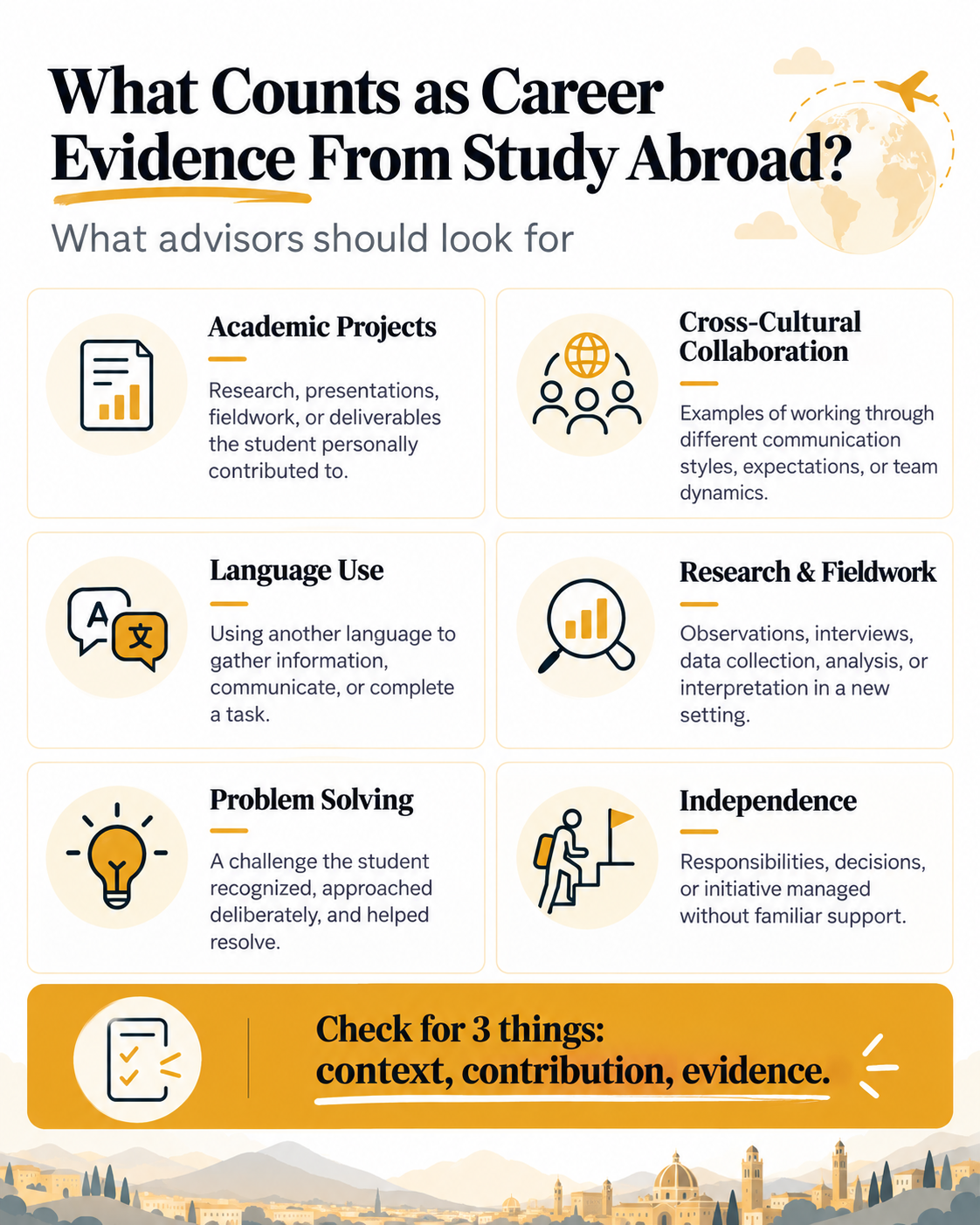
Career evidence is a specific action, contribution, or outcome that demonstrates a capability relevant to professional work. For study-abroad students, this evidence may come from academic projects, research, collaboration, language use, or challenges handled independently. Your task as an advisor is to identify what students actually demonstrated rather than assume competencies based on participation.
For example, studying in another country does not automatically demonstrate cross-cultural communication.
Working with classmates who approach decisions differently, adjusting communication, and completing a shared assignment offers a more concrete example.
Career advisors can use the following framework to examine common study-abroad experiences.
| Experience | What advisors should investigate | Potential career evidence |
|---|---|---|
| Academic projects | What did the student personally produce or contribute? | Research findings, project deliverables, presentations |
| Cross-cultural collaboration | How did the student work through differences in communication or expectations? | Coordinated responsibilities, resolved misunderstandings, completed shared tasks |
| Language use | When was another language necessary to accomplish something? | Conducted interviews, communicated with local stakeholders, gathered information |
| Research and fieldwork | What methods did the student use, and what did they discover? | Data collection, observations, analysis, research findings |
| Problem-solving | What unfamiliar challenge required a deliberate response? | Decisions made, alternatives evaluated, solutions implemented |
| Independence | What did the student manage without familiar support? | Planning, prioritization, initiative, independent judgment |
Advising distinction: Exposure is not the same as demonstrated ability.
A student may have experienced different cultural practices without actively applying cross-cultural communication skills.
Similarly, navigating an unfamiliar city may demonstrate independence, but it does not necessarily establish professional leadership.
The evidence should support the competency being claimed.
How Can Advisors Help Returning Students Identify and Document Career Evidence?
Career advisors can help returning students identify career evidence through structured reflection sessions that examine specific experiences, individual contributions, and demonstrable outcomes. These sessions should ideally take place within the first few weeks after students return, while details of their projects, challenges, and interactions are still fresh.
Run a 30-Minute Post-Return Reflection Session
| Time | Advisor activity | Expected output |
|---|---|---|
| 5 minutes | Identify significant projects, interactions, responsibilities, and challenges | Short experience inventory |
| 10 minutes | Examine two situations where the student made a meaningful contribution | Specific actions and decisions |
| 10 minutes | Identify the capabilities demonstrated and supporting evidence | Two evidence-backed examples |
| 5 minutes | Discuss where those examples could be relevant professionally | Initial employer or role connections |
The University of Virginia offers a practical example of this approach.
Each semester, UVA Education Abroad and the UVA Career Center jointly offer a returnee workshop that helps students identify competencies developed abroad and explain their experiences in professional contexts.
Career centers can adopt a similar model by integrating guided reflection into existing returnee programming rather than relying entirely on individual advising appointments.
Ask Questions That Reveal Individual Contributions
Instead of asking students which skills they developed abroad, focus on what happened and how they responded.
For example, a student might initially say, "I learned to collaborate with people from different cultures."
Follow-up questions could reveal that the student worked on a research assignment with classmates from four countries, helped resolve disagreements about responsibilities, and introduced a shared schedule that kept the project on track.
Advisors can use similar questions to explore other experiences:
- Projects: What did you personally contribute to the assignment?
- Collaboration: What differences or disagreements affected the work, and how did you respond?
- Language: When did you use another language to accomplish something specific?
- Research: What information did you collect or analyze?
- Problem-solving: What unexpected challenge required you to change your approach?
- Independence: What decisions or responsibilities did you manage without familiar support?
For students who complete research projects abroad, advisors can apply similar approaches used to translate undergraduate research into career evidence.
Create a Record Students Can Revisit
Before the session ends, ask students to document their two strongest examples using three fields:
- Situation: What happened, and what responsibility or challenge was involved?
- Contribution: What did the student personally do or decide?
- Evidence: What outcome, deliverable, or observable result supports their explanation?
Not every experience needs a numerical result. A completed project, a resolved misunderstanding, or a well-supported decision may provide credible evidence.
The resulting record gives advisors and students a reference point for future discussions about internships, jobs, and employer expectations without requiring them to reconstruct the experience months later.
Career centers can also incorporate these sessions into broader advising debrief loops that help students reflect on experiences throughout their academic journey.
How Can Advisors Translate the Same Study-Abroad Experience for Different Employers?
Different employers may value different aspects of the same international experience. Career advisors should help students select evidence based on the responsibilities of a target role, while preserving what actually happened. The objective is not to create multiple versions of the experience but to explain its relevance from different professional perspectives.
Consider a student who completed an environmental research project during a semester abroad.
The student collected field observations, worked with international classmates, and presented findings about a local environmental issue.
The relevance changes depending on the employer.
| Employer or role | What may matter most | Evidence the student could explain |
|---|---|---|
| Environmental research organization | Research methods and analytical judgment | Collected field observations, analyzed findings, identified limitations |
| Consulting firm | Problem-solving and collaborative project execution | Structured an unfamiliar problem, coordinated tasks, developed recommendations |
| International nonprofit | Community awareness and communication | Worked with local participants, adapted communication, incorporated different perspectives |
| Corporate project team | Coordination and independent execution | Managed assigned responsibilities, addressed project obstacles, met deliverable requirements |
These connections should be treated as possibilities, not automatic claims about what all employers value.
Career advisors can make the translation more precise by examining actual role descriptions and asking:
- Which responsibility in this role is genuinely comparable to something the student did abroad?
- Which part of the experience provides the strongest evidence of that capability?
- What context would an employer unfamiliar with the country, institution, or academic program need to understand the contribution?
At UCLA, the International Education Office and Career Center jointly developed a Study Abroad Returnees Handbook to help students reflect on their experiences, identify relevant skills, and communicate their value to employers.
A similar resource can help career centers give students a consistent process for translating their experiences into professional evidence, particularly when students cannot attend a dedicated advising session.
This evidence-based approach also aligns with what recruiters look for in college students, particularly when evaluating communication, teamwork, problem-solving, and individual contributions.
Help students explain unfamiliar international contexts
An employer may not know the host institution, the program's academic requirements, or the significance of a particular assignment.
Students therefore need to explain the work itself rather than rely on the international setting to communicate its importance.
For example, saying "I participated in a research project at a university in Spain" leaves the employer with little understanding of the student's contribution.
Explaining that the student interviewed local participants, compared findings across groups, and contributed to an analysis of transportation patterns establishes a clearer professional connection.
The country provides context. The student's actions provide the evidence.
Career advisors should also avoid directing every study-abroad student toward internationally focused roles. Research, communication, collaboration, and independent judgment can be relevant to domestic employers when supported by specific examples.
How Can Career Services and Education-Abroad Offices Work Together?
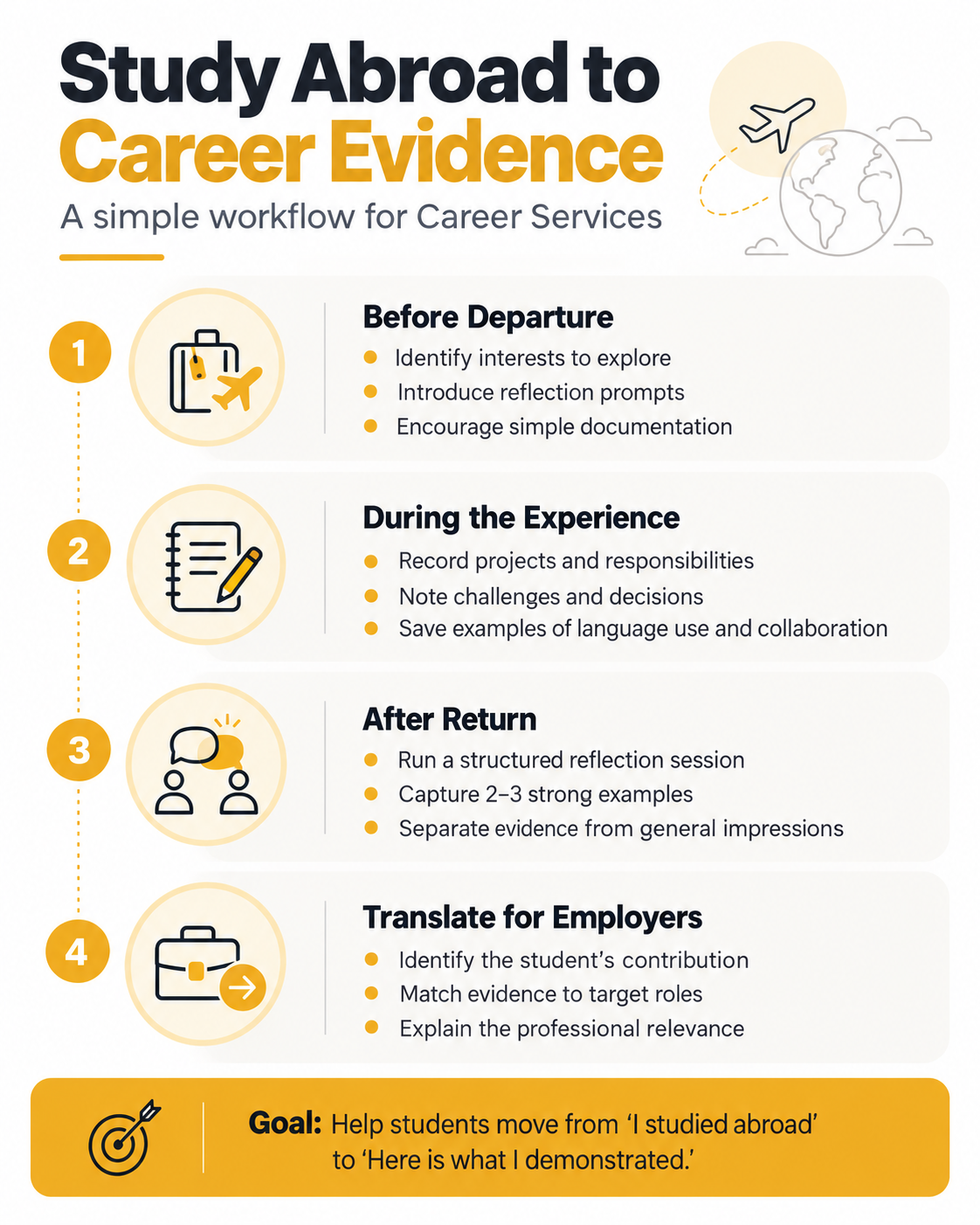
Career Services and education-abroad offices can make career reflection a natural part of the study-abroad experience without changing the program's academic purpose. Education-abroad staff provide the program context and direct access to participants, while career advisors help students recognize evidence and explain its professional relevance.
The collaboration is most useful at two points: before students depart and shortly after they return.
Before Departure: Help Students Identify What to Document
Career Services can contribute to existing pre-departure orientations by helping students recognize experiences worth documenting while abroad.
Advisors can introduce a few questions:
- What academic or professional interests would you like to explore abroad?
- Which projects or activities might help you apply those interests?
- How will you record meaningful contributions, challenges, or decisions?
Students can maintain a brief weekly record of projects, interactions, and responsibilities without needing to predict which competencies they will develop.
The University of Minnesota's Career Integration initiative, developed by the Learning Abroad Center in partnership with campus career services, provides an example of this approach. It connects career goal-setting before departure with reflection during the experience and communication of professional learning afterward.
Education-abroad offices can incorporate similar prompts into existing program materials, giving students a consistent way to document experiences they can revisit during post-return career advising.
After return: Connect experience reflection with career advising
Education-abroad offices can incorporate Career Services referrals into existing returnee communications and events.
A joint workshop could bring returning students together to:
- Identify two meaningful academic or collaborative experiences.
- Explain their individual contributions.
- Distinguish demonstrated abilities from general personal growth.
- Discuss how the evidence relates to different professional roles.
Students who need more support can continue the discussion during individual career advising appointments.
Final Thoughts
Study abroad can provide meaningful career evidence, but students often need guidance to identify what they demonstrated and explain why it matters to employers.
By working with education-abroad offices before and after the experience, Career Services can make that translation a more consistent part of student support.
The next step is helping students apply that evidence throughout their career preparation.
Hiration supports this process with career assessments, AI-powered resume optimization, interview simulations, and LinkedIn profile optimization. Its dedicated Counselor Module also helps career services teams manage student cohorts, workflows, and analytics within a FERPA- and SOC 2-compliant platform.
Book a walkthrough to see how Hiration can help your students turn meaningful experiences into stronger career opportunities while helping your team scale personalized support.