What should career centers post on TikTok and Instagram?
Career centers should post short, practical, student-centered content on TikTok and Instagram instead of relying only on event flyers or repurposed LinkedIn updates. TikTok works best for direct videos that answer common student questions, correct career mistakes, show short scenarios, respond to comments, and feature student or alumni perspectives. Instagram should be used as a more organized guidance library through Reels, carousels, Stories, Highlights, event walkthroughs, polls, and reminders. The goal is to give students one useful idea, one clear next step, or one realistic view of career preparation while keeping the posting cadence manageable for the career team.
If your career center is posting event flyers on Instagram, repurposing LinkedIn updates for TikTok, or struggling to decide what students would actually stop scrolling to watch, this guide is for you.
Your team needs a clear way to decide what belongs on each channel, how informal the tone should be, which formats are worth producing, and how often to post without creating an unsustainable workload.
This guide explains how career centers can use TikTok and Instagram differently from email and LinkedIn.
You will find practical post ideas for each platform, guidance on Reels, carousels, Stories, short videos, student-led content, and a realistic posting cadence that helps your team reach students without turning social media management into a full-time role.
How Should TikTok and Instagram Differ From Email & LinkedIn?
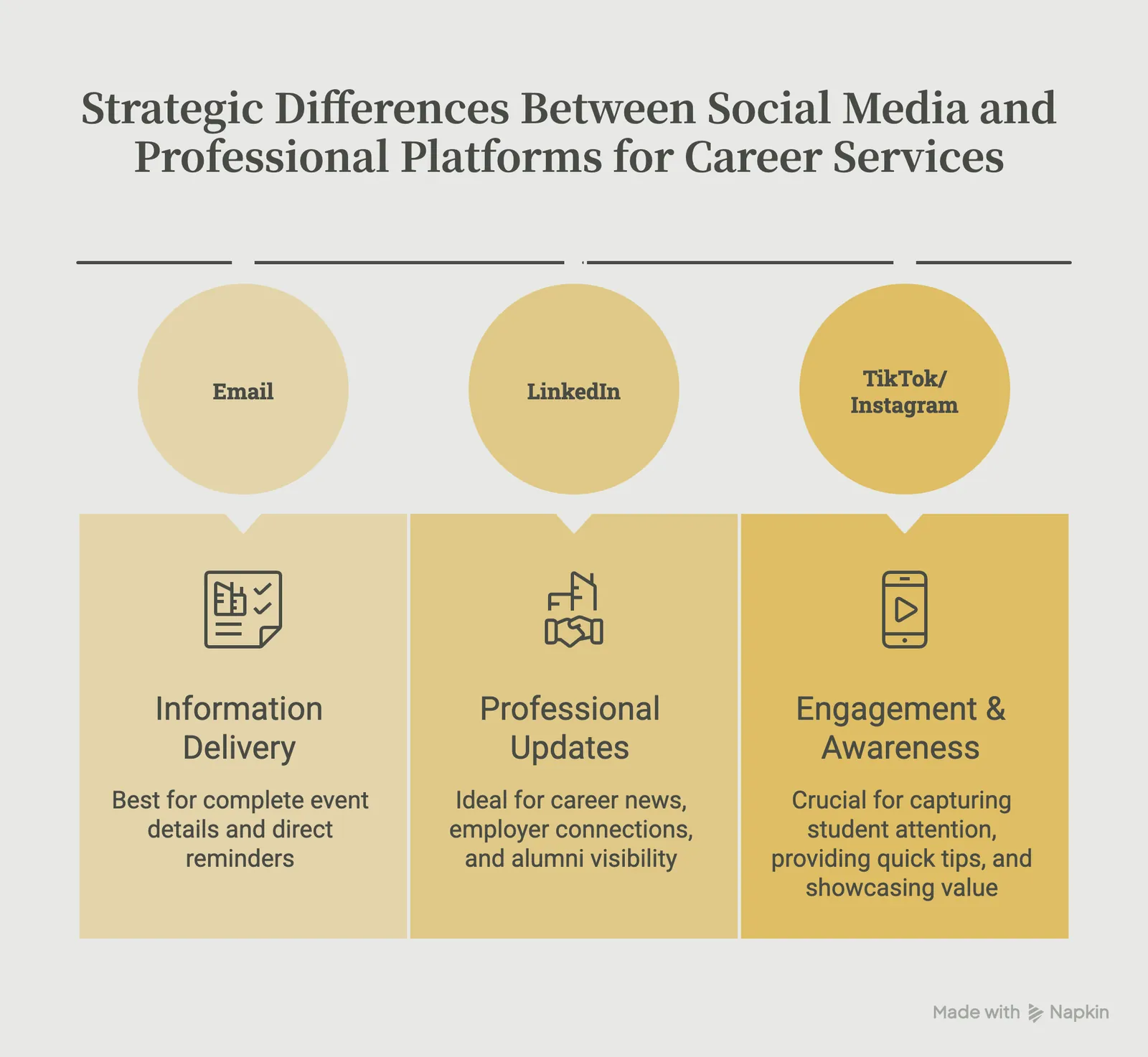
TikTok and Instagram should help students notice a career question, understand one immediate next step, and feel comfortable engaging with the career center. Email is better for delivering complete information and direct reminders. LinkedIn is better suited to professional updates, employer relationships, alumni visibility, and institutional credibility.
| Channel | Primary job | Best content | Typical student action |
|---|---|---|---|
| TikTok | Create discovery and interest | Short explanations, reactions, student perspectives, myths, timely advice | Watch, comment, share, visit the profile |
| Build familiarity and repeat engagement | Reels, carousels, Stories, event coverage, checklists | Save, share, reply, register | |
| Deliver complete information | Deadlines, instructions, event details, targeted outreach | Read, register, complete a task | |
| Reach professional audiences | Employer partnerships, alumni stories, outcomes, institutional updates | Comment, connect, share professionally |
A four-paragraph event announcement may work in an email because the student has already opened a direct message. On TikTok or Instagram, the content must earn attention before it can explain the event.
Instead of posting:
Register for our upcoming career fair next Thursday.
A social post could begin with:
The career fair is next week. Here are the three things to do before you walk in.
The registration link can still appear in the caption, Story, or profile. The post itself should provide enough immediate value to make the event feel relevant.
Rutgers University–Newark’s career services guidance recommends using Instagram and TikTok for consistent, authentic content such as quick career tips, student success stories, workshop footage, and student-created posts.
The important distinction is that the content demonstrates the value of career services instead of merely announcing its availability.
What Should Career Centers Post on TikTok?
Career centers should use TikTok to answer narrow career questions through direct, informal video. Each post should concentrate on one problem, one misconception, or one action a student can understand without previous knowledge of career services.
Answer the questions students hesitate to ask
Some of the strongest topics are questions students may consider too basic, awkward, or specific for an appointment:
- Is it too late to find a summer internship?
- Can a resume be longer than one page?
- What should a student say when an interviewer asks about salary?
- Is it acceptable to apply without meeting every requirement?
- What should a first-year student bring to a career fair?
- Does an unpaid campus role belong on a resume?
- What happens during a career coaching appointment?
An advisor can answer the question directly to camera in 20 to 45 seconds. The first sentence should state the question or problem. Lengthy introductions, department descriptions, and advisor credentials can be left out.
React to common career mistakes
Reaction videos allow advisors to show judgment rather than repeat generic advice. Possible formats include:
- An advisor reacts to a weak resume bullet.
- A recruiter explains why a job description is not a checklist.
- A career coach reviews a poor follow-up message.
- An employer relations specialist explains a suspicious job posting.
- An advisor compares a vague interview response with a stronger one.
Any student materials used should be fictional, anonymized, or shared with explicit permission.
The purpose is not to embarrass students. The post should make the mistake recognizable and show how to correct it.
Turn career preparation into short scenarios
TikTok works well when advice is placed inside a situation:
- “POV: Your interview begins in ten minutes.”
- “You found an internship, but the description asks for three years of experience.”
- “The recruiter says, ‘Tell me about yourself.’”
- “You attended the career fair and forgot to follow up.”
- “Your resume has six different versions and you no longer know which one to use.”
The advisor can then demonstrate the next step, provide a sample response, or identify the first decision the student should make.
Let students and alumni explain the experience
Students do not always need another institutional explanation of an internship, appointment, workshop, or recruiting process. They may respond better to someone describing what actually happened.
Possible prompts include:
- What surprised you during your first career coaching appointment?
- What did you change after receiving resume feedback?
- What do you wish you had known before your first internship?
- What happened at the career fair after you entered the room?
- How did you prepare for an interview while managing classes?
- What made you finally use the career center?
Penn State’s Instagram takeover guidelines ask participants to show internship responsibilities, everyday activities, projects, research, events, and experiences outside the formal program.
The same student-led approach can be adapted to TikTok through short internship diaries, “day in the life” clips, and reflective videos.
Reply to student comments with new videos
Comments can become an ongoing source of content. When one student asks whether a cover letter is still necessary, the answer can become a separate post available to every student with the same question.
This also changes the account from a broadcast channel into an advising surface. The career center is no longer guessing which questions students have. It is responding to questions students have already raised.
Use trends only when the connection is clear
A trending sound or format can help a post feel native to TikTok, but the trend should not become the entire idea. Career teams do not need to imitate every meme, dance, or creator format.
TikTok’s own creative guidance recommends creating specifically for the platform and its audience rather than transferring material created for another channel. It also notes that there is no single formula for successful TikTok content.
A trend is useful when it makes the career message easier to understand. It should be skipped when the connection requires a lengthy explanation or makes the career center appear to be performing youth culture rather than helping students.
What Should Career Centers Post on Instagram?
Career centers should use Instagram to build a reliable library of career guidance while keeping students aware of current opportunities and events. Reels can create reach, carousels can organize information, and Stories can support timely interaction and reminders.
Instagram’s professional Best Practices hub provides guidance on areas such as posting frequency, capturing attention, Reel length, engagement, reach, and the relationship between Reels and follower growth.
This reinforces the need to plan Instagram as several distinct formats rather than treating every post as a static feed graphic.
Use Reels for one clear explanation
Instagram Reels can cover many of the same subjects as TikTok, but the presentation can be slightly more structured.
Useful Reel formats include:
- Three ways to strengthen a resume bullet
- What to do one week before a career fair
- One interview mistake and how to correct it
- What career coaches look for during a resume review
- How to introduce yourself to an employer
- What to expect during a mock interview
- One career resource students are overlooking
TikTok versions can feel more spontaneous and conversational. Instagram versions can use a clearer cover, more deliberate captions, and a stronger connection to related resources saved in the profile.
Cross-posting is reasonable, but the exported TikTok watermark, references to another platform, and platform-specific captions should be removed.
Use carousels for content students may need later
Carousels are appropriate when the student needs to save, revisit, or follow several steps.
Suitable topics include:
- A career fair preparation checklist
- Questions to ask before accepting an internship
- A five-step resume review process
- What to include in a recruiter follow-up
- Interview preparation across the final 24 hours
- Signs that a job posting may be fraudulent
- What to bring to a career coaching appointment
- How to choose between two offers
Each slide should communicate one idea. A carousel should not reproduce an entire workshop deck in smaller type.
The opening slide should state the student’s situation rather than the career center’s topic, following student-centered messaging principles. “You have a career fair next week” is more direct than “Career Fair Preparation Resources.”
Use Stories for interaction and urgency
Stories are better suited to time-sensitive communication and low-effort participation than the permanent feed.
Career centers can use Stories for:
- Event countdowns
- Same-day reminders
- Registration links
- Question boxes
- Career myth polls
- Workshop clips
- Advisor availability
- Employer arrival updates
- Student takeovers
- Post-event follow-up resources
For example, a career center could ask, “What is your biggest interview concern?” through a question box on Monday. The answers could become a Reel, carousel, or TikTok series later that week.
The University of Virginia’s School of Data Science used an Instagram takeover with interactive educational videos followed by a live conversation. Career centers can apply the same structure to internship reflection, alumni Q&As, employer conversations, and advisor office hours.
Build Highlights around recurring student needs
Stories disappear, but their most useful material can be organized into Highlights such as:
- Start Here
- Appointments
- Resumes
- Interviews
- Internships
- Career Fairs
- Graduate School
- International Students
- First-Year Students
- FAQs
Highlights should reduce the work required to find a resource. They should not become an archive of outdated posters and expired registration details.
Show events from the student’s point of view
Social promotion should support the broader event strategy of the career center by answering the questions students have before attending:
- What does the room look like?
- What are students wearing?
- How long is the line?
- What happens at check-in?
- Can students attend without a polished resume?
- Are employers speaking with first-year students?
- What should someone do after entering alone?
A short walkthrough or student-hosted Story can reduce uncertainty more effectively than another event flyer.
Cape Fear Community College’s takeover guidance allows students to show classes, activities, study habits, engaged learning, and everyday campus experiences through Instagram and TikTok.
This type of student perspective can make a career event feel more understandable and less formal before a student arrives.
How Should the Tone Change Between TikTok and Instagram?
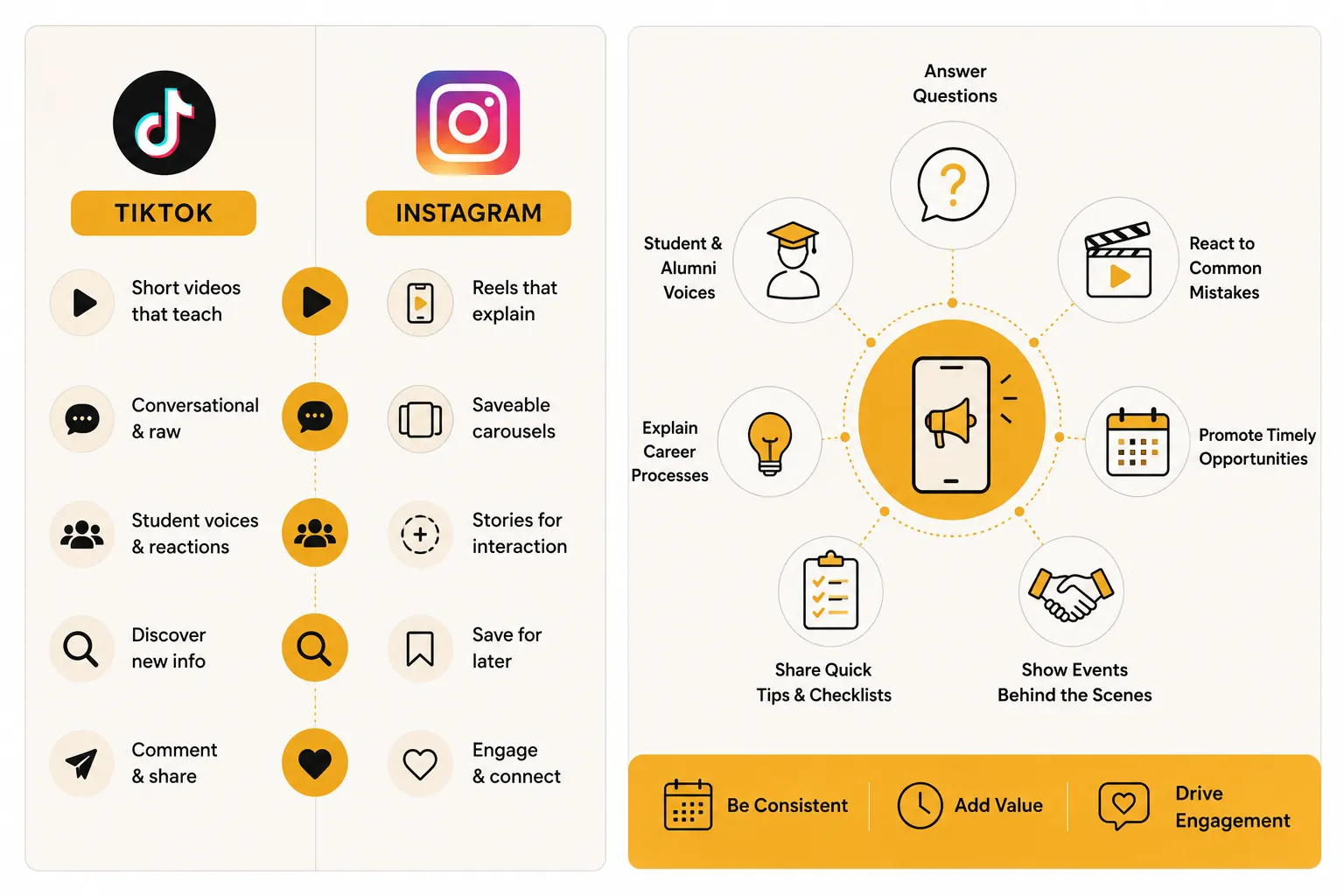
TikTok should sound like a useful conversation already in progress. Instagram should feel approachable but more organized. Neither channel should read like a university press release, policy memo, or LinkedIn announcement.
TikTok tone
TikTok content should be:
- Direct
- Conversational
- Specific
- Comfortable with minor imperfections
- Focused on one point
- Responsive to questions and comments
A TikTok opening might say:
You do not need to meet every qualification before applying. Here is what to check instead.
It should not begin with:
The Office of Career and Professional Development is pleased to provide students with the following job-search recommendation.
Instagram tone
Instagram can retain the same direct language while adding more structure:
Do not meet every requirement in the job description? Check these three areas before deciding not to apply.
The accompanying carousel or caption can then explain the three areas.
What should career centers avoid?
Career teams should avoid:
- Forcing slang that staff would not naturally use
- Copying student creators without understanding the format
- Turning every post into a promotion
- Treating student anxiety as a joke
- Using vague motivational statements without practical advice
- Writing captions filled with internal program terminology
- Reposting the same flyer repeatedly
- Giving complex advice without context or appropriate qualifications
- Featuring students, employers, or private materials without permission
Authenticity does not require advisors to behave like influencers. It requires the person, advice, and presentation to feel credible in the channel where the content appears.
TikTok’s research on creator-produced material emphasizes qualities such as authenticity, approachability, informativeness, believability, and entertainment.
Career centers can pursue the same qualities without abandoning professional standards.
How Often Should a Career Center Post?
Career centers should choose a cadence they can sustain through the semester rather than aiming for a high volume that disappears during busy periods. A practical starting cadence is two or three TikToks per week, two Instagram Reels, one carousel, and Stories on several active days.
This is a recommended starting point, not a universal posting formula.
| Channel and format | Sustainable starting cadence | During a major campaign |
|---|---|---|
| TikTok videos | 2–3 per week | 3–5 per week |
| TikTok comment replies | When useful questions appear | Several across the campaign |
| Instagram Reels | 2 per week | 3 per week |
| Instagram carousels | 1 per week | 1–2 per week |
| Instagram Stories | 3–5 days per week | Daily |
| Student or alumni takeover | 1 per month or term | Before or during a major event |
The exact frequency should reflect staffing, student behavior, production capacity, and the academic calendar. Instagram’s Best Practices feature provides account-specific recommendations, while TikTok’s guidance explicitly avoids presenting one fixed creative recipe.
Career centers without student creators can use a lighter production system:
- Monday: Record two or three advisor videos in one session.
- Tuesday: Publish one TikTok and add an Instagram Story poll.
- Wednesday: Publish an Instagram carousel based on a recurring advising question.
- Thursday: Publish the second TikTok or Reel and collect questions through Stories.
- Friday: Post a student perspective, event walkthrough, or response to a comment.
Several pieces can be recorded together without making them look identical. Change the question, speaker, location, or format while keeping production simple.
How Can Career Centers Keep Finding Useful Post Ideas?
Career centers do not need to invent a completely new campaign every week. Most content ideas already exist inside appointments, workshops, employer conversations, event questions, resource pages, and student feedback.
A simple monthly content mix can rotate through five categories:
Immediate career questions
Answer one question a student may be facing this week.
Examples include application deadlines, interview concerns, resume decisions, career fair preparation, and internship searches.
Career process explanations
Show what actually happens during an appointment, workshop, mock interview, employer event, or resume review.
These posts reduce uncertainty about using the career center.
Student and alumni perspectives
Feature internships, job searches, graduate school decisions, career changes, setbacks, and lessons learned.
The story should concentrate on a decision or experience, not only the final outcome.
Timely campus opportunities
Promote events, programs, employer visits, application periods, and recruiting deadlines by explaining why they are relevant.
The opportunity should be presented through the student problem it addresses.
Advisor judgment
Let career professionals explain how they assess a situation, compare options, or respond to a common mistake.
This shows students why career guidance involves more than downloading a template or following a generic checklist.
Carthage College’s Career Ambassador Program combined an Instagram takeover with career fair preparation and resume pop-up sessions.
The example shows how social content can support an existing career activity rather than operating as a separate communications project.
What Should Career Centers Post First?
Career centers starting from an inactive or flyer-heavy account should begin with recurring questions rather than a large launch campaign.
The first ten posts could include:
- What happens during a career coaching appointment?
- One resume bullet before and after revision
- Three things to do before a career fair
- A student explaining their first career center visit
- An advisor answering a comment about internships
- What to say when an interviewer asks, “Tell me about yourself”
- A Story poll about students’ biggest job-search concern
- A carousel showing how to follow up with a recruiter
- A behind-the-scenes look at an employer event
- One overlooked resource available through the career center
These posts provide several signals quickly. Career teams can see whether students respond more strongly to advisor explanations, student voices, event content, practical checklists, or interactive questions.
The next month of content should be based on those responses, not on a generic social media calendar created before any student has interacted with the account.
Wrapping Up
TikTok and Instagram can help career centers reach students earlier, answer common questions in a more accessible format, and make career support feel easier to approach.
The strongest content is not simply promotional. It gives students one useful idea, one clear next step, or a more realistic view of what career preparation involves.
The goal is to use each channel for what it does best. TikTok can create discovery through short, direct videos, while Instagram can support ongoing engagement through Reels, carousels, Stories, and student-led content.
Email and LinkedIn can then carry the more detailed information, professional updates, and formal calls to action.
Once students engage with that content, they still need a clear place to continue preparing.
Hiration supports that next step through a full-stack career readiness suite spanning career assessments, resume optimization, interview simulation, LinkedIn optimization, and other career preparation activities.
Career teams can manage cohorts, workflows, and analytics through a separate Counselor Module, all within a FERPA and SOC 2-compliant platform.
Book a walkthrough to see how Hiration can support the student journey beyond the social media post.
TikTok and Instagram for Career Centers — FAQs
What should career centers post on TikTok and Instagram?
Career centers should post practical content that answers student questions, explains career processes, shows real examples, promotes timely opportunities through a student problem, and gives students one clear next step. Strong formats include short videos, Reels, carousels, Stories, polls, student takeovers, event walkthroughs, and advisor Q&A posts.
How should TikTok and Instagram differ from email and LinkedIn?
TikTok and Instagram should help students notice a career question, understand one immediate action, and feel more comfortable engaging with the career center. Email is better for complete information and reminders, while LinkedIn is better for professional updates, employer relationships, alumni visibility, and institutional credibility.
What should career centers post on TikTok?
Career centers should use TikTok for narrow, direct, informal videos that answer one question, correct one misconception, or show one action. Useful topics include resume mistakes, internship questions, career fair preparation, interview answers, salary questions, follow-up messages, and what happens during a career coaching appointment.
What TikTok topics work well for career services?
Strong TikTok topics include questions students hesitate to ask, reactions to common career mistakes, short career-prep scenarios, internship or career fair tips, advisor responses to student comments, student success stories, alumni advice, and behind-the-scenes explanations of career center services.
Should career centers use TikTok trends?
Career centers can use TikTok trends when the connection to the career message is clear. A trend should make the advice easier to understand, not force staff into awkward content or make the career center appear to be performing youth culture without adding useful guidance.
What should career centers post on Instagram?
Career centers should use Instagram to build a reliable library of career guidance while keeping students aware of current opportunities. Reels can explain one idea, carousels can organize step-by-step guidance, Stories can support reminders and interaction, and Highlights can preserve recurring resources.
What career center content works best as Instagram Reels?
Instagram Reels work well for one clear explanation, such as three ways to improve a resume bullet, what to do before a career fair, one interview mistake to fix, how to introduce yourself to an employer, what happens during a mock interview, or one overlooked career resource.
What career center content works best as Instagram carousels?
Carousels work best when students need to save, revisit, or follow several steps. Suitable topics include career fair checklists, internship decision questions, resume review steps, recruiter follow-up messages, interview preparation timelines, job scam warning signs, and what to bring to a career coaching appointment.
How should career centers use Instagram Stories?
Career centers should use Stories for time-sensitive updates and low-effort interaction. Useful Story formats include event countdowns, same-day reminders, registration links, question boxes, career myth polls, workshop clips, advisor availability, employer updates, student takeovers, and post-event resources.
What Instagram Highlights should career centers create?
Useful Highlights include Start Here, Appointments, Resumes, Interviews, Internships, Career Fairs, Graduate School, International Students, First-Year Students, and FAQs. Highlights should help students find current resources quickly rather than archive expired posters or old registration details.
How should the tone differ between TikTok and Instagram?
TikTok should sound like a useful conversation already in progress: direct, specific, informal, and focused on one point. Instagram can be slightly more structured and organized while still avoiding press-release language, internal terminology, and overly formal announcements.
What should career centers avoid posting on TikTok and Instagram?
Career centers should avoid forcing slang, copying student creators without understanding the format, turning every post into a promotion, reposting the same flyer repeatedly, using vague motivational statements, treating anxiety as a joke, or sharing student materials without permission.
How often should career centers post on TikTok and Instagram?
Career centers should choose a cadence they can sustain. A practical starting point is two or three TikToks per week, two Instagram Reels, one carousel, and Stories on several active days. Smaller teams can reduce the cadence and batch-record content to avoid making social media a full-time role.
How can career centers keep finding useful social media ideas?
Career centers can find post ideas inside advising appointments, workshops, employer conversations, event questions, resource pages, student comments, and feedback forms. A simple monthly mix can include immediate career questions, process explanations, student perspectives, timely opportunities, and advisor judgment.
What should career centers post first on a new or inactive account?
Career centers should begin with recurring student questions rather than a large launch campaign. Useful first posts include what happens during a coaching appointment, one resume bullet before and after revision, three things to do before a career fair, a student’s first career center visit, and what to say when asked “Tell me about yourself.”
Should career centers cross-post TikTok videos to Instagram Reels?
Cross-posting can work when the content fits both platforms, but career centers should remove TikTok watermarks, platform-specific captions, and references that do not make sense on Instagram. Instagram versions can use clearer covers, stronger captions, and links to related resources.
How can student-led content support career center social media?
Student-led content can make career preparation feel more concrete and approachable. Students can describe internships, first appointments, career fair experiences, resume feedback, interview preparation, graduate school decisions, job-search lessons, and what made them finally use the career center.
How can Hiration support students after they engage with career center social posts?
Hiration can give students a clear next step after a TikTok, Reel, carousel, or Story by supporting career assessments, resume optimization, interview simulation, LinkedIn optimization, and other career preparation activities. Career teams can manage cohorts, workflows, and analytics through the Counselor Module in a FERPA and SOC 2-compliant platform.