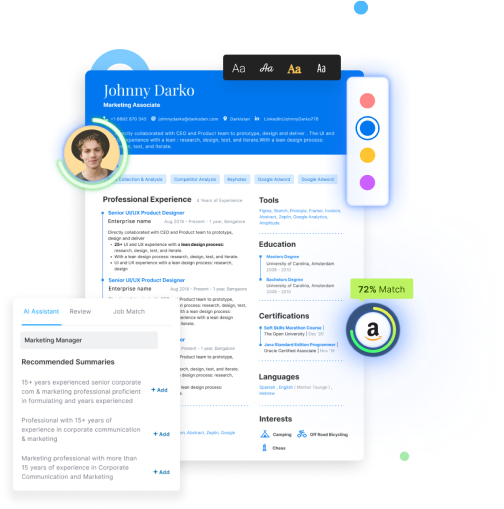
Why do some career centers choose Hiration instead of StandOut?
StandOut is a strong option for asynchronous video interview practice, but Hiration extends beyond interview preparation into resume optimization, cover letters, career exploration, job tracking, student outreach, and advisor reporting. For career centers looking to manage readiness across the entire student journey rather than a single activity, Hiration provides a broader platform with stronger workflow visibility, intervention capabilities, and student support tools.
If your career center is comparing StandOut alternatives, you are probably trying to figure out what you should actually evaluate.
Is the priority simply giving students a place to record mock interview answers? Or does your team also need students to review feedback, improve their resumes, prepare for specific roles, complete assigned practice, and give staff enough visibility to know who needs support?
That distinction matters because mock interview tools can look similar on the surface. Most promise practice, feedback, and scalability. The real difference is what happens around the interview.
This guide looks at StandOut through that lens and explains where Hiration fits for career centers that need interview practice connected to the broader student readiness journey.
Hiration vs StandOut at a glance
| Evaluation area | StandOut | Hiration | Why it matters for career centers |
|---|---|---|---|
| Core strength | Asynchronous video interview practice | Full career readiness platform with interview practice | Interview prep becomes more useful when it connects to the rest of the student journey |
| Interview practice | Video-based mock interviews, AI feedback, retry, share-by-link workflows | Role-based, resume-based, job-description-based, assigned, admission, and category-based interview practice where configured | Students prepare for different interview contexts instead of using one generic flow |
| Assignment workflow | Faculty and staff can create practices and review student recordings | Career teams can assign interviews and guide students through Start via Code | Useful for classes, workshops, events, cohorts, and targeted campaigns |
| Feedback model | AI feedback, reviewer comments, ratings, private notes | Interview review and feedback with broader student readiness context | Feedback works better when it connects to student goals, resume quality, and application readiness |
| Admin visibility | Engagement reporting is publicly mentioned, but dashboard depth appears limited in public materials | Admins can track student activity, product adoption, interview starts, interview completions, review checks, and students below defined score thresholds | Teams need action-ready data, not only usage counts |
| Student outreach | Public materials focus more on practice and review workflows | Admins can identify students needing support and contact them from the platform | This closes the gap between insight and intervention |
| Resume support | Interview-focused | Resume Builder, AI resume review, ATS checks, NACE skill analysis, WHO bullet analysis | Interview performance often depends on how clearly students understand and explain their own experience |
| Cover letter and CV support | Not a central public focus | Resume-to-cover-letter generation and CV support | Helpful for students applying across jobs, internships, research, academic, healthcare, and graduate pathways |
| Career exploration | Not a central career-center feature | Career Compass with quiz-based guidance and O*NET-backed career data | Supports students before they reach the interview stage |
| Job search support | Not a central career-center feature | Job Tracker and AI-supported job search | Helps students move from preparation to active opportunity tracking |
| Best fit | Centers that mainly need video-first mock interviews and distributed reviewer workflows | Centers that want one platform for preparation, practice, tracking, reporting, and outreach | Hiration fits teams looking to consolidate career readiness support |
Free Migration Checklist
Planning a Career Platform Switch?
Use this checklist to prepare for a career platform switch before your current contract ends. It covers notice periods, data exports, templates, rubrics, rosters, staff access, SSO, vendor questions, setup, and launch.
Download the Free Migration ChecklistWhat does StandOut do well?
StandOut has a clear role in higher education: it helps students practice interviews asynchronously.
Students can record responses, retry answers, receive AI feedback, review their performance, and share recordings with faculty, career staff, peers, mentors, or other reviewers. That makes it useful for career centers that want to reduce the scheduling burden of mock interviews.
StandOut also works well when interview practice needs to move into courses. Faculty can create practices, add questions, set rules, review responses, and use comments or ratings. That is helpful for business courses, nursing programs, capstones, first-year seminars, and other structured career preparation programs.
The platform also has a cross-campus story. Its public higher-ed positioning spans career services, classroom practice, admissions, scholarship screening, and campus hiring. For institutions that want one video interview layer across several departments, that can be attractive.
So the short answer is simple: StandOut is strong when the main problem is scalable video interview practice.
Where can StandOut feel limited for career centers?
StandOut becomes less compelling when the career center needs more than interview recordings.
Most career teams do not treat mock interviews as a standalone service. Interview readiness usually depends on several earlier steps:
- Does the student know which role they are targeting?
- Does the student’s resume clearly show relevant experience?
- Can the student explain their projects, internships, coursework, or campus work?
- Has the student tailored their story to the job description?
- Has the student applied to enough relevant roles?
- Can the advising team see which students are stuck?
StandOut supports the practice moment. The public evidence makes that clear.
The limitation is the surrounding workflow. Public materials show less depth around enterprise documentation, detailed role-based admin architecture, reporting granularity, data exports, FERPA-specific language, LMS/LTI/API/SCORM documentation, and native rubric-authoring depth.
That does not prove those capabilities are absent. It means buyers may need more diligence during procurement.
For career centers, this creates a practical question: is the team buying a mock interview tool, or is the team trying to improve career readiness at scale?
If the answer is the second one, Hiration becomes a stronger alternative.
Why does Hiration work as a StandOut alternative?
Hiration covers mock interview prep, but it does not stop at the mock interview.
Students can practice interviews in several ways, including role-based practice, resume-based practice, job-description-based practice, assigned interviews from the career center, admission interview practice, and category-driven interview practice where configured.
That flexibility is key because students rarely prepare for interviews in one standard way.
A first-year student may need basic behavioral practice. A business student may need role-specific interview preparation. A nursing student may need program-specific questions. A student applying to internships may need practice tied to a job description. A graduate student may need admission interview prep.
Hiration gives career teams more ways to route students into the right practice experience.
The Start via Code flow also gives staff a simple assignment mechanism. A student can enter an interview code, see the interview summary, continue an incomplete attempt, view progress, and start over where applicable.
That works well for workshops, classes, employer events, targeted campaigns, and cohort-based programming.
Instead of sending every student to a generic practice library, staff can guide them into the exact interview practice they need.
What does Hiration add beyond mock interview practice?
This is where Hiration separates itself from StandOut.
StandOut focuses heavily on the interview practice layer. Hiration connects interview practice to the larger student readiness journey.
Resume Builder and AI resume review
Many students struggle in interviews because they cannot clearly explain their own experience. A weak resume often signals the same problem. Students may list tasks without showing skills, methods, impact, or relevance.
Hiration helps students build professional resumes and improve them through AI-powered review. It checks structure, readability, and ATS compatibility. It also helps students create a resume that career teams can use as a readiness signal.
For career centers, resume creation and resume downloads show more than platform usage. They show whether students are taking concrete preparation steps before applying.
NACE Skill Analysis
Hiration can analyze resumes against the eight NACE career readiness competencies when the feature is enabled. It separates competencies into demonstrated and not clearly shown, and it can provide student-facing feedback and evidence from the resume.
This is useful for career centers that already use NACE competencies in advising, reporting, employer conversations, or student learning outcomes.
Instead of treating resume review as a formatting exercise, Hiration connects resume quality to employability skills.
WHO Bullet Analysis
Hiration reviews resume bullets through the WHO framework: What the student did, How they did it, and the Outcome of the work.
This helps students move beyond duty-based bullets like “Worked on social media campaigns” and add the missing context: the action, method, tool, project scope, or measurable result.
For interview prep, stronger resume bullets give students stronger stories to use in behavioral answers. When students can clearly explain what they did, how they did it, and what changed, they answer with more confidence and detail.
ATS compatibility review
Hiration also checks ATS-friendly structure, including layout, section headings, readability, and formatting issues such as tables or complex layouts.
This helps students create resumes that work for both applicant tracking systems and human reviewers, while giving career centers a scalable way to teach structure without manually correcting every formatting issue.
Resume-to-cover-letter generation
Hiration lets students generate a cover letter from their resume. The system maps resume content to a cover letter template, then students can edit and refine the draft.
This helps students move faster from preparation to application. It also keeps the cover letter connected to the student’s actual experience.
CV Builder
Some students need CVs instead of standard resumes. This includes students pursuing academic, research, healthcare, graduate school, international, or professional pathways.
Hiration supports CV creation, which helps institutions serve a wider range of student goals.
Career Compass
Hiration also supports career exploration through Career Compass, which uses student inputs, quiz responses, and O*NET-backed career data to help students discover possible paths.
This matters because many students reach the career center before they know what role to target. Interview practice helps once a student has a direction. Career Compass helps earlier, when the student still needs structure.
Job Tracker and AI-supported job search
Hiration includes a Job Tracker with AI-supported job search capabilities. Students can provide preferences such as role and location, then use AI support to find relevant opportunities and stay organized.
This moves the platform beyond preparation. Students can explore careers, build documents, practice interviews, track jobs, and manage their search in one ecosystem.
Why does this matter for career center teams?
Career centers need more than student-facing tools. They need operating visibility.
A mock interview platform may show that students practiced. That is useful. But career teams also need to know what happened before and after the practice.
Hiration gives career teams visibility into actions such as:
- Students signed up
- Resumes created
- Resumes downloaded
- Interviews started
- Interviews completed
- Interview reviews checked
- Students below defined score thresholds
- Student groups needing attention
- Product adoption by cohort or group
That kind of visibility helps staff move from general reporting to targeted support.
For example, a team may see that many students started an interview but did not check their review. That creates a clear intervention: send a reminder, run a short workshop, or ask advisors to follow up with that cohort.
A team may see that a group of students falls below a defined score threshold. That creates another intervention: email those students directly from the platform, assign a new practice, or invite them to a coaching session.
This is the difference between a practice tool and a career center workflow.
How Hiration supports advisor workflows better
Career centers often face the same issue: students use tools unevenly.
Some students prepare early. Others wait until the week before an interview. Some complete a resume but never practice. Some practice once but never review their feedback. Some need help but never schedule an appointment.
Hiration gives advisors more ways to see these patterns.
The platform supports student management, cohort-based tracking, assigned activities, student performance visibility, resume and interview review workflows, admin controls, reporting, and outreach from the platform.
That helps advising teams answer practical questions:
| Career center question | Why it matters | How Hiration helps |
|---|---|---|
| Which students have started preparing? | Shows early engagement | Tracks signups and product usage |
| Which students created a resume? | Shows document readiness | Tracks resume creation |
| Which students downloaded a resume? | Shows application readiness | Tracks resume downloads |
| Which students practiced interviews? | Shows interview preparation activity | Tracks interview starts and completions |
| Which students reviewed feedback? | Shows whether practice turned into learning | Tracks interview review checks |
| Which students need support? | Helps advisors prioritize outreach | Groups students below defined score thresholds |
| Which cohorts are adopting the platform? | Helps leaders measure program reach | Tracks adoption by cohort or group |
| Can staff act on the data? | Reporting only matters when it drives follow-up | Allows student outreach from the platform |
This is where Hiration’s alternative positioning becomes practical. It gives career teams a way to manage readiness, not only provide practice.
Also Read: Can One Tool Replace Five? Consolidating Career Services Tech Stack
Final Takeaway
StandOut gives career centers a solid way to scale mock interview practice. It works well for asynchronous video interviews, AI feedback, re-recording, sharing, and distributed review.
Hiration is the stronger alternative when a career center wants interview practice connected to the full preparation journey.
Students can explore career paths, build resumes and CVs, improve resume quality, generate cover letters, practice interviews, review feedback, track jobs, and search for opportunities with AI support.
Career teams can assign activities, track engagement, monitor student progress, review student work, identify students who need help, contact students from the platform, and measure adoption by cohort or group.
That broader scope is crucial because career readiness rarely happens inside one isolated activity. Instead of using one tool for mock interviews, another for resumes, another for cover letters, another for exploration, and another for job tracking, career teams can bring more of the student journey into one system.
Students get a simpler experience, staff get better visibility, and leaders get clearer reporting around readiness actions.
Hiration offers a full-stack career readiness suite that spans the student journey, including Career Assessments, AI-powered Resume Optimization, Interview Simulation, LinkedIn and cover letter support, and a dedicated Counselor Module for managing cohorts, workflows, and analytics within a secure, FERPA and SOC 2-compliant platform.
Career centers evaluating StandOut alternatives should look closely at where interview prep fits inside their larger operating model.
If the goal is to support students from exploration to application, Hiration is the cleaner, more scalable choice.
Hiration vs StandOut — FAQs
What does StandOut do well?
StandOut is designed around asynchronous video interview practice, allowing students to record responses, receive AI feedback, re-record answers, and share recordings with reviewers.
Where can StandOut feel limited for career centers?
StandOut focuses primarily on interview practice and public materials provide less visibility into broader career readiness workflows such as career exploration, resume development, job tracking, outreach, and intervention management.
How does Hiration approach interview preparation differently?
Hiration supports multiple interview pathways, including role-based, resume-based, job-description-based, assigned, admission, and category-based interview practice where configured.
What does Hiration offer beyond mock interviews?
Hiration includes resume building, AI resume review, ATS checks, cover letter generation, CV creation, career exploration tools, job tracking, and AI-supported job search features.
How does Hiration support career exploration?
Through Career Compass, students can explore potential pathways using guided assessments and O*NET-backed career data before moving into application and interview preparation.
What is WHO Bullet Analysis?
WHO Bullet Analysis evaluates resume bullets based on What the student did, How they did it, and the Outcome achieved, helping students create stronger evidence and interview stories.
How does Hiration help advisors identify students who need support?
Advisors can track activity such as resume creation, interview completion, review engagement, adoption patterns, and students falling below defined readiness thresholds.
Why does platform visibility matter for career centers?
Visibility allows teams to identify stalled students, target outreach, measure adoption, monitor readiness activities, and intervene before students disengage from the preparation process.
Which type of career center is the best fit for StandOut?
StandOut is often a strong fit for institutions primarily seeking scalable asynchronous video interview practice and distributed review workflows.
Which type of career center is the best fit for Hiration?
Hiration is often a stronger fit for teams looking to consolidate career exploration, resume support, interview preparation, job search management, reporting, and student outreach within a single platform.