How can career centers standardize cover letter feedback without losing coaching quality?
Career centers can make cover letter reviews faster, fairer, and more scalable by using a shared evaluation rubric. Strong rubrics separate structural mechanics from higher-value narrative coaching, establish consistent scoring criteria, support peer and AI-assisted reviews, and help advisors focus on how well students connect their experiences to an employer's specific needs.
Cover letter reviews can quickly turn into inconsistent line edits when advisors do not have a shared standard.
One student gets grammar feedback, another gets formatting notes, and the deeper question often goes untouched: does the letter clearly connect the student’s experience to the employer’s needs?
A strong rubric helps teams move beyond subjective feedback and make cover letter coaching faster, fairer, and easier to scale.
This guide explains how to build a cover letter review rubric, what criteria to include, how to separate mechanics from narrative coaching, and how advisors can use the rubric across drop-ins, workshops, 1:1 appointments, peer reviews, and AI-supported review workflows.
Why should career centers use a cover letter rubric instead of manual review?
Implementing a standardized rubric reduces subjective, ad-hoc feedback and creates a more consistent standard across students. A rubric can also accelerate the review process, establish clear benchmarks, and give teams a more structured way to identify recurring strengths and gaps in student writing.
When advisors critique cover letters without a standardized framework, they defaults to editing grammar or nitpicking formatting. This completely glosses over strategic messaging.
Furthermore, the document still carries immense weight in the job market.
According to Harvard Business Review, cover letters still matter, even if they’re not mandatory in the application.
A rubric protects your staff from giving conflicting advice. It transforms a highly subjective piece of writing into an objective, data-backed assessment tool aligned with institutional key performance indicators (KPIs).
What should a cover letter rubric include?
A comprehensive rubric covers design, formatting, introduction, core narrative, and closing. Rather than grading on pure aesthetics, it evaluates core NACE competencies like communication and professionalism. Effective rubrics grade structural precision alongside high-impact content, ensuring the student effectively connects their background to the employer's specific organizational needs.
To build a rigorous rubric, avoid vague categories like "Good Writing." Instead, segment your assessment into highly trackable performance brackets.
For example, look at the Cal Poly Humboldt Cover Letter Scoring Rubric, which scores students across a 1, 3, 5-point scale spanning "Not Acceptable," "Acceptable," and "Exemplary."
Your rubric should contain these core criteria:
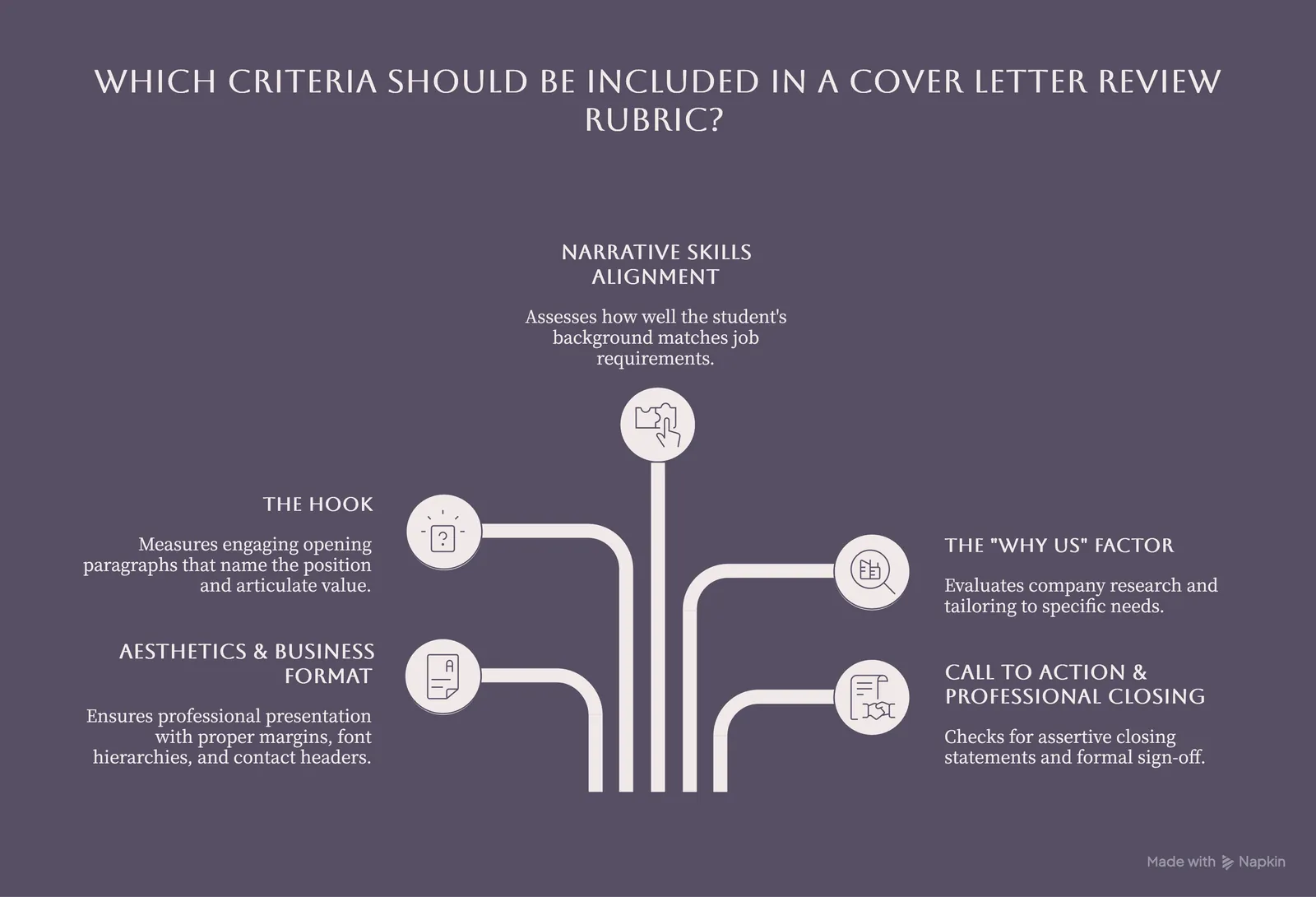
- Aesthetics & Business Format: Evaluates proper margins, clean font hierarchies, professional contact headers, and a strict one-page limit.
- The Hook (Opening Paragraph): Moves beyond dry clichés. It measures whether the student explicitly names the position and articulates an immediate, engaging value statement.
- Narrative Skills Alignment: Measures how well the student maps their personal background to the explicit needs of the job description.
- The "Why Us" Factor (Tailoring Index): Grades the depth of company research. Look for references to specific organizational challenges, recent initiatives, or corporate culture rather than generic praise, assessing how well the student positions themselves as an immediate solution to the employer's needs.
- Call to Action & Professional Closing: Checks for an assertive closing statement, reference to attached documents, and a formal sign-off.
- Writing & Communication: Evaluates whether the letter is clear, concise, professional, easy to follow, and largely free from grammar or spelling issues.
Sample cover letter rubric for career centers
Career centers can translate those criteria into a common scoring sheet that students, peer coaches, and professional advisors use throughout the review process.
The example below uses three performance levels and a 1, 3, 5 scoring scale. Teams can adjust the language, criteria, or weighting to reflect their own advising philosophy and employer expectations.
| Criterion | 1 - Needs Revision | 3 - Meets Expectations | 5 - Strong |
|---|---|---|---|
| Business Format & Presentation | Multiple formatting, layout, or professionalism issues make the document difficult to scan or inconsistent with business-letter conventions. | Uses an appropriate business-letter format with only minor layout or presentation issues. | Uses a clean, consistent, professional format that makes the letter easy to read and review. |
| Opening Paragraph | Uses a generic opening, does not clearly identify the target role, or gives the reader little reason to continue. | Clearly identifies the role and establishes relevant interest in the opportunity. | Opens with a specific, engaging connection between the student, the opportunity, and the value they could bring. |
| Narrative Skills Alignment | Lists experiences or skills without clearly connecting them to the employer's needs. | Connects relevant experiences and skills to important requirements of the role. | Uses specific evidence, examples, and outcomes to demonstrate how the student's background addresses the employer's needs. |
| Employer Tailoring | Relies on generic statements that could be sent to almost any employer. | Shows some knowledge of the organization, role, or industry. | Demonstrates specific understanding of the employer and clearly connects that context to the student's motivation and fit. |
| Professional Closing | Closing is generic, incomplete, or missing a clear expression of interest. | Ends professionally and reinforces interest in the opportunity. | Reinforces fit and interest while leaving the reader with a clear, confident final impression. |
| Writing & Communication | Frequent clarity, tone, grammar, or spelling problems distract from the message. | Writing is clear and professional with only minor issues. | Writing is concise, persuasive, specific, and consistently professional throughout. |
A shared rubric also gives advisors a clearer way to explain why a section needs work. Instead of telling a student that an opening is "weak" or a letter "needs more tailoring," the advisor can point to the relevant criterion, explain the gap between performance levels, and give the student a concrete revision target.
That makes the rubric useful as both an evaluation tool and a teaching tool.
How should career centers score a cover letter rubric?
Career centers can score the rubric by assigning points to each performance level and then using the total as a diagnostic rather than treating it as a traditional academic grade.
For the six-criterion example above, a 1, 3, 5 scoring model produces a maximum score of 30.
A sample interpretation might look like this:
| Total Score | Interpretation | Suggested Next Step |
|---|---|---|
| 6-14 | Significant revision needed | Student addresses major structural and content gaps before moving to deeper advisor review. |
| 15-23 | Developing | Student focuses revision on the lowest-scoring criteria, with targeted peer or advisor feedback where needed. |
| 24-30 | Strong | Draft is ready for a final strategic review focused on positioning, specificity, employer alignment, and nuance. |
These bands should be treated as a starting framework, not universal thresholds. A career center may decide that some criteria deserve more weight than others or that students must meet a minimum standard in specific categories before advancing.
For example, a team might require students to meet the baseline score for Business Format & Presentation before using a 1:1 appointment for narrative coaching.
Another center may weigh Employer Tailoring and Narrative Skills Alignment more heavily because those areas better reflect the kind of strategic feedback its professional staff wants to prioritize.
The purpose of the score is not simply to label a cover letter as good or bad. It is to identify where the student needs help and what level of intervention makes sense next.
How to separate structural issues from higher-value narrative feedback?
Separate these elements by splitting your rubric into two operational tiers: foundational mechanics and strategic storytelling. Structural elements like margins, typos, and business layouts are evaluated through binary checklist criteria. This keeps advisors from spending limited 1:1 appointment time on routine grammar and formatting corrections, allowing them to focus strictly on narrative depth.
To solve this, implement a strict Two-Tier Review System:
| Review Tier | Focus Areas | Evaluation Method | Who Handles It? |
|---|---|---|---|
| Tier 1: Structural Mechanics | Margins, fonts, formatting consistency, length, grammar, spelling, business letter structure, and basic professionalism | Binary pass/fail checklist based on predefined formatting and completeness standards | Peer coaches, AI-supported reviewers, or self-service quality checks |
| Tier 2: Strategic Narrative | Opening hook, motivation, behavioral examples, evidence of impact, employer alignment, and overall persuasiveness | Qualitative rubric using a 1–5 scale across clarity, specificity, relevance, and storytelling quality | Professional career advisors or experienced writing coaches |
By making a passing Tier 1 score a prerequisite for an advisor-led Tier 2 narrative review, you shift accountability back to the student.
This frees up your professional staff to focus on deep, conversational coaching.
Also Read: Resume Rubric Framework for Career Centers: How to Standardize Reviews
How can advisors use the rubric for quick triage, workshops, & 1:1 appointments?
Advisors can use the rubric as a multi-modal diagnostic tool. In quick triage, it acts as a rapid checklist to catch major flaws. In workshops, it provides a structured peer-to-peer evaluation framework. For 1:1 appointments, it guides deeper coaching conversations by immediately highlighting low-scoring narrative and tailoring gaps.
To make your rubric actionable, map it directly to your primary service delivery models:
1. Express Drop-In Hours (Quick Triage)
Instead of scribbling notes on a student's printed draft during a hectic 10-minute walk-in, advisors can rapidly circle scores on a physical or digital rubric. The completed rubric is the feedback sheet. This slashes drop-in processing time by half while giving the student clear, scannable steps for improvement.
2. High-Engagement Lab Workshops
Ditch the traditional PowerPoint presentation on "Cover Letter Basics." Instead, hand students a sample job description, a fictional student cover letter, and your center's rubric. Have them act as hiring managers to score the letter. According to NACE Career Readiness guidelines, this peer-assessment exercise directly cultivates critical thinking, analytical reasoning, and communication skills.
3. Strategy-Focused 1:1 Appointments
Require students to fill out a rubric self-assessment before booking an appointment. When the session begins, the advisor compares the student's self-score with their own assessment. This instantly surfaces blind spots and ensures the conversation targets the student's exact areas of need.
How should cover letter rubric criteria change by application type?
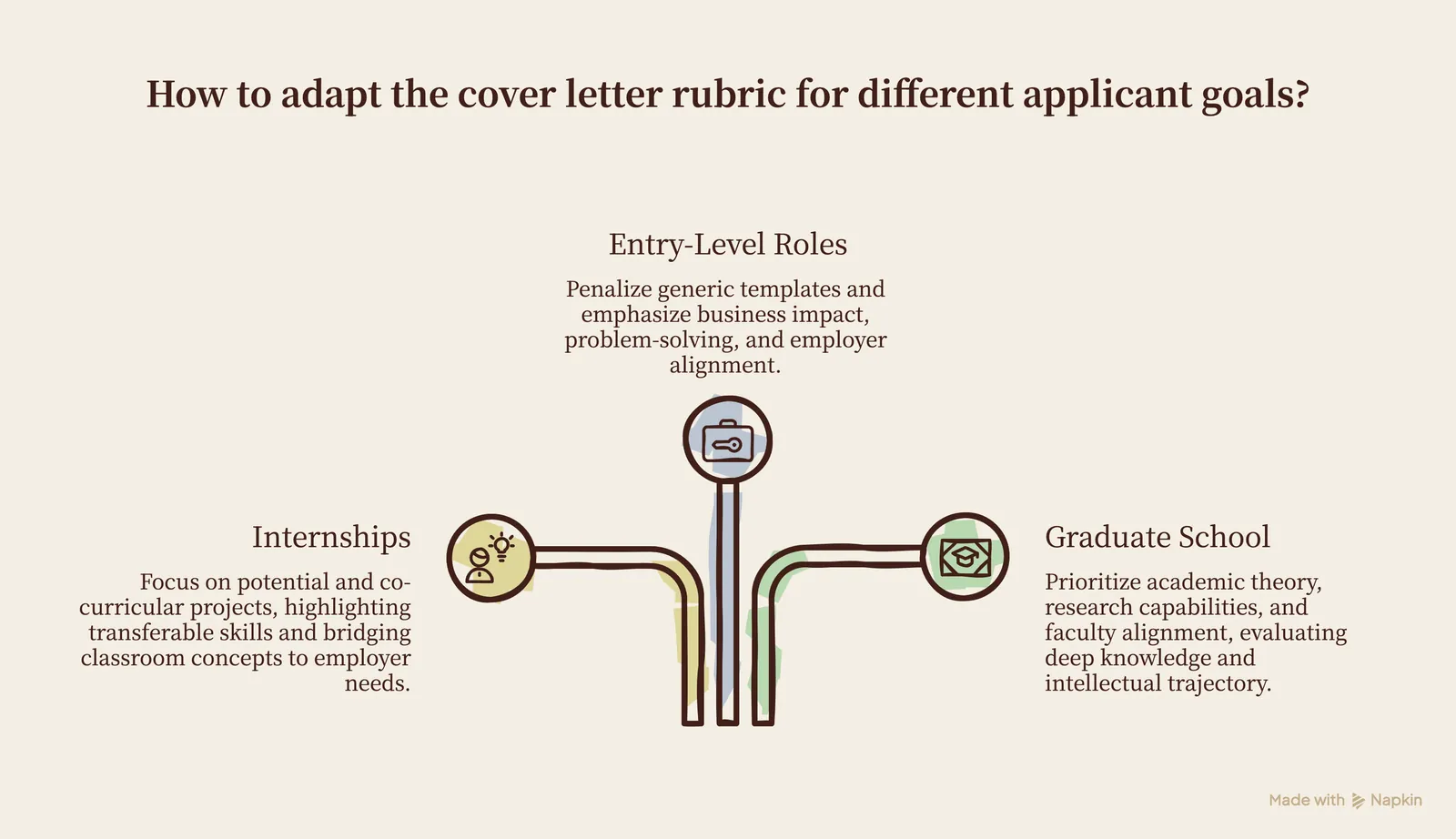
Adapt your rubric by adjusting the evaluation weight based on the applicant's destination. For internships, prioritize potential and co-curricular projects. For entry-level roles, heavily penalize generic templates and weigh tailored employer alignment. For graduate school, shift the focus entirely toward academic theory, research capabilities, and specific faculty alignment.
A one-size-fits-all approach will fail because different targets require completely different messaging strategies. You can use a standardized core rubric by using modular, audience-specific weightings:
For Internship Seekers
Shift the scoring emphasis away from extensive professional history and toward academic or co-curricular transferable skills. University of Michigan Career Center guidelines suggest that students highlight specific numbers, results, and accomplishments drawn from academic, volunteer, or co-curricular experiences. Your rubric should evaluate how effectively they bridge classroom concepts to the employer’s domain.
For Entry-Level Corporate Roles
The rubric must strictly penalize generic template lines (e.g., "I am writing to express my strong interest..."). The focus here belongs on business impact, situational problem-solving, and precise alignment with the employer’s unique culture and market position.
For Specialized or Industry-Specific Roles
Keep the core rubric consistent, but adjust what strong evidence looks like. A communications role may place greater weight on clarity, audience awareness, and writing quality, while a technical role may require the student to translate projects, technical skills, or problem-solving experience into language a non-technical hiring manager can understand.
The goal is not to create a different rubric for every major or employer. Instead, career teams can retain a shared baseline while changing the emphasis of selected criteria when the target role calls for it.
Also Read: Mock Interview Rubric for Advisors: Scoring Framework & Examples
How can career centers scale consistent cover letter reviews using AI & peers?
Deploying AI as an automated first layer allows career centers to scale operations rapidly while protecting advisor capacity. By letting technology handle structural triaging and basic mechanics, your professional staff saves hundreds of hours. This shifts their focus away from proofreading and entirely toward high-value, authentic narrative coaching.
The technology must be positioned carefully to protect the student's job prospects.
The strategic solution isn't using AI to write the letter, but using AI to audit it against your center's exact rubric.
This first-layer automation can catch basic issues like typos, incorrect formatting, and missing contact blocks before a human reviews the document.
To scale successfully without sacrificing quality, use this multi-step review pipeline:
- Applies the career center’s exact rubric through a structured AI prompt.
- Automatically flags structural issues, formatting problems, and basic writing errors.
- Handles mechanical feedback at scale, preserving advisor capacity for higher-value coaching.
- Validates the AI-generated structural baseline.
- Ensures the student’s authentic voice and intent are preserved.
- Focuses entirely on higher-level strategy, positioning, and nuance.
- Refines the narrative hook, employer alignment, and overall industry fit.
By uploading your rubric into an approved campus GenAI tool as a system prompt, you ensure the AI acts as an objective evaluator rather than a ghostwriter.
The system screens the draft against your rubric criteria, pointing out where the student lacks evidence or formatting compliance.
From there, trained Peer Career Coaches can review the output using the Wayne State University Career Services Rubric framework.
This structural workflow ensures that every student receives a rapid, consistent baseline review, while preserving your professional advisors' schedules for high-touch, impactful career coaching.
Also Read: AI in Career Services: Benefits, Limits, and Ethical Best Practices
Wrapping Up
A strong cover letter rubric helps career centers move from subjective editing to consistent, strategy-focused coaching. It gives advisors a shared language for evaluating fit, evidence, tone, structure, and employer alignment across different student needs.
Hiration supports this work through its Cover Letter Builder, where teams can guide students with structured, AI-powered support and customize review parameters around the standards their office wants to reinforce.
Instead of managing cover letters, resumes, interviews, LinkedIn profiles, and student workflows across separate tools, career centers get a consolidated platform that supports the full career readiness journey.
Our suite includes Career Assessments, AI-powered Resume Optimization, Interview Simulation, LinkedIn optimization, and more, along with a separate Counselor Module to manage cohorts, workflows, and analytics within a secure, FERPA and SOC 2-compliant platform.
A clear rubric makes cover letter feedback easier to scale, and the right system helps teams turn that feedback into a repeatable student learning process.
Cover Letter Rubrics for Career Centers — FAQs
Why should career centers use a cover letter rubric?
A shared rubric reduces subjective feedback, improves consistency across advisors, and creates a common standard for evaluating student writing.
What should a cover letter rubric evaluate?
Effective rubrics assess business format, opening impact, narrative alignment, employer tailoring, communication quality, and professional closing.
Why should mechanics and narrative be scored separately?
Separating these areas prevents advisors from spending valuable appointment time fixing formatting and allows them to focus on strategy and storytelling.
What is a two-tier cover letter review process?
A two-tier system uses a basic structural review for formatting and mechanics before advancing students to deeper advisor-led narrative coaching.
How can rubrics improve drop-in appointments?
Rubrics provide a quick diagnostic checklist that helps advisors identify the highest-priority issues and give students clear, actionable feedback in limited time.
How should rubrics be used in workshops?
Workshops can use sample job descriptions and cover letters to let students practice scoring documents and thinking like hiring managers.
Should the same rubric be used for internships and graduate school applications?
The core framework can remain consistent, but scoring emphasis should shift depending on whether the student is applying for internships, entry-level roles, or graduate programs.
How can AI support scalable cover letter reviews?
AI works best as a first-pass evaluator that checks rubric compliance, formatting, and missing elements before a human advisor reviews narrative quality.
What role can peer reviewers play?
Trained peer coaches can use the same rubric to provide consistent baseline feedback, allowing professional advisors to focus on higher-value coaching conversations.
What is the biggest strategic shift career centers should make?
Career centers should move from subjective line-editing toward standardized evaluation systems that make cover letter coaching measurable, scalable, and consistently student-centered.